
You’re standing in a crowded hotel ballroom at an SNMA conference. The formal panel just ended. People are drifting toward the coffee table, some lining up to talk to the keynote speaker. You’re clutching a tote bag full of flyers, your CV on your phone, and you’re thinking:
“I’m here. I joined SNMA. I came to the conference. But how do people actually get those real mentors? The ones who make calls for you. The ones who say your name in rooms you’re not in.”
(See also: How PDs Quietly Weigh AMSA vs SNMA vs AAMC on Your Application for insights on mentorship dynamics.)
Let me tell you what actually happens behind the scenes.
The students who win in this game are not just “networking.” They’re tapping into back‑channel mentorship – the hidden faculty networks inside and around SNMA that never make it into the brochures, the official mentorship programs, or the website blurbs.
I’m going to show you how those networks really work, who controls the access, what faculty say about students after events, and exactly how to position yourself so that when opportunities are whispered, your name comes up first.
This is the part no one explains on the podium mic.
What “Back‑Channel Mentorship” Really Is (And Why SNMA Is a Goldmine)
Back‑channel mentorship is the quiet layer of support that doesn’t show up on any org chart.
Not the “sign up for a mentor through our Google Form.”
Not the official faculty advisor posted on the school website.
I’m talking about:
- The program director who texts another PD, “This student is solid – keep an eye out for their application.”
- The attending who forwards your research abstract to their old co‑fellow at another institution with, “Can you give this student a shot in your lab?”
- The dean who whispers your name when an away rotation spot unexpectedly opens.
SNMA sits right on top of these networks. Especially at med schools and national meetings, SNMA is like a bridge between:
- Black faculty who’ve navigated brutal training environments and built power quietly over decades
- Black students who are trying to break in but often do not see where the real levers are
Here’s the insider truth faculty will not say publicly:
They’re often actively looking for “their people” to support. But they will not announce this at the podium. They do it by watching. Observing. Listening to how you move in spaces like SNMA.
At many institutions, SNMA is their primary filter.
They’ll never phrase it like this in a brochure, but the internal logic goes something like:
“If this student is consistently doing real work in SNMA and other service spaces and still performing academically, that tells me a lot about their discipline, values, and resilience. That’s someone I can vouch for without getting burned.”
So yes, joining SNMA is step one. But the real action is learning how to plug yourself into these hidden faculty circuits.
How Faculty Actually Use SNMA to Vet and Select Students
Let’s walk through what faculty really do at SNMA events – national and local – because it’s not what students assume.
You see “Networking Reception with Faculty.”
Faculty see “Scouting and Screening Opportunity.”
They’re not just smiling for photos. They’re mentally categorizing you.
At a typical event, here’s what happens on the faculty side that students never hear about:
- After the panel, a few faculty drift to a corner. One will say, “Who was that M2 who asked the question about research in health disparities? She seemed sharp.”
- Another replies, “That’s Jasmine, she’s the SNMA VP here. She’s been helping run the pipeline program. I’ve seen her in clinic – very prepared.”
- A third quietly says, “She emailed me last month with a concise, professional request for shadowing.”
Congratulations. Jasmine is now on a mental “short list.” From that moment, when something comes up – a project, a payer‑funded opportunity, a dean’s initiative – she’s eligible for the back‑channel conversation: “Jasmine would crush this.”
Faculty watch for specific behaviors in SNMA contexts:
Who does visible work, not just holds titles
At every school I’ve been at, faculty privately know the difference between “SNMA president who shows up, delegates, and disappears” and “SNMA secretary who literally runs the logistics and follows through.”
The secret: the logistics person gets more unsolicited recommendations long‑term.Who asks sharp, grounded questions
At regional/national SNMA meetings, panel Q&As are a hunting ground. Faculty remember the student who asks:- “In your experience as PD, what concrete things have you seen residents do that made you go out of your way to advocate for them?”
That’s a back‑channel oriented question. You’ve signaled you understand how systems actually work.
- “In your experience as PD, what concrete things have you seen residents do that made you go out of your way to advocate for them?”
Who keeps showing up
Faculty track pattern, not one night of charm. If every time there’s an SNMA‑faculty mixer, the same few students are there, on time, engaged, not clinging to friend groups – those are the ones who get mentally tagged as “serious.”Who gets vouched for by another student or resident
The most powerful sentence in the room is not what you say. It’s:
“Dr. Thompson, this is Malik – he’s been running our SNMA MAPS outreach and did an amazing job with the high school program this year.”
Faculty ears perk up when students/residents take the risk of vouching for you. It’s a signal.
You think you’re “just attending an event.”
They’re evaluating whether they can safely attach their name to yours.
Once you understand that, you start moving differently in every SNMA context.
The Three Hidden Layers of SNMA Faculty Networks
Most students only see the surface layer: the official SNMA faculty advisor or the keynote speakers.
The real opportunity lies in understanding all three layers and deliberately accessing each.
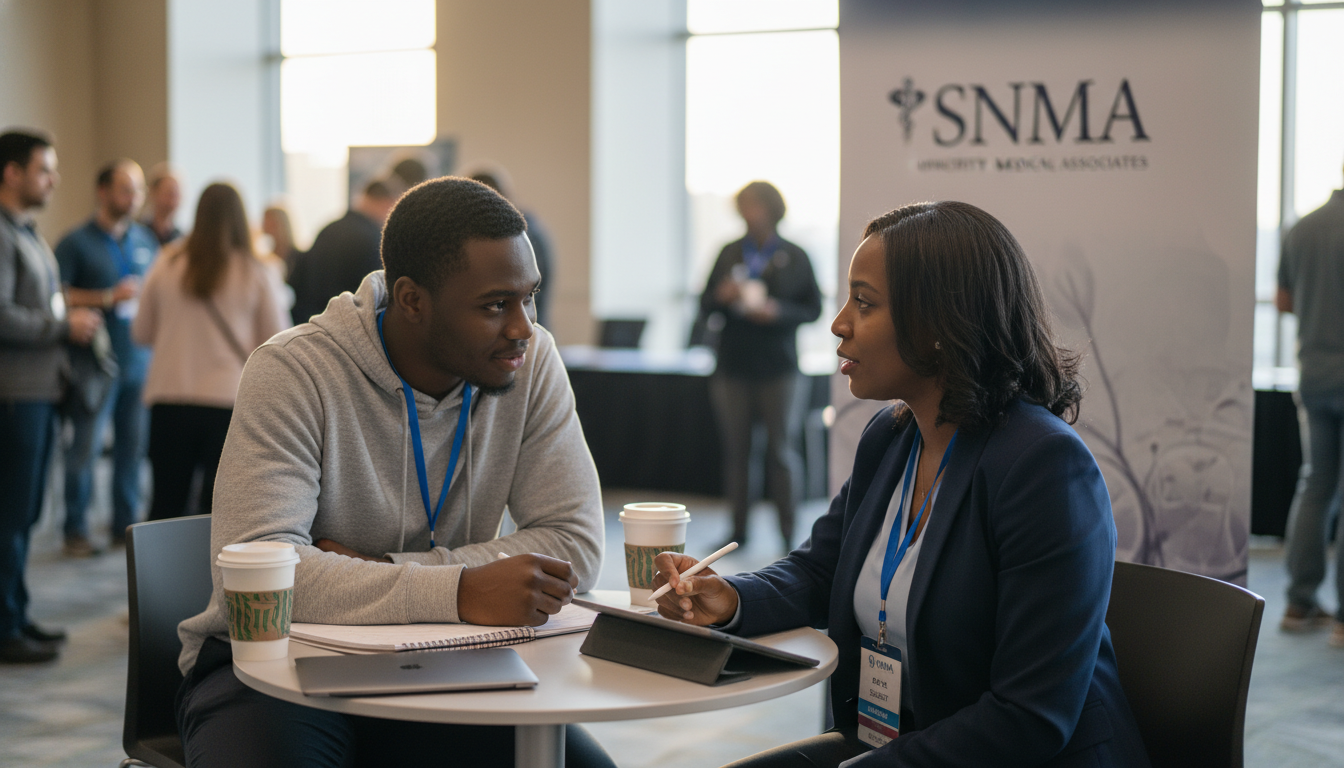
Layer 1: The Official Bridge – Advisors and Named Mentors
These are the people whose names are on the website: SNMA faculty advisor, Office of Diversity dean, named mentors in structured programs.
Students usually approach them in the most generic way possible: “I’d love to grab coffee sometime and hear about your path.” That’s fine for a first‑year move, but it rarely generates deep back‑channel support.
How these people really get activated:
- They see you doing concrete work in SNMA: running a pipeline program, organizing a regional event, managing a scholarship drive.
- You approach them with specific asks: “I’m serious about internal medicine with a health equity lens. Are there 1–2 faculty you’d recommend I shadow who are actively on the residency selection committee?”
- You demonstrate you’re not treating them as your career concierge but as a strategic guide. Faculty notice the difference instantly.
These official bridges are often the ones who:
- Know which attendings will actually mentor vs. extract free labor
- Know which program directors quietly protect URM applicants when the committee gets brutal
- Know who’s “safe” and who will smile and then undercut you in letters
You won’t see that written anywhere. You hear it across a coffee table, after they’ve decided you’re not naïve and you’re not going to repeat them irresponsibly.
Layer 2: The Hidden Allies – Faculty Who Don’t Wear SNMA Labels
Every school has them. They don’t have SNMA titles, they may not be at every event, and some aren’t even URM themselves. But they’re deeply plugged into SNMA students and care enough to act behind the scenes.
They might be:
- A non‑Black PD whose closest mentees are SNMA leaders
- A researcher in social determinants of health who’s quietly funneling SNMA students into paid positions
- A hospitalist who always takes SNMA students for shadowing and writes letters with real teeth
You find these people through SNMA, but they aren’t branded as SNMA faculty.
How to access this layer:
- Ask SNMA upperclassmen very specific questions:
“Who are 2–3 faculty outside of our formal advisor who’ve really gone to bat for SNMA students when it counted?”
Names will come quickly. Those are your targets. - When you email them, you reference the SNMA connection explicitly:
“Dr. X, I’m an M1 involved with SNMA, and several of our leaders spoke highly of how you’ve supported SNMA students over the years…”
Faculty like this are often more flexible, less burned out from institutional tasks, and very capable of picking up the phone or firing off a “you should meet this student” email.
They also talk to each other. Their own hidden network is where many back‑channel opportunities are born.
Layer 3: The Invisible Web – Faculty‑to‑Faculty SNMA Channels Across Schools
The most powerful, least visible layer is the network between faculty across different institutions who share SNMA, NMA, or mentorship overlap.
Here’s how this plays out in real life:
- You meet Dr. Clark, an academic hospitalist, at a national SNMA meeting.
- You follow up, maintain light contact, and she quietly becomes a mentor.
- Three years later, you apply to residency at a different institution.
- Dr. Clark trained with that program’s associate PD. She sends one email:
“Renee is one of my best SNMA mentees. Very strong. Please look out for her application.” - The associate PD now reads your file differently. Your interview day goes differently. The ranking meeting goes differently.
This happens every year. I’ve watched it up close in IM, EM, peds, psych, OB/Gyn.
SNMA is one of the main ecosystems where those cross‑institution faculty relationships start. Old friends from training, prior co‑residents, people who have watched each other present at SNMA for a decade. That’s the hidden highway your name can travel on.
Your job isn’t to manipulate that web. Your job is to build real, sustained relationships with a few key faculty nodes whose networks extend far beyond your home campus.
Tactical Moves: How to Turn SNMA Contact Into Back‑Channel Advocacy
Now we get to the part no one teaches: the concrete behaviors that turn a generic “nice to meet you” into “I will go to bat for you six years from now.”
Here’s how the students who win this game actually move.
Step 1: Anchor Yourself Locally First
If you’re premed or early med school, you start by becoming logistically useful to your local SNMA or MAPS chapter.
Not performatively busy. Genuinely reliable.
Why? Because faculty and residents ask the same question every year:
“Who made this event actually happen?”
If your name comes up consistently, you become a low‑risk investment for them. So:
- Show up early and stay late at SNMA events. Faculty notice who’s still stacking chairs at the end.
- When a project needs a lead, pick something visible but finite: moderating a panel, running a portion of a premed pipeline program, coordinating a shadowing signup system.
- Keep one thing in your pocket you can actually execute well, rather than scattering yourself across ten half‑done initiatives.
The internal faculty dialogue sounds like:
“This student always delivers. If I drop their name to my colleague, I’m not going to regret it later.”
That’s the foundation.
Step 2: Engineer “Second Conversations” With Faculty
The worst thing you can do is treat each interaction as a one‑off.
You don’t need a deep heart‑to‑heart to start a back‑channel relationship. What you need is a pattern: faculty sees your name, face, and follow‑through more than once.
A simple playbook:
- You meet a faculty member at an SNMA mixer. You have a short, sane conversation with one thoughtful question.
- Within 24–48 hours, you send a concise email:
- Reference where you met
- One line about what stuck with you
- One specific, low‑friction ask (e.g., “Could I attend one of your clinics to observe?” or “Could I send you my CV for quick feedback on how to align it with X field?”).
- When they say yes and you complete the thing, you send a short follow‑up: what you learned, how you used it, and one sentence of gratitude.
Now that faculty has experienced you as:
met you → heard a specific ask → watched you follow through → heard reflection.
That’s a very different profile than the dozens of students who say “I’d love mentorship” and then vanish.
Step 3: Make It Easy for Them to Advocate for You
Faculty whisper on your behalf when it’s easy to do so and low risk.
You can’t control risk entirely, but you can dramatically lower friction:
- Keep a clean, one‑page CV updated and ready. When an opportunity pops up, they can attach it without emailing you five times for edits.
- Tell them your direction, not necessarily your final destination. For example:
“I’m drawn to internal medicine or pediatrics, ideally with a focus on underserved populations and maybe academic work.”
That gives them multiple mental hooks: IM faculty, peds faculty, health equity projects. - Periodically (2–3 times a year) send a very brief update email:
“I wanted to share a quick update: I just finished my first‑year summer in Dr. ___’s lab working on ___; next I’m hoping to get more clinical exposure in ___; I still really appreciate your advice from ___. If there are 1–2 things you’d suggest I focus on this year to strengthen my trajectory in ___, I’d love to hear.”
Now when something relevant crosses their inbox – a research posting, a funded elective, a “looking for URM students for X” – your name is right there in working memory.
Back‑channel advocacy is mostly recall plus trust. You’re engineering both.
For Premeds: Using SNMA & MAPS Before You Ever Matriculate
If you’re still premed, you’re not behind. You’re early – if you know how to play it.
Most premeds think of SNMA/MAPS as “a club that does volunteering and MCAT panels.”
Insider version: it’s also your first access point to the faculty networks you’ll need later.

Here’s how serious premeds use SNMA/MAPS strategically:
- They treat every SNMA physician guest as a potential long‑game acquaintance, not just a one‑off speaker.
- They ask targeted questions that show they’re thinking beyond admission: “From your vantage point, what do you wish premeds understood about building credible mentorship before med school?”
- They ask the chapter leadership: “Which physicians come back year after year and actually support students beyond this event?”
Those are your early nodes. You can keep light contact with them for years.
Premeds who do this right sometimes walk into M1 year with 1–2 physicians who already know their name and have seen them grow over time. When med school chaos hits, that pre‑existing back‑channel relationship is stabilizing.
For Current Med Students: Turning SNMA Work Into Residency‑Relevant Capital
By M2–M4, you’re entering the phase where back‑channel mentorship can literally change where you match.
Faculty and residents do not just look at your leadership lines on ERAS/CV. They call people. They ask, “How was this person to work with? Would you trust them on night float?”
SNMA can provide the receipts.
Here’s how faculty quietly translate your SNMA record when they’re deciding whether to push your name:
- “Led SNMA pipeline program for 2 years” → This person can manage logistics, communicate with multiple stakeholders, and complete unglamorous tasks consistently.
- “Organized regional SNMA conference” → They can handle stress and details under pressure. Probably good on wards under high volume.
- “SNMA chapter president, but everyone shades them” → Red flag. Faculty hear gossip too. They’ll dig deeper before cosigning.
If you want SNMA to actually move the residency needle, do the following:
- Pick 1–2 roles that generate concrete deliverables (events, programs, retreats).
- Make sure at least one faculty member witnesses or is looped in enough to see what you’re doing behind the scenes.
- Ask that faculty explicitly if they’re comfortable being a “global recommender” – someone who can’t speak to your surgical technique but can speak very strongly about your character, follow‑through, and leadership.
Residency committees love those letters when they come from people with established credibility and clear SNMA connections.
What Students Get Wrong About Mentorship in SNMA Spaces
Let’s be blunt about the most common mistakes I’ve watched students make for years.
Treating every famous Black physician like a lottery ticket.
The big‑name keynote speaker with a national reputation is often the worst person to rely on for real, sustained mentorship. They’re stretched, overcommitted, and already carrying 40 mentees.
The mid‑career associate professor at a workshop who’s quietly run SNMA‑adjacent programs for a decade? That’s your long‑game mentor.Collecting mentors like Pokémon.
“I have 9 mentors.” No, you don’t. You have 9 people you’ve met and maybe emailed once.
Back‑channel networks are built on a few people who actually know you, not a giant list you drop in every conversation.Being vague about your goals in the name of staying ‘open.’
Faculty are not asking for a binding contract when they ask about your interests. They need a working model so they know where to place you.
It’s ok to say: “Right now I’m between EM and IM, but I know I want an urban, underserved, academic‑leaning career.” That’s plenty specific.Disappearing for 18 months and then asking for a last‑minute letter.
This is the fastest way to kill back‑channel advocacy. Mentorship is not transactional – it’s relational. Light, periodic contact matters.Assuming proximity equals investment.
Just because you see a faculty member at every SNMA event does not mean they are invested in you. They become invested when they’ve watched you operate, seen your follow‑through, and perceived your integrity.
FAQ: Back‑Channel Mentorship in SNMA
1. I’m introverted and hate “networking.” Can I still tap into these faculty networks?
Yes – and frankly, introverts sometimes do this better. You don’t need to work the whole room. You need a handful of focused, genuine conversations over time. Pick 1–2 faculty per event to connect with, ask thoughtful questions, and then follow up well. Back‑channel mentorship rewards depth, not volume.
2. How early is “too early” to start talking about specialties with mentors I meet through SNMA?
It’s never too early to share directional interests. You’re not signing a contract. Saying, “I’m an M1 but I’m drawn to pediatrics or family med, especially with a community health focus,” helps faculty know which opportunities to flag for you. You can always change course; insiders do that all the time.
3. What if my school’s SNMA chapter is small or not very active?
Then you lean harder on regional and national structures. Attend regional SNMA conferences, national AMEC if you can, virtual SNMA webinars, and NMA or specialty‑specific URM groups. Also: sometimes the strongest back‑channel mentors at “quiet” schools are faculty who are plugged in nationally even if the local chapter is sleepy. Ask around: “Who here is active in SNMA/NMA or national DEI work?”
4. Is it okay to be explicit with mentors about hoping they’ll advocate for me down the line?
You don’t say, “Will you pull strings for me?” But you can absolutely say: “I really value your perspective and hope to build the kind of relationship where, as I progress, I can come to you for honest guidance on opportunities and applications.” Most faculty understand what that means. If they lean in instead of backing off, you’re in safe territory.
5. How do I know if a faculty member I met through SNMA is actually willing to invest in me and not just being polite?
Watch behavior over time. Do they respond thoughtfully to emails? Do they remember details about you? Do they offer concrete next steps (“Let’s loop you into this project,” “Email my admin for clinic dates,” “I want you to meet my colleague”)? When a faculty mentor starts introducing you to their network – residents, other faculty, project leads – that’s a strong sign they’ve mentally moved you into their “I will invest here” category.
Key points to keep in your pocket:
- SNMA isn’t just a student org; it’s a live wire plugged into hidden faculty networks that make real decisions.
- Back‑channel mentorship grows from visible, reliable work plus repeated, thoughtful contact – not from one magical conversation.
- Your goal isn’t to collect mentors; it’s to build a few deep relationships with faculty whose names still mean something in the rooms where your future is being decided.