
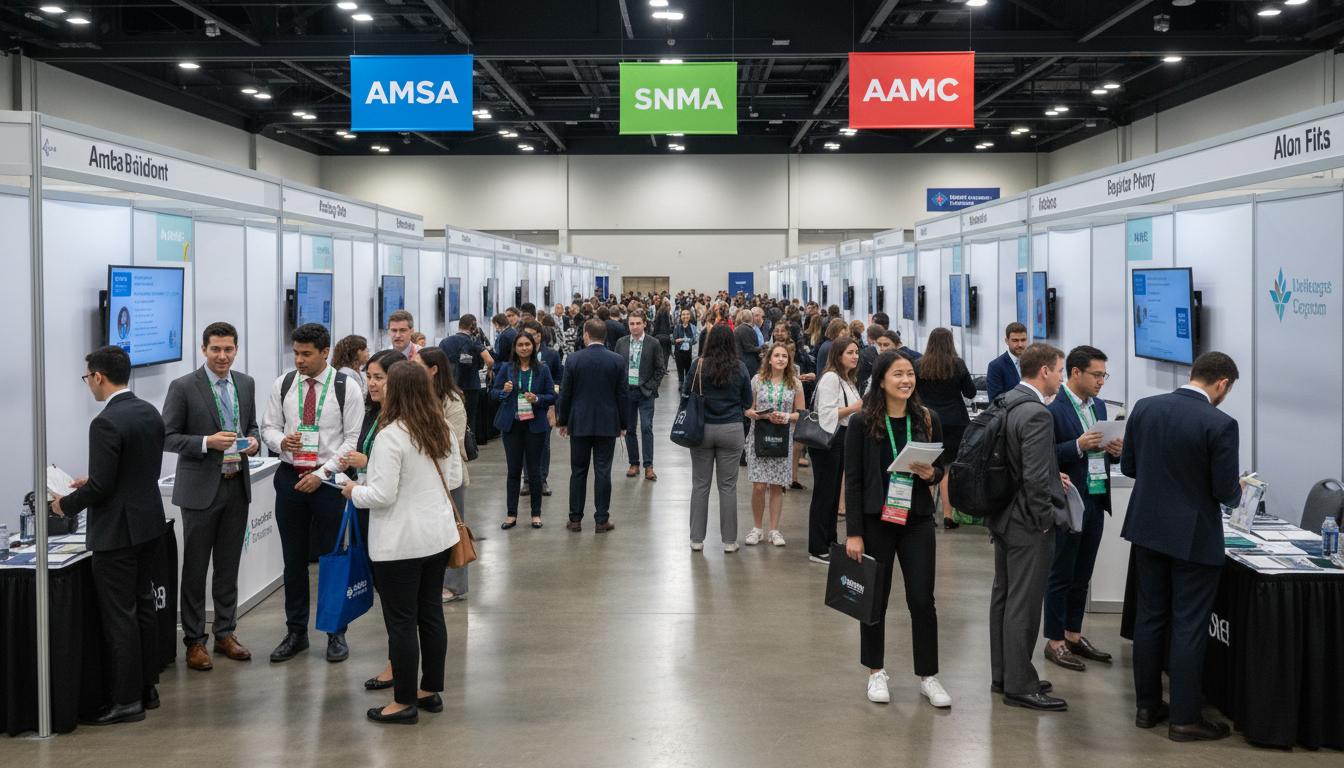
The worst way to approach AMSA, SNMA, and AAMC conferences is to “see what happens” once the emails start rolling in. If you treat conference season as random events instead of a yearly cycle, you will overspend, double-book exams, and miss the best networking opportunities.
You need a calendar, not vibes.
This guide walks you, month by month, through how to plan AMSA, SNMA, and AAMC travel wisely—from early premed through clinical years—so you know exactly what to do and when.
First: Know the Usual Conference Windows
Before we build your calendar, you need basic timing. Exact dates change yearly, but patterns stay stable.
Typical timing (U.S.):
AMSA National Convention & Exposition
- Often: March–April
- Audience: Mostly premeds and early medical students
- Focus: Advocacy, clinical skills, specialty exploration, networking
SNMA Annual Medical Education Conference (AMEC)
- Often: March–April (frequently around Easter)
- Audience: Black premeds and medical students, residents, physicians
- Focus: Mentorship, diversity, pipeline programs, residency networking
AAMC Conferences (student-relevant)
- Learn Serve Lead (AAMC annual meeting) – usually November
- Big national meeting for academic medicine; some student programming
- Regional Group on Student Affairs / Organization of Student Representatives (GSA/OSR) – usually spring
- More admin-heavy, but student reps and leaders often attend
- Some institutions sponsor OSR reps to attend AAMC meetings
- Learn Serve Lead (AAMC annual meeting) – usually November
At this point, you should open a digital calendar (Google Calendar, Notion, whatever you use) and:
- Create a new calendar called: “Conferences & Travel”
- Add generic placeholders:
- “AMSA Convention – March/April”
- “SNMA AMEC – March/April”
- “AAMC LSL – November”
- Set each as an all-day event spanning a 10–14 day window (until dates are posted) so you visually protect that time of year.
That rough blocking prevents you from stacking major exams or life events on top of conference season.
Year-Round Baseline: Money, Documents, and Memberships
Conferences aren’t just about showing up. They’re about being ready when registration opens and flights are still affordable.
Every January: Reset Your Conference Readiness
At this point in the academic year, you should:
Renew or confirm memberships
- AMSA Membership
- SNMA Membership (or MAPS for premeds)
- Check if your school pays for AAMC-related student involvement (OSR, student affairs roles)
Update your “Conference Folder” (digital & physical)
- Digital folder in Google Drive/OneDrive:
- Updated CV (1-page for premeds, 2-page for med students)
- Headshot (neutral background, professional outfit)
- Abstract template with your current research projects
- List of scholarships & travel grants you’re eligible for
- Physical:
- Simple carry-on friendly roller bag
- Business casual + 1 business formal outfit
- Small folder for receipts, boarding passes, business cards
- Digital folder in Google Drive/OneDrive:
Build a Conference Savings Line
- Add a line in your budget: “Conferences”
- Target per year (very rough):
- Premed: $500–$1,000
- Med student: $1,000–$1,500
- Automatic transfer monthly into a dedicated savings bucket
Check ID and Travel Logistics
- ID/passport not expiring during the next 12 months
- TSA PreCheck / CLEAR (optional, but helpful if you’ll fly often)
You’re not booking anything yet—you’re pre-loading the system so future you can act quickly.
Premed Timeline: Freshman–Senior Year
Freshman Year (Premed)
You’re not behind if you don’t attend anything yet. The goal is exposure, not maximal travel.
Fall (Aug–Nov)
At this point you should:
- Find your campus:
- Premed club
- AMSA chapter
- MAPS (Minority Association of Pre-Medical Students) or SNMA-affiliated premed group
- Go to interest meetings; ask:
- “Does our chapter send students to AMSA / SNMA / AAMC events?”
- “Do we have any funding for national conferences?”
December–January
- Ask older students:
- Which conferences they found worth the money
- Whether virtual attendance options exist
- Decide: One in-person or one virtual conference for spring or next year
Spring (Feb–April)
If you attend anything, treat it as a test run:
- Maybe a regional AMSA or SNMA event or a virtual national meeting
- Focus on:
- Understanding conference structure: plenaries, workshops, exhibit hall
- Taking basic notes on what specialties or issues interest you
- Keep travel cheap:
- Regional driving distance
- Shared hotel rooms with your chapter
Sophomore Year (Premed)
This is a great year for your first big in-person AMSA or SNMA AMEC.
August–September
At this point you should:
- Decide: AMSA or SNMA for this academic year (you can’t usually do everything)
- Check each org’s website & socials for:
- City and rough dates for upcoming national meetings
- Deadlines for:
- Early-bird registration
- Travel scholarships
Block those potential dates on your calendar with a “busy” hold.
October–December
Start talking to:
- Premed advisor about time off around midterms
- Financial aid or diversity office about travel funding
- Chapter leaders about group travel
If you’re planning AMSA or SNMA in the spring:
- Aim to have a decision to attend by December
- Begin a biweekly savings transfer specifically for that trip
January–February
- Once exact dates drop:
- Confirm with advisors you can miss those days of class
- Apply immediately for:
- Conference travel scholarships
- Institutional funds (premed advising office, diversity/inclusion, student government)
February–Conference Month
- Book:
- Registration first (before discounts expire)
- Flights 6–8 weeks ahead
- Shared hotel room with 2–4 other students (pre-arrange roommates through your chapter group chat or GroupMe)
At this point, 2 weeks before travel, you should:
- Create a simple conference schedule:
- 3–4 sessions per day max
- 1–2 exhibitor hall blocks
- 1 structured networking event each day
- Prepare a 30-second introduction:
- Name, school, year
- Main interest (e.g., “interested in internal medicine and health policy”)
Junior Year (Premed)
This is often your most strategic premed year for conferences.
You’re closer to applying, maybe doing research, and networking matters more.
August–September
At this point you should:
Decide your primary goal:
- Learn about specialties and schools? (AMSA + SNMA exhibit halls)
- Present research? (Consider AMSA & sometimes SNMA poster sessions)
- Find mentors and application guidance? (SNMA AMEC is excellent for this)
Identify 1–2 target conferences:
- Many premeds: SNMA AMEC junior year + maybe an AMSA year before or after
October–December
Check abstract deadlines for poster presentations
- These can be 3–6 months before the conference
- Talk to your research mentor:
- Ask if your project is ready for a poster by the conference
- Draft abstract at least 2 weeks before the deadline
Align with MCAT schedule:
- Do not stack:
- MCAT within 2 weeks after a big conference, or
- MCAT within 1 week before a conference
- Mark MCAT test date and conference dates in the same calendar view
- Do not stack:
January–Conference Month
- Confirm:
- Poster acceptance?
- Group travel arrangements?
- If presenting, at this point (3–4 weeks before travel) you should:
- Finalize your poster
- Practice a 2-minute explanation of your project
- Ask your mentor how to introduce the project when networking
Senior Year (Premed / Application Cycle)
Conferences now serve application and interview strategy.
Fall (Aug–Nov)
- You may attend:
- Virtual AAMC Learn Serve Lead student sessions
- SNMA or AMSA regional events
- Do not overbook—interviews and secondaries come first.
Spring (Jan–April)
- If you’re waitlisted or still interviewing:
- SNMA AMEC can be powerful:
- Meet current med students from schools where you’re on the waitlist
- Attend sessions on navigating waitlists, reapplying, etc.
- Keep travel short so you don’t miss late-season interviews.
- SNMA AMEC can be powerful:
Medical School Timeline: M1–M4
Now conferences shift from “explore medicine” to “build a career and match well.”
M1 Year
Fall (Aug–Nov)
At this point you should:
Join or re-join:
- School’s AMSA chapter
- School’s SNMA chapter
Ask:
- “Who went to AMSA / SNMA / AAMC last year?”
- “How does our school fund student travel?”
If your school has an AAMC OSR rep, introduce yourself and ask:
- Which AAMC events are student-friendly?
- How students are selected to attend
Spring (Jan–April)
Attending AMSA or SNMA AMEC once in M1 is ideal:
- Go with:
- An eye toward potential specialties
- A goal of meeting at least 3 residents or faculty in fields that interest you
- Go with:
At 6–8 weeks before the meeting, you should:
- Confirm exam schedules:
- Ask course directors about policies for missing Friday/Monday
- Book:
- Flights/travel
- Shared hotel
- Plan your study schedule so you’re not learning new content at the conference—just reviewing
- Confirm exam schedules:
M2 Year
This is where planning gets tight: Step 1/Level 1 plus conference season.
July–September (early M2)
- Decide whether this is a conference year or not:
- If taking Step 1 between February–May, doing a major March/April conference may be rough
- If Step 1 is summer (June–July), a spring conference might be manageable
At this point, you should:
- Put in the calendar:
- Planned Step 1 study block
- Potential conference windows
- If you’re going to attend:
- Choose either:
- SNMA AMEC or
- AMSA Convention
- Not both, unless your Step timeline is unusually flexible
- Choose either:
October–Conference Month
Evaluate:
- Are you on track with coursework & Step prep?
- Do you have a clear goal for the conference?
- Research presentation?
- Specialty interest sessions?
- Leadership in national organizations?
If you present research:
- Aim abstract submissions for late M1 or early M2
- Use the conference as a Step 1 break, not extra stress
M3 Year (Clinical Rotations)
Now conferences directly intersect with rotations and future matching.
Summer Before M3
At this point you should:
Get your rotation schedule as soon as possible
Identify which blocks:
- Are more flexible for time off (e.g., outpatient, elective)
- Are critical to protect (e.g., surgery, medicine core clerkships)
Mark:
- SNMA AMEC / AMSA windows in your rotation calendar
- AAMC Learn Serve Lead in November
3–4 Months Before Each Meeting
For each potential conference:
- Ask:
- Clerkship director about time-off policy
- Dean’s office about approved professional conferences
- If you’re considering AAMC Learn Serve Lead:
- Coordinate with your school’s student affairs dean or OSR rep:
- Sometimes they’ll fund OSR or SNMA/AMSA leaders to attend
- Coordinate with your school’s student affairs dean or OSR rep:
If Attending SNMA AMEC or AMSA in M3
Your focus shifts heavily to residency and specialty exploration:
At 4–6 weeks before:
- Print updated CV
- Make a 1-page “residency interests” summary for yourself:
- Top 2–3 specialties
- Geographic preferences
- Key interests (health equity, academic medicine, global health)
Identify:
- Sessions with residents and PDs in your fields
- Booths of programs from regions you like
At the conference, you should:
- Prioritize:
- PD/resident-led panels
- Diversity & inclusion events where PDs often attend
- Keep track:
- Names + emails of PDs/residents you speak with
- Specific details (program features you mentioned) for future emails
M4 Year (Application & Match)
Conferences now support your application and network maintenance.
Early M4 (April–July)
- You’re focused on ERAS, but:
- SNMA AMEC or AMSA may still be on your calendar (from earlier planning)
- If you’re in a leadership role (local or national), plan:
- How to transition leadership,
- Whether your last conference is M3 or early M4
Fall M4 (Sept–Nov)
At this point you should:
- Look at AAMC Learn Serve Lead as:
- A place to explore academic medicine careers
- A chance to present med ed or research work
- Coordinate with:
- Your medical education office
- Your research mentors
- Do not sacrifice interview days for conferences unless:
- You have a very flexible schedule
- You’ve already secured all key interviews
Annual Conference Planning Calendar (Any Year)
Now, let’s build your month-by-month rhythm for any given academic year, whether you’re premed or med.

July–August
At this point you should:
- Confirm:
- Class schedule
- Major exams
- Rotations (if med student)
- Create a year view and:
- Block tentative windows for:
- AMSA Convention
- SNMA AMEC
- AAMC Learn Serve Lead
- Block tentative windows for:
- Decide:
- “This year, my primary conference is ______.”
September
Check:
- AMSA & SNMA sites for:
- Finalized city
- Confirmed date ranges
- AAMC for:
- Exact November meeting days
- AMSA & SNMA sites for:
Start:
- Conversation with:
- Advisors about time off
- Student affairs/financial aid about funding options
- Conversation with:
October
- Look for:
- Early-bird registration dates
- Travel scholarship announcements
At this point you should:
- Put every deadline (abstracts, scholarships, registration) as separate calendar items:
- With reminders at:
- 4 weeks
- 1 week
- 2 days before
- With reminders at:
November
Secure:
- Funding applications submitted
- Abstract submissions (many spring conferences have fall/winter deadlines)
For AAMC Learn Serve Lead (if attending):
- Lock down travel early:
- This is peak conference travel season
- Lock down travel early:
December–January
Confirm:
- You’re actually going
- Your goal(s) for each conference:
- Explore specialties?
- Network for residency?
- Present research?
- Leadership in the org?
Start:
- Monthly savings for travel remainder
- Draft or update your personal statement bullet points if networking for residency or med school
February
At this point, you should:
Treat this as final prep month for March/April conferences:
- Book all travel if you haven’t already
- Coordinate roommates
- Confirm class/rotation time off formally (emails, forms)
Create:
- A packing checklist specific to conferences:
- Professional clothes
- CV copies
- Laptop/tablet
- Chargers
- Business cards (if you have them)
- A packing checklist specific to conferences:
March–April (AMSA & SNMA Conference Season)
During conference weeks:
- Each day before sessions start you should:
- Star your 3 “must attend” events
- Choose 1–2 “if energy allows” backup options
- Build in:
- 1–2 hours daily for:
- Debriefing
- Organizing notes
- Rest
- 1–2 hours daily for:
Within 48 hours after the conference, you should:
- Send short follow-up emails:
- To PDs, residents, faculty you met
- To students you might collaborate with or stay in touch with
- Update:
- Your CV with presentations, leadership roles, and committee meetings you attended
May–June
Reflect:
- Did that conference help you achieve your goal?
- Is it the right one to prioritize next year, or should you switch (e.g., from AMSA to SNMA or vice versa)?
Adjust:
- Next year’s plan
- Savings targets
Simple Checklists for Smart Travel
To keep this practical, here are short, repeatable checklists.
3–4 Months Before Any Conference
At this point you should:
- Confirm dates and location
- Check exam/rotation conflicts
- Ask about institutional funding
- Note all deadlines in calendar
- Decide your primary goal for attending
6–8 Weeks Before
- Book travel (flight, train, or carpool)
- Reserve hotel or shared room
- Register before early-bird deadline
- Coordinate with roommates/peers
- Start planning which sessions to attend
2 Weeks Before
- Finalize travel details (check-in options, transit from airport)
- Confirm time off with course/rotation leads
- Print or save digital versions of:
- CV
- Poster/slides (if presenting)
- Prepare your 30–60 second intro
During the Conference
- Aim for 3–4 sessions per day
- Spend at least 1–2 hours in the exhibit hall
- Log every meaningful contact:
- Name, role, institution
- How you met and what you discussed
1–3 Days After
- Send follow-up emails
- Update CV and LinkedIn (if applicable)
- Write a quick reflection:
- 3 things you learned
- 2 people you’ll stay in contact with
- 1 action step you’ll take
Bottom Line
- Treat AMSA, SNMA, and AAMC conferences as a yearly cycle you plan for in July–August, not random events you react to in March.
- Align each conference with a specific goal for your current phase—exploration in early premed, research and mentorship in late premed/M1–M2, and residency networking in M3–M4.
- Use a consistent 3–4 month planning runway: mark dates early, secure funding, protect exam/rotation time, and follow up after meetings so the travel translates into real opportunities.