
The fastest way to waste your SNMA experience in your personal statement is to turn it into a buzzword and a brag.
If you treat SNMA like a gold star instead of a story, admissions committees will see it as fluff—and they’ll be right.
You’re not just competing with people who joined SNMA. You’re competing with people who can show why SNMA changed the way they think, serve, and plan to practice medicine. The difference between those two groups usually comes down to how they write about it.
(See also: Stop Joining Every Club: Student Org Overload That Hurts Med Apps for more insights.)
This is where people make avoidable, painful mistakes.
Let’s walk through how not to use SNMA in your personal statement—and how to quietly outsmart those common errors.
Mistake #1: Dropping “SNMA” as a Name-Drop and Nothing Else
If your personal statement says something like:
“Through my involvement in SNMA, I developed my passion for underserved communities.”
That sentence says almost nothing. It’s like writing: “Through breathing air, I continued living.”
Common “name-drop” versions of this mistake:
- Listing SNMA in a long chain: “I was involved in AMSA, SNMA, research, and volunteering…”
- Using it as moral shorthand: “SNMA showed my commitment to diversity and equity.”
- Mentioning it once with zero follow-up, context, or example
Why this is a problem:
- Admissions committees see “SNMA” on hundreds of applications.
- The acronym alone tells them almost nothing about you.
- Without specifics, it looks like résumé padding or a checkbox.
How to avoid this:
- Never let “SNMA” appear alone without:
- A specific role or activity
- A concrete example
- A personal takeaway or change in perspective
Weak:
“In SNMA, I learned leadership and advocacy.”
Stronger:
“As co-chair of our SNMA MAPS mentorship program, I realized how often first-gen premeds misinterpret ‘average’ MCAT scores. After a mentee broke down in tears over a 508 because she thought it ‘killed’ her chances, I created a data-based workshop on realistic score ranges and school selection. Watching students revise their strategies, instead of their dreams, reshaped how I plan to teach patients about their own health data.”
Notice what happened there:
- You see the role (co-chair).
- You see the problem (misinterpretation of scores).
- You see the action (data-based workshop).
- You see the insight (education as protection, not gatekeeping).
Do not let SNMA stand in for that deeper story. Use it as the doorway, not the destination.
Mistake #2: Turning SNMA Into a Generic “Diversity Paragraph”
Too many applicants write one of these paragraphs:
- “Growing up in a diverse community and joining SNMA taught me to value diversity.”
- “SNMA reinforced the importance of inclusion and cultural competence.”
- “As a member of SNMA, I’m committed to health equity.”
These sound fine at first glance. They’re also nearly meaningless.
Here’s the trap:
You assume “SNMA + diversity words” = compelling. Committees see “SNMA + vague equity talk” = copy-paste territory.
What this looks like in practice:
- Lots of adjectives (“diverse,” “underserved,” “marginalized,” “inclusive”) with no specifics
- No actual patient, event, tension, or ethical dilemma
- No connection between SNMA work and how you’ll behave as a future physician
How to avoid the generic diversity trap: Focus on:
One concrete SNMA experience
- A specific community event
- A tough SNMA meeting
- A clash with administration over clinic access or funding
- A time something didn’t go well
The tension or challenge
- School wanted the optics, not the investment
- Patients didn’t trust you at first
- A program failed to reach who you thought it would
- You realized your own blind spots
Your internal shift
- What you misunderstood before
- What changed in your thinking
- How this will affect your clinical decisions, not just your language
Weak:
“SNMA taught me about the importance of cultural competence when working with underserved communities.”
Stronger:
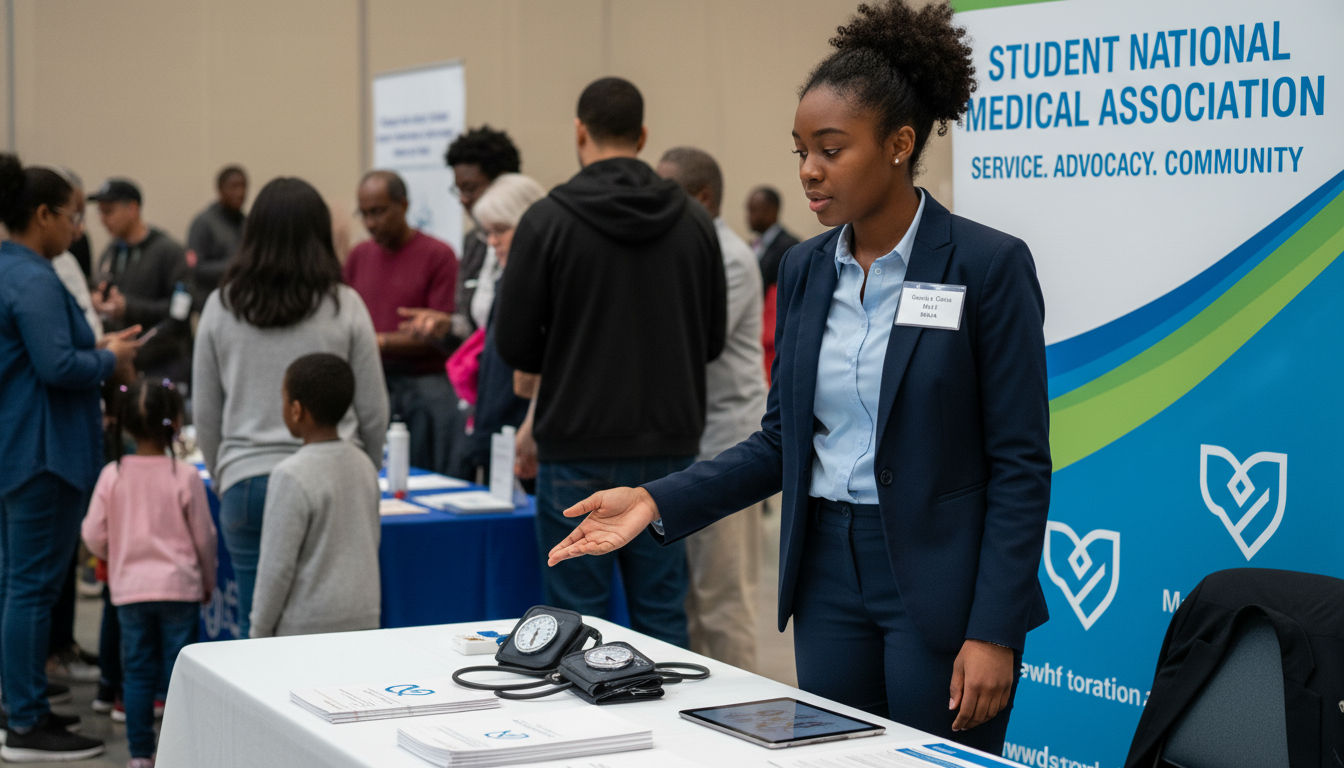
“During an SNMA blood pressure screening at a neighborhood church, several older Black men refused our flyers about hypertension but stayed to talk about the Tuskegee study and a local hospital closure. It forced me to see ‘mistrust’ not as a barrier to overcome, but as evidence-based self-protection. Since then, I’ve stopped framing patient education as ‘fixing’ beliefs and started asking, ‘What’s happened in your life or community that makes the medical system feel unsafe?’ Medicine will always need guidelines; SNMA taught me that it also needs memory.”
That’s not “I value diversity.”
That’s “Here’s how I will practice differently because of what I learned through SNMA.”
Mistake #3: Overinflating Your Role or Impact
Do not turn your SNMA involvement into fiction. Admissions readers don’t just dislike exaggeration—they’re trained to smell it.
Red-flag phrases that often signal overinflation:
- “Single-handedly”
- “Transformed the organization”
- “Completely changed the culture”
- “Revolutionized outreach”
- “Dramatically reduced disparities”
You’re a premed or medical student. You’re not the CDC.
Common inflation errors:
- Calling yourself “leader” when you attended meetings but never led a project
- Claiming “policy change” when it was a one-time exception for one event
- Taking credit for long-running SNMA initiatives you didn’t create
- Using data you can’t back up (“reduced ER visits,” “improved adherence,” “cut wait times in half,” etc.)
Why this can quietly hurt you:
- It clashes with your letters if your SNMA advisor describes a different role
- It sounds disconnected from your level of training
- It makes your humility and self-awareness questionable
How to avoid overinflation:
- Anchor your impact to your actual position:
- “Member of the outreach committee”
- “Volunteer tutor in the academic support program”
- “Treasurer during my M2 year”
- Describe scale realistically:
- “Worked with a team of five SNMA board members…”
- “Joined an ongoing SNMA pipeline program that had run for years before I arrived…”
- Own contribution without owning the universe:
- “My specific role was…”
- “My contribution to this larger effort was…”
Unsafe:
“As an SNMA member, I revolutionized our school’s approach to diversity and significantly reduced health disparities in the community.”
Safe and still strong:
“As SNMA community service chair, I reorganized our volunteers into consistent teams for our student-run hypertension clinic. Instead of rotating new volunteers each week, we kept the same pairs with the same patients for a semester. We didn’t change blood pressure guidelines or prescribe medications, but we did see patients open up more about medication side effects and costs once they recognized the faces taking their readings. That experience showed me that continuity isn’t just a billing code; it’s an emotional safety net.”
You don’t need grandiose claims for your SNMA story to matter. In fact, those claims are what make you look less credible.
Mistake #4: Making SNMA Your Entire Personality (and Your Whole Essay)
This one’s subtle. You should highlight meaningful SNMA involvement. But some applicants turn their entire personal statement into “SNMA, SNMA, SNMA” and accidentally erase everything else about themselves.
Common versions:
- Every paragraph begins with “Through SNMA…” or “With SNMA…”
- No family background, no academic growth, no clinical contact outside SNMA-related work
- The only exposure to medicine you discuss is through SNMA events
Here’s what goes wrong:
- You look one-dimensional—even if you’re not
- It sounds like you only care about medicine in a very narrow context
- Committees wonder: Can this person handle other patient populations? Academic rigor? Research? Bread-and-butter medicine?
How to avoid the “SNMA-only” trap:
Limit SNMA to 1–2 focused episodes
- One strong story about leadership or advocacy
- One brief reference elsewhere if relevant
- That’s usually enough in a personal statement
Integrate SNMA with other parts of your life
- Show how SNMA connects with:
- Your clinical volunteering or scribing experiences
- Your research interests
- Your family background or lived experience
- Your long-term goals in medicine
- Show how SNMA connects with:
Ask: If I deleted the word “SNMA,” would this essay collapse?
- If yes, you’re over-relying on the acronym instead of the underlying values and actions
Unbalanced:
First paragraph: My background
Second paragraph: SNMA
Third paragraph: SNMA again
Fourth paragraph: Another SNMA program
Fifth paragraph: I want to continue SNMA work in medical school
Balanced:
- 1 paragraph on early exposure to medicine or motivation
- 1 paragraph on a formative clinical or personal experience
- 1 focused SNMA story that shaped your understanding of health equity and your role
- 1 paragraph that ties your experiences together and looks forward
You’re not applying to be an SNMA officer. You’re applying to be a physician who will bring those values into every environment.
Mistake #5: Using SNMA as a Shield Instead of Owning Your Experience
Some applicants—especially those from marginalized backgrounds—feel a subtle pressure to “perform” their identity through SNMA references without actually saying anything personal.
Signs you might be doing this:
- Your essay leans on “SNMA” to imply your background, but you never state it explicitly
- You hide behind organizational language and avoid anything vulnerable
- You feel like you “have to” mention SNMA because of what others expect, not because it truly tells your story
Another version: using SNMA to “prove” you care about underserved or minoritized communities, while your real experiences and motivations remain off-screen.
Why this is a quiet but serious mistake:
- Your essay becomes less human and more institutional
- Committees don’t get to meet you; they meet your affiliations
- You might miss the chance to tell the story only you can tell
How to avoid using SNMA as a shield:
Ask yourself:
- If I couldn’t mention SNMA, what would I still want them to know about my identity, values, and experiences?
- What about SNMA felt personally uncomfortable, challenging, or eye-opening?
- Is there a moment when I felt like an outsider even within SNMA?
Then write from that angle, not from the brochure.
Surface-level:
“SNMA has given me a community where I feel supported as an underrepresented minority in medicine.”
More honest:
“I joined SNMA expecting instant belonging. Instead, at my first regional conference, I felt oddly out of place when conversations shifted to HBCU premed pipelines and legacies in medicine. As a first-gen student whose parents still worry about taking time off work to see a doctor, I realized that even inside SNMA, there are different kinds of access and history. That discomfort pushed me to start a small support group for local community college premeds who didn’t see themselves in the typical ‘premed trajectory.’ It reminded me that shared identity doesn’t erase differences—and that as a physician, I’ll need to recognize those layers in my patients too.”
SNMA is not just your banner. It’s the setting where your real, complicated story unfolds. Show that.
Mistake #6: Confusing SNMA’s Mission Statement with Your Personal Voice
SNMA does have a powerful mission. That’s the problem: many students copy it, echo it, or dilute it until their personal statement sounds like an organization’s website.
Phrases that scream “copied from the brochure”:
- “Committed to supporting current and future underrepresented minority medical students and addressing the needs of underserved communities”
- “Striving to increase the number of clinically excellent, culturally competent, and socially conscious physicians”
- “Dedicated to academic excellence, social justice, and community service”
You can believe all of that. But if your essay sounds like it was written by a committee of 12, you lose your edge.
How to avoid mission-statement mimicry:
- Strip out jargon:
- Replace “underserved communities” with the actual community
- Replace “address barriers” with the specific barrier (transportation, cost, language, fear)
- Replace “health disparities” with the precise outcome (HbA1c levels, missed appointments, no-show rates, BP control)
- Change “we” to “I,” and force yourself to complete the sentence:
- Not: “SNMA is committed to…”
- But: “In SNMA, I chose to spend most of my time doing X because…”
Unoriginal:
“SNMA’s mission to address the needs of underserved communities deeply resonates with my passion for healthcare equity.”
Authentic:
“I spent most of my SNMA hours not at meetings, but in the fluorescent-lit back room of a church, translating intake forms and listening to Spanish-speaking patients tell me why they hadn’t seen a doctor in years: lost jobs, expired visas, fear of a bill they couldn’t read. Those evenings clarified what ‘access’ really means to me—time, language, and trust—not just an insurance card.”
If a sentence could appear on any SNMA chapter website, don’t put it in your personal statement. Or at least, rewrite it until only you could’ve written it.
Mistake #7: Treating SNMA as Past-Only Instead of Future-Oriented
Some applicants describe SNMA like a phase they completed:
- “Through SNMA, I learned XYZ.”
- “SNMA was a valuable experience in college/med school.”
- Then… nothing about how that shapes their future.
You’re not being evaluated on what you did. You’re being evaluated on what those experiences suggest you’ll do next.
Common “past-only” errors:
- Nice SNMA story, zero connection to specialty interests, practice setting, or future goals
- No mention of continuing advocacy, mentorship, or community work in residency or practice
- SNMA section feels like a closed chapter, not an ongoing thread
How to avoid this:
- Ask directly:
- How will the way I showed up in SNMA show up in residency?
- What kind of colleague, advocate, teacher, or leader will I be because of SNMA?
- Where (exactly) do I imagine continuing this work—clinic type, patient population, institutional roles?
Weak ending:
“SNMA helped shape my commitment to serving underserved communities, and I look forward to continuing this in medical school and beyond.”
Sharper, future-facing ending:
“The same way I sat with anxious premeds in our SNMA mentorship room, circling their MCAT score reports and building realistic school lists instead of false hope, I want to sit with patients sorting through treatment options. I’m drawn to internal medicine in an urban safety-net hospital, where those skills—translating data, naming systemic barriers without blaming patients, and staying at the table when fear surfaces—will matter every day. SNMA wasn’t just an activity; it was rehearsal for the kind of physician I intend to be.”
Do not let your SNMA paragraph just die in the past. Pull it forward.
Mistake #8: Stuffing Every SNMA Activity into One Paragraph
You do not score extra points for volume. A breathless list of SNMA events is one of the quickest ways to make a reader’s eyes glaze over.
What this looks like:
- “Through SNMA, I volunteered at health fairs, organized mentorship programs, attended conferences, led pipeline initiatives, and participated in community service projects…”
- Then you move on. No depth. No reflection. No story.
Why this hurts you:
- It reads like the Activities section pasted into paragraph form
- It suggests you don’t understand the purpose of a personal statement
- It makes it impossible for an interviewer to remember a single concrete thing you did
How to avoid the activity list trap:
- Choose one or two SNMA activities to explore in depth
- Use:
- A single event that crystallized something for you
- A role you held over time and how you grew in it
- One moment that captures your values more clearly than any bullet list
Bad use of space:
“In SNMA I: volunteered at health fairs, mentored undergraduates, attended conferences, led a pipeline program, tutored peers, and organized community events that taught me leadership, resilience, and communication.”
Better use of the same space:
“Of all my SNMA roles, the one that unsettled me most was calling high school students when they stopped showing up to our Saturday pipeline sessions. One student, J., finally answered on the fourth try and admitted he’d picked up extra shifts to help his mom with rent. I realized our rigid program schedule assumed free weekends and reliable transportation—luxuries he didn’t have. After that call, I pushed our team to rework the program into shorter weeknight sessions with bus passes built in. The change cost us some convenience but kept more students in the room. That was my first real lesson in redesigning systems around people’s lives, not the other way around.”
Depth beats density. Every time.
Key Takeaways
- Don’t let “SNMA” be a buzzword. Attach it to specific roles, stories, and shifts in how you think or behave.
- Avoid generic diversity language, overinflated impact, and activity lists. Show honest, grounded growth instead of brochure-copy.
- Use SNMA as one powerful thread in your story—not your whole personality—and connect it clearly to the kind of physician you plan to become.