
It is a Thursday evening, 7:15 PM, and you just logged off your virtual organic chemistry review. You open your email and see a subject line: “Welcome to SNMA MAPS – Pipeline Program Orientation Details.” You have heard of SNMA in passing, you know it has something to do with supporting Black medical students, but you are not entirely sure what “pipeline” really means for you as a pre‑med. Is this just another club, or is it the structured mentorship you keep hearing everyone say you “need to find”?
Let me break this down specifically.
You are dealing with a real problem: fragmented advice. One mentor tells you to start MCAT prep early, another says wait. Your pre‑health office has a 3‑week email response time. Reddit is chaotic. SNMA pipeline programs, when used correctly, give you something you seldom get as a pre‑med: a structured path with people just ahead of you who already survived this system—and are willing to talk honestly about it.
This is not just about joining a student organization. It is about learning to deliberately structure mentorship using SNMA’s existing pipeline framework so you are not guessing your way to an application cycle.
1. What “Pipeline” Actually Means in SNMA Language
SNMA (Student National Medical Association) is built around pipeline work. In simple terms, “pipeline programs” are structured initiatives that support students from K‑12 through medical school with the goal of increasing the number of Black physicians and other underrepresented in medicine (URiM) students entering and succeeding in medicine.
For you as a pre‑med, the relevant part of the pipeline looks like this:
K–12 Programs (Future pipeline):
- HPREP (Health Professions Recruitment and Exposure Program)
- Saturday Academies
- Youth enrichment programs led by SNMA chapters
Undergraduate / Post‑bacc Level:
- MAPS (Minority Association of Pre‑Medical Students) – SNMA’s official pre‑medical arm
- Local chapter pipeline teams pairing you with med student mentors
- Regional and national conferences with structured programming
Medical School Level:
- SNMA chapters at MD and DO schools
- National leadership, committee work, and mentorship roles
- Med students serving as mentors, workshop facilitators, and pipeline directors
In other words, SNMA’s pipeline is not one program. It is a vertical system. You plug into it at your current stage (MAPS as a pre‑med), and you are automatically one “step” away from someone who is where you want to be—usually a first‑ or second‑year medical student at a nearby school.
The practical implication: you do not need to reinvent a mentorship system. SNMA already built the skeleton. Your work is to use it intentionally.
2. MAPS: Your On-Ramp Into SNMA’s Pipeline
If you are pre‑med, MAPS is your formal entry point.
MAPS chapters are typically housed in:
- Large public universities (e.g., University of Michigan, University of Georgia)
- HBCUs (e.g., Howard, Spelman, Xavier University of Louisiana)
- Private institutions with pre‑health offices (e.g., Boston University, NYU)
- Sometimes community colleges or post‑bacc programs
2.1 What MAPS Actually Does (Beyond “General Body Meetings”)
Well-run MAPS chapters usually offer:
- Academic support
- Group study sessions
- MCAT strategy workshops
- “How I got a 510+ MCAT” panels
- Application strategy
- Personal statement writing sessions
- AMCAS/AACOMAS walkthroughs
- Activity description clinics (how to frame scribing vs. tutoring vs. research)
- Professional exposure
- Physician panels (often URiM physicians)
- Shadowing pipelines via local physicians who know SNMA leadership
- Mentorship structures
- Peer mentoring (upper‑division pre‑meds with first‑years)
- Vertical mentoring (med student–undergrad pairings)
- Identity-specific support
- Sessions on navigating racism, microaggressions, impostor phenomenon
- Safe space to discuss being first-gen, low‑income, or URiM in pre‑med settings
That is the content. But the real strategic value is who is in the room:
- Pre‑meds a year or two ahead of you who know your campus resources
- Med students who know exactly how your region’s schools think
- Sometimes residents or faculty closely linked to SNMA
You want to think of MAPS not as a club, but as your access point into a regional mentorship ecosystem.
2.2 If Your School Does Not Have MAPS
If you search SNMA’s website and your school is not listed under MAPS:
Check neighboring universities
Many SNMA medical school chapters partner with multiple local undergrad institutions. You can often join events even if you are not officially from that campus.Reach out directly to the nearest SNMA chapter
Use the “Chapters” section on SNMA’s site → find nearest medical schools → email their SNMA president or pipeline director and simply state:- Your name, school, year
- That you are interested in any pre‑med programming open to non‑home institution students
- Whether you hope to help establish MAPS at your campus later
Ask to become an “at‑large” MAPS member
SNMA sometimes allows students at non‑MAPS campuses to join nationally and connect via regional programming and virtual events.
You do not need a local chapter to tap into SNMA’s pipeline culture. It just makes the logistics easier.
3. The Core SNMA Pipeline Programs You Should Know
SNMA’s national and local initiatives form the skeleton; chapters adapt them. The exact branding varies chapter to chapter, but the core principles are consistent.
3.1 HPREP and K–12 Outreach (Where You Become the Mentor)
You might not think of K–12 outreach as “pre‑med mentorship” for you, but it is.
Programs like HPREP (Health Professions Recruitment and Exposure Program) typically involve:
- Med students running health career workshops for middle and high school students
- Pre‑med students (you) serving as near‑peer mentors or small‑group leaders
- Sessions on anatomy, public health, career paths, and college readiness
How this helps you:
- You develop a narrative of sustained community engagement rooted in SNMA’s mission
- You get face time with med students planning and running the program
- You build specific leadership and teaching experiences that interviewers like to probe:
- “Tell me about a time you had to explain a complex concept to a younger learner.”
You are both giving mentorship and quietly auditioning as someone serious about medicine in the eyes of SNMA med student leaders.
3.2 Pre‑Med/Med Student Mentorship Programs
Most SNMA chapters and regional bodies run some form of vertical mentorship, often under titles like:
- “Pre‑Med Mentorship Initiative”
- “SNMA–MAPS Mentorship Program”
- “Bridging the Gap Mentorship”
Core components tend to include:
- Matching pre‑meds with 1–2 med students (often MS1/MS2)
- A recommended meeting cadence (e.g., monthly or bi‑monthly)
- Curriculum or themes:
- Semester 1: academic and MCAT planning
- Semester 2: application strategy and drafting
- Ongoing: wellness, impostor syndrome, clinical exposure
Some programs are very structured, others are more “open.” Your job: impose structure even if the program is loose (we will get to how).
3.3 Conferences and Regional Summits
SNMA’s national and regional conferences are underused by pre‑meds.
Key examples:
SNMA Annual Medical Education Conference (AMEC)
Tracks for:- Pre‑meds (applying, MCAT, personal statement)
- Med students (Step, clerkships, residency)
- Residents and attending physicians
As a pre‑med, AMEC offers: - Medical school fair with dozens of admissions reps
- Small-group mentorship sessions
- Pre‑med tailored programming
Regional Conferences / Leadership Institutes
Smaller, often cheaper, and more intimate:- Easier to have repeated contact with specific med students / faculty
- Good for building sustained mentorship relationships
You are not just attending sessions. You are identifying potential long‑term mentors and letting them see you as someone who shows up consistently.
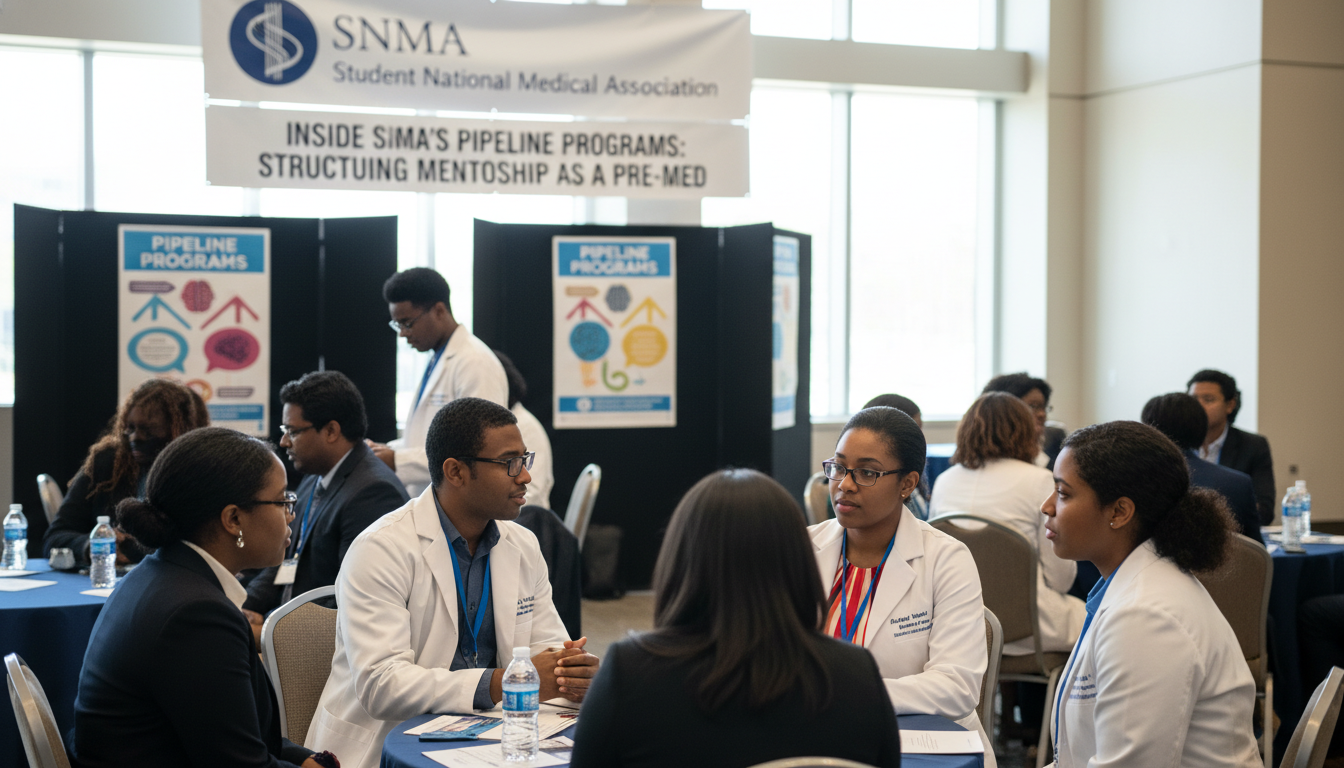
4. How to Deliberately Structure Mentorship Through SNMA as a Pre‑Med
This is where most students fail: they join MAPS or an SNMA pipeline program and then “see what happens.” From the outside the program looks supportive, but the mentorship never becomes targeted enough to change your trajectory.
You must be the one who structures it.
4.1 Step 1: Clarify Your Stage and Immediate Needs
Your needs as a first‑year with a 3.9 GPA are very different from those of a senior reapplicant with a 2.9 science GPA and a 497 MCAT.
Before you request or engage with a mentor, write down:
- Academic profile:
- Cumulative GPA, science GPA
- Trend (upward, flat, downward)
- MCAT status:
- Not started / studying / scheduled / taken
- Target timeline
- Application timing:
- When you realistically intend to apply (not just when you “hope” to)
- Gaps / worries:
- Limited clinical exposure?
- No research?
- Weak letters?
- Financial barriers?
This self‑audit lets you ask for the right kind of mentorship instead of generic “advice.”
4.2 Step 2: Select the Right Mentor Profile
Within SNMA’s pipeline space, you can often find several types of mentors:
MS1 / MS2 at your home or nearby med school
- Best for: academic strategy, recent MCAT experience, application logistics
- Often closer to the process and more empathetic; they remember the struggle
MS3 / MS4
- Best for: long-term trajectory, choosing specialties, evaluating schools
- Their application process may be a few years older, but they see the bigger picture
Resident or attending through SNMA connections
- Best for: career trajectory, navigating bias, specialty‑specific insights
- Less ideal for granular “AMCAS section 5” questions
You ideally want:
- 1 primary med student mentor who fits your immediate phase (MCAT vs. application)
- 1–2 “light touch” mentors (e.g., residents, older students) for occasional big‑picture discussions
SNMA events and pipeline programs are fertile ground for this. After panels, identify specific people whose trajectory resembles your goals: HBCU undergrad → MD; non‑traditional post‑bacc → DO; 504 MCAT → successful reapplicant.
4.3 Step 3: Run Mentorship Like a Structured Curriculum
Treat the year like a course with objectives, not a series of random check‑ins.
Example structure for a pre‑med–med student mentorship within SNMA:
Meeting 1: Foundation and Timeline (60–90 minutes)
Agenda:
- Share academic background and current status
- Review timeline: when you aim to apply and whether that is realistic
- Identify 2–3 priority areas (e.g., MCAT, GPA recovery, clinical experiences) Deliverables:
- Simple written timeline (month‑by‑month, even if rough)
- List of key tasks for the next 4–6 weeks
Meeting 2: MCAT and Coursework Strategy
Agenda:
- Confirm MCAT target date and score goal based on school list tiering
- Discuss content review resources vs. practice test strategy
- Map MCAT prep onto semester course load Deliverables:
- Weekly MCAT prep schedule with concrete hours
- Decision on resources (e.g., UWorld, AAMC bundle, Anki deck)
Meeting 3: Experiences and Narrative
Agenda:
- Review current activities (shadowing, clinical, research, leadership)
- Identify gaps relative to target schools (e.g., no longitudinal clinical)
- Discuss how your lived experiences fit into a future personal statement Deliverables:
- Activity gap list + plan to address
- Early narrative themes (e.g., rural upbringing, chronic illness in family, social justice work)
Meeting 4+: Application and Interview Prep (closer to cycle)
Agenda:
- Personal statement drafts
- Activity descriptions
- School list refinement
- Mock interviews / MMI station practice Deliverables:
- Application components with deadlines
- Specific follow‑up tasks before the next meeting
You do not need your mentor to design this curriculum. You present it and ask for their input. That alone signals seriousness and usually leads to better engagement.
4.4 Step 4: Leverage Group Mentorship Intentionally
SNMA pipeline environments are full of:
- Panels
- Group Q&A sessions
- Breakout workshops
- Case-based learning with med students
Many pre‑meds show up, listen passively, then leave. You should be doing three things at each session:
Take structured notes
- “MCAT advice from MS2 panel – high‑yield themes”
- “School list red flags mentioned”
- “Common interview pitfalls they saw”
Ask 1 targeted question informed by your self‑audit
- Not: “Any advice for pre‑meds?”
- Instead: “For students working 20 hours a week and taking orgo + physics, how would you realistically time MCAT prep to avoid burnout but still be competitive?”
Identify 1–2 potential deeper connections
- After the session, email or approach:
- “You mentioned being a first-gen student balancing family responsibilities. That resonated with me because I also am first‑gen and working while in school. Would you be open to a brief follow‑up conversation about how you paced your pre‑med years?”
- After the session, email or approach:
Group mentorship is where you “screen” for mentors whose experiences align with your own.
5. Common Pitfalls Pre‑Meds Face in SNMA Pipeline Programs
Even within strong SNMA ecosystems, certain patterns derail mentorship.
5.1 Passive Consumption
You:
- Attend everything
- Take notes
- Follow SNMA and MAPS accounts on social media
But you never:
- Request a recurring mentor relationship
- Ask for feedback on a draft
- Share your GPA, MCAT score, or struggles
Outcome: you feel inspired but not moved forward.
Correction: in at least one event per month, ask for something specific (feedback on a paragraph, opinion on your MCAT date, or critique of your semester schedule).
5.2 Over-Reliance on One Mentor
Another pattern: you secure one med student mentor and load every expectation onto that person.
Problems:
- Their experience may not match your pathway (e.g., they had a 520 MCAT and T20 acceptance; you are a 497 reapplicant)
- They have limited time; meetings become infrequent
- You do not get cross‑validation of strategies
Correction: use a portfolio approach:
- 1–2 primary mentors (often med students)
- A few “content specialists” encountered via SNMA:
- One who knows post‑baccs well
- One who navigated being a student parent
- One who did SMP or informal DIY post‑bacc
SNMA conferences and regional events are perfect for building that portfolio.
5.3 Avoiding Honest Academic Conversations
Many URiM and first‑gen pre‑meds underreport or gloss over poor grades due to shame. The result: mentors give advice assuming a stronger academic profile than you actually have.
You need to say out loud in SNMA mentorship spaces:
- “My science GPA is currently 2.8 after a bad freshman year.”
- “I have 1000 clinical hours but no research at all.”
- “I scored 496 on an FL after 3 months of solo MCAT study.”
SNMA mentors are used to hearing this. Many lived it. If they do not know, they cannot help you structure an appropriate repair plan (e.g., formal post‑bacc vs. SMP vs. GPA trend optimization).
6. Building Long-Term Professional Identity Through SNMA
SNMA pipeline work is not solely a transactional “help me get into medical school” instrument. You are also quietly building your professional identity.
6.1 From Mentee to Near-Peer Mentor
A powerful arc:
- Year 1: You join MAPS, get mentored, attend SNMA med school events.
- Year 2–3: You take on MAPS leadership, help coordinate outreach, or run pre‑med study sessions.
- Year 4: You co‑lead pipeline initiatives that pair you with med students as peers in planning.
Medical schools like to see this longitudinal arc:
- It reads as commitment to community, not temporary resume padding.
- It aligns with the mission language many schools publicize about workforce diversity.
- It gives your letters of recommendation more depth (e.g., from SNMA advisers, physicians working with your chapter).
When interviewers ask, “What does being a physician mean to you beyond clinical work?” you have years of structured pipeline and mentorship engagement to reference, not one‑off volunteer shifts.
6.2 SNMA as a Continuity Plan Into Medical School
If you enter medical school, SNMA does not disappear. It becomes your new professional home:
- You can step into roles such as:
- Pipeline director
- MAPS liaison for your med school
- AMEC or regional planning committees
- You now sit on the other side of the mentor table, designing the very programs you once attended.
Strategically, that continuity matters because:
- It anchors your wellness; SNMA chapters often provide crucial social support.
- It expands your network regionally and nationally for residency applications.
- It keeps you connected to pre‑med mentees at your alma mater or surrounding schools.
Your pre‑med involvement is the seed. Your med school involvement is the tree.
7. Practical Action Plan: How to Start Structuring Mentorship This Semester
Let us make this concrete. Over the next 8–12 weeks, your steps can look like this:
Week 1: Map the local and regional landscape
- Identify:
- Your school’s MAPS chapter (or closest equivalent)
- Nearest SNMA medical school chapters
- Upcoming SNMA/regionally affiliated pipeline events
- Identify:
Week 2: Attend 1 event with a mentorship lens
- Show up at a MAPS meeting or an SNMA‑hosted pre‑med workshop.
- Ask 1–2 targeted questions.
- Take notes on who resonates with your story.
Week 3–4: Make 2 specific mentorship asks
- Email or message:
- One med student (through SNMA) for a recurring 30–45 minute monthly mentoring session.
- One additional student or physician for a single “school list / career arc” conversation.
- Frame it clearly:
- Share GPA, MCAT timeline, and 2–3 clear questions.
- Email or message:
Week 5–8: Implement your mini-mentorship curriculum
- Have at least 2 structured meetings.
- Between meetings, complete agreed‑upon tasks (MCAT schedule, draft personal statement paragraph, etc.)
- Report back on progress. This reinforces the relationship.
Week 9–12: Move from recipient to contributor
- Ask how you can support SNMA pipeline efforts:
- Help with a high school HPREP event
- Support MAPS leadership with logistics or media
- Offer to share your experience in a “new pre‑meds” panel if you are a junior/senior.
- Ask how you can support SNMA pipeline efforts:
You are not waiting passively for mentorship to materialize. You are using SNMA’s pipeline architecture as a scaffold and building a deliberate, stage‑appropriate mentorship plan on top of it.
FAQ (Exactly 5 Questions)
1. I do not identify as Black or URiM. Can I still participate in SNMA or MAPS pipeline programs?
Yes. Many SNMA and MAPS chapters welcome all students who support the mission of increasing the number of Black and other URiM physicians and reducing health disparities. You should be transparent about your identity and be intentional about showing respect for the organization’s historical and current mission. Expect that programming may center Black and URiM experiences; your role includes listening, learning, and contributing without appropriating.
2. How early in undergrad should I join MAPS or SNMA-related pipeline programs?
As early as your first semester. First‑year students benefit from early exposure to realistic timelines, course sequencing advice, and MCAT planning. That said, if you are a junior, senior, or non‑traditional student, it is not “too late.” In those cases, you should enter with a very clear set of needs (e.g., MCAT targeting, reapplicant strategy) and immediately seek structured mentorship rather than slowly “checking it out.”
3. What if my GPA is low and I am embarrassed to share it with SNMA mentors?
You cannot receive meaningful guidance without sharing your academic reality. SNMA mentors frequently include people who had imperfect transcripts, took post‑baccs or SMPs, or re‑applied. Frame it plainly: show your GPA breakdown by year, note any extenuating circumstances briefly, and ask, “What repair pathways do you think are realistic for someone with this profile?” You are more likely to receive informed, compassionate advice in SNMA spaces than in anonymous online forums.
4. How does participating in SNMA pipeline programs actually show up in my medical school application?
In several ways:
- Activities section entries: sustained roles in MAPS, HPREP, outreach coordination, or mentorship count as leadership, community service, or teaching.
- Personal statement and secondary essays: SNMA work provides rich, concrete examples of commitment to underserved communities and diversity in medicine.
- Letters of recommendation: physicians, faculty advisers, or program directors connected to SNMA can write strong, context-aware letters about your character and growth.
- Interview talking points: your pipeline experiences help you answer questions about service, health disparities, and your understanding of medicine’s social context.
5. How do I know if a specific SNMA or MAPS chapter is “strong” and worth investing time in?
Look at the structure and outcomes:
- Do they have consistent meetings with clear agendas, or are events sporadic and unfocused?
- Are med student mentors visibly engaged, or is it mostly undergrads without upstream connections?
- Is there evidence of pipelines into local med schools (e.g., alumni of your MAPS chapter now at nearby MD/DO programs and active in SNMA)?
- Do programs go beyond motivation—offering application workshops, MCAT strategy, and concrete feedback? If the answer is yes to most, the chapter is likely strong. If not, you can still benefit by engaging regionally or nationally and, if you have the capacity, helping build that local infrastructure.
Key takeaways:
- SNMA’s pipeline is not a single program, but a vertical ecosystem running from K‑12 through residency; your pre‑med entry point is MAPS and local SNMA‑linked mentorship.
- Mentorship within SNMA works best when you structure it deliberately—clear goals, a simple curriculum across meetings, and honest disclosure of your academic and personal realities.
- Over time, you should move from mentee to near‑peer mentor, using SNMA and MAPS not just to “get in” but to build a durable professional identity grounded in service and community.