
You are a rising M2 sitting in the library after a rough advising meeting. Your mentor just said, “You need more academic stuff. Programs want evidence you can contribute intellectually. Do you have any research?” You do not. No posters. No abstracts. Nothing that looks “scholarly” on paper.
But what you do have:
- An AMSA chapter that is barely active.
- An AAMC student section email you have been ignoring.
- A nagging sense that you are behind, but no idea how to close the gap before applications.
Here is the fix: you can use AMSA and AAMC-related projects to build real academic credibility, even if you have zero traditional research right now.
This is not about fake padding. It is about turning student organization work into:
- Abstracts
- National presentations
- Policy papers
- Measurable outcomes that residency and medical school committees respect
Let’s build that, step-by-step.
Step 1: Redefine “Academic Credibility” Beyond Bench Research
Before you start emailing AMSA or AAMC contacts, reframe what you are trying to build.
Admissions and residency committees look for evidence that you can:
- Ask a structured question
- Collect relevant data
- Analyze and interpret that data
- Communicate results clearly (poster, talk, report, policy paper)
Traditional research (lab or clinical) is one route. But AMSA and AAMC work can check the same boxes if you structure it correctly.
Think in terms of scholarly products, not just “research”:
- Quality improvement-style projects based on chapter activities
- Needs assessments (surveys, focus groups)
- Educational interventions (workshops, curricula, peer teaching)
- Policy and advocacy briefs with citations and impact metrics
- National committee work that produces reports or consensus statements
If it can be:
- Systematically planned
- Documented
- Measured
- Presented or published
…it can support your academic credibility.
Your goal: Turn student organization work into academic outputs that look good on ERAS, AMCAS, and CVs.
Step 2: Inventory Your AMSA and AAMC Entry Points
You need access routes. Most students underuse what they already have.
For Premeds
Your main levers:
- Local AMSA premedical chapter
- Regional AMSA leadership (regional directors, local project chairs)
- AAMC Organization of Student Representatives (OSR)-related premed events
- Campus pre-health office projects tied to AAMC data or tools
Start with:
- Your AMSA chapter president or faculty advisor
- The AMSA national website → “Leaders & Chapters” or “Programs” sections
- Your pre-health advisor (“Do we have any AAMC-linked student initiatives or data projects?”)
For Med Students
You have more direct AAMC access:
- AMSA medical student chapters (local, regional, national)
- AAMC OSR representative at your school
- AAMC national initiatives (GQ survey discussions, curricular changes, diversity efforts)
- Institutional committees that respond to AAMC data (curriculum, wellness, DEI)
Action items this week:
- Identify your local AMSA leadership and send a short email asking about “ongoing or potential chapter projects that could yield presentations or abstracts.”
- Find your AAMC OSR rep (often listed on the med school website) and ask:
- “What AAMC or OSR projects are happening that need student involvement?”
- “Are there any working groups preparing posters or presentations?”
You are not looking for busywork. You are looking for projects that generate data, reports, or presentations.
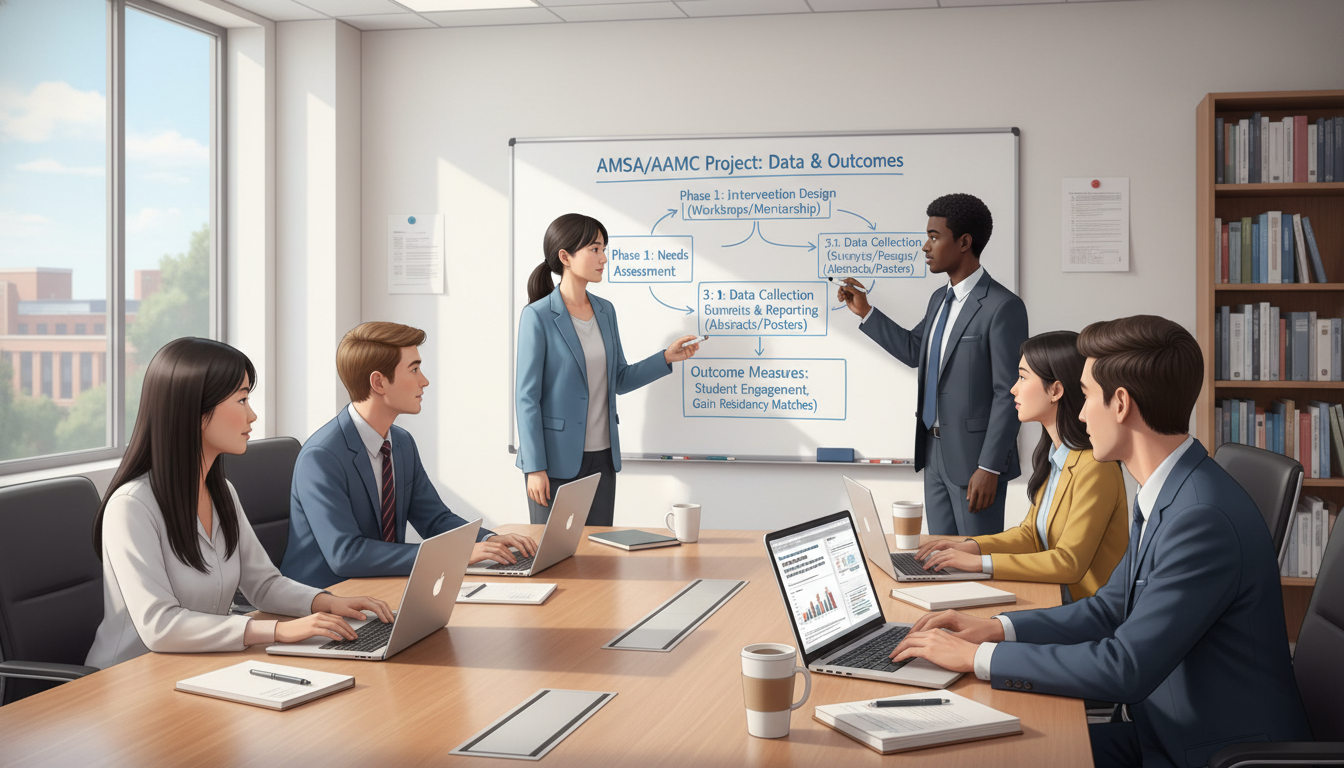
Step 3: Turn Basic Chapter Activities into Structured Projects
Most AMSA chapters already run events:
- Blood pressure screenings
- Health fairs
- Specialty panels
- Advocacy days
- Wellness initiatives
Typically these are “do and forget” events. You are going to convert them into academically valuable projects.
Model: Before vs After
Before
“Helped organize AMSA blood pressure screening at local church. Screened 80 people.”
After
“Designed and implemented a community hypertension screening and education intervention with pre- and post-knowledge surveys; analyzed data and presented findings as a poster at regional AMSA conference.”
Same core activity. Completely different academic signal.
How to Convert an AMSA Activity into a Project
Use this 7-step protocol:
Define a structured question
Example:- Does a short, structured teaching session during BP screening increase community knowledge about hypertension warning signs?
- What percentage of screened participants have undiagnosed elevated BP?
Plan simple data collection
- Pre-event: age, sex, prior diagnosis of HTN, if they have a PCP
- Knowledge: 3–5 multiple choice questions before and after a 5-minute teaching talk
- Outcome: proportion with BP ≥ a set threshold; percentage with new PCP referrals
Standardize your intervention
- A one-page script or slide deck for the teaching portion
- A consistent BP measurement protocol
This makes the project “repeatable” and more defensible academically.
Build IRB awareness (basic level)
- Talk to a faculty advisor: “We want to use de-identified data from our AMSA event for a potential abstract or poster. Do we need IRB review or can this be considered QI/education?”
- Many educational or QI-type projects are exempt or can be reviewed quickly if de-identified and low risk.
Run the event with data in mind
- Use structured forms (paper or Google Forms)
- Train volunteers to collect data consistently
- Keep identifiers separate if collected at all
Analyze in a way you can explain
You do not need advanced statistics for most chapter projects. Examples:- Descriptive stats: percentages, means, distributions
- Simple pre/post comparisons (even basic proportions with p-values if you have a mentor)
Convert into formal outputs
- Abstract → AMSA regional or national conference
- Poster → school research day or AMSA meeting
- Short report → shared with community partner and uploaded to chapter site
- CV entry under “Presentations” and “Scholarly Projects”
Repeat this formula for:
- Wellness workshops for classmates
- Step 1/MCAT study support initiatives
- Specialty exposure programs
- Peer mentorship programs (retention or performance outcomes)
Your AMSA chapter becomes your research lab. You are essentially doing education or QI-style projects.
Step 4: Plug Directly into AMSA National Initiatives
You do not need to invent everything yourself. AMSA offers structured programs that already carry academic weight.
1. AMSA Action Committees and Teams
Committees like:
- Global Health
- Gender & Sexuality
- Race, Ethnicity & Culture in Health
- Wellness & Student Life
Often work on:
- Surveys
- Position papers
- Toolkits
- Educational campaigns
What you can do:
- Join a committee and volunteer specifically for:
- “survey design and data analysis”
- “writing group for position statements”
- “evaluation of program impact”
- Ask: “Are there any projects that are being turned into conference presentations, reports, or publications that need an extra student contributor?”
This is how you move from “member” to “co-author on a national student-led project.”
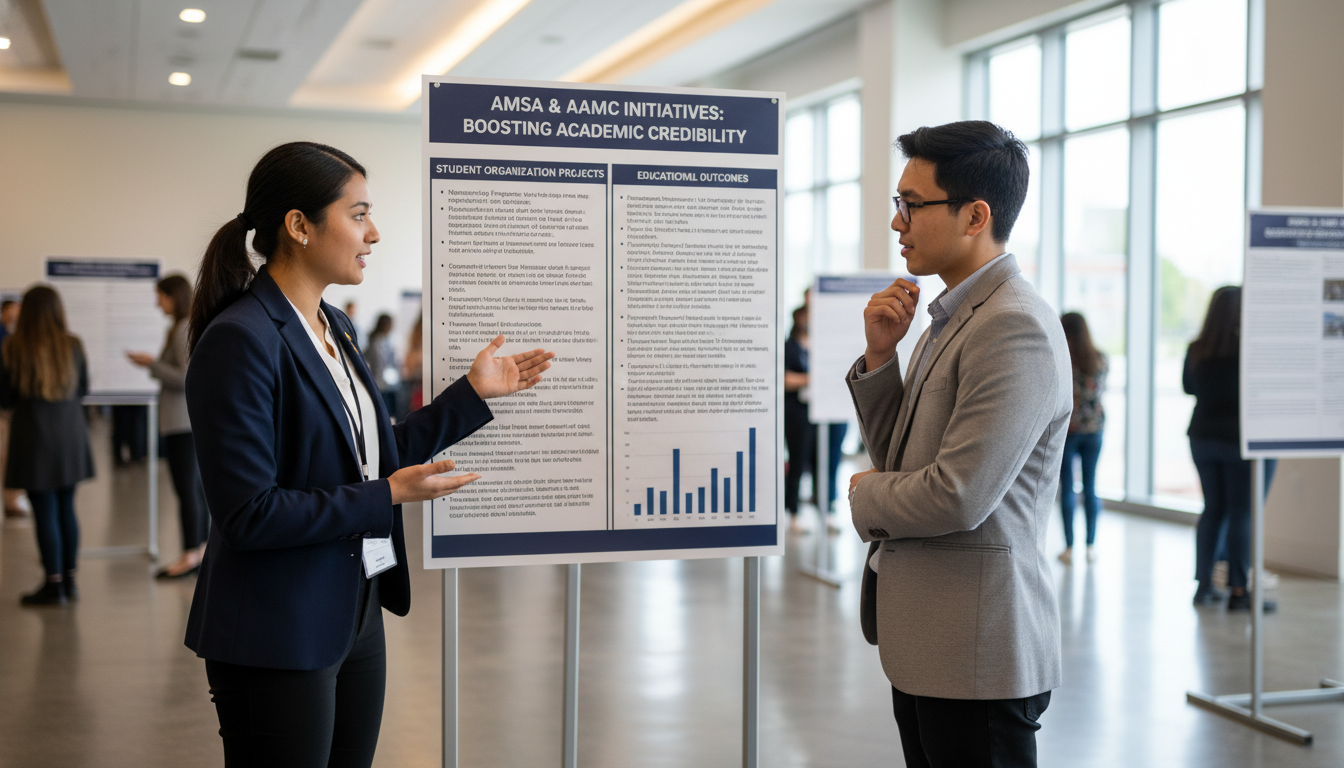
2. AMSA National Conferences and Poster Sessions
AMSA national and some regional meetings accept:
- Educational interventions
- Advocacy projects
- Chapter innovations
- Health equity initiatives
Strategy:
- Design one strong, structured chapter project (health fair, workshop, advocacy initiative).
- Collect pre/post data or implementation data.
- Prepare a short abstract (250–300 words: background, methods, results, conclusion).
- Submit to:
- AMSA convention
- Your school’s research day
- Regional academic meetings (state ACP, AAFP, etc. if relevant)
You are aiming for:
- 1–2 posters before applications
- 1 named role in project design or data analysis
That is enough to shift your CV from “no academic productivity” to “emerging scholarly involvement.”
Step 5: Use AAMC and OSR Projects to Add Institutional-Level Credibility
For medical students in particular, AAMC-linked work can look very strong, even when it is not classic bench or clinical research.
Understand Your AAMC Touchpoints
AAMC-related student work often revolves around:
- OSR (Organization of Student Representatives)
- Curriculum reform influenced by AAMC data (GQ, Y2Q, etc.)
- Diversity, equity, and inclusion (DEI) initiatives
- Wellness interventions tied to AAMC or LCME standards
These generate:
- Reports to administration
- Institutional presentations
- Posters at AAMC regional or national meetings
How to Get Involved
Meet your OSR rep
Ask:- “What AAMC-related projects or working groups are ongoing?”
- “Has our school done anything with the AAMC GQ or Y2Q data that involved students in analysis or presentations?”
- “Are any posters or presentations planned for AAMC or other educational conferences?”
Target active committees
Focus on groups that naturally lend themselves to data:- Curriculum committee subgroups
- Wellness committees evaluating interventions
- DEI task forces looking at pipeline programs, recruitment, or climate surveys
Offer specific skills, even as a beginner
You can credibly say:- “I can help clean survey data and run basic descriptive stats.”
- “I can draft sections of a report or poster.”
- “I can help design a simple evaluation instrument for our program.”
Example: Turning AAMC Data into a Scholarly Project
Scenario: Your school implemented a new wellness curriculum in response to AAMC survey feedback.
You could:
Help design a brief pre/post survey assessing:
- Burnout indicators (using a validated short scale, if approved)
- Utilization of wellness resources
- Perceived stigma around seeking help
Support data collection and follow-up.
Run simple descriptive and comparative analyses (with mentor oversight).
Co-author:
- A poster at your school’s education day
- A potential submission to an AAMC regional meeting
- A write-up for internal or external educational journals (if your mentor is interested)
On a CV this reads as:
- “Co-investigator, evaluation of an AAMC-informed wellness curriculum; co-authored poster presented at [Institution] Education Day and submitted to AAMC regional meeting.”
To a program director, that is legitimate academic experience.
Step 6: Build a Mini-Scholarly Portfolio from Student Organization Work
You are aiming for a small but coherent portfolio, not 20 random line items.
Your Minimum Target by Application Time
If you move intentionally, from AMSA and AAMC-related work you can realistically have:
- 1–3 posters or presentations
- 1–2 named roles on institutional or national reports / position statements
- 2–4 well-described leadership or project roles with measurable outcomes
These should all tell a consistent story:
- “I am someone who identifies problems, designs structured responses, collects data, and shares results.”
How to Structure These Items on Your CV/ERAS/AMCAS
Under “Leadership / Activities”
- “AMSA Chapter President – Designed and led a longitudinal community health screening initiative that incorporated structured pre/post education and data collection on hypertension awareness and control; project generated two posters presented at regional and institutional meetings.”
Under “Research / Scholarly Work”
- “Co-investigator, Evaluation of a student-led wellness curriculum”
- “Lead student author, AMSA chapter initiative assessing the impact of peer-taught Step 1 preparation workshops on test anxiety and perceived readiness.”
Be honest and specific:
- Your exact role (design, data collection, analysis, writing)
- The scope (sample size, setting, time frame)
- Outputs (where presented, who attended)
Admissions committees understand that not all scholarship is lab-based. They respond well to clear, structured, and outcome-driven work.
Step 7: Protect Yourself from the Common Pitfalls
There are traps that can turn this plan into frustration. Avoid these.
Pitfall 1: Unstructured Volunteering
Danger signs:
- “Just show up, we will figure it out.”
- No clear question, no plan to measure anything, no timeline for outputs.
Fix:
- Before committing major time, ask:
- “What is the goal?”
- “How will success be measured?”
- “Is there a plan to present, publish, or formally report these results?”
If they cannot answer, either help create that structure or redirect your effort.
Pitfall 2: Overclaiming “Research”
Do not call your work “clinical research” if it is a student-led education project.
Safer framings:
- “Educational research project”
- “Quality improvement initiative”
- “Program evaluation”
You gain more credibility when your labels are accurate.
Pitfall 3: Doing Everything Alone
You need:
- At least one faculty mentor (even if lightly involved)
- One or two student collaborators
Benefits:
- Practical help with IRB, analysis, and submissions
- Someone to back you up in a letter of recommendation
- Shared responsibility for follow-through
Pitfall 4: No Timeline
Projects without deadlines drag on forever.
For each initiative, define:
- Start date
- Data collection window
- Target analysis week
- Abstract submission deadlines (AMSA, local research day, regional meeting)
Use those conference deadlines to back-calculate your project schedule.
Concrete 6–12 Month Playbook
Here is a realistic roadmap if you are starting with zero research today.
Months 1–2: Position Yourself
- Join or re-engage with your AMSA chapter.
- Identify the OSR rep and request a brief meeting.
- Ask both: “What ongoing or potential projects could lead to a poster or report in the next year?”
- Select one main AMSA project and one AAMC/OSR-linked project to focus on.
Months 3–5: Design and Launch Projects
For your AMSA project:
- Define a question (community health, wellness, education, advocacy).
- Draft simple data collection tools (survey, pre/post test, logs).
- Get faculty input on design and IRB considerations.
- Run your first event or launch your intervention.
For your AAMC/OSR-linked project:
- Join an existing wellness, curriculum, or DEI working group that already interacts with AAMC data.
- Volunteer for data or evaluation roles.
- Clarify expectations for eventual poster/report.
Months 6–9: Analyze and Present Locally
- Clean and analyze data (even basic stats).
- Prepare posters for:
- School research day
- AMSA regional or national meeting
- Write clear project descriptions and update your CV.
Months 10–12: Scale and Consolidate
- If the AMSA project is successful, extend it:
- Second site
- Larger sample
- New outcome measures
- Prepare a more polished abstract for a larger conference (AMSA national, education conference, specialty meeting).
- Ask mentors for letters that explicitly mention your role in structured project work.
By the time you apply, you are no longer “the student with no research.” You are “the student who built academic projects through AMSA and AAMC engagement.”
Key Takeaways
- You can build real academic credibility without traditional lab or clinical research by turning AMSA and AAMC involvement into structured, data-driven projects.
- Focus on activities that produce measurable outcomes and sharable products—posters, reports, position statements, and program evaluations.
- Be intentional: secure a mentor, define clear questions, collect data systematically, and aim for at least 1–3 presentations tied to your student organization work before you apply.