
Here’s the myth: study groups improve M1 outcomes.
Here’s what the data actually shows: that statement is way too sloppy to be useful.
“Outcomes” in first year aren’t one thing. If you don’t define them, you can prove anything with vibes. M1 outcomes include at least four separate targets: exam performance, long-term retention, course progression, and well-being. Those are not interchangeable. A group that makes you feel less isolated may absolutely help your well-being. Good. That does not mean it improved your renal block score. A group that keeps you on schedule may help you complete the material. Also good. That still doesn’t prove it beat high-quality solo retrieval practice.
And that’s the bait-and-switch people pull all the time. They say, “Study groups help,” when what they really mean is, “I liked my group,” or, “My group made me study,” or, “The top students in my class studied together.” Those are different claims. Some are true. None automatically establish an effect on grades.
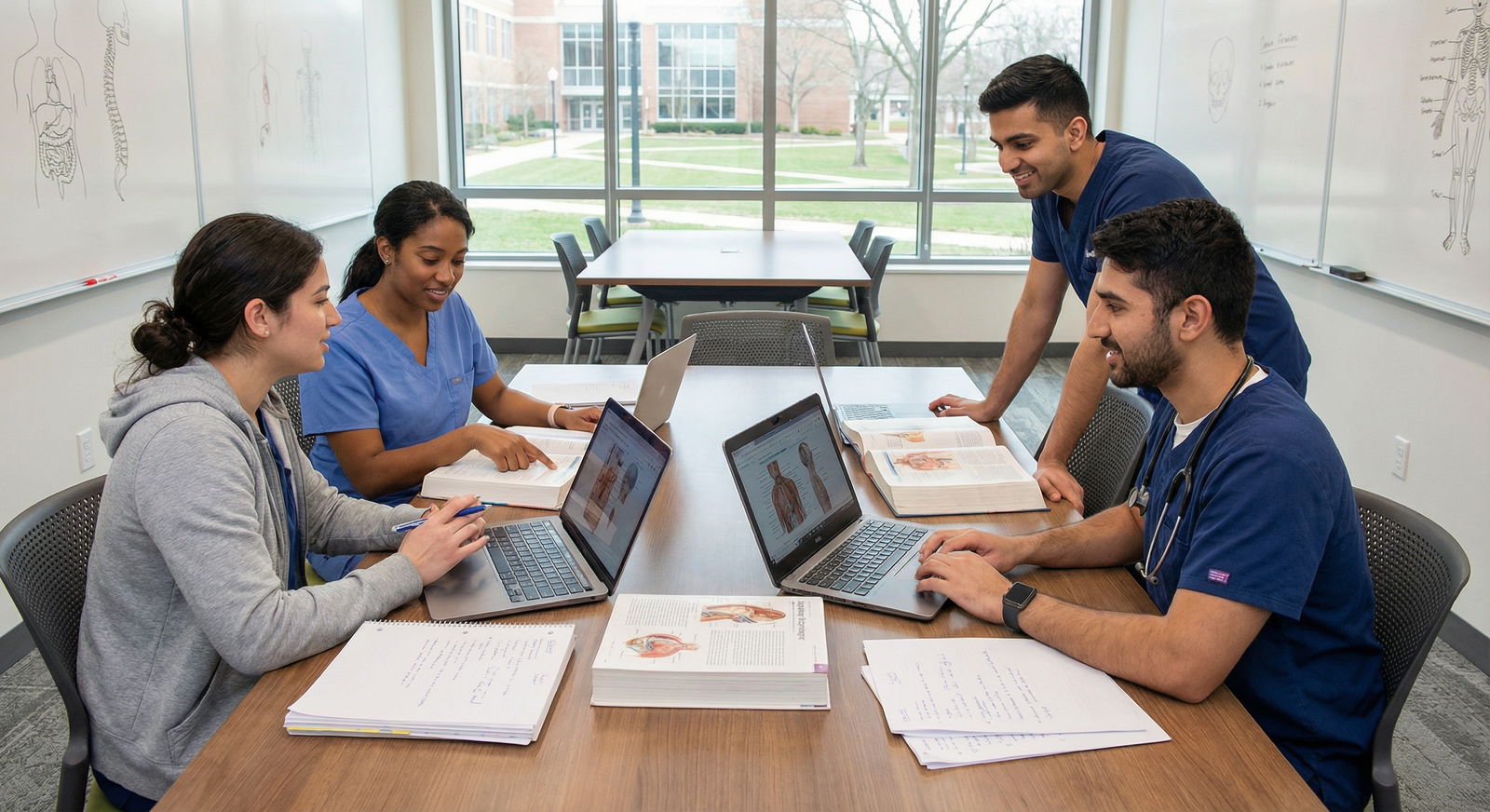
I’ve watched this play out in M1 over and over: six students reserve a library room, open slides, talk for two hours, and leave feeling virtuous. Productive? Emotionally, maybe. Cognitively, not necessarily. The real question isn’t whether groups can help. Of course they can. The question is sharper: under what conditions do they outperform disciplined, individual, evidence-based study?
That’s the only question worth asking. Everything else is folklore.
What the evidence actually says (and what it doesn’t)
A lot of people confuse the existence of collaboration with proof that collaboration improves learning. Medical students study together. True. Students often report liking group work. Also true. Those facts do not establish a reliable causal effect on exam performance.
Most of the literature around study groups and collaborative learning in higher education is messy. Small samples. Single institutions. Specific course designs. Often no randomization. Frequently no serious control for baseline student ability, motivation, or study habits. That matters because the students who form effective groups are often the exact students who’d have done well anyway. Motivated people cluster. Organized people cluster. Students who already use question banks, Anki, calendars, and office hours also tend to cluster. Then the group gets credit for traits the members brought with them.
That’s classic selection bias. Add confounding and you can tell yourself any fairy tale you want.
Meanwhile, the strongest learning science doesn’t put “generic study groups” at the center. It puts mechanisms there. Retrieval practice. Spaced repetition. Interleaving. Practice testing. Feedback. Error correction. These have a much more consistent evidence base. Why? Because they directly change what memory has to do. They force recall, discriminate similar concepts, expose weaknesses, and strengthen future retrieval.
A group can contain those mechanisms. But the group itself is not the mechanism.
That distinction matters more than most students realize. If your study session is mostly summarizing lectures, explaining slides, and nodding along while one confident person carries the room, you’re not doing the thing the evidence supports. You’re renting the appearance of learning.
That chart isn’t giving exact pooled effect sizes. It’s showing a hierarchy of confidence. The evidence for core learning mechanisms is stronger than the evidence for the vague intervention called “study groups.” That’s not a subtle point. It’s the point.
There’s publication bias too. Positive, enthusiastic educational interventions are more likely to get attention than “students met and nothing much happened.” And there’s a huge measurement problem: many studies assess student satisfaction, engagement, or self-reported helpfulness. Fine. But self-reported helpfulness is not the same thing as improved recall on a Monday morning exam after three days of sleep deprivation and a histology practical.
So no, the evidence does not support the lazy claim that study groups automatically improve M1 outcomes. It supports a narrower claim: groups may help when they reliably deliver active retrieval, feedback, correction, and structure better than the student would get alone.
That’s a very different sentence.
Why many study groups help… but for the wrong reasons
Let’s give study groups their due. They often do help. Just not for the reason people think.
What helps is accountability. The 7 p.m. library meeting means you stop doom-scrolling and show up. What helps is shared deadlines. The group says, “By Thursday we’ve all done cardio,” so you actually do cardio. What helps is emotional regulation. You realize everyone else also got punched in the face by embryology and maybe you’re not uniquely doomed. That matters. Anxiety drops. Motivation rises. Studying becomes easier to sustain.
Real benefits. Wrong mechanism.
Those benefits are support systems around learning, not the learning itself. If the actual session still consists of re-reading notes, splitting PowerPoints, and letting the loudest person “teach,” then the group is basically a social productivity app with snacks.
I’ve seen groups that swear they’re high-yield because one person explains everything beautifully. Sounds efficient. Usually isn’t. The explainer may learn through retrieval and organization. Everyone else mostly experiences recognition. Hearing a smart classmate say, “This should remind you of nephritic syndrome because of the inflammatory picture” feels clarifying. It also creates fluency. You feel like you know it because it made sense when someone else said it. Then the exam asks the same concept sideways and your brain returns a 404.
Without deliberate practice, groups drift. Always. They drift into summaries, tangents, reassurance, and “coverage.” Coverage is seductive because it feels complete. “We got through 110 slides.” Great. Did you answer 25 mixed questions correctly from memory under time pressure? That’s the metric. Everything else is theater unless it feeds that.
The study-group traps that quietly sabotage M1 performance
The first trap is unequal preparation. Half the group shows up ready, half doesn’t. So the session turns into remedial explanation. That sounds generous and collaborative. It’s often a bad trade. The prepared students spend time re-framing material they already know. The unprepared students receive cleaned-up explanations instead of doing the ugly work of recall. Nobody gets the full benefit.
Trap two is group-pace normalization. Fast learners slow down to match the room. Slower learners hide inside the room. Nobody works at their actual edge. M1 is full of this fake harmony. It feels nice. It’s not efficient.
Trap three is social loafing. A two-hour session can contain shockingly little real cognitive effort. People talk. People laugh. Someone draws a nephron. Another person says, “Wait, can you explain RAAS one more time?” Suddenly it’s 9:40 p.m. and five questions got done. That’s not serious practice. That’s academic hanging out.
Trap four is explanation illusion. This one is deadly. Hearing an answer explained creates confidence faster than it creates memory. Fluency rises. Accuracy doesn’t. Students walk out saying, “I get it now,” then miss the question alone the next day. If you can’t retrieve it independently, you do not know it. I don’t care how good the group discussion felt.
Trap five is coverage goals instead of question goals. “Let’s finish all of micro tonight” is a weak goal. “Let’s each do 20 mixed NBME-style questions, justify every answer, and log every miss” is a strong one. One measures exposure. The other measures performance.
That’s the whole game. Structure determines whether the group is a learning tool or a waste of polished table space.
How to choose: group study vs independent high-yield study
Here’s the decision rule I’d use, and it’s blunt on purpose: default to solo retrieval practice unless the group is doing something better than you can do alone.
Most students should build their week around independent, active study. Questions. Recall. Spaced review. Timed blocks. Error logs. Then use a group only when it adds a specific function: accountability, answer justification, misconception correction, or realistic test-like practice.
When are groups genuinely valuable? Three situations. First, timed retrieval under pressure. Sitting with others and doing a 20-minute block in silence can keep everyone honest. Second, problem sets or question sets where answers must be defended. Not “What did you put?” but “Why is C better than D, and what clue in the stem proves it?” Third, calibration. If the group has a strong facilitator, shared answer key, or trusted reference standard, it can quickly expose misconceptions before they harden.
When are groups a net negative? Easy. When the culture rewards talking over answering. When the session runs on summaries and vibes. When people avoid testing conditions because being wrong in public feels uncomfortable. Comfort is expensive in med school. Sometimes the thing that protects your ego also protects your weaknesses.
That allocation won’t fit everyone, but the principle is right: the group should be the side dish, not the meal.
Make the group work: a practical protocol that can survive the myth
If you want a study group that actually earns its keep, stop calling it a study group. Call it what it should be: a practice-testing lab.
Before the session, everyone prepares alone. Non-negotiable. That means reviewing prerequisite material and attempting a set number of questions solo first. Ten to twenty is enough to expose confusion. If people arrive cold and expect the session to “teach” them, the group collapses into entertainment. I’ve seen this happen in week three of physiology every single year. One prepared student performs. Everyone else consumes. It looks collaborative. It’s not.
Set shared objectives in advance. Not “renal.” Too vague. “Acid-base interpretation, diuretic mechanisms, nephritic vs nephrotic patterns.” Better. Use question banks, faculty-provided cases, old formative items, or self-written NBME-style stems if you must. The source matters less than the format: it has to force discrimination and retrieval.
During the session, start with silence. Timed block. Twenty to thirty minutes. No talking. Everybody answers individually. This is the part students love to skip because it’s uncomfortable. That’s exactly why it works. The brain has to commit before it gets social help.
Then compare answers. But don’t do the lazy version. No rapid-fire “I got B.” Make people justify. What clue in the stem ruled in the answer? What made the distractor tempting? Which concept failed if someone missed it? Use a trusted reference immediately. Don’t let myths survive because the most confident person sounded smooth.
Record errors in a running log. Not pages of notes. Just a compact list: concept missed, why it was missed, what the correct reasoning is, and when it will be retested. Patterns matter. If your group keeps missing mechanism questions in pharm or confuses restrictive and obstructive physiology in different disguises, that’s the signal. Chase signals, not feelings.
Then build the follow-up loop. Within 24 to 72 hours, re-test the same concepts. Not by rereading the notes. By doing new questions or short recall prompts. If the group discussed acid-base beautifully on Tuesday but can’t solve a fresh problem on Thursday, the session failed. Full stop.
And track quality with the only metric that matters: accuracy trends. Not hours. Not attendance. Not how locked-in the session felt. Are your scores rising? Are your misses becoming narrower and more sophisticated? Are you retrieving faster with fewer cues? If not, the group is failing the learning-mechanism test.
That sounds harsh. Good. M1 is too compressed for sentimental methods.
Bottom line: busting the myth without banning groups
Study groups don’t inherently improve M1 outcomes. That’s the myth. What improves outcomes is deliberate retrieval, feedback, error correction, and spaced re-testing. Groups only deserve credit when they actually deliver those things.
So keep the group if it behaves like an assessment engine. Kill it if it behaves like a discussion club with highlighters.
The practical checklist is simple. Show up prepared. Use timed retrieval. Answer individually before discussing. Justify every answer. Correct errors immediately. Re-test missed concepts later. Track accuracy, not effort theater.
That’s the contrarian takeaway, and it’s the honest one: the best “study group” usually isn’t very groupy. It’s structured, a little uncomfortable, and obsessed with performance data. Which is exactly why it works.
The rest? Nice story. Weak evidence. Expensive time.