
Your coffee's cold. Your textbooks are still in the shrink wrap. That week-long break that was supposed to recharge you somehow left you more drained than the entire first semester. You're staring down the barrel of another 18 weeks, and the initial burst of new-term motivation is already flickering.
This is the M1 slump. It's not a moral failing, and it's certainly not a sign you're unfit for medicine. It's simply what happens when you stop the academic treadmill for a week, then try to jump back on at full speed. The good news? You can recover faster than you think, you just need a concrete plan, not a pep talk.
The M1 Slump: Assessing Your Current State
Right now, your brain feels like it's wrapped in cotton wool. You sit in lecture and the words float past without sticking. That's the post-break brain fog, a combination of circadian rhythm disruption, reduced cognitive load, and the very real biochemical shift from relaxation back to high stress. It's normal. But before you can fix it, you need to figure out whether you're dealing with transition friction or something deeper.
Transition friction is the temporary resistance you feel when restarting any complex mental task. It's like the first five minutes of a workout: your body protests, but once you're moving, you're fine. Academic burnout, on the other hand, is a state of emotional exhaustion, cynicism, and reduced personal efficacy that doesn't lift after a single good study session. If you dread every class, can't concentrate even after several days of effort, and feel detached from the material, you might be flirting with burnout. The fix for burnout is rarely "study harder." It's often a conversation with a counselor or a real schedule overhaul. But if you just feel sluggish and unfocused, that's friction, and friction can be neutralized with the right techniques.
Your first mission: a Data Audit. Before you touch a single new lecture, pull up your grades and any feedback from the previous term. Look at the subjects where you scraped by and the ones where you bombed. Be brutal. If you passed anatomy by memorizing high-yield structures but failed every embryology exam, that's not random bad luck, that's a content blind spot. I've seen students waste entire semesters rereading everything because they were too proud to admit they had a weakness in physiology. Don't be that student. Open your old exam reports, if you have them, and note the topics where you consistently scored below 70%. Those are your priority one areas. This audit turns a fuzzy feeling of "I'm behind" into a targeted hit list. You'll stop flailing and start hunting specific knowledge gaps. It's the difference between digging a random hole and mining for gold.
Need a more comprehensive strategy? Read how faculty quietly judge your coping skills in m1 to understand how to present your progress effectively.
Once you've identified your weak spots, you've turned an emotional crisis into a logistical problem. And logistical problems have solutions.
If the social pressure is becoming overwhelming, consider these first-year fears to overcome anxiety to help maintain your focus.
The 72-Hour Turnaround: Immediate Practical Steps
The first 72 hours after a break are make-or-break. If you try to cram 10-hour study days right out of the gate, you'll crash. If you do nothing, the backlog will bury you. The solution is a Low-Threshold method, a term I use for any strategy that makes starting a study session so ridiculously easy you can't talk yourself out of it.
Here's what I want you to do tonight: set a timer for 15 minutes. Open your weakest subject from the audit. Do one thing, just one, that requires output. That could be 10 Anki cards, 5 USMLE-style practice questions, or a single one-page summary from memory. That's it. The point isn't to learn everything; it's to prove to your brain that you can still study. Inertia is physics, not psychology. Once you break through the initial resistance, the second 15-minute block is easier. The next day, push to two 30-minute blocks. By day three, you'll be back to a functional routine. I've watched this technique rescue students who thought they'd have to drop a class. It works because it bypasses the willpower tax.
Now, let's talk about your study tool selection. Passive reading is a trap. I'll say it plainly: if you spend your first week back highlighting textbooks, you're sabotaging your semester. You need high-yield resources that force your brain to retrieve information, not just recognize it. I'm talking about Anki for spaced repetition and UWorld or Amboss for clinical application. These are the gold standard for a reason. The workflow I'm about to show you is simple but unforgiving: you must prioritize active recall.
That flowchart isn't just a suggestion; it's the backbone of every successful M1 recovery I've seen. Start with the audit, identify the gaps that actually show up on exams (biochem pathways, pharm mechanisms, etc.), then hammer them with spaced repetition. Immediately test yourself with practice questions, not a week later. The review step is where you dissect why you got a question wrong. Did you misread? Did you confuse a pathway? That's the gold.
Alongside this, reset your biological clock. If you spent break sleeping until noon and mainlining coffee at midnight, you're fighting your own physiology. Caffeine regulation is critical. I tell students: no caffeine after 2 PM for the first week. Your sleep drive needs to kick in naturally. Set a strict wake-up time, 7 AM, no exceptions, and expose yourself to bright light first thing. It's not glamorous, but it pulls your circadian rhythm back into alignment fast. Without sleep, you'll retain nothing, no matter how many Anki cards you do.
Optimizing Workflow: Efficiency Over Intensity
Here's the dirty little secret of medical school: the students who brag about studying 12 hours a day are usually the ones who burn out fastest and score lower than they should. Study hours are a vanity metric. Content mastery is the only KPI that matters.
I want you to do a time audit. Write down, honestly, how you spent your study time last week. Be specific: "Reading First Aid, 3 hours," "Making pretty Notion pages, 2 hours," "Staring at wall, 1 hour." Now categorize each activity as high-yield or low-yield. If it didn't involve solving a problem you'd see on an exam, it was low-yield busywork. Making color-coded tables might feel productive, but it's often just procrastination dressed up as diligence. I've seen too many students pour hours into rewriting lecture notes only to fail NBME shelves. That's not studying; that's transcription.
The ideal study strategy mix looks like this:
That's the 60-30-10 rule. At least 60% of your study time should be active recall, doing practice questions, teaching concepts out loud, or writing answers from memory. Spaced repetition gets 30%, covering the review of premade or custom Anki decks. Passive reading gets 10%, max. And that 10% is only for initial exposure to a new concept you genuinely don't understand. Once you've seen it, switch to questions.
Now, about extracurriculars. I'm not going to tell you to quit your student interest group or stop shadowing entirely, but if your grades are on life support, it's time to triage. Freeze all non-essential activities for the next three weeks. That includes that exciting research project that "only takes five hours a week." Five hours is 2-3 productive study blocks you can't afford to lose. Set a hard boundary: no extracurricular work until you've completed your daily question and Anki quota. Your priority is stabilizing your academic foundation. The rest can wait. Trust me, you'll have plenty of time to shine later, but not if you're on academic probation.
Navigating the Administrative and Social Landscape
Asking for help in medical school feels risky. You've heard horror stories about "red flags" on transcripts or whispers among faculty. But the reality is that most academic advisors and deans want you to succeed, if you approach them correctly. The key is to show up with a plan, not a plea.
When you meet with an advisor, don't say, "I'm struggling and I don't know what to do." That's a red flag because it signals helplessness. Instead, say, "I've done a data audit on my last term. I'm performing well in anatomy but consistently miss pharmacology questions that require mechanism comparisons. I've adjusted my study workflow to do 20 UWorld questions daily and cross-reference with Sketchy. I'd like your input on whether that seems sound for our curriculum." That's a professional conversation. It demonstrates self-awareness and initiative. Advisors eat that up.
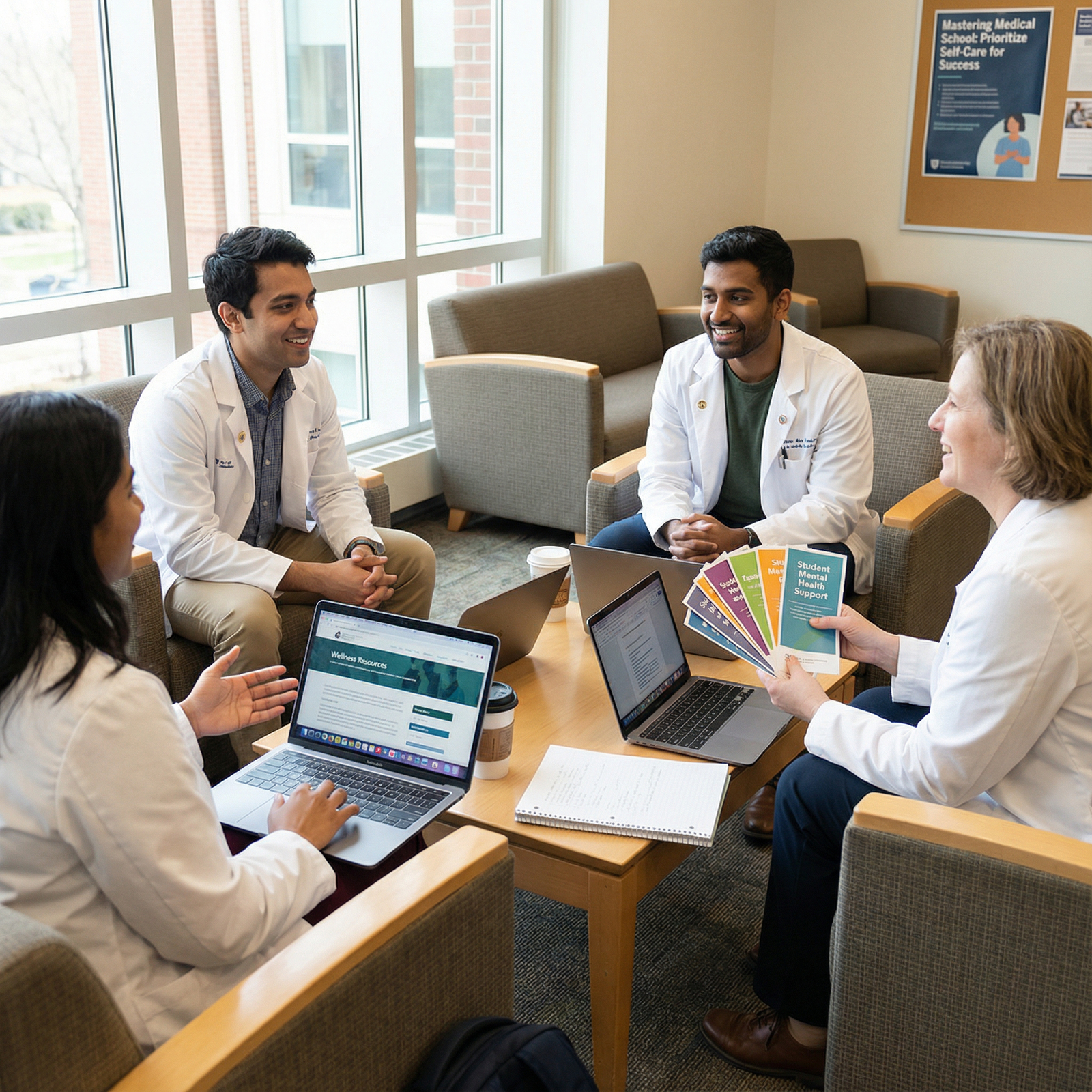
Now, the social side. Post-break, peers will be buzzing about what they covered over break or how "behind" they feel. This is a minefield of competitive anxiety. Avoid the comparison trap. If someone brags about finishing UWorld twice, smile and move on. Their progress has nothing to do with your recovery. In fact, I recommend finding one accountability partner, someone who won't feed the anxiety spiral. Make a simple pact: you text each other at the end of the day with a "done list." Not "I studied for 8 hours," but "I completed 30 renal physiology cards and 15 practice questions." Concrete. Keep each other honest. That social pressure, when positive, can nudge you back to your desk on days when motivation is zero. But if your partner is a stress-hoarder who only wants to panic, drop them. You need a teammate, not a therapist.
The Long Game: Sustainability for M2 and Beyond
Recovering after one break is great. But building a system that prevents the next crash is better. You don't want to repeat this scramble every time you have a week off.
The goal is a rhythm, not a sprint. I suggest anchoring your study to specific triggers. For example, "After I brush my teeth in the morning, I do 20 Anki cards." Or, "Before I check my phone, I complete a 10-question block on my phone app." These micro-habits bypass decision fatigue. Over time, they become as automatic as breathing. That's how you maintain momentum through long semesters without relying on bursts of motivation.

And please, bake in some non-negotiable wellness. I'm not talking about meditation retreats. I mean protecting one night a week where you don't study, or scheduling a Saturday morning run. The key is that these habits are rigid, non-negotiable, and they're scheduled around your study, not the other way around. If you wait until you "feel" like taking a break, you'll never take one, and you'll burn. The students who make it through M2 and into clinicals in one piece are the ones who treat sleep, food, and movement like a prescription.
Here are three truths to tape to your wall:
- Momentum is not created through motivation; it is created through automated habits.
- Do not attempt to "catch up" by doubling study hours, this leads to burnout. Instead, focus on higher-yield content prioritization.
- A bad start to a term is a fixable data point, not a reflection of your medical potential.
You're not going to be the doctor who got a C in biochem first year. You're going to be the doctor who learned how to course-correct, how to triage, and how to keep moving when things get messy. That's the skill that will serve you long after Step 1 is a distant memory. So, commit to the incremental progress model: one question at a time, one concept at a time, one day at a time. Start today.