The ugly fear is usually not subtle. It sounds like this: What if my accommodations don't come through in time, I'm forced to sit for Step without what I need, and I absolutely spiral? Not "I get a little nervous." Spiral. Freeze. Lose minutes. Can't think. Start catastrophizing in block one and never recover.
I get why that fear hits so hard. Step already feels like a pressure cooker. Add a pending accommodations decision, and now your brain has a second full-time job: scanning for disaster. Every unread email feels sinister. Every delay feels personal. Every "we're still reviewing your case" message lands like a threat.
Here's the part I want you to hold onto: a delay can absolutely increase stress, but it does not automatically doom your exam day. That belief, that delay equals panic, panic equals poor score, is exactly the kind of anxiety math that makes things worse. It's bad math.
What actually helps is boring, practical, unglamorous stuff. A contingency plan. Clear documentation. Knowing exactly who you'll contact and what you'll ask. Having a backup routine for test day if the situation is still unresolved. Anxiety hates structure because structure gives your brain fewer places to invent horror stories.
So yes, delays happen. Annoyingly often. And yes, they can stir up real test anxiety. But no, you are not helpless here. You need a plan before your brain starts improvising one at 2:13 a.m.
Will My Accommodations Delay Make Me Panickingly Anxious on Step Day?
Maybe. But not in the way your anxious brain is predicting.
The worst-case thought is usually blunt: If I don't have my accommodations, I won't be able to function. That fear deserves respect. If you've requested accommodations, it's because support matters for your access and performance. This isn't you being dramatic. It's you trying to take the exam under conditions that don't punish your brain or body.
But anxiety adds a second layer that's often even more destabilizing: the fear of losing control in public. Not just "What if I'm uncomfortable?" but "What if I panic at check-in? What if I blank out? What if everyone else can cope and I can't?" I've seen applicants get more frightened by the idea of unraveling than by the actual testing demands.
That's why expectations matter. Delays can happen. Bureaucracies are slow, vague, and often weirdly indifferent to the fact that you're trying not to implode before one of the biggest exams of your career. That part is real. What's also real is that test-day anxiety becomes much more manageable when you stop waiting passively and build a contingency plan.
You need two things:
- clear communication with the relevant accommodations/testing offices
- a practical "if-then" plan for exam day
Not magical calm. Not perfect certainty. Just a plan sturdy enough to keep you from free-falling.
What Actually Causes Test Anxiety on Exam Day (and What Doesn't)
A lot of applicants blame the wrong thing.
The delay itself? That's stressful, yes. But the delay is often not the direct cause of the worst anxiety spike. The bigger driver is what your mind does with the delay. Specifically: it fills in the blanks with catastrophe.
You're usually dealing with two different fears, and they're not the same.
First: fear of the unknown. You don't know whether approval will come through, what the timeline is, whether you should postpone, whether the test center will have instructions, whether this whole thing will blow up the week of your exam. Uncertainty is gasoline for anxious brains.
Second: fear of not having support. This one cuts deeper. It's the belief that if the accommodation isn't finalized, you'll be left alone to white-knuckle your way through a high-stakes exam while your brain or body does something unhelpful at the worst possible time.
That second fear is usually what sends people into the real panic loop.
Here's how the loop works:
- You think, I might have to do this without what I need.
- Your body reacts like there's immediate danger, racing heart, tight chest, nausea, shaky hands.
- You notice the physical symptoms and decide they're proof you won't cope.
- Focus gets worse.
- The fear feels confirmed.
Messy. Exhausting. Very common.

What doesn't reliably cause anxiety on its own? The mere existence of a pending status. I've seen students with unresolved accommodations walk in calmer than students with full approval, because the calm students had a plan and the panicked students had only reassurance-seeking. Reassurance-seeking feels productive. It isn't. It just burns energy.
Evidence-based planning interrupts the cycle because it answers the brain's favorite threat: "I'll have to cope alone." Once you can say, "If X happens, I will do Y," your nervous system stops treating every unknown like a cliff edge.
That doesn't mean you'll feel zen. Frankly, "zen" is overrated on Step week. It means you'll be less hijacked.
If Accommodations Are Delayed: Will Anxiety Automatically Get Worse?
No. And I want to say that plainly because anxious people love the word "automatically." We act like one bad variable triggers an inevitable collapse.
A delay can increase uncertainty. Uncertainty can increase rumination. Rumination can crank up anxiety. That chain is real. But it is not destiny.
The problem with the automatic-worsening assumption is that it ignores the most important factor in test anxiety: threat perception. Your body doesn't just react to facts. It reacts to what it thinks those facts mean. If your brain translates "delay" into "I am trapped and unprotected," your nervous system will behave accordingly. If your brain translates "delay" into "this is frustrating, but I have a backup plan and a communication path," the threat signal drops.
That's not motivational fluff. That's how anxiety works.
Preparedness changes the equation in three big ways:
It reduces rumination. If you've already decided what you'll do if approval is still pending 7 days out, 3 days out, and the morning of the exam, your brain has less room to rehearse doom scenarios.
It lowers threat perception. A plan tells your system, "I may not like this, but I'm not defenseless." Huge difference.
It helps with physiology. Grounding, pacing strategies, and break routines can lower physical arousal whether the accommodation decision is finalized or not. Your nervous system does not require perfect paperwork before it agrees to calm down a notch.
Also, let's be honest: some students become more anxious after approval because now the exam feels real and imminent. So no, approval status is not the sole dictator of your emotional state. The brain is more annoying than that.
What predicts a rougher exam day isn't simply "delay present." It's more like this:
- unresolved uncertainty
- no concrete next steps
- all-or-nothing thinking
- poor sleep
- repeated checking/doom-scrolling
- no test-day coping routine
That's the cluster that causes trouble.
So if your accommodations are delayed, don't ask, "Will I definitely do worse?" Wrong question. Ask, "What would make this situation less threatening by test day?" That question gets you somewhere.
A Contingency Plan for Step Day (Even If Approval Isn't Final)
This is the part anxious brains resist because it feels too practical. But practical wins.
If your approval isn't final, your goal is not to solve every uncertainty tonight. Your goal is to build a minimum viable support plan, enough structure that you don't arrive at the test center in full chaos.
Start with this checklist:
1) Confirm the exact status
Don't rely on memory or vibes. Check your portal, email, and any official correspondence. Know:
- what has been submitted
- what is still under review
- whether additional documentation was requested
- whether there's a posted timeline
- who the contact person or office is
Screenshots help. Save everything in one folder. Name files like a sane person. "FinalLetter2REALfinal.pdf" is how panic starts.
2) Document everything
Keep:
- approval request materials
- clinician letters or medical documentation
- prior email exchanges
- dates of submission
- dates of follow-up calls
- any instructions you were given
Why? Because anxious people under stress forget details, and bureaucracies lose context. A clean paper trail is calming because it turns "I think I sent that" into "Here's the record."
3) Contact the right office early
Don't wait until 48 hours before the exam if you can avoid it. Reach out to the appropriate accommodations or testing support office and ask direct questions:
- What is the current review status?
- Is there an estimated decision timeline?
- If approval is not finalized by my exam date, what are my options?
- Should I keep my date, postpone, or wait for further guidance?
- Are there specific day-of instructions I should know?
Keep the tone calm and concise. You do not need to write a ten-paragraph emotional memoir. Bureaucracies reward clarity, not eloquence.
A script helps:
Hi, I'm scheduled for Step on [date] and I'm following up regarding my accommodations request submitted on [date]. I'd like to confirm the current status, expected timeline, and what steps I should take if a decision is still pending as my exam date approaches. I want to make sure I'm following the correct process and planning appropriately. Thank you.
4) Decide your "minimum viable support"
This matters a lot. Ask yourself: If approval is still pending, what supports can I control anyway?
Examples:
- choosing the calmest possible travel/logistics plan
- arriving early
- protecting sleep the week before
- using a written pacing strategy for blocks
- pre-planning breaks, hydration, and snacks according to exam rules
- having a practiced grounding routine
- reducing last-minute email checking on exam morning
No, these are not substitutes for needed accommodations. But they are still real supports. Don't dismiss them just because they're not perfect.
5) Reduce the amount of decision-making on test day
Anxiety loves empty space. Fill it with decisions made ahead of time:
- what time you'll wake up
- what you'll eat
- when you'll leave
- what you'll do if you feel panic during block one
- whether you'll continue, pause, or use a reset between blocks
Make those decisions now, not in the parking lot while your pulse is in the stratosphere.
The whole point is to spend less of test day negotiating with your fear. You need fewer open loops, fewer "what now?" moments, fewer opportunities for your brain to declare an emergency.
On-Test-Day Skills to Prevent Anxiety From Hijacking Your Performance
You do not need to eliminate anxiety. That's a terrible goal because the second you notice anxiety, you'll decide you're failing at calming down. Very efficient way to get more anxious.
Your goal is simpler: keep anxiety from driving the car.
Here's the test-day toolkit I trust most.
1) Use a 30-second breathing reset
Nothing fancy. Don't overcomplicate it.
Try:
- inhale for 4
- exhale for 6
- repeat 4 times
Longer exhales help blunt the body's threat response. You're not trying to achieve spiritual enlightenment in a Pearson center. You're just trying to stop the adrenaline from calling all the shots.
2) Ground in the room you're actually in
When panic starts, your brain time-travels. It jumps to "I'm going to fail, delay graduation, ruin residency, and become a cautionary tale." That's not the room. The room is a chair, a screen, your breath, and one question.
Pick 3 sensory anchors:
- feet on floor
- back against chair
- fingertips touching desk or clothing
Tiny. Concrete. Effective.
3) Label the anxiety correctly
Say, silently: This is anxiety, not danger. Or: This is a stress signal, not a verdict.
That phrasing matters. If you label anxiety as proof of incapacity, symptoms escalate. If you label it as noise from an activated nervous system, you recover faster.
4) Use a focusing cue
Choose one short phrase before test day:
- one question at a time
- read, decide, move
- back to the stem
- next best step
Your cue should be functional, not inspirational. "I am unstoppable" is cheesy and useless when your heart is pounding. "Back to the stem" actually helps.
5) Have a between-block reset protocol
This is where students either stabilize or unravel. Don't wing it.
My preferred reset protocol:
- Stand up.
- Drop your shoulders.
- Exhale slowly.
- Sip water.
- Eat a small familiar snack if planned.
- Do not autopsy the previous block.
- Repeat your focus cue.
- Start the next block clean.
The "no autopsy" rule is big. Obsessing over three questions you maybe missed is one of the dumbest and most destructive habits on Step day. You cannot fix block three during block four.
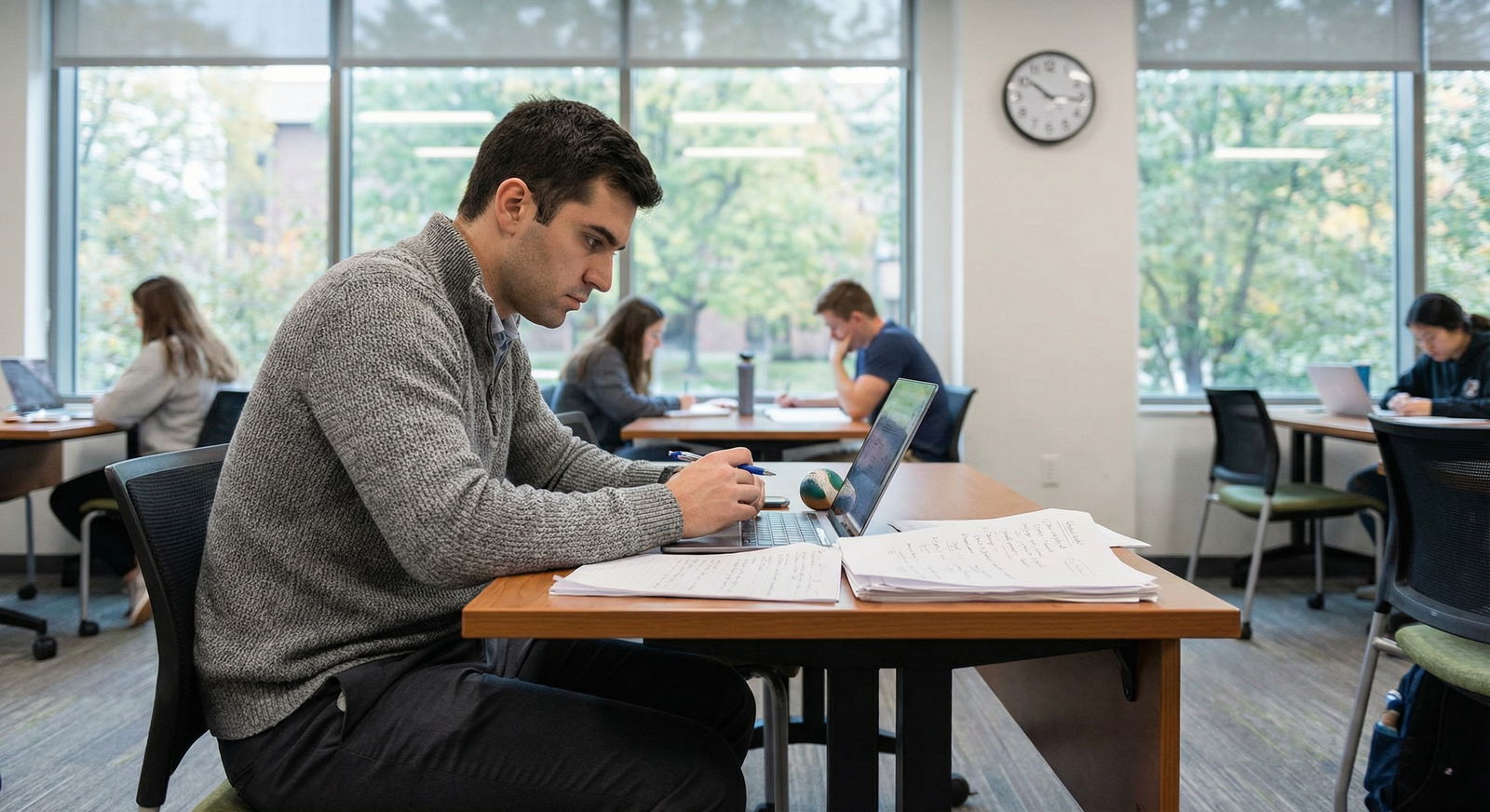
6) Return to plan, not to emotion
If you spike with anxiety mid-block, don't ask, "Do I feel okay now?" That question is a trap. Instead ask, "What does my plan say to do next?"
Maybe the answer is:
- take one slow breath
- reread the last two lines of the stem
- eliminate two choices
- make the best decision available
- move on
That's how you regain traction. Not by waiting to feel perfect.
Anxiety hijacks performance when it turns your attention inward. Your job is to gently, repeatedly move attention back outward, to the stem, the options, the next action. Over and over. It's repetitive. It's not glamorous. It works.
When to Escalate: Red Flags That Warrant Extra Support
Some anxiety is expected. Some is not something you should just "push through."
Do not ignore these signs:
- panic symptoms that feel overwhelming or recurrent
- trauma-related triggers around testing environments
- going blank so completely that you can't attempt questions
- severe insomnia in the days before the exam
- repeated crying spells, shutdown, or inability to complete practice blocks
- physical symptoms so intense they impair functioning
If that's happening, this is not the moment for stoicism cosplay. You need more support.
Think of it this way:
- Mild anxiety: use breathing, grounding, and a reset cue.
- Moderate anxiety: add structured practice, timed simulations, and an escalation call or email to your support team.
- Severe anxiety: seek urgent guidance from your clinician, school disability office, student affairs, or mental health support. Get a documented plan.
And no, asking for help does not mean you're weak or "not cut out for medicine." That line of thinking is garbage. Plenty of capable medical students need support under high-stakes conditions, especially when accommodations are delayed and uncertainty is chewing through their sleep.
Reach out early. Say plainly what's happening:
My anxiety symptoms are increasing as my exam approaches and the accommodations decision remains unresolved. I'm having difficulty sleeping/functioning/completing practice blocks, and I need guidance on the safest and most appropriate next steps.
That message is strong, not dramatic. It gives people something to respond to.
Reassurance, Realistic Hope, and What You Can Control Tonight
Here's the reminder I wish anxious applicants would tape to the wall: a delay is stressful, but it is not a prophecy. It does not automatically mean panic. It does not automatically mean a bad score. It does not automatically mean you'll fall apart in the testing center and confirm all your worst fears. Anxiety loves "automatically." Reality usually doesn't.
What you can control tonight is smaller than your fear wants and more powerful than it looks:
- review your plan once
- gather your documents and essentials
- send one clear follow-up if needed
- choose one calming behavior
- stop doom-scrolling forums full of other people's panic
- protect your sleep like it actually matters, because it does
That's enough for one night.
You do not need to solve your entire future before bed. You need the next right step. Then the next one after that. That's it.
If your brain starts up with, "But what if I spiral?" answer it with something steadier: If anxiety shows up, I already know what I'll do.
That's not false reassurance. That's preparedness. And tonight, preparedness is your best form of peace.