It’s three days before your shelf, OSCE, or Step exam. Your heart races every time you open UWorld. You’re not sleeping, you’re nauseous, and the idea of sitting through a 7-hour test feels physically impossible. You’re staring at the scheduling portal wondering:
“Can I actually reschedule this… and not ruin my life? Or my career?”
Let me cut straight to it.
You can safely reschedule in some situations.
You should reschedule in a subset of those.
And there are times where rescheduling is actually worse than taking the exam anxious but prepared.
Let’s walk through how to decide, based on the type of exam, your current state, and the real consequences (not the catastrophes in your head).
1. The Real Question: “Should I?” Not Just “Can I?”
Most medical exams can be rescheduled. The real issue is whether doing it:
- Helps you perform significantly better
- Protects your mental health in a meaningful way
- Doesn’t create a bigger mess with scheduling, rotations, or graduation
The trap students fall into is this:
They treat acute anxiety like a sign they’re “not ready” instead of what it often is—a symptom of being under high pressure with a perfectionist brain.
So here’s the blunt truth:
- If your anxiety is crippling (panic attacks, can’t sleep at all, vomiting, can’t study, can’t function on clinical duties), rescheduling is absolutely on the table.
- If your anxiety is high but you’re still functioning, rescheduling often just moves the anxiety forward and makes it larger, because now you’ve added guilt, time pressure, and scheduling chaos.
You don’t decide this by vibes. You decide it by a simple framework.
2. Framework: Should You Postpone This Exam?
Use this 3-part check: Function – Risk – Reality.

| Step | Description |
|---|---|
| Step 1 | Severe anxiety |
| Step 2 | Strongly consider reschedule |
| Step 3 | Usually take as scheduled |
| Step 4 | Reschedule reasonable |
| Step 5 | Take as scheduled |
| Step 6 | Able to function? |
| Step 7 | Major risks if delayed? |
| Step 8 | Extra time will be used well? |
1. FUNCTION: How impaired are you right now?
Ask yourself, honestly:
- Can you sit and do 40–80 practice questions with reasonable focus?
- Can you get through a normal day of clinical work, even if you’re anxious?
- Are you sleeping at least 4–6 hours most nights, even if it’s not perfect?
If the answer to all of those is no, you’re not just “stressed before a test.” You’re in clinical-level impairment territory. That’s not “push harder” mode. That’s “talk to a professional and consider rescheduling” mode.
If the answer is largely yes, you might hate how you feel, but you’re still operational. That makes postponing a more strategic decision, not an emergency one.
2. RISK: What happens if you delay?
This depends heavily on which exam we’re talking about.
| Exam Type | Reschedule Risk Level | Key Concerns |
|---|---|---|
| Step 1 / Level 1 | High | Delayed rotations, graduation |
| Step 2 CK / Level 2 CE | Medium–High | Application timelines |
| NBME Subject (Shelf) | Medium | Clerkship grade timing |
| OSCE / Skills Exams | Medium | Limited make-up dates |
| In-house Block Exams | Low–Medium | Course policies but flexible |
For each:
- High risk = delays graduation, affects match timeline, complicates visas/loans/contracts
- Medium = affects grades, impressions, needs more paperwork/logistics
- Low = mostly stress and some admin headache
If rescheduling your exam will likely:
- Push back a core rotation
- Interfere with ERAS submission or letters
- Jeopardize on-time graduation
…then you should be very cautious about moving it, unless your functioning is clearly unsafe.
3. REALITY: Will extra time actually change the outcome?
Hard question you need to answer honestly:
"If I had 2–4 more weeks, would I actually improve my performance… or just prolong my anxiety?"
Look at your recent data:
- Are your NBMEs or practice exams on an upward trend?
- Do you know exactly what’s weak (e.g., biostats, heme/onc, ethics) and have a realistic plan to fix it?
- Have you already done the bulk of content review and just need consolidation?
If yes, a short postponement can yield real score gains.
If no, and you’re just hoping you “feel better later,” postponing is usually a band-aid.
3. By Exam Type: What “Safe” Rescheduling Actually Looks Like
Step 1 / Level 1
This is the exam that tends to fry people mentally. The stakes feel enormous (and historically were). With P/F scoring, the psychology changed but the anxiety really didn’t.
Rescheduling is reasonable if:
- You’re failing multiple NBMEs by a clear margin (not 1–2 points)
- Your school or advisor explicitly recommends postponing
- You’re having severe, persistent anxiety symptoms that make 6–8 hrs/day of study impossible
- A mental health professional supports a short medical delay
Rescheduling is usually not helpful if:
- You already have passing-range NBMEs, but perfectionism is screaming that “I’m not ready”
- You’re mostly afraid of “what if I fail” rather than actually failing practice tests
- You’re moving it by a week or two with no clear adjustment in your study method
You don’t need to feel calm to pass Step 1. I’ve watched plenty of students walk in nauseous, sweaty, convinced they’d fail—and they passed comfortably.
Step 2 CK / Level 2 CE
This is more score-sensitive for residency. So two things matter:
- Your current practice scores
- Your application timeline
Rescheduling is safer when:
- You’re 4–6+ weeks before ERAS deadlines
- Your practice exams are below your program-range and trending up
- You have a specific, targeted plan for weak areas
It’s riskier when:
- Delaying pushes your score past when programs start reviewing apps
- Your school has a strict sequence for when you must take Step 2
- You’re an IMG with limited scheduling windows and visa constraints
Shelf Exams and In-House Written Exams
Here your main bottleneck is usually school policy, not the testing agency.
- Some schools allow make-ups easily; others treat make-up shelves like a big deal.
- Some will require documentation (doctor’s note, disability office involvement) if you no-show or ask last minute.
Rescheduling can be sensible if:
- You’re in clear mental health crisis territory
- You can arrange a formal documented absence vs just ghosting the exam
- Your clerkship director is informed and supportive
But if you’re just scared of getting a lower percentile, be careful. Shelf delays can spiral and pile up in the second half of third year.
OSCEs / Clinical Skills Exams
These are typically less anxiety-triggering than big standardized tests, but test anxiety can absolutely wreck performance here too.
Rescheduling may be the right move if:
- Your anxiety is so severe you’re likely to blank out completely and fail basic tasks
- You can access a documented accommodation (extra time, breaks, quiet room) with your disability office
- The school actually offers reasonable make-up options
But OSCEs are also a chance to use your anxiety management skills in a controlled environment. If your fear is of looking shaky or imperfect in front of attendings, rescheduling doesn’t fix that long term.
4. When Test Anxiety Itself Justifies Rescheduling
Here’s where people get stuck:
“Is my anxiety ‘bad enough’ to count as a real reason?”
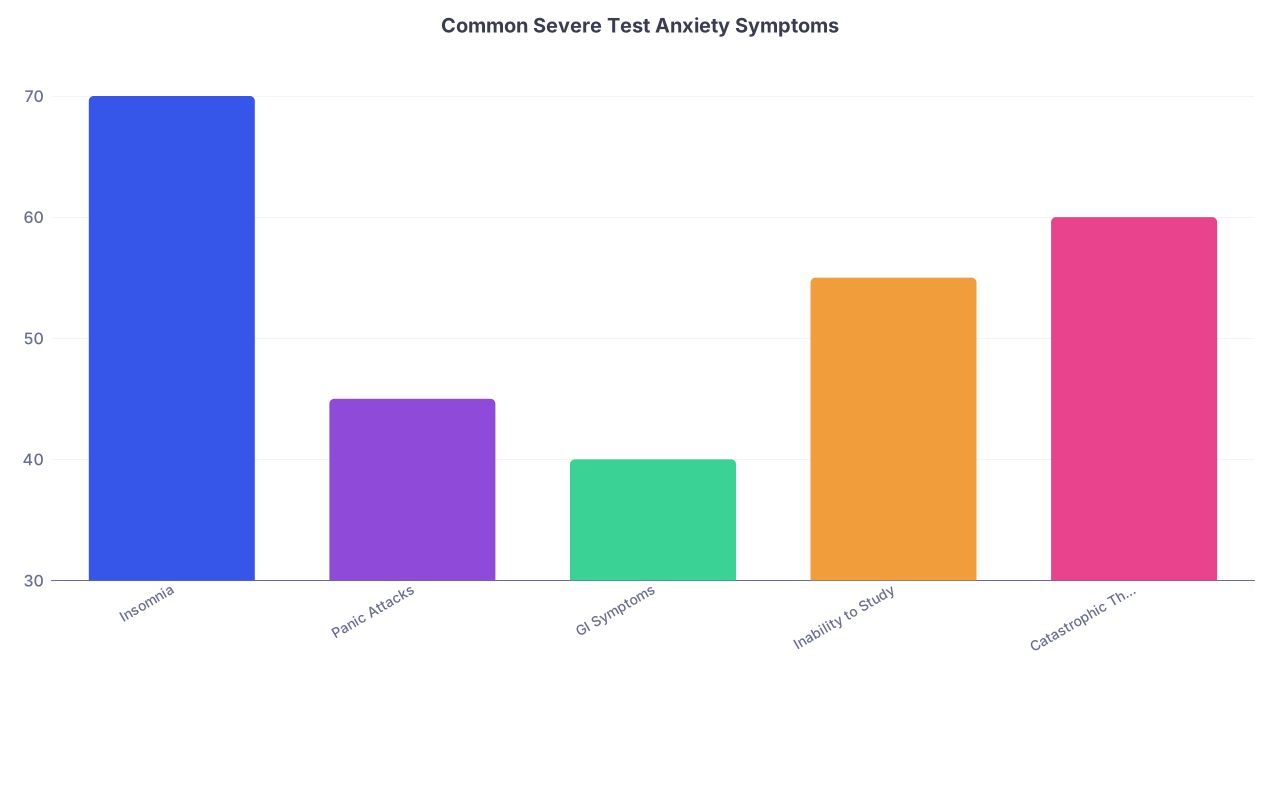
If any of this sounds like you in the week leading up to the exam, you’re in the zone where postponement should be a serious discussion, not a private guilt trip:
- Panic attacks when you even open your study resources
- 2–3 nights in a row with almost no sleep because of racing thoughts
- Physical symptoms so bad (vomiting, diarrhea, faintness) that you can’t imagine sitting through the whole exam
- Thoughts like “if I fail this, there’s no point in anything” (this is a huge red flag—talk to someone now)
That’s not just “nerves.” That’s mental health territory where a clinician’s note, exam accommodation, or temporary medical leave might be appropriate.
| Category | Value |
|---|---|
| Insomnia | 70 |
| Panic Attacks | 45 |
| GI Symptoms | 40 |
| Inability to Study | 55 |
| Catastrophic Thoughts | 60 |
If you’re there, here’s the move:
- Tell someone today: advisor, student health, therapist, dean of students. Hiding it just raises the stakes.
- Ask explicitly: “Can we discuss a short-term exam postponement for mental health reasons?”
- Get documentation if advised—this protects you with administration and exam boards.
That’s how you reschedule safely: not by a midnight solo decision, but with institutional backing.
5. If You Don’t Reschedule: Making It Through Safely
Let’s say you go through the framework and decide not to reschedule—either because you can function, the risk is too high, or extra time wouldn’t meaningfully help.
Then the goal shifts from “eliminate anxiety” to “perform well with anxiety.”
Three practical, non-fluffy tactics:
Practice the worst 30 minutes of the test
Don’t try to visualize a calm, perfect scenario. Instead, simulate your most anxious first block. Set a timer, sit down, heart racing and all, and do 40 questions. The skill you need is not serenity; it’s functioning under adrenaline.Lock in your pre-exam script
The morning of the test is not the time to improvise. Decide now:- What you’ll eat
- What time you’ll wake up
- What you’ll tell yourself when the panic hits (“I’ve done X practice questions. I don’t need to feel ready to pass.”)
Use a hard cut-off
The day before, no more new content. Just light review or nothing. Overstudying the night before is anxiety’s favorite trick for burning you out.

6. If You Do Reschedule: Don’t Waste the Second Chance
Rescheduling buys different time, not magically better time.
If you move your exam, you must change how you’re preparing, not just how long you’re preparing.
Concrete steps:
- Schedule a meeting with an academic support person or advisor. Ask: “What should I change in my prep based on my current scores?”
- Block your weeks: specific goals by day, not vague “study more” plans.
- Add anxiety-specific interventions: therapy (especially CBT), medication review if appropriate, and structured practice with exam-like conditions.
And tell at least one person you trust that you rescheduled. Shame thrives in secrecy; it makes it way harder to recover.
| Category | Value |
|---|---|
| Targeted Studying | 35 |
| Repeating Same Habits | 30 |
| Avoidance/Procrastination | 20 |
| Therapy/Support Work | 15 |
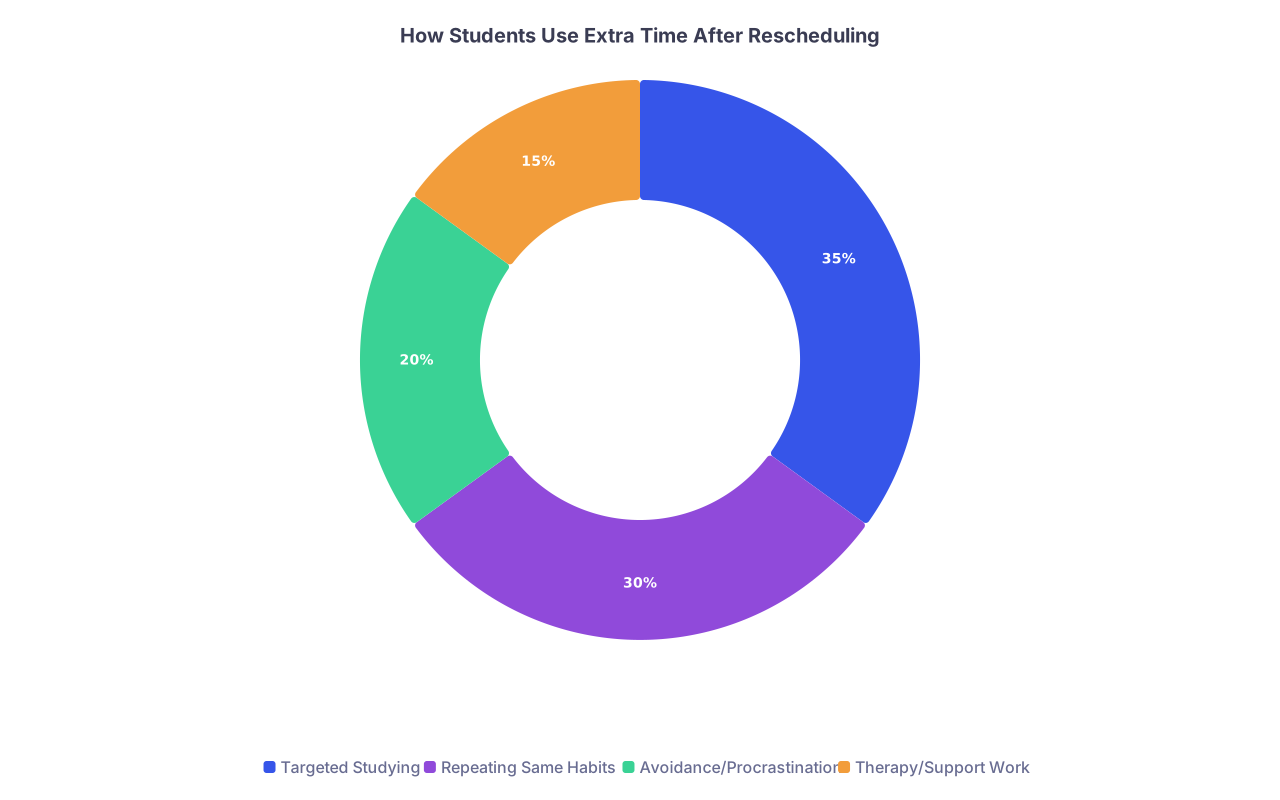
You want to be in that “targeted studying + therapy/support” wedge, not the “same habits, more stress” one.
7. Talk To The Right People Before You Click Reschedule
There are three conversations you should ideally have before you move a major exam:
Academic advisor / clerkship director / dean
Ask: “If I postpone, what happens to my schedule, graduation, and evaluations?”Mental health professional
Ask: “From your perspective, am I in a place where postponing is clinically warranted, or should we focus on acute coping strategies instead?”Someone one step ahead of you (MS4, resident)
Ask: “Did you ever think about postponing? What happened to people who did vs didn’t?”
You’re not the first person in your school to be crushed by test anxiety. Systems exist—imperfect, but real. Use them.

FAQ: Severe Test Anxiety and Rescheduling (7 Questions)
1. Is test anxiety a valid reason to reschedule a major exam like Step 1 or Step 2?
Yes—if it’s severe enough to significantly impair your functioning. That means you’re unable to study effectively, can’t sleep, or are having panic-level symptoms. In those cases, test anxiety is absolutely a legitimate medical reason, often requiring documentation from student health or a mental health provider. What’s not a valid reason is just “I don’t feel perfectly ready”—no one does.
2. Will rescheduling my exam look bad to residency programs?
For the most part, no—programs don’t see that you rescheduled unless it led to a major delay (like taking Step 2 very late or graduating off-cycle). What they care about is your score, pass/fail status, and timing relative to applications. If rescheduling helps you avoid a fail or a truly damaging performance, that’s usually the smarter long-term move.
3. What if I’m still anxious even after rescheduling—did I make a mistake?
Not necessarily. Postponing doesn’t erase anxiety; it just gives you more time to prepare and stabilize. If you used that time to work on both content and coping skills, then it probably was the right call even if you’re still nervous. If you mainly avoided studying and spiraled more, then the issue isn’t the rescheduling—it’s the plan you followed afterward. Fix the plan, not the calendar.
4. How close to the exam is “too late” to reschedule?
For Prometric-style exams (Step/COMLEX), there’s usually a change deadline with escalating fees the closer you get. For school exams, “too late” is whenever they start treating it as an unexcused absence instead of a reschedule. Once you’re inside 24–48 hours and you’re thinking of backing out, you should be contacting student health and your dean immediately, not silently skipping.
5. Should I try medication (like a beta blocker) before deciding to reschedule?
You can discuss meds with a clinician, but don’t throw them in as a last-minute Hail Mary the night before the exam. Beta blockers or short-term anxiolytics can help physical symptoms, but they’re not magic, and they require a test run during practice sessions to see how you respond. If your anxiety is that bad, you deserve a proper evaluation, not a one-off pill to white-knuckle it.
6. How do I talk to my school about rescheduling without sounding weak or irresponsible?
Be direct and specific. Something like: “I’ve been experiencing severe test anxiety with [concrete symptoms] that’s significantly limiting my ability to prepare and perform safely. I’ve spoken with [student health/therapist], and I’d like to discuss whether a short-term postponement and formal support is appropriate.” This is not weakness—it’s mature, professional behavior. Schools have policies for this; you’re not inventing a new problem.
7. If I decide not to reschedule, what should I do in the last 48 hours to manage severe anxiety?
Lock in a strict routine: cut off new studying 24 hours before, focus on light review or nothing, get outside, and prioritize sleep. Plan your test day hour-by-hour (wake time, breakfast, commute, pre-exam breathing exercise). Also, accept ahead of time that you will feel anxious in the exam—and your job is not to make that go away, but to keep clicking through questions anyway. Performance, not comfort, is the goal.
Today’s next step:
Open your calendar and your latest practice scores. In writing, answer three questions:
- Can I function day-to-day despite this anxiety?
- What exactly happens to my schedule/graduation if I delay?
- If I had 2–4 more weeks, what specifically would I do differently?
Once that’s on paper, you’ll know if you truly need to reschedule—or if you need a better plan to walk into the exam anxious, but still ready.