
Coaching is not “better” than therapy for test anxiety in medical school—but it can be faster, more targeted, and more practical for the exam side of the problem. Therapy is better for the person side of the problem. Most med students need some mix of both, whether they admit it or not.
Let me cut through the noise and give you the real answer medical students actually need.
The Core Truth: Coaching vs Therapy in One Sentence
If your main issue is performance on exams (NBME, Shelf, Step 1/2, in‑house tests) and you’re mostly otherwise functioning fine, a good test-anxiety coach will often help you faster.
If your issues include panic attacks, depression, trauma, burnout, or life chaos, then therapy (and maybe meds) must be front and center, and coaching should be secondary or layered on later.
So it’s not “which is better,” it’s:
- What exactly is going wrong?
- How fast do you need it fixed?
- How deep does the problem go?
Let’s break that down.
What Test-Anxiety Coaching Actually Does (When It’s Done Right)
Coaching is not therapy-lite. When done well for med students, it’s closer to a performance lab than a feelings circle.
A solid test-anxiety coach will:
Anchor everything to a specific exam You don’t just “talk about anxiety.” You talk about:
- Your last NBME score pattern
- Where you freeze (first 5 questions, mid-block, last 10 questions)
- What happens in the last 2 weeks before an exam
Identify your “performance pattern” Most test anxiety in med school falls into a few archetypes:
- You know the content but blank on exam day
- You start strong, then spiral when you hit a tough question
- You over-review, under-test, and never feel “ready,” so you cram and melt
- You get intrusive “what if I fail Step and ruin my life” loops mid-block
A coach doesn’t just validate this. They map it.
Give you concrete, drillable skills Not “just breathe.” Actual, repeatable tools:
- A scripted pre-block routine (breath + self-talk + pacing plan)
- Specific timing rules per block (e.g., 10 questions every 12 minutes)
- Fast reset protocols for when you hit a brutal question
- Daily reps of “practice under nerves” instead of just passive review
Hold you accountable This is the part students pretend they don’t need but absolutely do.
- You say: “I’ll do 4 blocks this week.”
- A coach says: “Great. Screenshot your completed blocks and we’ll dissect them Friday.”
- If you bail, they ask why—and fix the pattern, not just the excuse.
Rewire your exam story Many med students carry an identity like “I’m a bad test-taker.”
A good coach will challenge that with data:- Look at your first-pass vs second-pass questions
- Look at how often you change from right to wrong vs wrong to right
- Look at section-by-section scores rather than global shame
Net result:
Coaching is very “do this on Tuesday, then this on Wednesday, and this is how you breathe in Q32 when you’re down 10 minutes.” It’s tactical. Which is exactly what many medical students need.
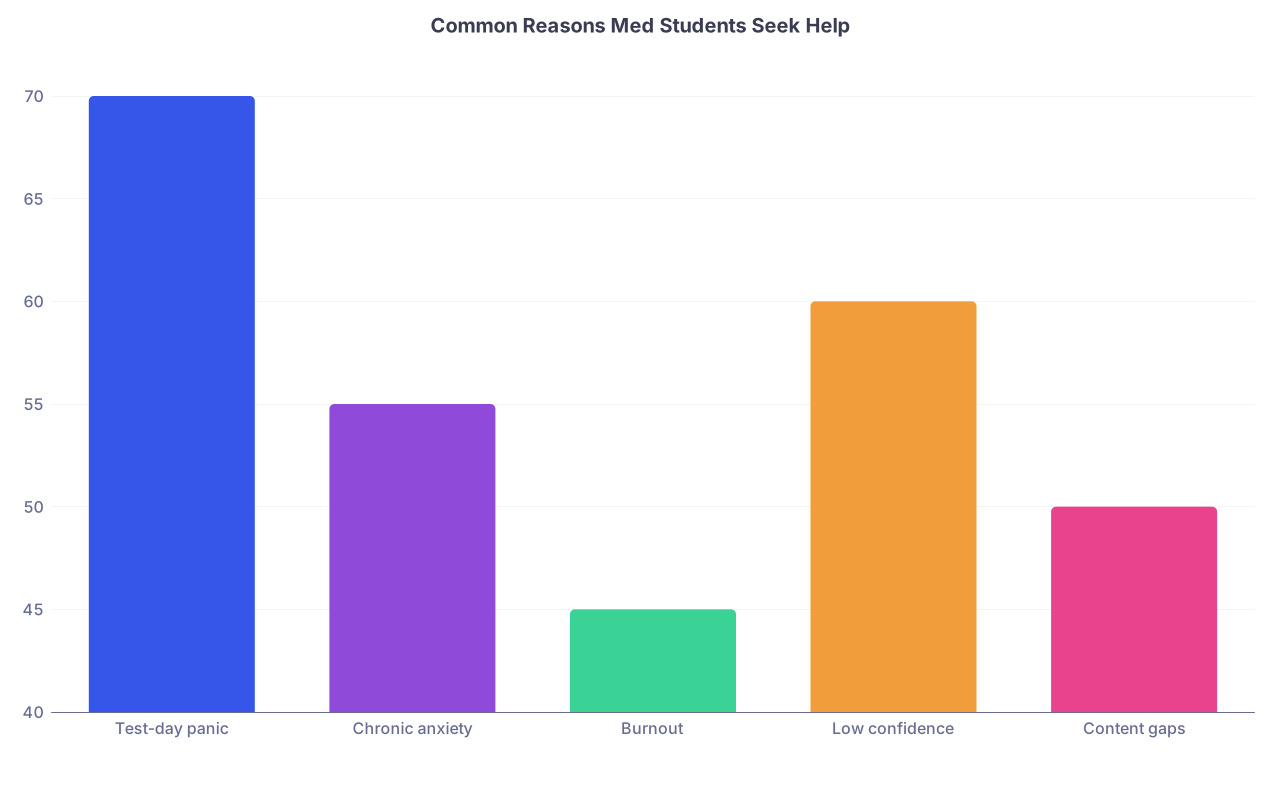
| Category | Value |
|---|---|
| Test-day panic | 70 |
| Chronic anxiety | 55 |
| Burnout | 45 |
| Low confidence | 60 |
| Content gaps | 50 |
What Therapy Actually Does (And When It’s Essential)
Now, therapy. Real therapy, not “I saw student health once and they said to buy a coloring book.”
Therapy—especially CBT, ACT, or trauma-informed approaches—goes after the roots instead of just the leaves.
A good therapist will work on:
Clinical anxiety and mood issues If you:
- Have panic attacks, chest tightness, or derealization
- Can’t sleep for nights before an exam
- Have intrusive thoughts not just about exams, but constantly
- Feel hopeless, empty, or numb most days
That’s not “just test anxiety.” That’s your brain genuinely struggling. Therapy (and sometimes meds) is the right line of attack.
Core beliefs about worth, failure, and identity In therapy, you’ll unpack things like:
- “If I don’t honor, I’m a failure.”
- “If I don’t match derm, my life is over.”
- “I only matter when I’m achieving.”
These beliefs drive test anxiety hard. Coaching might slap a Band‑Aid on performance, but if deep down you believe you’re one exam away from worthlessness, your nervous system will keep redlining.
Old stuff that bleeds into test-day I’ve seen:
- Students with past trauma where any evaluation feels like danger
- Perfectionists raised in emotionally abusive homes who shut down if they’re not perfect
- Students with ADHD who’ve internalized “lazy/stupid” narratives for years
That’s therapy territory, not coaching.
Big-picture functioning If you’re:
- Nonfunctional outside studying
- Losing relationships
- Imploding physically (GI issues, migraines, etc.)
- Using substances to cope
You need someone addressing the whole system, not just your exam behaviors.
Therapy tends to be slower and deeper. It’s not always optimized for “your Step exam in 9 weeks,” but it will improve your life, not just your test scores.
Side-by-Side: Coaching vs Therapy for Test Anxiety in Med School
Here’s how they compare when you’re specifically thinking about med-school test anxiety.
| Factor | Test-Anxiety Coaching | Therapy (e.g., CBT, ACT) |
|---|---|---|
| Primary focus | Exam performance, skills, strategy | Mental health, patterns, core beliefs |
| Speed of impact | Often fast (weeks) | Moderate to slow (weeks to months) |
| Best for | High-functioning but underperforming | Distress, impairment, broader anxiety |
| Format | Directive, homework, performance tasks | Reflective, insight + tools |
| Who it’s *not* for | Severe anxiety, crisis, suicidality | Students wanting only tactics and hacks |
How to Decide Which You Need (Be Brutally Honest Here)
Don’t overcomplicate this. Use these filters.
Choose primarily COACHING if:
- Your main struggle is on exam day, not all day, every day.
- You roughly understand the content but your score doesn’t reflect it.
- You freeze, rush, or spiral mid-block but otherwise function fine in rotations/life.
- You have a big exam within 2–12 weeks and need rapid performance gains.
- You’re willing to:
- Do practice blocks even when they feel bad
- Get uncomfortable on purpose to train your nervous system
- Have someone dissect your performance without sugarcoating
Choose primarily THERAPY if:
- You have panic attacks, relentless worry, or your body is in constant fight-or-flight.
- Your anxiety shows up everywhere, not just exams.
- You’re dealing with depression, trauma, OCD, ADHD, or substance use.
- You’ve had thoughts like “it would be easier if I just didn’t wake up.”
- You’re barely surviving, not just “nervous about Step.”
Consider BOTH if:
- You’re functional but fragile:
- You push through, but every exam cycle wrecks you.
- You have moderate generalized anxiety + high exam stress.
- You’ve done some therapy before, but you never applied it to test performance.
- You want to fix the scores now and the systems/psychology long-term.

| Step | Description |
|---|---|
| Step 1 | Test Anxiety in Med School |
| Step 2 | Therapy first |
| Step 3 | Therapy primary + Coaching later |
| Step 4 | Coaching primary |
| Step 5 | Reassess before major exams |
| Step 6 | Functional in daily life? |
| Step 7 | Symptoms severe or pervasive? |
What Results Can You Expect From Each?
Let’s be concrete. Here’s what I’ve seen repeatedly.
Typical gains from good test-anxiety coaching
Over 6–10 weeks with a solid coach, many med students report:
- 10–25 point jumps on NBMEs/CBSEs (sometimes more from a very underperforming baseline).
- Going from “I blank on questions” to “I can stay in the game even when it’s hard.”
- Reduced variance: fewer random crashing test days, more consistent performance.
- Less mental drama around scores: you start treating them as data, not verdicts on your worth.
Important: coaching isn’t magic. If your content foundation is weak, coaching will expose that fast. But that’s a good thing—you can then fix the right problem instead of blaming “anxiety” for everything.
Typical gains from good therapy
Over a few months with a competent therapist, med students often:
- Sleep better, which alone can bump performance.
- Stop feeling like every exam is existential life-or-death.
- Feel less ashamed of needing help (this barrier kills careers quietly).
- Handle feedback, clerkship stress, and future boards without shattering.
And long term? You’re not just a doctor who passed exams. You’re a doctor who isn’t quietly falling apart inside every time someone evaluates you.
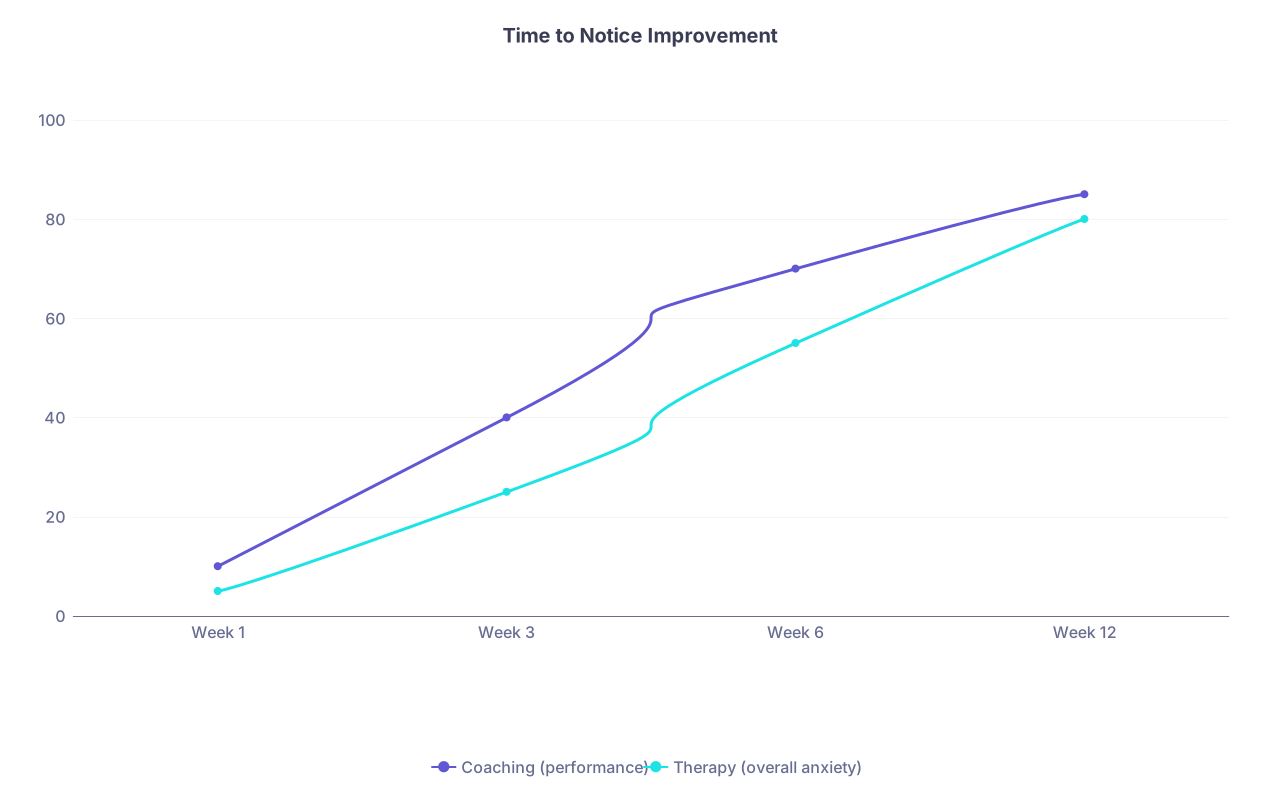
| Category | Coaching (performance) | Therapy (overall anxiety) |
|---|---|---|
| Week 1 | 10 | 5 |
| Week 3 | 40 | 25 |
| Week 6 | 70 | 55 |
| Week 12 | 85 | 80 |
How to Evaluate a Coach (Because Some Are Useless)
Not all “test-anxiety coaches” are worth your money. Some are glorified cheerleaders with no real tools.
Red flags:
- Vague promises like “I’ll help you manifest confidence.”
- No mention of timed questions, NBMEs, or concrete exam strategy.
- No structure: every session is just “So how are you feeling this week?”
- They discourage therapy or meds when you clearly need them.
Green flags:
- They ask specific exam questions in the first session:
- Which tests, when, scores, patterns, Qbank use, timing data.
- They give homework that involves:
- Timed blocks
- Specific pre-block and mid-block routines
- Thought-work you actually apply in the heat of the test
- They’re comfortable saying:
- “This looks more like a content issue than anxiety.”
- “Your symptoms are severe enough that I recommend therapy/psychiatry too.”
You want someone who treats your exam like a sport. Game film, drills, feedback, repeat.
How to Work With a Therapist Without Wasting Time
You can waste a lot of time in therapy if you’re vague.
When you start:
Say directly:
“I’m a medical student. I have serious test anxiety on major exams. I also want to figure out whether there’s broader anxiety or depression under this. I care about real tools, not just venting.”Ask what they use:
- CBT (cognitive behavioral therapy)
- ACT (acceptance and commitment therapy)
- Exposure-based work
These are often better for anxiety than endless free-floating talk therapy.
Bring data:
- Sleep schedule before exams
- What exactly happens in your body on test day
- Thoughts that show up before, during, and after a test
The combination of your data + their clinical tools is where the magic happens.

Practical Game Plan: What I’d Tell a Med Student Sitting Across from Me
If you were in front of me asking, “So what should I actually do, now?” here’s the blunt version.
Screen yourself honestly.
If you have:- Panic attacks
- Suicidal thoughts
- Can’t function day-to-day
Start with therapy (and likely campus mental health or a psychiatrist). Non-negotiable.
If you’re functional but underperforming on exams, do this:
- Book a test-anxiety coach with med-student experience.
- Commit to 6–8 weeks of real work.
- Simultaneously, consider at least a consult with a therapist if you notice anxiety leaking outside of exams.
For major exams (Step 1/2, COMLEX, etc.):
- Ideally:
- 3–6 months out: start therapy if anxiety is a long-term pattern.
- 8–10 weeks out: layer in structured performance coaching.
- Ideally:
Stop waiting to be “bad enough” to deserve help.
The bar does not have to be “total breakdown on the ward.” If your test anxiety is costing you scores, sleep, or sanity, that’s enough.

Key Takeaways
- Coaching is usually better for fast, targeted improvement in exam performance when you’re otherwise functioning.
- Therapy is better for deep, persistent, or global anxiety, depression, or trauma—and it’s non-negotiable if you’re in real distress.
- The smartest move for many medical students isn’t choosing one forever, but using each at the right time for the right job: therapy for the foundation, coaching for the performance.
FAQ (Exactly 5 Questions)
1. Can coaching alone fix my test anxiety if I’ve had anxiety for years?
Sometimes it can help your scores, but it usually won’t fix the underlying anxiety that’s been there for years. You might perform better on exams, but still feel wired, tense, or exhausted in the rest of your life. If anxiety predates med school or shows up everywhere, you should pair coaching with therapy.
2. Is it a waste of money to do therapy if my main problem is just tests?
If your anxiety truly only shows up around big exams, and you’re otherwise stable, it’s reasonable to start with coaching. But most “just test anxiety” students, when they’re honest, have broader perfectionism, chronic worry, or sleep problems. In those cases, therapy is not a waste; it’s insurance against burnout and a much better career long-term.
3. How long does it take for coaching to start helping my scores?
You can see process changes within 1–3 weeks (less panic, better timing, fewer spirals). Score jumps on practice tests usually show up within 4–8 weeks if you’re consistent and your content base is solid. If nothing is changing after 6–8 weeks, either the coach isn’t good, or test anxiety isn’t the main problem (content gaps, untreated ADHD, or depression may be in play).
4. What if my school offers “performance coaching” for free—should I use that first?
Yes, try it. Some school learning specialists and performance coaches are excellent and understand Step/Shelf exams. Others are generic and only talk study tips without addressing test-day physiology and thoughts. Use them, but be honest: if you’re not seeing change after a few sessions, consider an external coach or therapist with specific medical training experience.
5. Can I talk about coaching or therapy in residency applications?
Yes, but carefully. You don’t need to disclose treatment. If you mention it, frame it as growth: “I realized my test anxiety was holding me back, so I sought structured help and developed performance systems that now let me show my true knowledge.” You don’t need to detail diagnoses or crises. Program directors care that you handled the problem, not that you pretended you never had one.