
The biggest mistake med students make with test anxiety is pretending it’s a “mindset problem” instead of a documented condition that can unlock real help.
If you’re asking whether it’s worth getting a formal evaluation for test anxiety, here’s the blunt answer:
If your anxiety is regularly tanking your exam performance or wrecking your life around exam time, yes — a formal evaluation is usually absolutely worth it.
Let’s walk through when it isn’t worth it, when it definitely is, what the evaluation actually looks like, and how it changes your options for med school exams, shelf exams, and Step/COMLEX.
The Core Question: When Is It Actually “Worth It”?
You don’t need a formal evaluation just because you get nervous before exams. That’s normal.
You do start needing one when anxiety is clearly interfering with what you’re actually capable of.
Here’s the quick decision rule I use with students:
It’s probably worth pursuing a formal evaluation if at least one of these is true:
- Your practice questions and non–high-stakes work are consistently much better than your real exam scores.
- You have physical symptoms (racing heart, sweating, nausea, blanking out) that kick in on tests and not during normal studying.
- You avoid practice exams or freeze when timed, even though you know the material.
- You’ve failed or barely passed multiple exams you studied properly for.
- You’re already changing big life/career decisions out of fear of exams (e.g., not aiming for a competitive specialty only because of Step/COMLEX).
On the other hand, it’s probably not worth it right now if:
- Your main problem is you’re underprepared, behind on content, or not doing enough questions.
- Anxiety feels more like general stress across life, not specifically tied to testing.
- You’ve only had one bad exam and there’s an obvious non-anxiety reason (illness, family crisis, etc.).
The key distinction:
If your knowledge is the bottleneck → you need better studying.
If your nervous system is the bottleneck in test conditions → you may need a formal evaluation.
What a Formal Evaluation Actually Gets You (That “Just Coping” Never Will)
Students wildly underestimate what changes when you go from “I’m anxious” to “I have documented test anxiety / an anxiety disorder with educational impact.”
Here’s what a proper evaluation can do for you.
1. It opens the door to testing accommodations
A diagnosis plus a formal report is the currency boards and med schools accept. Without it, your story is basically: “Trust me, I’m anxious.” Programs don’t (and can’t) make decisions off that.
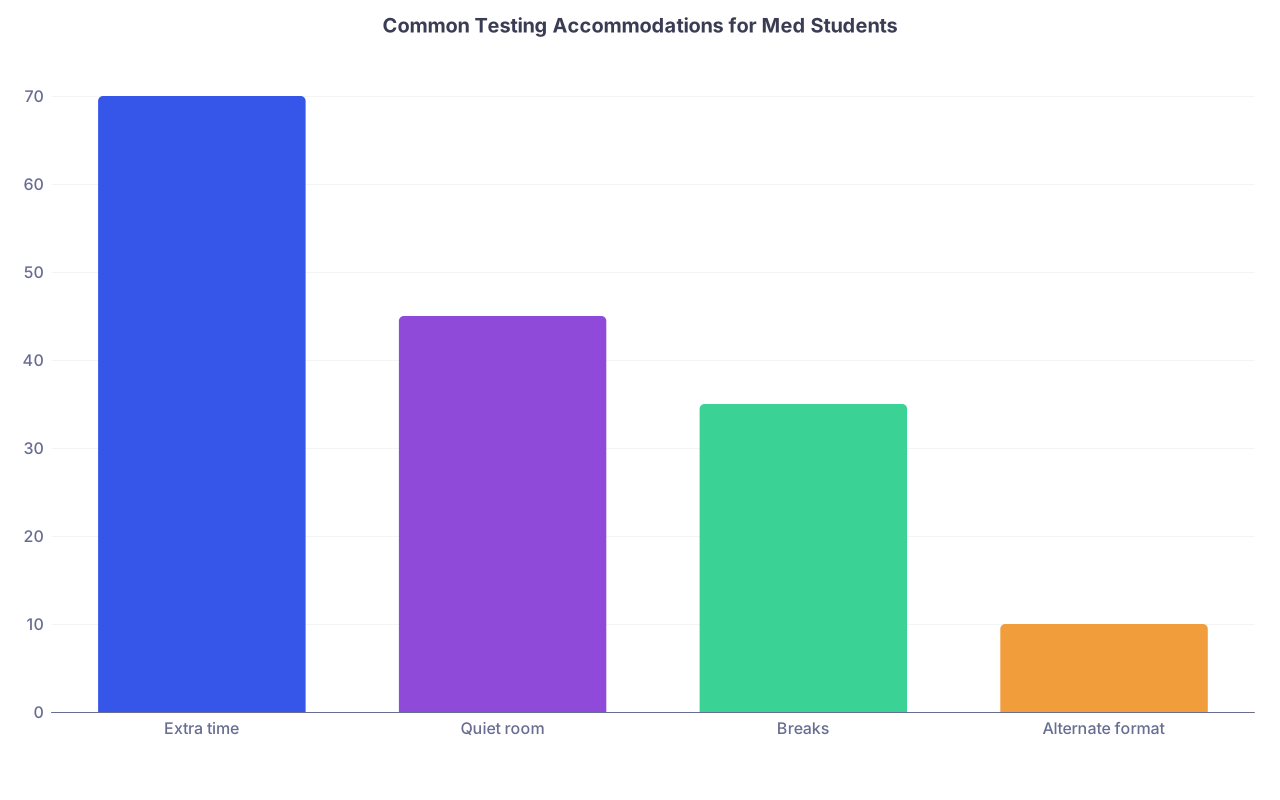
With a good evaluation, you can potentially get:
- Extra time (commonly 1.25x or 1.5x) on exams
- Reduced-distraction or private testing environment
- Ability to take breaks during long exams
- Paper-based instead of computer-based tests (less common but can happen)
- Modified scheduling (e.g., one exam per day instead of two back-to-back)
For big exams like USMLE Step or COMLEX, this documentation is mandatory if you want accommodations. They won’t even consider anecdotal “I get anxious” statements.
| Category | Value |
|---|---|
| Extra time | 70 |
| Quiet room | 45 |
| Breaks | 35 |
| Alternate format | 10 |
(Those percentages are rough proportions of what I’ve seen students actually receive, not official stats.)
2. It gives you clarity on what’s really going on
You might think you have “test anxiety” when what you actually have is:
- ADHD with executive dysfunction under timed conditions
- Generalized anxiety disorder that spikes in any performance setting
- Panic disorder (full physiological panic attacks around testing)
- Major depression making studying impossible, then anxiety showing up at the exam as the visible symptom
- Or yes, specific test/performance anxiety
The treatment and accommodations differ for each. A proper evaluation can keep you from chasing the wrong solution for a year.
3. It gives you language and leverage with your school
Deans, course directors, and student affairs people react differently when you say:
“I’m just really anxious about tests, I don’t know what to do.”
vs.
“I’ve had a formal evaluation and have documented test anxiety, here’s my report and the recommendations. I’d like to work with disability services to set up appropriate accommodations.”
One sounds like emotion. The other sounds like a disability/educational access issue. Med schools are legally and structurally set up to respond much more seriously to the second.
What Does a Formal Evaluation Involve?
Most people imagine some giant, months-long process. It usually isn’t.
There are generally three pieces:
Clinical interview
A psychologist or psychiatrist takes a detailed history:- When anxiety started
- How it shows up (symptoms, timing, severity)
- Academic and test history (MCAT, undergrad exams, current med school exams)
- Any previous diagnoses or meds
- Sleep, substance use, medical history
Standardized questionnaires and/or psych testing
Depending on the clinician and what you’re describing, this might include:- Anxiety/depression inventories (e.g., GAD-7, PHQ-9)
- Specific performance/test anxiety scales
- If indicated, ADHD or learning-disorder testing (which is lengthier but often relevant if you’ve always struggled with time pressure or reading speed)
A written report with diagnosis and recommendations
This is the critical part for schools and boards:- Diagnosis (e.g., “Social Anxiety Disorder, performance only” or “Specific Learning Disorder with impairment in reading” or “Panic Disorder”)
- Functional impact on testing and learning
- Specific recommended accommodations (extra time, break structure, environment changes, etc.)
| Provider Type | Good For |
|---|---|
| Clinical psychologist | Full psych testing + detailed report |
| Psychiatrist | Medication + diagnostic eval |
| Neuropsychologist | Suspected ADHD/learning issues |
| College counseling center | Initial screening, referrals |
You don’t necessarily need the Cadillac version (8 hours of neuropsych testing) unless ADHD/learning issues are suspected or you’re applying for high-stakes board accommodations that require that level of evidence.
Pros and Cons: Is It Really Worth the Hassle?
Let me be honest about both sides.
The upside (when it is worth it)
- Huge stress relief: Just having a name and a plan for what’s happening lowers baseline anxiety for a lot of students.
- Real accommodations: Extra time alone can completely change performance for students whose brain locks up under the clock.
- Board exam survival: If you’re already struggling with in-house exams, going into Step/COMLEX without support is playing on hard mode.
- Preventing career derailment: I’ve watched excellent future surgeons and anesthesiologists give up on their dream specialty purely out of fear of board exams. That’s fixable in many cases.
- Better treatment options: Once you know if it’s pure test anxiety vs. generalized anxiety vs. panic vs. ADHD, your therapy and possibly meds can actually be targeted.
The downside (when it may feel “not worth it”)
- Cost: Comprehensive evaluations can be expensive if not covered by insurance. University clinics are often cheaper, but there may be waitlists.
- Time: Some evaluations take multiple visits, and reports can take weeks. This matters if your big exam is in 3 weeks.
- Emotional friction: Admitting you need help, sharing personal history, and seeing “disorder” on paper can sting if you’re used to being the high-functioning one.
- No guarantee of accommodations: Even with documentation, some schools or testing boards might deny or limit accommodations. That’s reality.
The cost/time/emotional friction are real. But compare that to:
- Failing or barely passing multiple block exams
- Remediation
- Delayed Step/COMLEX
- Needing an extra year
- Shutting down entire specialties because “I can’t handle the tests”
That’s usually a far more expensive and disruptive outcome than a few appointments and a report.
How to Decide: A Simple Framework
If you’re on the fence, use this 4-step filter. Be brutally honest.
Look at your score pattern.
Are you consistently:- Doing fine on untimed practice and tanking timed tests?
- Freezing only on high-stakes days (OSCEs, NBME, COMSAE, etc.)?
If yes, that’s a red flag for performance/test-specific factors.
Assess the physical and cognitive symptoms.
Ask yourself:- Do I get physical symptoms (heart pounding, shaky, sweaty, GI issues) near exams?
- Do I blank on things I knew the night before?
- Does my brain feel “foggy” or “far away” under pressure?
If yes, that’s more than “I’m a bit nervous.”
Consider the trajectory.
Is this:- Getting worse over time?
- Starting to affect how you plan your career or rotations?
- Making you avoid studying or practice exams because it’s so uncomfortable?
Estimate the stakes of doing nothing.
If nothing changes, over the next 12–18 months:- Do you realistically see yourself passing all your major exams on first try?
- Or do you secretly suspect you’re headed for a wall (Step/COMLEX, a brutal shelf, OSCE, etc.)?
If you’re nodding “yes” to most of those, you’re in the zone where a formal evaluation is usually very worth it.
Practical Steps: How to Get an Evaluation Without Making It Your New Part-Time Job
Here’s the no-drama version of what to do.
Step 1: Start with your school
Almost every med school has some combination of:
- Student mental health services
- Counseling center
- Disability/accessibility office
- Student affairs / dean of students
Email something like:
“I’m a current medical student struggling with what I believe is test anxiety that’s affecting my performance. I’m interested in getting a formal evaluation and discussing possible accommodations. Could you point me to the right person or process to start that?”
Let them route you. This does not automatically go on your transcript or get sent to residency programs.
Step 2: Ask very specifically about documentation for accommodations
You want to know:
- Do they accept evaluations done by outside providers, or do they prefer in-house?
- What kind of report is needed for:
- In-house exams
- NBME shelf exams
- USMLE/COMLEX boards
Sometimes your school’s disability office will even tell you exactly what USMLE or NBOME want in the report.

| Step | Description |
|---|---|
| Step 1 | Notice exam problems |
| Step 2 | Contact student services |
| Step 3 | Improve study skills first |
| Step 4 | Get referral to evaluator |
| Step 5 | Clinical interview & testing |
| Step 6 | Written report & diagnosis |
| Step 7 | Meet disability office |
| Step 8 | Set up accommodations |
| Step 9 | Use therapy/skills + supports |
| Step 10 | Is it mainly anxiety? |
Step 3: Choose your evaluator carefully
Look for someone who:
- Regularly evaluates college or graduate/professional students
- Has experience writing reports used for standardized test accommodations
- Is familiar with USMLE/COMLEX requirements (this is a plus, not mandatory, but helpful)
If your evaluator has to Google “Step 1 accommodations” during your visit, that’s not ideal.
How Formal Evaluation Fits with Therapy, Skills, and Medication
One misconception: students think the evaluation is just about the paperwork. It isn’t.
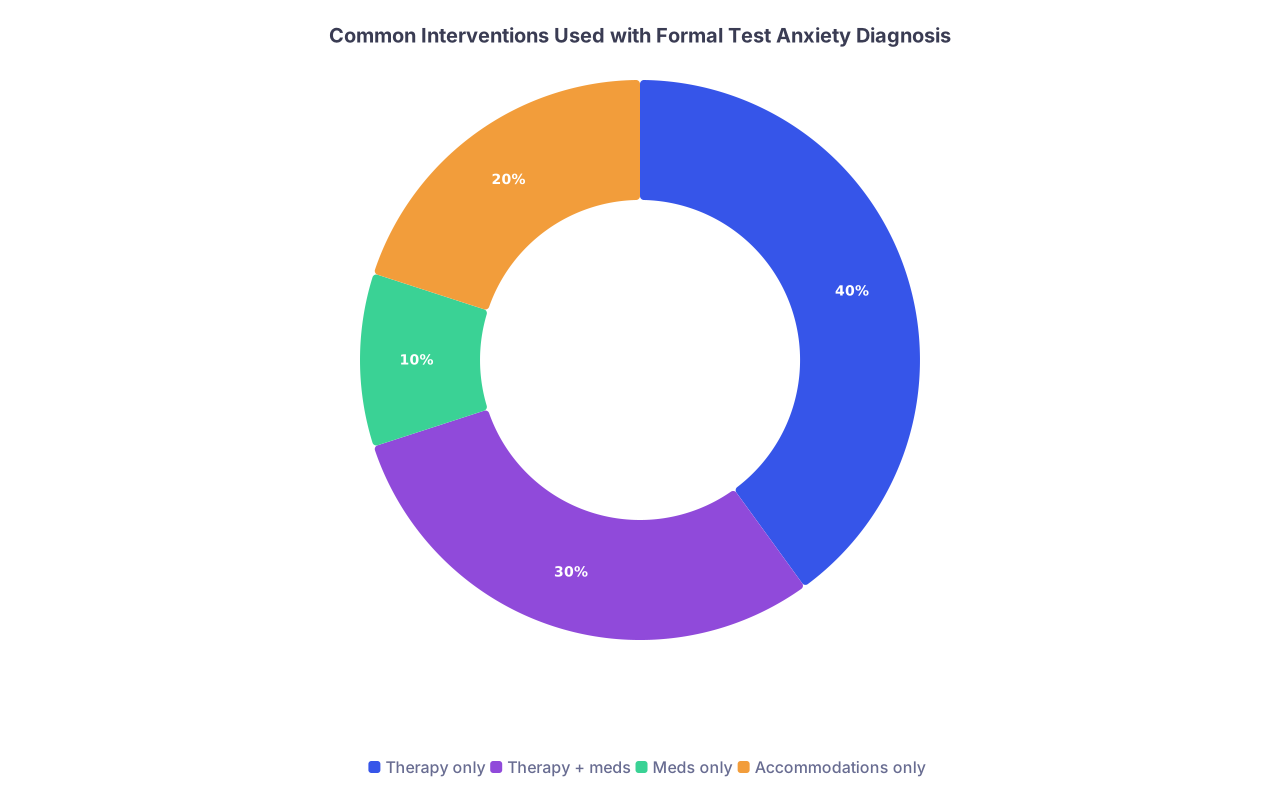
The best setup is usually a three-part combo:
Formal evaluation
For diagnosis and documentation.Skills-based work (therapy or coaching)
Specifically focused on:- Cognitive-behavioral therapy (CBT) for performance/test anxiety
- Exposure to practice exams under gradually simulated conditions
- Time-management and exam strategies tailored to how your anxiety shows up
Medication (sometimes)
This is not mandatory, but can be a game-changer for some:- Daily SSRIs or SNRIs for generalized anxiety or panic
- Rarely, as-needed beta-blockers in specific cases (for performance symptoms; must be discussed with a doc, especially for folks with asthma, cardiac issues, etc.)
| Category | Value |
|---|---|
| Therapy only | 40 |
| Therapy + meds | 30 |
| Meds only | 10 |
| Accommodations only | 20 |
You don’t have to pick everything on day one. But the evaluation anchors the plan.
When You Might Wait or Hold Off
There are a few cases where I’d say: slow down.
You’ve never once taken a full-length practice exam under realistic conditions.
You don’t know yet what’s knowledge vs. anxiety.You just started med school and bombed your first quiz or two.
Med school is a different beast; sometimes this is an adjustment problem, not a pure anxiety problem.You’re in immediate crisis with an exam in 1–2 weeks.
You can start the process, but you probably won’t get accommodations in time. Use short-term coping strategies, schedule the eval for after the exam, don’t stake everything on a last-minute miracle letter.
Waiting doesn’t mean “do nothing.” It means: fix the more obvious variables first, then reassess honestly.
FAQ: Formal Evaluation for Test Anxiety in Med School
1. Will getting a formal diagnosis hurt my chances for residency?
Generally, no. Your medical school doesn’t put “anxiety disorder” or “accommodations” on your transcript or MSPE. Residency programs don’t see your psych records. The place it can show up indirectly is if your timeline is significantly delayed (extra year, multiple exam failures). A formal evaluation often helps you avoid that, not cause it.
2. Do USMLE or COMLEX automatically give extra time if I have a diagnosis?
No. They’re picky. They want:
- Clear diagnosis
- Evidence of functional impairment
- Often a history of needing accommodations in previous academic settings
- A report that matches their documentation standards
But without a diagnosis and formal report, your odds are basically zero. With it, you at least have a real shot.
3. Is extra time “cheating” or unfair?
No. Extra time is about equalizing function, not boosting performance beyond your actual ability. If your anxiety or processing speed issues mean you can’t show what you know in standard conditions, the accommodation lets you compete on content, not on how fast your nervous system recovers from panic.
4. How long does the whole evaluation process take?
Range: 2–8 weeks typically.
- Initial appointment: 60–90 minutes
- Any testing sessions: sometimes one longer session, sometimes a couple shorter ones
- Report writing: 1–4 weeks depending on the provider’s backlog
This is why you don’t want to start the process three days before your Step exam.
5. What if I get evaluated and they say it’s not “real” test anxiety?
Then you’ve still won. Because now you know what is going on. Maybe it’s depression. Maybe it’s burnout. Maybe your study habits are objectively poor. Maybe you have ADHD. Whatever the answer is, you’re no longer guessing. And you can target the right problem.
6. Will my classmates or attendings find out?
Not unless you tell them. Your evaluation and accommodations live in student services / disability offices, not on your ward team’s daily list. You don’t show up to rounds with “extra-time test taker” stamped on your ID.
7. Bottom line: Should I get a formal evaluation?
If:
- You consistently underperform relative to your knowledge
- You have clear anxiety symptoms tied to testing
- This pattern is threatening your progress or specialty plans
Then yes — getting a formal evaluation for test anxiety in med school is usually absolutely worth it.
If you’re just mildly stressed and underprepared? Fix your prep first. If you’re still getting wrecked by exams after that, don’t white-knuckle it. Get evaluated, get documented, and give yourself a fair shot.