
You’ve got another exam in three weeks. You’re anxious enough that your heart rate jumps when you open UWorld or question banks—but you’re also terrified of burning out like you did before your last shelf. You keep asking yourself: “How much practice is actually enough to help my test anxiety… without grinding myself into the ground?”
Here’s the answer you’re looking for: you need enough practice to build prediction and control—not endless practice that turns into punishment.
Let me walk you through a concrete way to find that “enough” line.
The Core Principle: Anxiety Drops When Your Brain Can Predict
Test anxiety isn’t just “being nervous.” It’s your brain screaming, “I have no idea what’s going to happen and I don’t know if I can handle it.”
Practice helps only if it does three things:
- Makes the format of the test feel predictable
- Makes the content feel familiar enough that your brain stops seeing it as a threat
- Shows you a track record that you can improve or stay stable under exam-like conditions
Practice stops helping (and starts hurting) when:
- You’re doing more questions but learning less from each one
- Your sleep, mood, and energy are steadily getting worse
- You’re using questions to punish yourself, not to train
So the real question isn’t “How many questions?” It’s: “How much high-quality, exam-like practice do I need per week to lower my anxiety, before the marginal gain becomes tiny and the burnout cost becomes huge?”
A Concrete Framework: The “Enough Practice” Zone
Use this structure as a baseline and then adjust.
Step 1: Set a Weekly Practice Band, Not a Daily Prison
You want a range, not a rigid quota.
For most medical students during a standard preclinical block or non-crazy rotation, a reasonable effective practice band looks like this:
| Phase/Intensity | Low Range (questions/week) | Typical Range | High but Sustainable |
|---|---|---|---|
| Light academic week | 120 | 150–200 | 250 |
| Heavy rotation / call | 60 | 80–120 | 150 |
| Dedicated Step period | 200 | 250–350 | 400 |
That “Typical Range” column is where most people see anxiety reduction and steady learning without crashing.
Notice what’s missing? A magic “do 100 questions a day” rule. That’s the kind of advice that sounds hardcore and destroys people.
Step 2: Use the 3:1 Time Rule
A question is not 60–90 seconds.
A full learning loop per question is:
- Read and answer: ~1–1.5 minutes
- Review explanation, compare with your reasoning, maybe annotate: ~2–3 minutes
So budget 3–4 minutes per question if you’re actually trying to learn.
That means:
- 20 questions = 60–80 minutes
- 40 questions = 2–2.5 hours
- 60 questions = 3–4 hours
If you’re cramming 80–100 questions into a single evening after a full clinic day, you’re not “grinding,” you’re burning.
For test anxiety, depth beats volume. You want to be able to say: “I’ve seen this pattern, I know the trap, I know how to reason it out.” That comes from good review, not big numbers.
How Much Practice Per Day Actually Lowers Anxiety?
Instead of fixed daily quotas, think in these buckets. These are averages, not commandments.
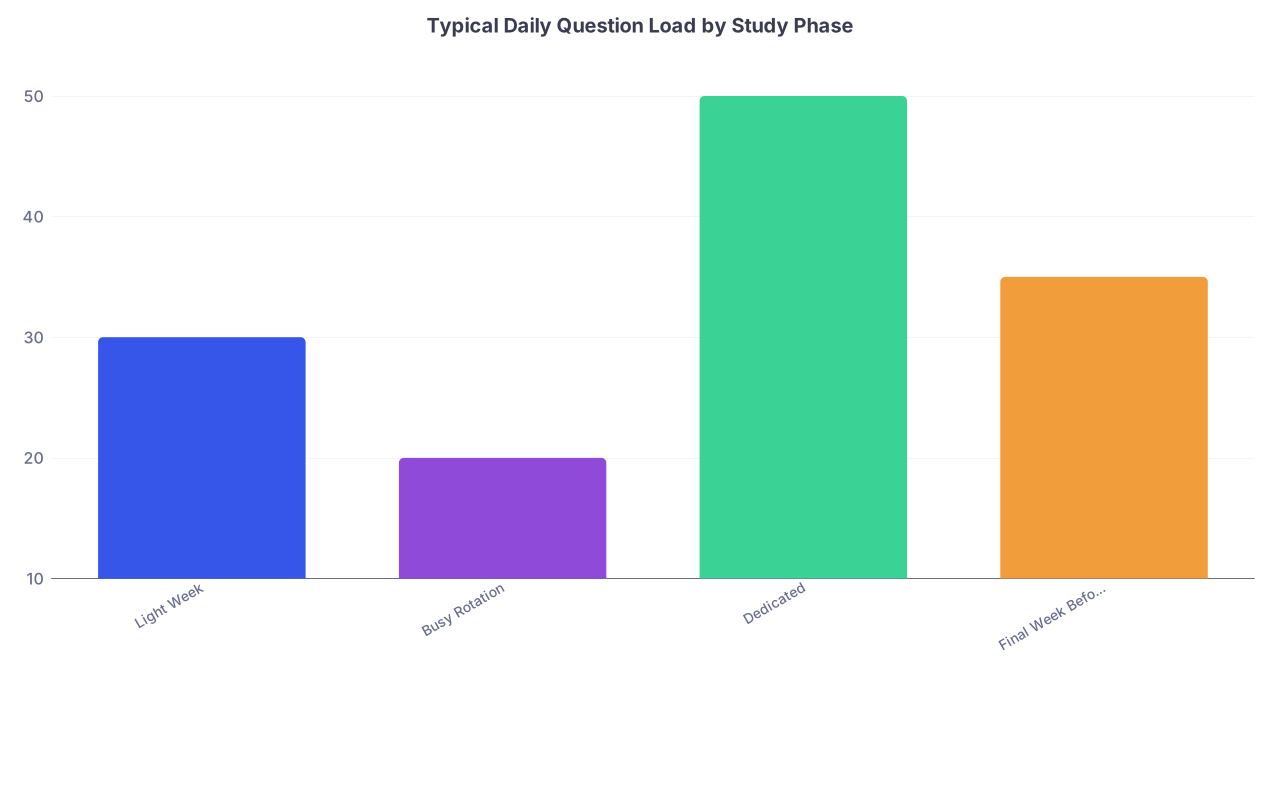
| Category | Value |
|---|---|
| Light Week | 30 |
| Busy Rotation | 20 |
| Dedicated | 50 |
| Final Week Before Exam | 35 |
Rough targets:
- Light academic week (non-exam week):
25–40 questions/day, 5 days/week - Heavy rotation (wards, call, clinic):
10–25 questions/day, 4–5 days/week - Dedicated Step/COMLEX/board prep:
40–60 questions/day, 6 days/week (with 1 rest/low day) - Final 5–7 days before a big exam:
30–40 questions/day, with more emphasis on review and mental reset
These loads are usually enough to:
- Keep your brain in contact with the test format
- Show you daily wins (even small ones) that chip away at anxiety
- Avoid the exhaustion that makes anxiety worse
If your anxiety is severe, you might actually want to start on the lower end of those ranges and build up. Your first job is to prove to your brain: “I can face this in manageable doses without being destroyed.”
The Anxiety-Sweet Spot: Simulation, Not Just Volume
There are three types of practice that specifically help test anxiety more than random question grinding:
- Timed blocks that look like the real thing
- Full-length exams at the right frequency
- Short, daily “exposure doses”
1. Timed Blocks: 20–40 Questions, 3–5x/Week
If your exam uses 40-question blocks in 1 hour, then your practice should too—at least some of the time.
A realistic anxiety-reducing pattern:
- 3–4 days/week: 1 timed block (20–40 questions)
- 1–2 days/week: review-only or lighter untimed blocks
These blocks teach your brain: “Yes, my heart rate goes up, but I survive this. Repeatedly.” That’s exposure therapy in practice.
2. Full-Length Practice Exams: Less Often Than You Think
Students with anxiety often overdo this: “More NBME = more security, right?” Not really.
For most med students:
Shelf exams / block exams:
1 full practice (NBME-style or school-style) 2–3 weeks before,
maybe 1 more 7–10 days before if it won’t fry youStep/Level exams:
1 baseline full-length (NBME/UWSA/COMSAE) at the start of dedicated
1–2 more, spaced about 7–10 days apart
Stop if they’re destroying your sleep and confidence
If a full-length exam ruins you emotionally for 2–3 days, it’s too frequent. The goal isn’t endless “data.” The goal is enough exposure to the format that your brain stops seeing test day as some alien event.
3. Daily Exposure: 10–20 Questions Even on Busy Days
Anxious brains hate big gaps. If you go 4–5 days without touching practice questions, your anxiety spikes when you come back.
On brutal weeks:
- Do 10–15 questions, timed, most days
- Spend 15–20 minutes reviewing key takeaways
That’s enough to keep your brain familiar with the test environment without needing 3-hour study blocks.
Where Burnout Starts: Red Flags You’ve Crossed “Enough”
You probably already know what burnout feels like, but here are specific practice-related signs you’ve gone too far:
- You’re doing >60–70 questions/day consistently and your scores are flattening or dropping
- You dread questions so much that you procrastinate for hours, then binge at night
- Your review is rushed, half-read, or skipped entirely because “I just need to get through the block”
- You feel numb or hopeless after almost every session, regardless of the score
- You’re cutting sleep below 6.5 hours to keep up your question quota
If 3+ of those are true for more than a week, I’d say you’re well past the effective zone. That practice isn’t helping your anxiety anymore; it’s just confirming your worst fears.
How to Adjust If You’re Already Fried
If you’re reading this already exhausted, don’t solve it by quitting practice completely. That usually spikes anxiety even more.
Do this instead for 5–7 days:
Cut your question volume by ~30–40%.
If you’re doing 60/day, drop to 35–40/day.Switch 50–70% of your time to review over new questions.
Deep dives on missed questions, pattern recognition, error logs.Add 1–2 days of no timed blocks at all.
Untimed sets or just targeted review.Hard cap your total study time.
For example, max 4–5 hours/day outside of clinical duties. When the time’s up, you stop. Period.
People hate this because it feels like “doing less,” but what actually happens is your efficiency and confidence bounce back, which lowers anxiety more than brute force ever does.
The Other Half: What You Do Around Practice
If you want your practice to reduce anxiety, your brain needs to show up with some minimum level of capacity. That’s physiology, not mindset.
There are three non-negotiables I’ve seen move the needle the most for anxious med students:
Sleep: You need a minimum of 7 hours most nights
6 is survivable for a day or two. Below that, anxiety goes through the roof and your question review is a joke.Exercise: 2–3 short, consistent sessions/week
20–30 minutes. Walk fast. Light run. Short lift. I don’t care what it is, but anxious nervous systems need some outlet that isn’t scrolling or caffeine.Pre-practice ritual for your nervous system
3–5 minutes before blocks:- 5 slow breaths (inhale 4 seconds, exhale 6 seconds)
- Remind yourself: “This is training, not judgment. My only job is to think clearly on each question.”
Practicing this script repeatedly wires your brain to see practice blocks as rehearsal, not verdict.
None of this is fancy. But if you’re doing 70 questions/day on 5.5 hours of sleep with no movement, don’t blame “test anxiety” when your mind falls apart halfway through blocks.
Putting It All Together: A Practical Weekly Plan
Here’s what a balanced, anxiety-aware week might look like 3–4 weeks before a big exam.

| Step | Description |
|---|---|
| Step 1 | Plan Week |
| Step 2 | Choose Total Q Range 150-200 |
| Step 3 | Schedule 3 Timed Blocks |
| Step 4 | Schedule 2 Light Question Days |
| Step 5 | 1 Heavy Review Day |
| Step 6 | 1 Low/Rest Day |
| Step 7 | Add Short Pre-block Ritual |
| Step 8 | Focus on Missed Topics |
| Step 9 | Deep Review + Flashcards |
| Step 10 | Sleep, Exercise, Non-medical Time |
Example:
- Mon: 40 questions timed + 1.5–2 hours review
- Tue: 30 questions timed + 1.5 hours review
- Wed: 20–30 untimed questions, focused on weak topics
- Thu: 40 questions timed + review
- Fri: 20–25 light questions + flashcards / Anki / notes
- Sat: Either a practice exam OR heavy review of the week’s mistakes
- Sun: Minimal or no new questions; brief review or rest
Total: ~150–200 questions/week, largely timed, with real review, and built-in downshifts. That’s usually enough exposure to lower anxiety, if you actually stick to your caps.
Quick Self-Test: Are You at “Enough” Right Now?
Answer these honestly:
- When I sit for a timed block, my anxiety is there but not paralyzing.
- I can predict my performance range within about ±5–7%.
- I’m learning clear patterns from my mistakes each week.
- My sleep and mood are mostly stable (not perfect, but not collapsing).
- The idea of test day feels scary—but not like pure free fall.
If you can say “yes” to at least 3 or 4 of those, your current practice volume is probably enough. Tweak, don’t overhaul.
If you’re mostly “no,” then either:
- You’re not doing enough realistic practice, or
- You’re doing way too much with poor recovery
Adjust your weekly load toward those ranges above and give it 10–14 days. Anxiety doesn’t fix overnight, but your brain does respond pretty quickly to consistent, sane exposure.
FAQ: Test Anxiety, Practice, and Burnout
1. How many practice questions do I need before I stop feeling anxious at all?
You probably won’t stop feeling anxious entirely. The goal is to get anxiety into the “useful alertness” zone, not zero. For most med students, that happens after a few weeks of consistent, realistic practice (150–250 questions/week) with solid review. If you’re waiting to feel “ready” or “not anxious at all” before your exam, you’ll never hit that point.
2. Should I push through burnout because my exam is close?
If you’re two days out, you can white-knuckle a bit. If you’re 1–6 weeks out and already burned out, pushing harder usually lowers your eventual score and makes your anxiety worse. Cutting volume by 20–30% and improving sleep and review quality for even 5–7 days can give you a better trajectory than forcing another 500 rushed questions.
3. What if my practice scores are low—doesn’t that mean I need more questions?
Not always. Low scores usually mean you need better review and clearer strategy, not just more volume. Look for patterns: Are you missing questions because of content gaps, misreading, rushing, or second-guessing? Target those. 40 well-reviewed questions can improve your performance more than 80 half-reviewed ones.
4. Is untimed practice useless for test anxiety?
Untimed practice is not useless. It’s good for early learning, new topics, or recovery days. But for anxiety specifically, you do need a steady dose of timed blocks that feel like the real exam. A good mix is 60–80% timed, 20–40% untimed or lightly timed, depending on how fragile or fried you’re feeling that week.
5. How do I know if I need professional help for test anxiety?
Consider therapy or specialized support if: you’re having panic attacks during or before practice, your sleep is consistently wrecked by test thoughts, you find yourself avoiding practice entirely for days at a time, or your anxiety is bleeding into daily functioning (relationships, basic tasks, appetite). At that point, changing your question volume alone won’t be enough, and cognitive-behavioral therapy or meds can make a big difference.
Key points to hold onto:
- “Enough” practice is a range, not an extreme—most med students land around 150–250 solid questions/week.
- Timed, exam-like blocks and good review lower anxiety far more than raw volume.
- If your practice is destroying your sleep, mood, and focus, you’ve crossed from training into self-sabotage—dial it back, don’t double down.