
The blunt truth: most of the time you should not disclose test anxiety in your dean’s letter or personal statement. And when you do, it has to be surgical, strategic, and paired with clear evidence that you’ve already handled it.
Let me walk you through when it helps you, when it hurts you, and exactly how to frame it if you decide to mention it.
Core Principle: Programs Care About Reliability, Not Sympathy
Residency programs and selection committees are not asking, “Do I feel bad for this applicant?”
They’re asking three things:
- Can this person pass their licensing exams on time?
- Will they be reliable on call and under pressure?
- Are they going to be a problem I have to manage?
“Test anxiety” sets off alarm bells for all three if it’s handled badly. That’s why casual disclosure is a mistake.
So here’s the basic rule:
- If your test anxiety is a minor background issue that has not significantly affected performance → do not disclose.
- If it has caused real damage (exam failures, leaves, delays) → you may need to address it, but only:
- Briefly
- With evidence of resolution
- In the right place (and often not in the dean’s letter you don’t control)
Should I Disclose in My Dean’s Letter (MSPE)?
Short answer: almost never your choice, and you generally shouldn’t push to add it.
The MSPE (dean’s letter) is:
- An institutional document
- Written by your school
- Meant to summarize your performance, not explore your psyche
If you’re thinking, “Should I ask them to include my test anxiety to explain my scores/failures?” here’s the framework.
When to Avoid Dean’s Letter Disclosure
Do not push to include test anxiety in your MSPE if:
- You’ve never failed a major exam (Step/Level, clerkship shelf, block exam)
- Your scores are average or slightly below average but passing
- You’re just hoping programs will be “nicer” if they know you’re anxious
Why? Because then it becomes an official, permanent institutional label: “This student has test anxiety.” Committees will infer:
- Potential future board problems
- Possible accommodations/logistics issues
- Fragility under stress
You gain almost nothing in exchange.
When It Might Belong in the MSPE
You consider some reference to it only if:
- You had a documented exam failure or major delay
- The anxiety was formally evaluated and treated
- The school already knows and has been involved in remediation
- There is a clear narrative of resolution (e.g., failed Step 1, got help, passed Step 2 with solid score)
Even then, it’s usually better for the MSPE to say something like:
“The student experienced personal and health-related challenges that contributed to this delay but has since demonstrated improved performance and timely completion of subsequent requirements.”
Rather than using the label “test anxiety” directly.
If you’re considering this, you talk to:
- Your dean of students
- Academic support / learning specialist
- Possibly student mental health (if they’re looped into academic planning)
Your angle is not: “Please document that I have anxiety.”
Your angle is: “How can we contextualize this in a way that is honest but emphasizes improvement and current readiness?”
Bottom line: you don’t casually “add” test anxiety to a dean’s letter. That’s a high-risk label.
Should I Disclose in My Personal Statement?
This is where people get themselves in trouble.
The personal statement is not your therapy note. It’s a sales document. Its job:
- Show why you’re a good fit for the specialty
- Convey maturity, insight, and reliability
- Highlight growth and strengths
Most test-anxiety disclosures fail all three.
When You Should Not Mention Test Anxiety in Your PS
Skip it if:
- Your test anxiety has never led to a failed exam or major academic disruption
- Your scores are within range for your target specialty
- You’re just looking for “authenticity” or vulnerability content
I’ve read personal statements that spend a paragraph on panic attacks before Step 1. All I remember afterward: “This person might melt down on call.”
That’s not fair. It’s just how selection psychology works.
You especially should not:
- Open your personal statement with test anxiety
- Use it as the central story of your medical school experience
- Frame it as an ongoing, unstable struggle
That’s an automatic red flag for many reviewers.
When You Might Consider Mentioning It
There are narrow situations where a brief, targeted mention can help:
- You had:
- A USMLE/COMLEX failure or very low score
- A leave of absence for mental health / anxiety
- Repeated shelf failures early that are now resolved
- And you also have:
- Clear documentation of improvement
- A strong Step 2/Level 2 or later performance
- Concrete coping strategies that are working
In this scenario, you might use 2–4 sentences to:
- Acknowledge the problem
- Show what you did about it
- Show how your later performance changed
Then tie it back to your resilience and reliability.
How to Frame Test Anxiety if You Do Mention It
If you decide you must address it, here’s the structure that works and doesn’t tank your application.
1. Keep It Short and Concrete
Do not go into a blow-by-blow of symptoms. Programs don’t need:
- How many panic attacks you had
- Every medication trial you’ve been on
- Details of therapy sessions
They need clarity and closure. Something like:
“Early in medical school, I struggled with significant performance anxiety around high-stakes exams, which contributed to my initial failure on Step 1. I worked with our school’s learning specialist and a therapist, completed a course of CBT, and adopted structured study and test-day routines. Since then, I have passed all subsequent exams on first attempt, including Step 2 with a score of XXX.”
Notice:
- Problem is clearly in the past
- There’s professional help involved
- There’s objective evidence of improvement
- It sounds managed, not fragile
2. Emphasize Action, Not Identity
Never write:
“I am someone who has always had debilitating test anxiety.”
Better framing:
- “I encountered significant test anxiety in my second year…”
- “At that time, I realized my approach to high-stakes exams wasn’t working…”
- “Since addressing it, I’ve developed…”
You’re not branding yourself as “the anxious applicant.” You’re showing a solved problem.
3. Show Outcome Data
You can’t just say “I worked on it and got better.” Back it up.
Examples of good evidence:
- Step 1 fail → Step 2 strong pass
- Early shelf failures → later shelves high pass/honors
- Needing extra time → later exams taken standard time with passes
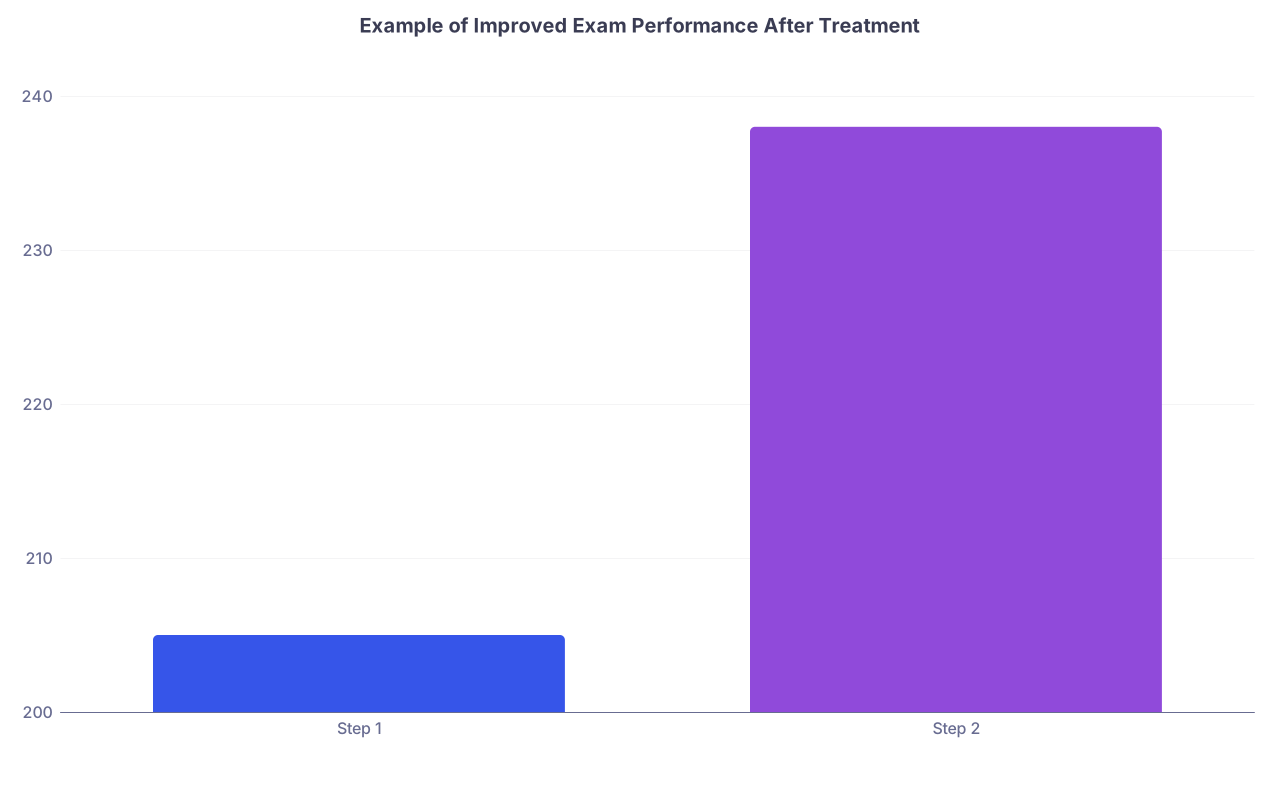
| Category | Value |
|---|---|
| Step 1 | 205 |
| Step 2 | 238 |
The numbers are fictional here, but you get the point. Show a before and after.
4. Tie It to Skills That Matter Clinically
If you stop at “I was anxious, I got therapy, I passed,” you’re leaving value on the table.
Connect the experience to:
- Empathy for struggling patients
- Better planning and organization
- Knowing when to ask for help
- Respect for mental health care
For example:
“Going through this process gave me a more practical understanding of how anxiety can impair functioning. I’m more attuned to the early signs of burnout in myself and colleagues and more comfortable speaking directly about mental health with patients.”
That reads as growth, not weakness.
Where Else Can I Explain Test Anxiety?
Sometimes the personal statement is not the best place. You have other options.
1. ERAS “Personal Comments” or “Exceptions” Section (If Available)
Many systems offer a short section to explain academic irregularities. This is often a better home for the “test anxiety” piece than your main narrative.
Use that section if:
- You’re addressing a specific event (Step fail, leave of absence)
- You want the explanation accessible but not front and center in your story
Format it like a short memo:
- 2–5 concise sentences
- Directly tied to the irregularity
- Same structure: problem → intervention → improvement
2. Advisor or Dean’s Phone Calls
For highly competitive specialties where your school advocates for you with calls, your dean might briefly mention:
“This student had some test anxiety issues early on, got treatment, and has since performed very well.”
That hits the context without putting a diagnostic label in writing everywhere.
What If I Need Accommodations for Exams?
Different question, different strategy.
If you require formal accommodations (extended time, separate room, etc.) for licensing exams, you absolutely handle that directly with the testing body, not through the personal statement or dean’s letter.
You:
- Get proper documentation from a licensed professional
- Follow the test organization’s accommodation process
- Work that out long before you’re in residency
Programs generally don’t need, and often prefer not, to see the details of your accommodation documentation. What they care most about:
- Did you pass your boards?
- Are you cleared to practice?
- Can you function safely in a clinical environment?
Practical Decision Tree: Should I Say Anything?
Here’s a quick mental flowchart.

| Step | Description |
|---|---|
| Step 1 | Test anxiety history |
| Step 2 | Do NOT disclose |
| Step 3 | Get help FIRST, delay apps if possible |
| Step 4 | Minimal or no disclosure |
| Step 5 | Brief, past-tense, evidence of improvement |
| Step 6 | Any exam failures/delays? |
| Step 7 | Now performing well? |
| Step 8 | Need context to explain failure? |
If you’re still struggling actively, your priority is treatment and stabilization, not building a narrative around it. Fix the problem before you advertise it.
Example: Bad vs Better Wording
To make this concrete, here’s how this often looks.
Bad (too raw, too central):
“I’ve always struggled with debilitating test anxiety. Step 1 was the worst period of my life; I couldn’t sleep, I was nauseous every day, and my mind went blank during the exam, leading to my failure. This experience continues to affect me, but I try my best to push through.”
Better (concise, resolved, with growth):
“I failed Step 1 during my second year, in large part because of poorly managed test anxiety. With the support of a therapist and our learning specialist, I changed both my study methods and how I approached high-stakes testing. Since then, I’ve passed all subsequent exams on the first attempt, including Step 2 with a score of XXX, and completed my clerkships without further academic issues. Working through this has made me more proactive about seeking help and more attuned to trainees facing similar challenges.”
That second one tells a program: this is over, and there’s something positive left behind.
How to Actually Manage Test Anxiety (So You Have a Better Story)
I’m not going to pretend mindset alone fixes this. Real test anxiety, especially at the med-school level, usually needs a multi-layer approach:
- Evidence-based therapy (CBT is the workhorse here)
- Sleep and exercise that are non-negotiable, not “if I have time”
- Structured study plans with lots of practice questions
- Desensitization to exam conditions (mock exams, timed blocks)
- Sometimes, short-term medication in consultation with a physician

If you haven’t actually addressed the anxiety, you don’t have a good narrative yet. Handle the condition first. Then decide what, if anything, needs to go into your application.
Comparing Where Test Anxiety Belongs (If Anywhere)
| Situation | Best Place to Address It |
|---|---|
| No failures, passing scores | Nowhere |
| Single Step 1 failure, strong Step 2 | Short explanation section / PS (brief) |
| Multiple failures, now stable | Explanation section + dean advocacy |
| Leave of absence for mental health | Explanation section, possibly dean’s letter |
| Ongoing severe anxiety, no remediation yet | Off the application – get treatment first |
Quick Reality Check: What Programs Actually See
On their screen, a typical reviewer sees:
- Your scores (Step/Level, shelves if provided)
- MSPE/Dean’s letter
- Transcript
- Personal statement
- Letters of recommendation
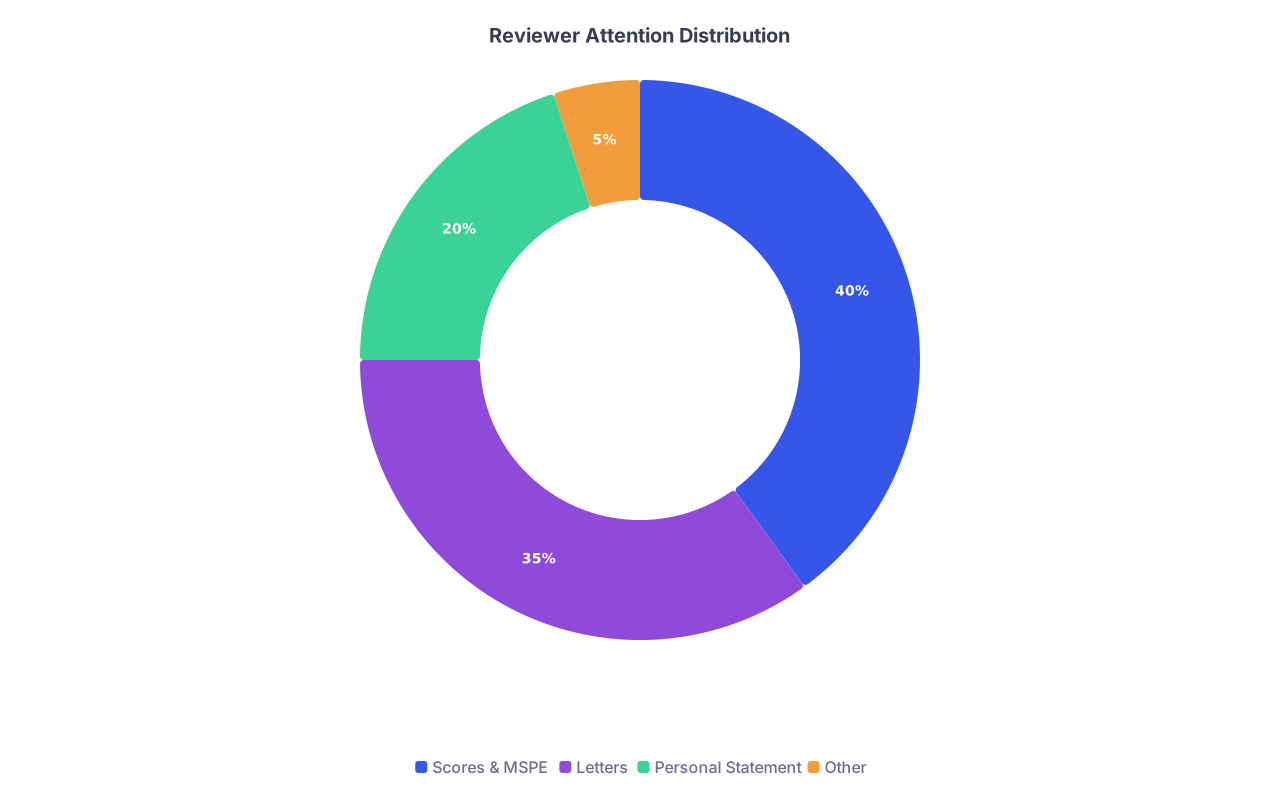
| Category | Value |
|---|---|
| Scores & MSPE | 40 |
| Letters | 35 |
| Personal Statement | 20 |
| Other | 5 |
The personal statement isn’t the main place that saves or sinks you. But it can absolutely plant a negative impression if you foreground untreated or unresolved anxiety.
So use it to confirm that you are stable, capable, and ready. Not to introduce new doubts.
FAQs
1. I failed Step 1 because of test anxiety. Do I have to mention anxiety specifically?
No. You have to explain the failure briefly. You do not have to name “test anxiety” if you don’t want to. You can say:
“I struggled with performance on my first licensing exam. I subsequently worked with academic support and mental health services, changed my preparation strategy, and passed Step 2 with a score of XXX.”
That covers context and improvement without putting a diagnostic label front and center.
2. My therapist wrote a letter about my anxiety. Should I upload it with my application?
Usually no. Those letters are for exam accommodations with NBME/USMLE/COMLEX, not for residency or program selection. Program directors don’t want stacks of mental health documentation; they want to know you’re cleared, competent, and have passed your required exams.
3. Can I talk about test anxiety as a way to show vulnerability and resilience, even if I never failed anything?
You can, but I don’t recommend it. You’re taking on real risk for minimal benefit. There are safer ways to show resilience—difficult rotations, family responsibilities, research setbacks—without triggering concerns about high-stakes performance.
4. My school wants to mention “health issues” in my MSPE. Should I push them to specify anxiety?
Usually no. A vague “health issues” or “personal circumstances” line often serves you better than explicitly naming anxiety, unless your entire file is already structured around a documented disability with clear resolution and successful accommodations. Specific psychiatric labels in official school documents tend to follow you longer than you think.
5. Who should I talk to at my school before deciding what to disclose?
Three people, in this order if possible:
- A confidential mental health provider (to make sure your condition is actually being treated).
- An academic support/learning specialist (to document improvements and strategies).
- A dean or faculty advisor who understands residency selection.
They’ve seen applicants like you before. Use their experience to fine-tune how much to say and where.
Key takeaways:
Most of the time, you do not disclose test anxiety in your dean’s letter or personal statement. If you’ve had exam failures and must provide context, keep it short, past-tense, and backed by clear evidence of improvement. Fix the anxiety first; then decide if it needs a brief mention, not the other way around.