
Do Program Directors Care If Test Anxiety Lowered My Step Scores?
What happens when you’re a strong med student on paper, but your Step scores look “meh” because your brain completely short-circuited on test day?
Let me be blunt: program directors care why your Step scores are low only if (1) there’s clear context and (2) the rest of your application is strong enough to make them pause and ask, “What happened here?”
They don’t have time—or incentive—to deeply psychoanalyze every application. But they do care about patterns, risk, and whether you can pass boards.
Let’s walk through how test anxiety actually lands with program directors, when it helps to explain it, when it hurts, and what you should do now.
How Program Directors Actually Look at Step Scores
Strip away all the feel-good talk. Here’s what most PDs are doing with your scores:
- Using Step scores as a filter
- Using them as a risk prediction tool for board passage
- Then, if you survive those two steps, looking at the story and pattern
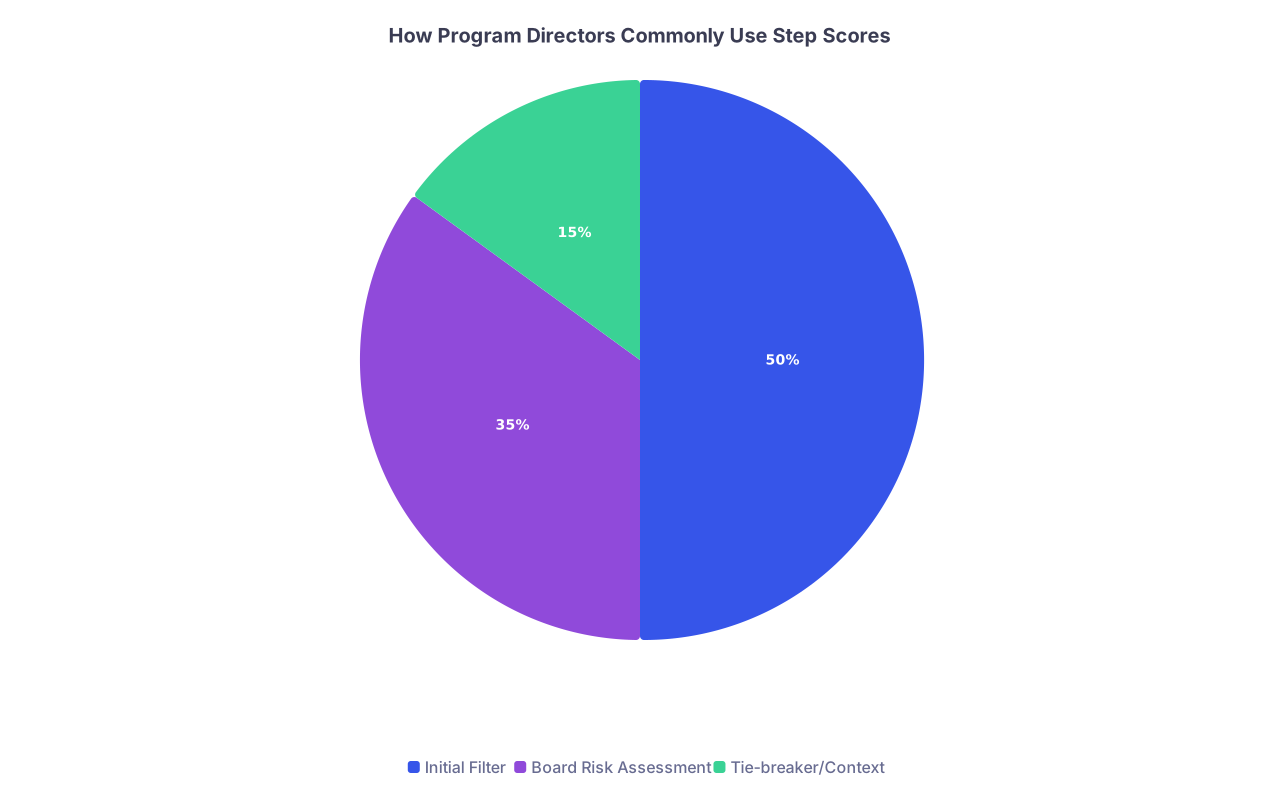
| Category | Value |
|---|---|
| Initial Filter | 50 |
| Board Risk Assessment | 35 |
| Tie-breaker/Context | 15 |
If Step 1 is pass/fail for your cohort (like it is now), then Step 2 CK becomes the numerical gatekeeper. If both of your scores are borderline or low, PDs get nervous about your ability to pass specialty boards.
Do they care why they’re low? Some do. Many don’t—unless something else about you makes them want to care.
Here’s the hierarchy I’ve seen:
- First: Did you pass on the first attempt?
- Second: Are the scores roughly in range for this specialty/program?
- Third: Is there a red flag pattern? (failures, big drop, clear inconsistency)
- Only then: Is there a reasonable explanation that reassures me?
“Test anxiety” only matters at step four. And only if the answer reassures them—not just emotionally, but statistically.
Does “Test Anxiety” As An Explanation Help Or Hurt?
Short answer: it depends how you use it. Sloppy explanation? Hurts you. Clean, documented, and paired with improvement? Can actually help.
When “test anxiety” hurts you
It makes PDs wary when:
- It sounds like an excuse instead of an explanation.
- You mention it with no evidence you’ve addressed it (no formal evaluation, no accommodations, no improved scores on later exams).
- You blame it for everything while your clerkship grades, shelf exams, and in-house exams are also mediocre.
- You come across as fragile, unreliable, or likely to implode on future high-stakes exams.
If your story is basically, “I would have crushed Step if not for my anxiety,” that’s a red flag. Programs don’t want to bet their board pass rate on someone who “would have.”
When “test anxiety” can actually help
Flip side: the same diagnosis can strengthen your narrative if:
- You have objective documentation (learning specialist, psychologist, disability office).
- You’ve made specific changes: therapy, coaching, meds, accommodations, new study strategies.
- Later data show clear improvement: stronger Step 2, better NBME practice scores, good shelf performance.
- You present it like: “Here’s what happened. Here’s what I changed. Here’s proof it worked.”
Program directors don’t need you to be flawless. They need to see risk that’s been addressed and reduced.
If your explanation signals insight, maturity, and resilience, you’re actually more attractive than the generic “perfect” applicant who’s never been tested.
Where (And How) To Mention Test Anxiety In Your Application
Most people get this wrong. They either overshare or say nothing at all. Both can backfire.
Here’s a clean breakdown of your main options:
| Option | When To Use | Risk Level |
|---|---|---|
| Personal Statement | Only if central to your story + shows growth | Medium |
| ERAS Experiences | To briefly mention accommodations or learning work | Low |
| Dean’s/MSPE Letter | Good if your school supports you and frames it well | Low |
| Supplemental Application/Signal Essays | If asked about academic challenges | Medium |
| Interview Conversation | Best for nuance and reassurance | Low-Medium |
1. Personal statement
Use this only if your test anxiety story is:
- Short
- Clear
- Directly tied to a positive outcome (improvement, growth, new habits)
Bad version:
“I’ve always struggled with test anxiety…” followed by three paragraphs of suffering.
Better version (tight, 2–3 sentences embedded in a bigger story):
“During my first high-stakes exam (Step 1), I underperformed relative to my academic record because of poorly managed test anxiety. I worked with our learning specialist, completed a formal evaluation, and changed both my study strategy and how I handle high-pressure settings. By Step 2, those changes translated to stronger performance and more confidence—especially during busy rotations.”
You’re not asking for pity. You’re showing evidence of a fix.
2. ERAS experiences section
This is subtle but effective. For example:
- Experience: “Learning Skills & Resilience Coaching – [Your Med School] Office of Student Affairs”
- Description: “Met biweekly with a learning specialist for one year to address test anxiety and develop structured study plans for high-stakes exams, which I applied successfully during clinical clerkships and Step 2 CK preparation.”
This tells a PD: “This wasn’t ignored. It was handled.”
3. Dean’s / MSPE letter
If your school is supportive and competent (some are, some aren’t), this can be powerful. They can frame:
- A low Step 1 with stronger Step 2
- Documentation of a learning difference or anxiety disorder
- Improvement over time
If you trust your Dean’s office, explicitly ask: “Can you contextualize my Step scores and mention the formal steps I took to address test anxiety?”
If they do it well, PDs read that as “institution-backed context,” which carries more weight than you saying it yourself.
What Program Directors Want To See Instead Of Excuses
They don’t primarily want explanations. They want evidence that future exams won’t be a problem.
If test anxiety lowered your Step scores, your job is to stack the file with counter-evidence:
- Pattern of clinical performance: strong clerkship grades, great comments, trust with responsibility.
- Improved exams: shelves, Step 2 CK, in-training exams (later on).
- Clear behavior change: therapy, coaching, accommodations, backed by consistency.
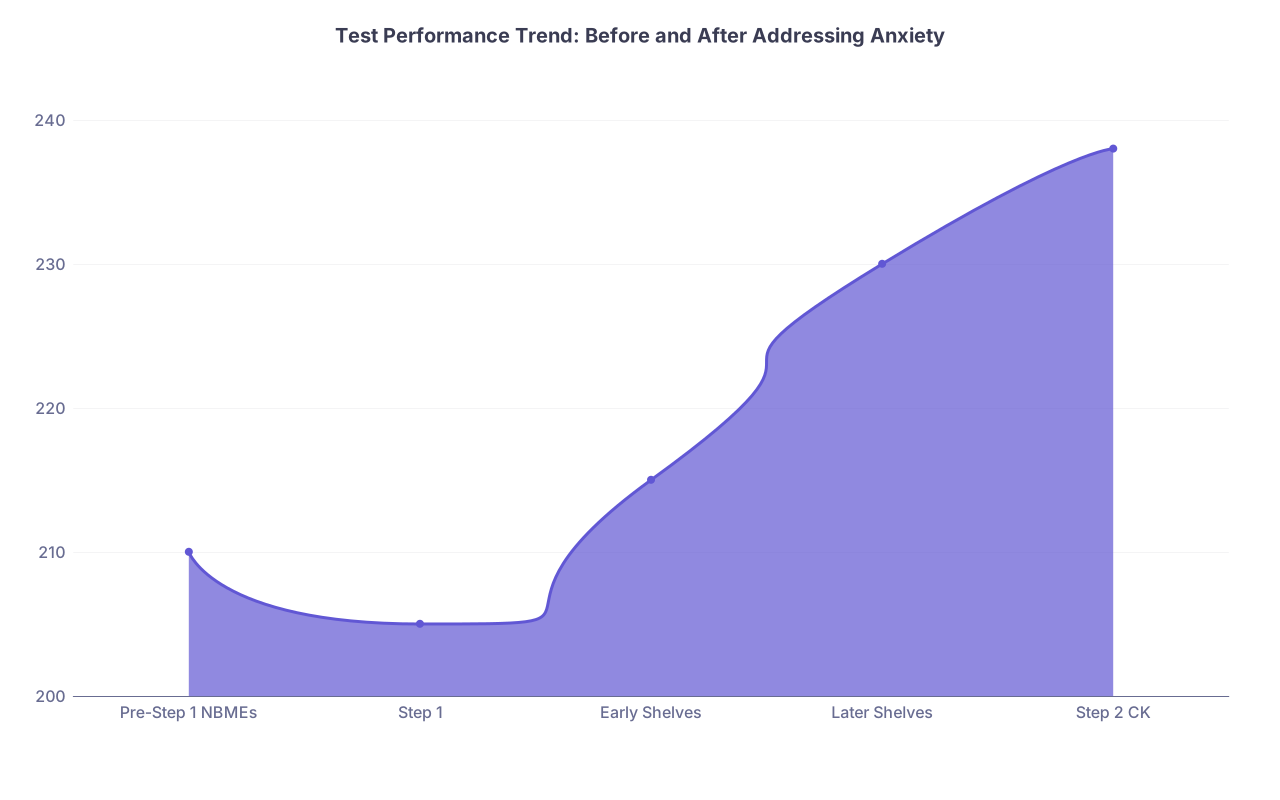
| Category | Value |
|---|---|
| Pre-Step 1 NBMEs | 210 |
| Step 1 | 205 |
| Early Shelves | 215 |
| Later Shelves | 230 |
| Step 2 CK | 238 |
If you’re still in med school and worried about your scores, this is where you should be ruthless and strategic.
Concrete steps that actually move the needle
Get formally evaluated
- Learning specialist or psychologist.
- Helps with accommodations (extended time, separate room).
- Makes your explanation real, not hand-wavy.
Lock down your Step 2 CK (if you haven’t taken it)
You can’t change Step 1 anymore. But a solid Step 2 (even just “respectable”) massively reduces PD anxiety.Stop hiding this from your school
Students often treat test anxiety like a personal shame. Meanwhile, your school has people whose literal job is to help you with it. Use them.Practice the exact test environment
High-fidelity practice: full-length timed blocks, scratch paper, breaks, food plan. This is boring, but it’s what calms the lizard brain on test day.If you already took both Steps and they’re low
Your move now is not to keep re-litigating the cause. It’s to:- Crush clinical performance
- Build strong relationships for letters
- Target programs realistically
- Prepare a tight, concise explanation for interviews
How To Talk About Test Anxiety In Interviews Without Sounding Weak
This is where a lot of people blow it. They over-disclose, get emotional, or sound fragile. You need a 3-part, 60–90 second script:
- What happened
- What you did about it
- How we know it worked
Example:
- “I’ve historically done well in coursework and on in-house exams, but during Step 1 I had significant test anxiety that affected my performance relative to my typical level.”
- “After that, I worked with our learning specialist and a therapist, had a formal evaluation, and changed how I prepare for and approach high-stakes tests, including using structured practice under test-like conditions.”
- “Those changes helped me perform more consistently on clerkship shelves and Step 2 CK, and I feel much more confident about ongoing board exams and in-training exams.”
That’s it. No five-minute story, no oversharing about panic attacks at Prometric. Just clear cause → intervention → results.

| Step | Description |
|---|---|
| Step 1 | Low Step Score |
| Step 2 | Brief Explanation |
| Step 3 | Specific Actions Taken |
| Step 4 | Objective Improvement |
| Step 5 | Reassurance About Future Exams |
If they want more detail, they’ll ask. Most won’t. They just want to hear that you’re not a board-pass risk.
Specialty And Program Type: Does It Change How Much They Care?
Yes. Very much.
Competitive specialties and elite programs are blunt about scores. They’re flooded with applicants who don’t require “context.”
Less competitive fields and community programs are more open to context if the rest of your file is strong.
| Program Type | Weight of Scores | Flexibility With Context |
|---|---|---|
| Top academic, competitive specialty | Very High | Low |
| Mid-tier academic, competitive specialty | High | Low-Medium |
| Academic primary care programs | Medium | Medium |
| Community programs | Medium-Low | Higher |
| Rural/safety-net programs | Variable | Often Higher |
If you’re going into derm or ortho with low scores, “test anxiety” won’t save you. You’ll need:
- Serious research,
- Incredible letters,
- Often a post-Step turnaround (but still within range for the field).
If you’re going into IM, FM, psych, peds, EM, etc., many programs will at least look at the context if you give them a reason to care (strong clinical record, good Step 2, strong fit).
If You Haven’t Taken Your Next Big Exam Yet: Fix The Problem Now
Don’t just plan to “explain” test anxiety later. Fix what you can now and make later scores your best argument.
Here’s a tight, realistic plan:
Diagnostic reality check
- Are you underprepared content-wise, or is anxiety the main limiter?
- NBME or UWorld self-assessments help sort this out.
Professional help, not YouTube hacks
- School learning specialist
- Licensed therapist familiar with performance/test anxiety
- Possibly meds if appropriate (through a real clinician, not Reddit advice)
Build a repeatable test-day routine
The goal: nothing about test day feels “new” except the questions. You should already know:- What you eat
- When you wake up
- How long your breaks are
- What you do when you feel panic early in a block
Treat practice tests as dress rehearsals, not just diagnostics
You’re not only testing knowledge. You’re training your nervous system under stress.
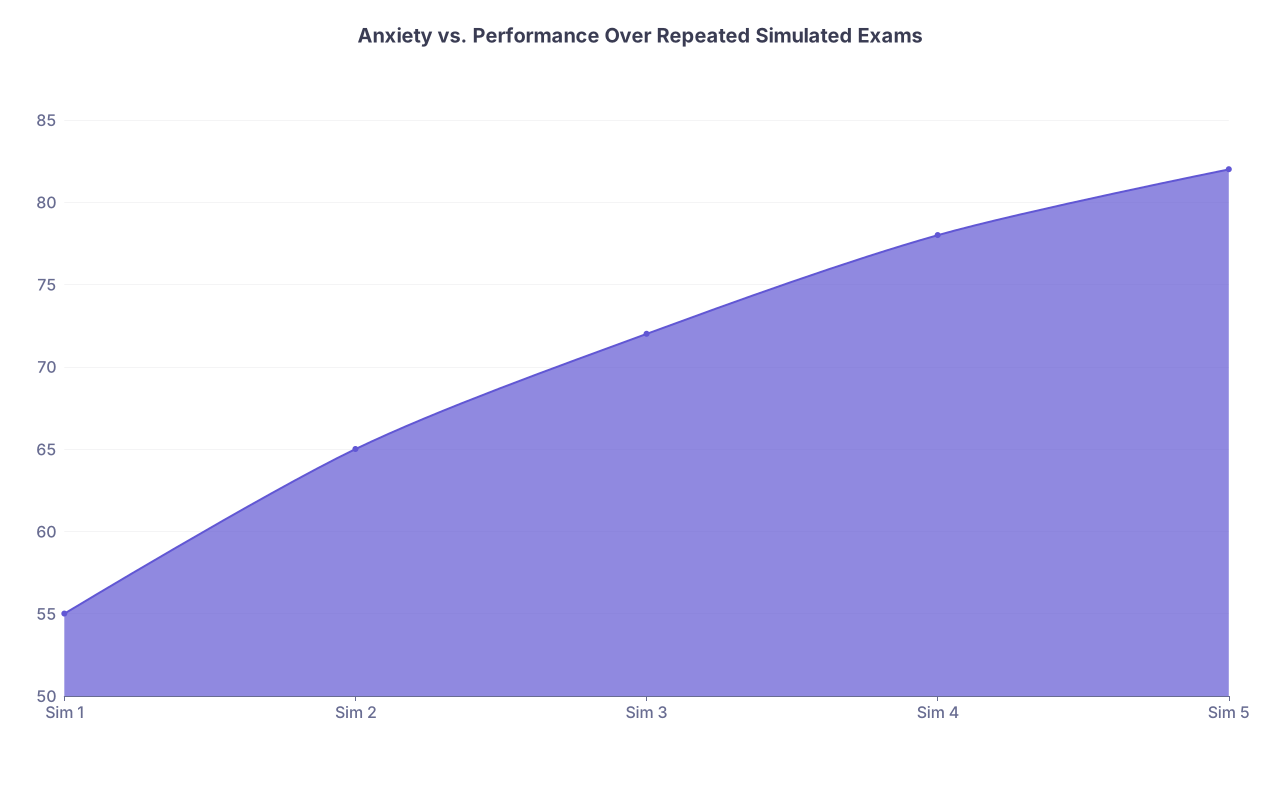
| Category | Value |
|---|---|
| Sim 1 | 55 |
| Sim 2 | 65 |
| Sim 3 | 72 |
| Sim 4 | 78 |
| Sim 5 | 82 |
The goal isn’t zero anxiety. It’s predictable, manageable anxiety.
Bottom Line: Do They Care?
Here’s the honest version:
- Program directors care mostly about what your scores predict, not how you felt taking them.
- Test anxiety only helps you if:
- It’s clearly documented or at least handled, and
- You can show improvement, and
- You talk about it calmly, briefly, and with evidence of growth.
- A vague “I have test anxiety” with no clear change or improvement? That just sounds like risk.
Your job isn’t to convince PDs that life was unfair. Your job is to convince them you’re ready and safe for residency now, that whatever sabotaged you before has been tackled, and that the data back that up.
FAQ (Exactly 5 Questions)
1. Should I directly say “test anxiety” in my personal statement or just hint at it?
If you mention it, say it directly but briefly. One or two concise sentences is enough, framed around what you did about it and how you improved. Don’t turn your statement into a therapy narrative. If you can’t keep it short and growth-focused, leave it for interviews or the Dean’s letter.
2. Do I need official documentation of test anxiety for it to matter to program directors?
It helps. Documentation from a learning specialist, psychologist, or disability office shows this isn’t just a casual self-diagnosis. It also often leads to actual interventions—accommodations, coaching—that improve performance. But what matters most is evidence of improvement, documented or not.
3. If both my Step 1 and Step 2 scores are low due to anxiety, am I basically done for?
No, but your path is narrower. You’ll need to lean heavily on strong clinical performance, excellent letters, realistic program selection, and a very tight, confident explanation of what’s changed. You might need to adjust specialty choice and be flexible geographically. People match every year with imperfect scores—but they match smartly, not magically.
4. Will talking about anxiety make programs think I can’t handle residency stress?
If you present it poorly, yes. If you present it as: “I hit a problem, sought help, built better coping skills, and now perform more consistently,” most reasonable PDs see that as a positive. They care far more about unmanaged issues than managed ones. Stability and insight are what they’re scanning for.
5. My Step 1 is low, but Step 2 is much better. Do I even need to bring up test anxiety?
Maybe not. A strong Step 2 already does a lot of talking for you. You can choose to briefly explain the gap if asked, framing it around better preparation and anxiety management, but you don’t have to pre-emptively center it in your application. Let your improvement be your main argument, and keep any explanation short and reassuring.
Key points:
- Program directors care most about risk, not feelings; test anxiety only matters if it’s clearly addressed and followed by improvement.
- Use test anxiety as a context plus solution, not an excuse—back it with documentation, better scores, and strong clinical performance.
- Keep your explanation short, specific, and focused on what you changed, not how miserable you were.