
Opening Statement: The Real Question Isn’t “Which Block Is Better?”
Here’s the myth: Step 2 CK is easy to study for if you have a dedicated block, and basically impossible if you’re buried in an inpatient month. Sounds neat. Sounds tidy. It’s also wrong.
The real question isn’t whether inpatient or dedicated is “better” in the abstract. That’s lazy thinking. The real question is whether you can generate enough high-quality study time, often enough, with enough energy, to move your score. Total usable hours matter. Active recall matters. Question volume matters. Sleep matters more than students want to admit. The label on the month? Much less than people think.
I’ve watched students on brutal medicine services still make steady progress because they did 15 questions most nights, reviewed their misses, and didn’t play games with passive studying. I’ve also seen students waste two precious dedicated weeks making color-coded schedules, rereading notes, and convincing themselves that “content review” counts as prep. It usually doesn’t.
So no, inpatient rotations are not automatically a disaster for Step 2 CK. But they’re not magical either. They work only when the rotation structure is realistic, your cognitive load is survivable, and your plan doesn’t depend on imaginary energy you won’t have after sign-out.
What the Data Actually Suggests About Inpatient vs Dedicated Study Time
The data on Step 2 CK prep doesn’t hand you a cartoonishly simple answer because exam performance never comes from one variable. There is no universal law that says inpatient rotations tank your prep. What repeatedly predicts stronger outcomes is consistency of question-based study, repeated retrieval, review of errors, and enough time to consolidate what you’re learning. Not vibes. Not whether your calendar says “dedicated.”
Inpatient months usually cut into usable study time for obvious reasons: prerounding, long rounds, notes, call, pages, admissions, and the special kind of post-call brain fog that makes every UWorld explanation look like it was written in ancient Greek. If you’re on a call-heavy medicine service or a surgical month with unpredictable late cases, your nominal “free time” is fiction. And fiction doesn’t raise scores.
But here’s what students miss. Inpatient work also gives you something dedicated study can’t fully replicate: live clinical reinforcement. You admit a patient with decompensated cirrhosis, then do a portal hypertension question that night, and suddenly the management algorithm sticks. You spend a week seeing CHF exacerbations, COPD, septic workups, postpartum hypertension, neonatal jaundice—and Step 2 stops being a giant pile of disconnected facts. It becomes pattern recognition. That matters.
Dedicated time has a different advantage. It is cleaner. More predictable. Usually better for volume. You can do larger question blocks, simulate exam pacing, review systematically, and patch weak areas faster. That’s real. But let’s kill another myth while we’re here: dedicated time is not inherently efficient. A dedicated block without structure is just unstructured anxiety in sweatpants.
I’ve seen students outperform during a busy clinical month simply because they kept doing disciplined micro-study—10 to 20 questions, careful review, spaced repetition—while someone with “all day to study” drifted into passive videos, endless note-making, and low-yield rereading. So no, the environment alone doesn’t decide the outcome. Your system does.
Why Inpatient Rotations Sometimes Work Better Than Students Expect
Students often underestimate how much the wards can turbocharge retention. Not because inpatient is pleasant. It isn’t. It’s chaotic, fragmented, and often exhausting. But memory loves relevance.
When you’ve just seen a real child with bronchiolitis, an adult with nephrotic syndrome, or a postpartum patient with endometritis, the next question on that topic lands differently. You’re not memorizing from scratch anymore. You’re attaching new information to a person, a room number, a morning presentation, a treatment decision you watched happen in real time. That’s sticky learning. Much stronger than staring at a review book at 11 p.m. and pretending highlighting counts.
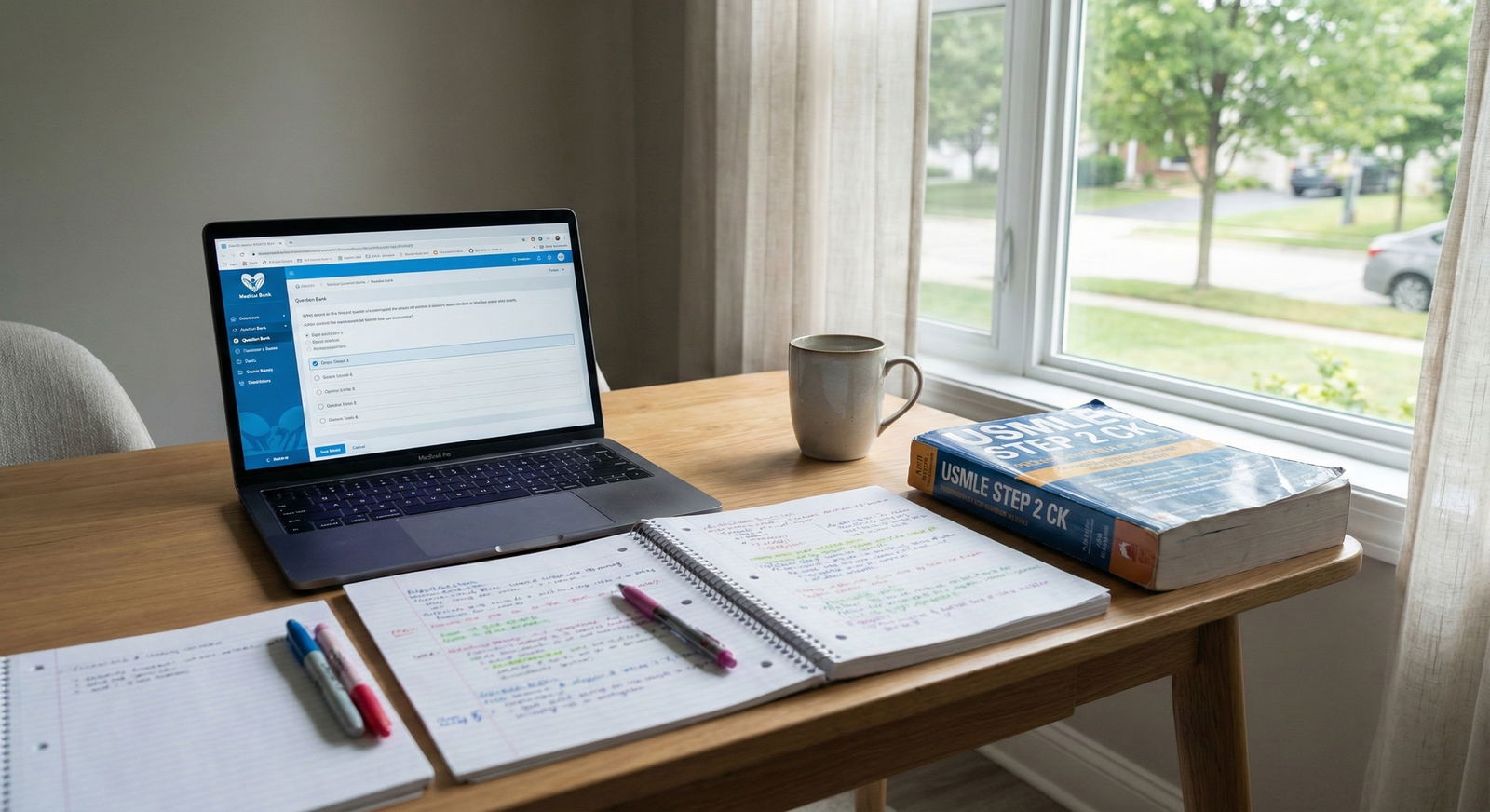
This effect is especially strong in medicine, surgery, pediatrics, and OB-GYN, where Step 2 CK rewards applied reasoning more than obscure trivia. Real patients sharpen illness scripts. You stop asking, “What chapter was that in?” and start thinking, “This is the unstable GI bleed versus the iron deficiency workup patient.” That’s a better exam brain.
But don’t romanticize it. Inpatient learning has a ceiling because fatigue is real and fragmented time is brutal. After a day of rounding, discharges, and cross-cover nonsense, passive reading is usually dead on arrival. You’ll read the same paragraph on acute pancreatitis three times and remember none of it. That’s not a discipline problem. That’s human neurobiology.
So the winning inpatient strategy is not ambitious. It’s efficient. Short question sets. Tight review. Targeted follow-up on what you missed. Maybe an Anki deck on your weak spots. That works. A giant plan to “read all of surgery this month” is fantasy dressed up as motivation.
What Dedicated Blocks Do Better—and Where Students Waste Them
Dedicated blocks do have a real edge, and pretending otherwise is performative. They give you control over your day. That means larger blocks of focused questions, deliberate review of wrong answers, more full-length practice, and cleaner feedback loops. You can identify a weak area on Tuesday and actually fix it by Friday. On inpatient, that same correction can get delayed for a week because your resident decided 4:30 p.m. was the perfect time for three new admissions.
Dedicated also helps with stamina. Step 2 CK is not just a knowledge exam; it’s an endurance test. Sitting for full blocks, pacing breaks, and keeping your reasoning sharp late in the day are trainable. Dedicated time is where that training belongs.
Now the myth-busting part: students waste dedicated time constantly. The biggest mistake is over-reading. They tell themselves they’re “building foundations” while dodging the discomfort of getting questions wrong. Bad plan. Step 2 rewards clinical decision-making, prioritization, next-best-step logic, and test stamina. You build that with questions, not with twelve hours of passive video review.
The second mistake is failing to track errors. If you miss OB management questions five days in a row and never categorize the problem—knowledge gap, interpretation issue, rushing, second-guessing—you’re not studying. You’re just repeatedly losing.
And yes, dedicated can burn you out fast. I’ve seen students create military-grade schedules with zero margin, sleep less during dedicated than on wards, stop exercising, stop seeing daylight, and then wonder why their performance plateaus. Because exhaustion flattens learning. This isn’t noble. It’s dumb.
The Smartest Strategy: Match the Plan to Your Energy, Not Your Ego
Here’s the position I’ll defend plainly: the best Step 2 CK plan is the one you can execute consistently without wrecking yourself. Not the most impressive spreadsheet. Not the one your classmate brags about. The one that survives contact with your actual life.
During inpatient months, think maintenance, not heroics. If the rotation is manageable, 10 to 20 questions a day is often enough to keep momentum. Review missed concepts tightly. Use patient encounters to anchor algorithms. Do spaced repetition on recurring weak spots. If the month is savage—q4 call, endless notes, no predictability—scale down further. A few questions and high-yield review done consistently beat grand plans abandoned by Wednesday.
During dedicated, increase the load on purpose. That’s when you should do bigger blocks, deeper review, and full-length practice. Questions come first. Always. Then targeted content review based on what your question performance exposes. Passive resources—videos, notes, rereading—belong at the bottom of the hierarchy, not the top. They feel productive because they’re comfortable. Comfortable is overrated.
And protect sleep. Seriously. Students love to act as if every spare hour should be converted into study time. But if inpatient leaves you chronically sleep-deprived, your theoretical extra study hour may be worthless. Worse than worthless, sometimes, because tired studying often turns into low-retention, low-morale sludge. Sleep is not laziness. It’s memory consolidation, attention control, and emotional stability. Things you need on test day.
So stop asking whether inpatient or dedicated is universally better. That’s the wrong frame. Ask instead: How many usable hours will I really have? How tired will I be? Can I do questions consistently? Can I review mistakes honestly? Can I protect sleep enough to retain what I learn?
That’s what the data actually points toward. Not a magical block. A workable system.
Reminder: Step 2 CK doesn’t reward the most dramatic study plan. It rewards repeated retrieval, smart review, and enough recovery to keep your brain functional. Match the plan to reality. Your score will care about that far more than whether you studied on the wards or at your kitchen table.