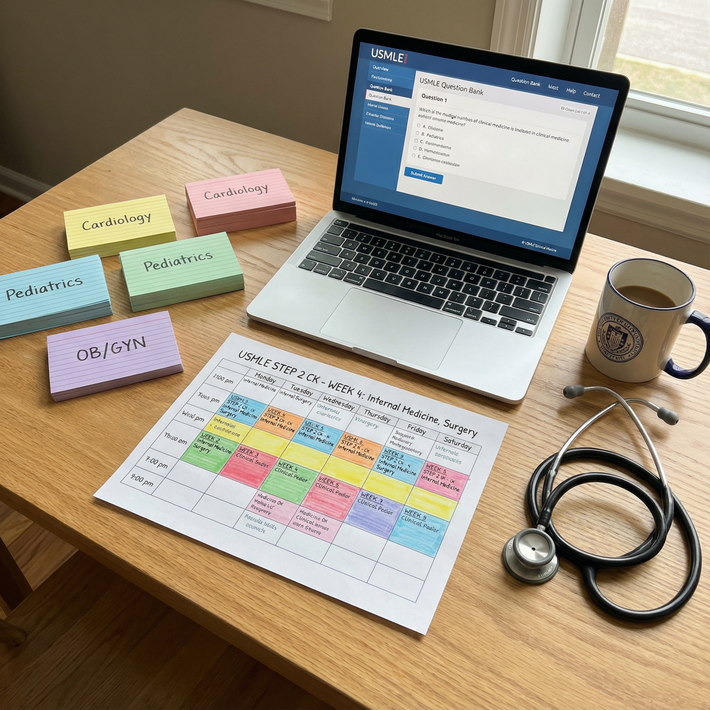
You're staring at your schedule builder like it personally insulted you.
One option is an inpatient-heavy block. Early mornings. Long rounds. Sick patients. Constant pages. The other is outpatient-heavy. More predictable hours. More breathing room. More time to do UWorld like a civilized person. And sitting underneath that choice is the real question: which one helps Step 2 CK more?
This matters because your goals are pulling in different directions. Clinical learning wants reps with real patients. Shelf exams want pattern recognition and management details. Step 2 CK wants both, plus speed, stamina, and a ridiculous amount of question review. Those things overlap, but not perfectly. I've seen students pick the "hardcore" inpatient path thinking it would automatically translate into a higher score, then get wrecked by fatigue and barely touch questions for six weeks. I've also seen students choose easier outpatient blocks, feel productive, and then realize they were underexposed to acute management and inpatient-style decision-making.
So let's fix the actual problem.
This article will do three things:
- Show what the data and real-world patterns generally say about inpatient vs outpatient rotations.
- Help you decide which setup is better for your current weakness.
- Give you a practical system to make either rotation work for Step 2 CK.
Because the wrong question is, "Which one is best overall?" The right question is, "Which one fixes the bottleneck that's holding my score back?"
What the Data Generally Suggests About Inpatient vs Outpatient Rotations
Here's the blunt answer: rotation setting by itself does not reliably determine your Step 2 CK score. Not even close.
What moves scores is usually some combination of:
- question volume
- quality review of missed questions
- feedback from residents/attendings
- shelf prep discipline
- your energy level
- whether your schedule lets you study consistently
That's the real engine. Not the word "inpatient" or "outpatient" stamped on the block.
Inpatient rotations often feel more educational because they're intense. And they are useful. You're managing real illness in real time. Chest pain, sepsis, delirium, post-op fever, electrolyte disasters, fluid decisions, antibiotics, discharge planning, decompensation overnight. That environment forces you to think fast and prioritize. For Step 2 CK, that matters. The exam loves acute care logic.
But intensity gets romanticized. Too much. A brutal inpatient month can absolutely make you sharper clinically while doing almost nothing for your score if you're too exhausted to review. I've seen this over and over: students confuse exposure with retention. They are not the same thing.
Outpatient rotations usually win on one huge variable: predictability.
Predictable hours mean you can do this consistently:
- 20 to 40 UWorld questions daily
- review incorrects before bed
- keep Anki from turning into a landfill
- revisit weak topics while they're still fresh
That rhythm is gold for Step 2 CK. Boring? Maybe. Effective? Very.
Still, outpatient has its own trap. If the clinic pace is light and nobody pushes you, it's easy to drift. You tell yourself you'll study after clinic, then you scroll, snack, chat, and somehow the evening is gone. Outpatient doesn't automatically become productive time. You have to use it on purpose.
And then there's the part students underestimate: specialty mix and clerkship structure matter more than the setting label.
A strong inpatient internal medicine service with teaching, autonomy, and shelf-focused pimping can be fantastic. A chaotic service where you're mostly transporting information between people? Much less helpful. Same thing outpatient. A high-volume family medicine clinic with breadth, procedures, and direct feedback can be excellent. A low-yield clinic where you mainly shadow and zone out? Not great.
My position is simple: If two students have equal baseline ability, the one who protects study consistency and reviews mistakes aggressively usually beats the one who just hopes clinical exposure will carry them.
That's what the data pattern supports, and honestly, that's what life on the wards supports too.
How Inpatient Rotations Can Help or Hurt Step 2 CK Prep
Inpatient rotations can be fantastic for Step 2 CK. They can also wreck your study system if you go in without one.
How inpatient helps
This is where you build muscle memory for high-yield Step 2 material:
- fluids and electrolytes
- antibiotics
- chest pain workups
- dyspnea and oxygen escalation
- delirium
- AKI
- GI bleeding
- post-op complications
- sepsis recognition
- discharge and transition decisions
You also get better at something students ignore until test day: triage thinking. Step 2 CK is full of "what do you do next?" questions. Inpatient work trains that instinct. Fast.
It also sharpens timing. On the wards, you don't have forever to admire the differential. You narrow it. You act. That mindset translates well to exam performance.
How inpatient hurts
The problem is obvious. Long hours. Fragmented days. Constant interruptions. By the time you get home, your brain feels microwaved.
That fatigue kills retention. A lot of students still force themselves to "study" for two miserable hours at night, but it's junk study. Highlighting. Rereading. Passive videos at 1.25x while half-asleep. Feels noble. Barely works.
Here's how to fix it
Use a minimum effective dose system. Not a fantasy schedule. A real one.
Pre-rounds: 5 to 10 minutes
- Review one acute care algorithm.
- Examples: chest pain, hyponatremia, DKA, post-op fever.
Daily questions: one block only
- Aim for 20 to 40 questions.
- If the day is brutal, do 10 to 15 tutor-mode questions. Still counts.
Post-rounds review routine
- Pick 2 patients from your list.
- Ask: What was the diagnosis? Why this treatment? What could Step 2 ask about this?
- Tie real cases to question-bank concepts.
Evening Anki
- Short. Focused. Cap it.
- Do not turn a tired evening into a punishment ritual.
Protect sleep
- Sleep-deprived question review is fake productivity.
Best use case for inpatient? Students who need better clinical reasoning, struggle with acute presentations, or freeze on management questions. If that's your weakness, inpatient is often the better corrective tool.
How Outpatient Rotations Can Help or Hurt Step 2 CK Prep
Outpatient rotations are often underestimated. That's a mistake.
How outpatient helps
The biggest benefit is simple: you can build a repeatable study cadence.
Predictable start and stop times make it easier to:
- complete full UWorld blocks
- review explanations properly
- keep up with Anki
- schedule NBME practice exams
- patch weak areas before they become chronic weak areas
That consistency is not glamorous, but it's probably the most important ingredient in Step 2 CK improvement. Students love to talk about "high-yield experiences." Fine. The highest-yield experience is often just doing questions every day for weeks without interruption.
How outpatient hurts
The downside is real too.
You may see fewer crashing patients, fewer overnight issues, fewer admission-style decisions, and less inpatient management. That can leave gaps in:
- acute stabilization
- hospital-based treatment sequencing
- post-op care
- discharge planning
- escalation steps
There's also a sneaky psychological problem: clinic can feel manageable, so students relax too much. They think, "I've got time later." Then later never becomes meaningful.
Here's how to fix it
Make outpatient time active.
Use clinic downtime
- Review short algorithms.
- Hit 5 to 10 Anki cards.
- Read one explanation from a question you missed earlier.
Do case-based question sets
- Family medicine, ambulatory medicine, OB/GYN follow-up, psych, preventive care.
- Then deliberately mix in inpatient-heavy medicine and surgery questions so you don't get soft.
Build an after-clinic trigger
- Don't "plan" to study. Trigger it.
- Example: get home, change clothes, 40-question block starts within 15 minutes. No debate.
Best use case for outpatient? Students who need consistency, more question volume, lower fatigue, or protected time heading into dedicated prep.

The Decision Framework: Which Rotation Type Should You Choose?
Stop asking which rotation looks more impressive. That's vanity. Ask which one solves your biggest score problem.
Use this framework.
Step 1: Identify your bottleneck
Pick the one that actually describes you:
- I miss acute management questions.
- I know content but run out of time.
- I'm inconsistent and my question volume is weak.
- I'm burned out and barely retaining anything.
- I have an IM or surgery shelf coming and need stronger clinical exposure.
- I'm close to dedicated and need protected study hours badly.
Now match the rotation to the bottleneck.
Choose inpatient if...
Inpatient is the better move if your problem is clinical sharpness, not calendar structure.
Choose inpatient when:
- you're weak on acute care and "next best step" questions
- you struggle to prioritize management in unstable patients
- an IM or surgery shelf is approaching and you need high-yield exposure
- you need reps with sick patients to build pattern recognition
- your biggest weakness is real-time clinical reasoning
This is especially true for students whose UWorld performance shows a pattern like: "I can recognize the diagnosis, but I'm shaky on what to do first." Inpatient fixes that faster than passive studying ever will.
Choose outpatient if...
Outpatient is the better move if your problem is consistency and recovery.
Choose outpatient when:
- your study routine falls apart on busy rotations
- you're fatigued enough that inpatient would just flatten you
- you need to maximize UWorld blocks and review time
- your Anki backlog is out of control
- you're entering the stretch before dedicated and need protected hours
- your score isn't limited by insight; it's limited by incomplete preparation
A lot of students need to hear this plainly: if your issue is that you're only doing questions three days a week, then an "educational" inpatient month is not the heroic answer. It's probably the wrong answer.
Step 3: Check your burnout honestly
Not performatively. Honestly.
If you're already dragging yourself through clerkships, sleeping badly, and forgetting what you studied yesterday, don't choose the harder schedule because it sounds tougher. That's ego. Step 2 CK doesn't reward ego. It rewards retention.
Step 4: Consider timing
Ask:
- Is a shelf exam coming soon that benefits from inpatient reps?
- Are you 4 to 8 weeks from dedicated and needing study hours?
- Is this a month when you can realistically maintain a question-bank streak?
Timing changes the answer.
Step 5: Apply the rule that actually works
Here's the clean rule:
Choose the rotation that best supports your biggest bottleneck.
Not the one your classmates brag about. Not the one that sounds more "serious." Not the one you think residency programs will magically admire from 30,000 feet.
If you need acute care reps, choose inpatient. If you need consistency and volume, choose outpatient.
That's the smart move. Every time.
How to Turn Any Rotation Into Step 2 CK Score Gains
This is the part that matters most, because once the rotation starts, the label matters less than your system.
Daily protocol
Use this every day, regardless of setting.
Preview: 5 to 10 minutes
- Pre-round or pre-clinic.
- Review one focused topic tied to likely patients that day.
- Examples: COPD exacerbation, prenatal screening, CHF meds, delirium workup.
One question block
- Standard target: 20 to 40 questions.
- Busy day target: 10 to 20.
- No zero days unless you are actually post-call and nonfunctional.
Review incorrects
- This is where the score move happens.
- Ask:
- Did I miss the diagnosis?
- Did I miss the next step?
- Did I get baited by a distractor?
- Is this a content gap or a reasoning gap?
One high-yield refresh
- 10 to 20 minutes.
- Revisit a weak concept from the day's questions or patients.
Weekly protocol
Once a week, do a reset.
- Track your weakest subjects.
- Make a short "repeat offenders" list.
- Revisit the concepts you missed more than once.
- Set one score-related goal for the next week.
Examples:
- "Finish 180 medicine questions."
- "Fix my OB management mistakes."
- "Get through all antibiotic and ventilator basics."
- "No more careless misses on preventive screening."
Keep the goal specific. Vague goals are decoration.
Practical safeguards that prevent stupid losses
These matter more than students admit.
- Protect sleep. Sleep deprivation wrecks recall.
- Cap passive scrolling. Your phone is stealing points from you.
- Use dead time. Commutes, elevator waits, lunch gaps, perfect for a few Anki cards or a short review note.
- Don't overbuild your system. You do not need a 14-app productivity ritual.
- Review real patients as test cases. That's free active learning.
The students who do best aren't necessarily on the "best" rotation. They're the ones who keep extracting usable study time from whatever block they're on. That's the habit that wins.
Summary: What the Data Says and What to Do Next
Here's the bottom line.
Neither inpatient nor outpatient rotations automatically raise Step 2 CK scores. The setting alone isn't the magic. Your study consistency, question volume, review quality, and fatigue management matter more.
Inpatient rotations are best for:
- acute management
- sick-patient exposure
- speed and clinical reasoning
Outpatient rotations are best for:
- consistency
- protected study time
- higher question volume
- lower fatigue
So what should you do next?
- Identify your biggest bottleneck.
- Choose the rotation that fixes that weakness.
- Attach a non-negotiable daily study protocol to it.
That's the move. Not the glamorous one. The effective one.
Key Takeaways
- Rotation type matters less than how well you protect daily study time and review mistakes.
- Inpatient rotations are better for acute management and broad sick-patient exposure; outpatient rotations are better for consistency and question volume.
- The smartest choice is the one that fixes your biggest bottleneck before Step 2 CK.