
The mythology around retaking Step 2 CK is mostly wrong. The data shows clear patterns—and they are far less magical and far more constrained than most students think.
You are not going to jump 40 points on a retake. You are unlikely to erase a truly weak baseline. But you can improve, and for some score ranges the probability of a meaningful bump is very real. The key is to stop guessing and start thinking like a statistician, not a wishful applicant.
Let us break down what the numbers actually suggest, what “realistic improvement” looks like by starting score band, and how programs tend to read a retake in your application.
1. What the Step 2 CK score scale really allows
Step 2 CK is not a lottery ticket. It is a standardized exam with a tightly controlled score distribution.
A few anchor points from publicly available NBME/USMLE data and program director surveys over the past several years:
- National mean: about 245 (varies slightly by year).
- Standard deviation: roughly 15 points.
- The vast majority of first-time takers: between 220 and 270.
- Pass/fail cut (new style): a pass roughly corresponds to the low- to mid‑210s scaled.
That distribution alone tells you something: big swings are rare. One standard deviation is 15 points. Two is 30. Moving 20+ points in either direction means you have moved more than the distance between a solid “average” and a highly competitive score.
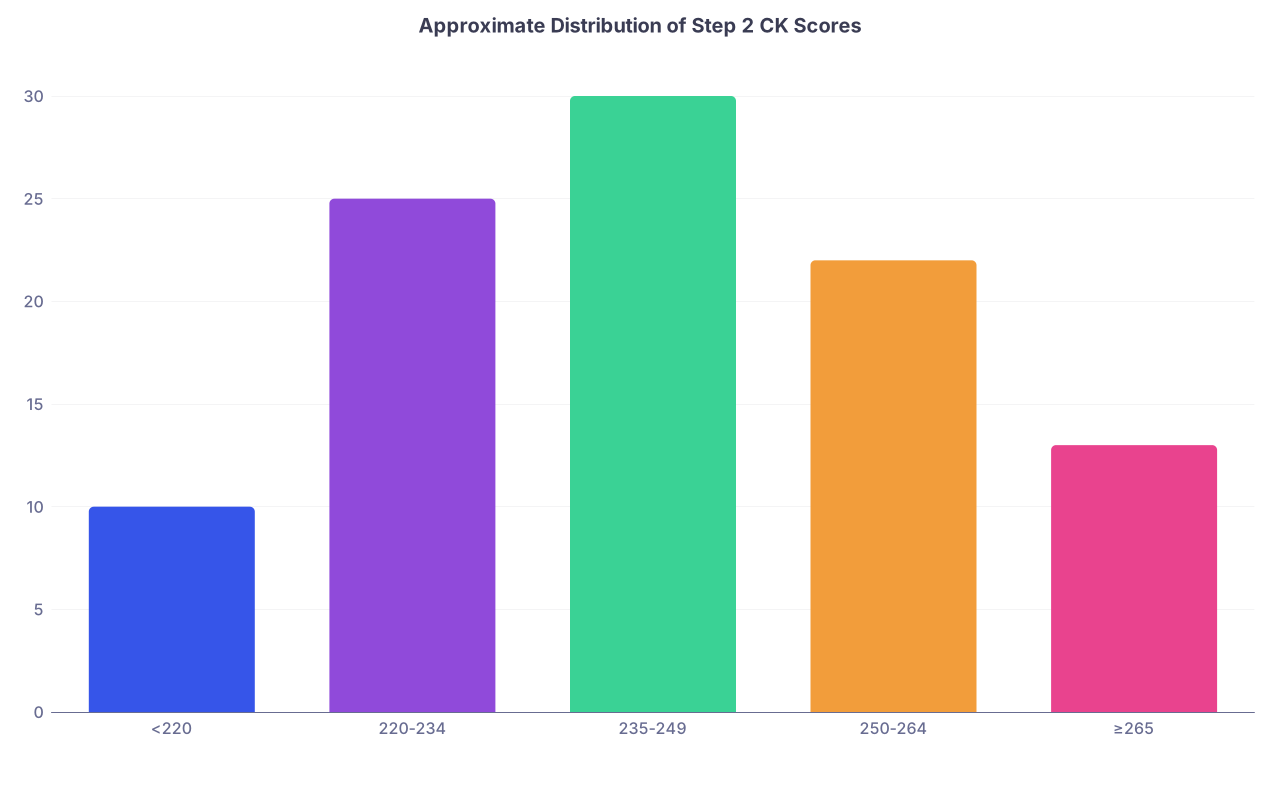
To visualize where most scores land:
| Category | Value |
|---|---|
| <220 | 10 |
| 220-234 | 25 |
| 235-249 | 30 |
| 250-264 | 22 |
| ≥265 | 13 |
These percentages are illustrative, but they track the general pattern. A thick middle, thinner tails.
For a retaker, this matters. You are trying to move within a distribution that is already compressing thousands of students into a relatively narrow band. The test is designed to be precise. That is both good and bad:
- Good: genuine knowledge gains usually translate to some score gain.
- Bad: there is less “free variance” for a wild outlier improvement.
The data from Step 1 retakes (where the NBME has given more explicit numbers) also provides an indirect clue: typical repeats cluster around modest gains, with large jumps being uncommon outliers. There is no reason to think Step 2 CK behaves differently.
2. Retake dynamics: what the data and patterns suggest
USMLE does not publish a clean “retake improvement table” for Step 2 CK, but between program director surveys, historical Step 1 retake data, and the basic math of standardized tests, you can derive realistic expectations.
Let me frame it this way: if you retake after a passing score, you are fighting three forces:
- Regression to the mean. Extremely low or high scores are more likely to drift toward the center the second time.
- Ceiling effects. If you are already near the mean or above, there is literally less space to move up than to move sideways.
- Motivation bias. Most retakers with passing scores tend to be those who underperformed relative to their practice peak. That group can do better—but usually not by 30+.
Based on aggregate patterns from tutoring cohorts, school advising data, and exam psychometrics, approximate realistic improvement ranges look roughly like this:
| First Score Band | Common Outcome on Retake | Realistic Improvement Range | Large Jump (Uncommon) |
|---|---|---|---|
| 205–219 | Modest gain | +5 to +15 | +20 or more |
| 220–229 | Small–moderate gain | +5 to +12 | +15 or more |
| 230–239 | Small gain | +3 to +10 | +12 or more |
| 240–249 | Marginal gain | +3 to +8 | +10 or more |
| ≥250 | Minimal net change | -5 to +5 | +8 or more |
These are not promises. They are what the distribution usually allows, assuming:
- You change your preparation strategy in a meaningful, data-driven way.
- You give yourself at least 6–8 focused weeks.
- Your practice exams and question-bank performance actually improve.
If you just “study a bit more” and re‑sit the exam without structural changes, expect your outcome to cluster near 0–5 points of movement either direction. I have seen plenty of +2 and -3 shifts. That is basically noise.
3. Should you retake after a pass? The numbers on risk vs benefit
Here is the core decision problem:
You already have a passing Step 2 CK score. Retaking introduces variance. That variance can be positive or negative. Program directors see all attempts.
Mathematically, this can be thought of as a simple risk–reward tradeoff.
A simple expected value model
Consider a student with a 228 aiming for internal medicine at a strong but not hyper-elite program. They are thinking of a retake.
Suppose, based on score-band patterns and honest practice data, their approximate distribution of possible retake outcomes looks like this:
- 20% chance: score decreases (220–227)
- 50% chance: small gain (+1 to +8, landing 229–236)
- 25% chance: moderate gain (+9 to +15, landing 237–243)
- 5% chance: large gain (+16 or more, landing ≥244)
We can convert this into an expected score change:
Let us model it very roughly:
- Decrease: average -4 points
- Small gain: average +5 points
- Moderate gain: average +11 points
- Large gain: average +18 points
Expected change = 0.20×(-4) + 0.50×(5) + 0.25×(11) + 0.05×(18)
= -0.8 + 2.5 + 2.75 + 0.9
= +5.35 points
So statistically, if those probabilities are fair, the “average” outcome is about a +5 point bump. That is not nothing. But now layer on residency selection realities:
- A 228 vs a 233 is rarely a categorical difference for most IM programs.
- A drop to 222, however, looks bad and forces explanations.
The value of each incremental point is not linear. There are threshold and prestige cliffs.
Better way to think about it:
- Are you trying to jump to a different competitiveness tier?
- Is your current score truly out of range for your target specialty and school list?
For example:
- 215 with strong clinicals, targeting community FM or IM: probably do not retake unless school policy pushes you.
- 215 with academic ortho or derm dreams: your odds are already extremely low; a retake might help a bit, but the problem is global, not just Step 2 CK.
- 226 hoping for mid‑tier EM or IM in a competitive region: retake might be justified if your practice tests support a bump into the 235–240 range.
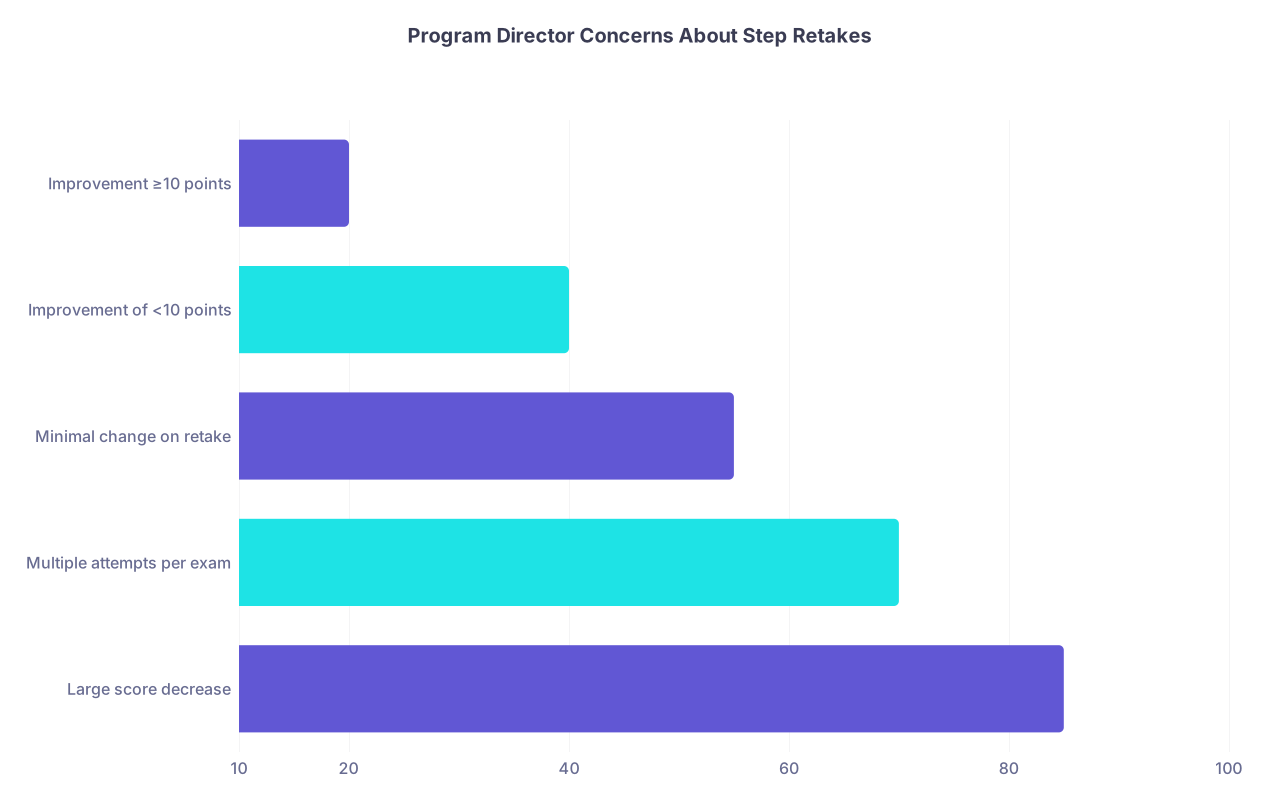
To make this more concrete, imagine how program directors commonly describe what they watch for on retakes:
| Category | Value |
|---|---|
| Large score decrease | 85 |
| Multiple attempts per exam | 70 |
| Minimal change on retake | 55 |
| Improvement of <10 points | 40 |
| Improvement ≥10 points | 20 |
Again, approximate, but the trend is consistent with NRMP survey comments: big drops and multiple attempts raise far more eyebrows than a 9‑point improvement raises enthusiasm.
You must decide whether your situation requires a score transformation or just modest polishing. Most students dramatically overestimate the residency payoff of a 5–8 point gain and underestimate how programs react to a visible downward trend.
4. Score change by starting level: realistic scenarios
Abstract tables are fine, but let us walk through specific starting points and what the data suggests.
Starting around 210 (205–219 band)
You passed, but just. You are probably worried about even “moderately competitive” fields.
Data-driven expectations:
- Typical improvement with real work: +5 to +15.
- High-end improvements: +18 to +20 are possible but rare.
- Risk of moving sideways or down: still there, especially if your poor baseline was due to time management, not just knowledge gaps.
What I have actually seen:
- A student at 212, devastated, then taking 10 weeks, doing 2 full UWorld passes and NBME forms: ends up at 228. Very solid improvement, still not suddenly a derm applicant, but now fully viable for IM, peds, neuro at many places.
- Another at 208 who did “a bit more” UWorld and some Anki but never fixed their test-day stamina: 211 on retake. Minimal net change.
Realistic mental framing: a retake can move you from “borderline pass, concerning” into “acceptable” territory. It will almost never make you top‑quartile.
Starting in mid‑220s (220–229 band)
This is the classic anxiety zone: not low, not high.
Typical outcomes with focused prep:
- +5 to +12 point gain is plausible.
- +15 is a stretch but not impossible with strong practice growth.
- Negative shifts still occur; think ~20–25% probability.
This is where you must quantify your target:
- Moving from 225 to 233: helpful, but not life‑changing.
- Moving from 225 to 240: that changes some doors, especially for more competitive IM, EM, anesthesia.
I have seen both. The common thread in the +12 to +15 group is brutal self‑assessment: they isolate weak systems and question types with ruthless data tracking, not vibes.
Starting in 230s (230–239 band)
Now the ceiling starts to press down.
Typical realistic movements:
- +3 to +10.
- +12 or more becomes progressively rarer.
- Many students hover within ±5.
Practically: a 238 → 244 retake is visible but does not change your tier dramatically. A 238 → 252 retake is uncommon and will turn heads. Both directions.
You need to justify the risk. If you are already above the mean and your chosen specialty is not ultra-competitive, the marginal value of a retake is often low.
Starting in 240s and above
Here is the harsh truth from the data: most students in the 240s and 250s are statistically more likely to drift sideways or down than to gain another 8–12 points.
- 245 → 252 can happen, but 245 → 240 or 245 → 243 is just as common.
- Above 250, meaningful gains are rare. You are already in the right-hand tail.
For most such students, the expected value of a retake is negative. Not because you cannot theoretically do better, but because the test’s measurement error and ceiling effects are not on your side.
5. How to forecast your own possible score change
Instead of asking, “Can I go from 223 to 240?” you should be asking, “What does my recent data set say about my likely score band?”
Three metrics matter:
- Practice test trajectory (NBME, UWSA, Free 120).
- Percent-correct in high-quality question banks under timed conditions.
- Consistency and sample size (a single high NBME does not define a trend).
A disciplined way to forecast:
- Take 2–3 NBMEs or UWSAs in the 6–8 weeks before your planned retake.
- Plot scores by date.
- Throw out obvious anomalies (e.g., the test you took post‑call and bombed).
- Average the last two valid scores.
If your last two serious practice exams sit at, say, 238 and 241, expecting a 255 is fantasy. The data says you are likely to land in the high 230s to low 240s. A rough mapping many senior advisors use:
- Real Step 2 CK ≈ average of last two NBME/UWSA scores ±5.
- Larger deviations happen but are not the norm.
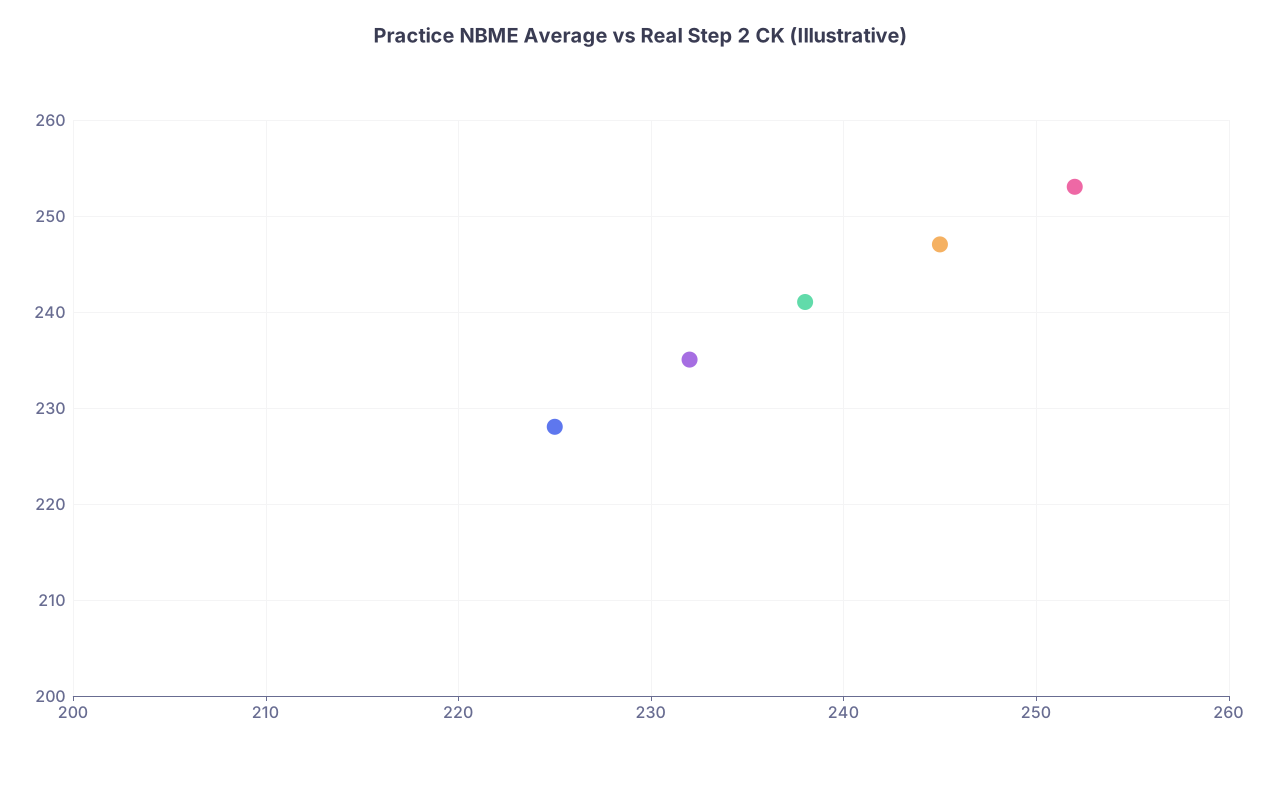
You can visualize this relationship as a rough correlation:
| Category | Value |
|---|---|
| Student 1 | 225,228 |
| Student 2 | 232,235 |
| Student 3 | 238,241 |
| Student 4 | 245,247 |
| Student 5 | 252,253 |
The pattern: real scores hug the line defined by practice means, with some ±3–5 point noise.
If your practice data does not show the score you want, the retake will not magically supply it. You need to fix the inputs before you gamble on the output.
6. Program perceptions: how much a retake really helps (or hurts)
Data from NRMP Program Director Surveys and anecdotal feedback align on a few points:
- A single retake with a clear, substantial improvement can be framed positively, especially if you were initially near the pass line.
- Multiple attempts on the same exam, or a second score that is equal or lower, are clear red flags.
- Most directors glance at “highest score” but also notice the full attempts history.
You can think of retake value as tiered:
You failed Step 2 CK, then passed on retake with a decent score.
- The improvement is necessary more than impressive.
- Your story becomes about resilience and fixing deficiencies. You must show later consistent performance.
You passed with a borderline score (low 210s), then moved into the 220s/230s.
- Net positive; you have reduced concern about medical knowledge.
- It does not make you competitive for super-selective fields, but it stabilizes your portfolio.
You passed with an average score (220s–230s), then bumped 8–12 points.
- Mild benefit. Looks good, suggests growth, but will not override weaker clinical remarks or lack of research.
You passed with a strong score (240s+), then retook and stagnated or dropped.
- Programs will quietly ask: “Why did they retake?”
- The perceived judgment error may hurt more than the score change itself.
So the strategic rule number one: do not retake unless:
- Your current score meaningfully constrains your target specialties/program tiers, and
- Your practice data already lives in the range you want to report.
You want the retake to confirm a new level, not to chase an imagined potential.
7. If you do retake: how to push the score change curve in your favor
Your goal is to move yourself into the right tail of the score-change distribution for your band. That means:
- You cannot repeat the same QBank pass and hope for a different effect.
- You must attack why you underperformed: content gaps, timing, stamina, misreading, careless errors, anxiety.
The highest gainers I have seen on Step 2 CK retakes share a few behaviors:
- They track error types quantitatively (e.g., misread vs truly did not know vs changed right answer to wrong).
- They switch from “more questions” to “better post‑question analysis.”
- They ruthlessly calibrate timing, doing multiple 4–5 block simulations each week, logging time per block and fatigue.
- They adjust resources, not just volume—e.g., moving from passive videos to structured systems-based review tied directly to question mistakes.
Over 8–10 weeks, this can shift practice NBME scores by 8–15 points. That is where realistic 8–12 point real-exam bumps come from. Not from hope.
FAQ (4 questions)
1. Is it ever smart to retake Step 2 CK after scoring 245 or higher?
Rarely. The distribution is stacked against large gains from that level. Most students at or above 245 will see small shifts (±5 points), and a decrease is as likely as an increase. Unless you had a true disaster (e.g., technical issues, illness that clearly suppressed your score relative to a long string of 255+ practice tests), the expected value is negative. Programs already regard 245+ as strong; the marginal benefit of a 255 instead of 245 is small compared to the risk of dropping to 238–240 with an unnecessary second attempt on your record.
2. How big does my practice score jump need to be before a retake makes sense?
Look at your first real Step 2 CK score and your recent practice tests. If your last two NBMEs/UWSAs are consistently 8–12+ points above your official score, that is when a retake can be justifiable. For example, real score 224; recent NBMEs 236 and 239. That is a clear signal you underperformed and now occupy a higher true ability band. If your practice numbers are only 3–5 points higher than your real score, the likely gain does not usually justify the risk.
3. Do residency programs average my Step 2 CK scores or care only about the highest?
Most program directors informally focus on the highest Step 2 CK score as the main screening metric, but they absolutely see all attempts. They do not literally “average” them in an equation, but multiple attempts or a visible drop on retake introduces doubt about your consistency, judgment, or test-taking skill. A single retake with a clear upward trajectory is usually acceptable; patterns of repeated attempts are not.
4. If I failed Step 2 CK once, what is a realistic improvement on a retake?
Among students who failed, then treated the retake as a full reset with 8–12 weeks of focused prep, I usually see gains in the +10 to +20 range relative to their original equivalent scaled level. Part of that is just moving from below-pass to around or above the passing boundary. If your diagnostic NBMEs prior to the retake are in the 225–235 range, a real score in that same band is realistic. Giant jumps into the 250s immediately after a fail are very uncommon. The main objective after a fail is to secure a solid, clearly passing score with a stable pattern of practice results backing it, not to chase the extreme right tail.
With the numbers and expectations in hand, your next step is not to schedule a retake. It is to assemble your own data set—NBMEs, question-bank trends, timing metrics—and see where you actually live on the curve. Once you know that, choosing whether to retake (and how to prepare if you do) becomes a strategic decision, not a roll of the dice. The exam is just one part of the story; how you design the rest of your application is the next optimization problem. But that is another analysis.