Mastering the Visa Transition from J-1 to H-1B: A Step-by-Step Guide for IMGs
International Medical Graduates (IMGs) in U.S. residency or fellowship programs frequently reach a critical decision point: how to transition from a J-1 Visa to an H-1B Visa so they can continue training or begin attending-level practice in the United States. This visa transition can shape your career trajectory, your immigration options, and your long-term plans for permanent residency.
This expanded guide walks you through the key concepts, eligibility rules, and step-by-step process of moving from J-1 to H-1B, with a focus on the realities facing IMGs in residency and beyond.
Understanding the J-1 and H-1B Visa Landscape for IMGs
Before planning any visa transition, it’s essential to understand how each visa works and what implications they carry for your career and immigration process.
J-1 Visa for Physicians: Exchange Visitor Program Basics
The J-1 Visa for physicians is generally sponsored by the Educational Commission for Foreign Medical Graduates (ECFMG) and is designed for graduate medical education and training (residency and fellowship).
Key features IMGs must understand:
Purpose
- Supports temporary training and educational exchange.
- Used for ACGME-accredited residency and fellowship programs and some research roles.
Two-Year Home Residency Requirement (INA 212(e))
Most J-1 physicians are subject to a two-year home-country physical presence requirement after completing their program. This means:- You must return to your home country (or country of last legal permanent residence) for an aggregate of two years, or
- You must obtain a J-1 waiver before you can:
- Change status to H-1B or L-1 within the U.S.
- Obtain an H-1B visa stamp abroad
- Adjust status to permanent residency (Green Card) or receive most immigrant visas.
Duration of Training
- J-1 physician sponsorship is typically granted in one-year increments, renewable as long as you remain in good standing and in an approved program.
- Total duration usually matches the length of your residency and/or fellowship, within ECFMG and program limits.
Dependents (J-2)
- Spouses and unmarried children under 21 may hold J-2 status.
- J-2 dependents may apply for work authorization (EAD), but their status is tied to the primary J-1.
Subject to Waiver Options
J-1 physicians subject to the two-year home residency requirement may seek a waiver based on:- Conrad 30 / State Health Department Waiver (Clinical, often underserved areas)
- Hardship to a U.S. citizen or permanent resident spouse or child
- Fear of Persecution in home country
- Interested Government Agency (IGA) waiver (e.g., VA, HHS, DoD for research/clinical needs)
- No-Objection Statement (often not accepted for clinical J-1 physicians sponsored by ECFMG)
H-1B Visa: Specialty Occupation for Physicians
The H-1B Visa is a temporary work visa that allows U.S. employers to hire foreign professionals in specialty occupations that require at least a bachelor’s degree (for physicians, an MD or equivalent and residency training).
Core aspects relevant to IMGs:
Specialty Occupation Requirement
- The role must require specialized medical knowledge and at least a medical degree.
- For practicing physicians, usually also requires completion of U.S. residency (and often board eligibility/certification).
Duration and Limits
- Typically granted for up to three years initially, renewable for a maximum of six years in total.
- Extensions beyond six years may be possible if you are in the Green Card process (PERM/I-140 stages) under certain conditions.
Employer-Sponsored
- The H-1B is strictly employer-specific:
- Your petition is filed by the employer.
- You can only work for the sponsoring employer in the approved role and locations.
- The H-1B is strictly employer-specific:
No Two-Year Home Residency Requirement
- Once in H-1B status (after satisfying or waiving the J-1 requirement), you are no longer bound by INA 212(e).
- H-1B is often considered more compatible with long-term plans and the immigration process for permanent residency.
Cap-Subject vs Cap-Exempt
- Many hospitals, universities, and academic medical centers are cap-exempt because they are:
- Institutions of higher education, or
- Non-profits affiliated with such institutions.
- Private practices and community hospitals without qualifying affiliation are usually cap-subject, meaning:
- They are limited by the annual H-1B cap (regular and advanced degree quotas).
- They require participation in the annual H-1B lottery.
- Many hospitals, universities, and academic medical centers are cap-exempt because they are:
Understanding these distinctions is foundational for planning your J-1 to H-1B transition strategy.
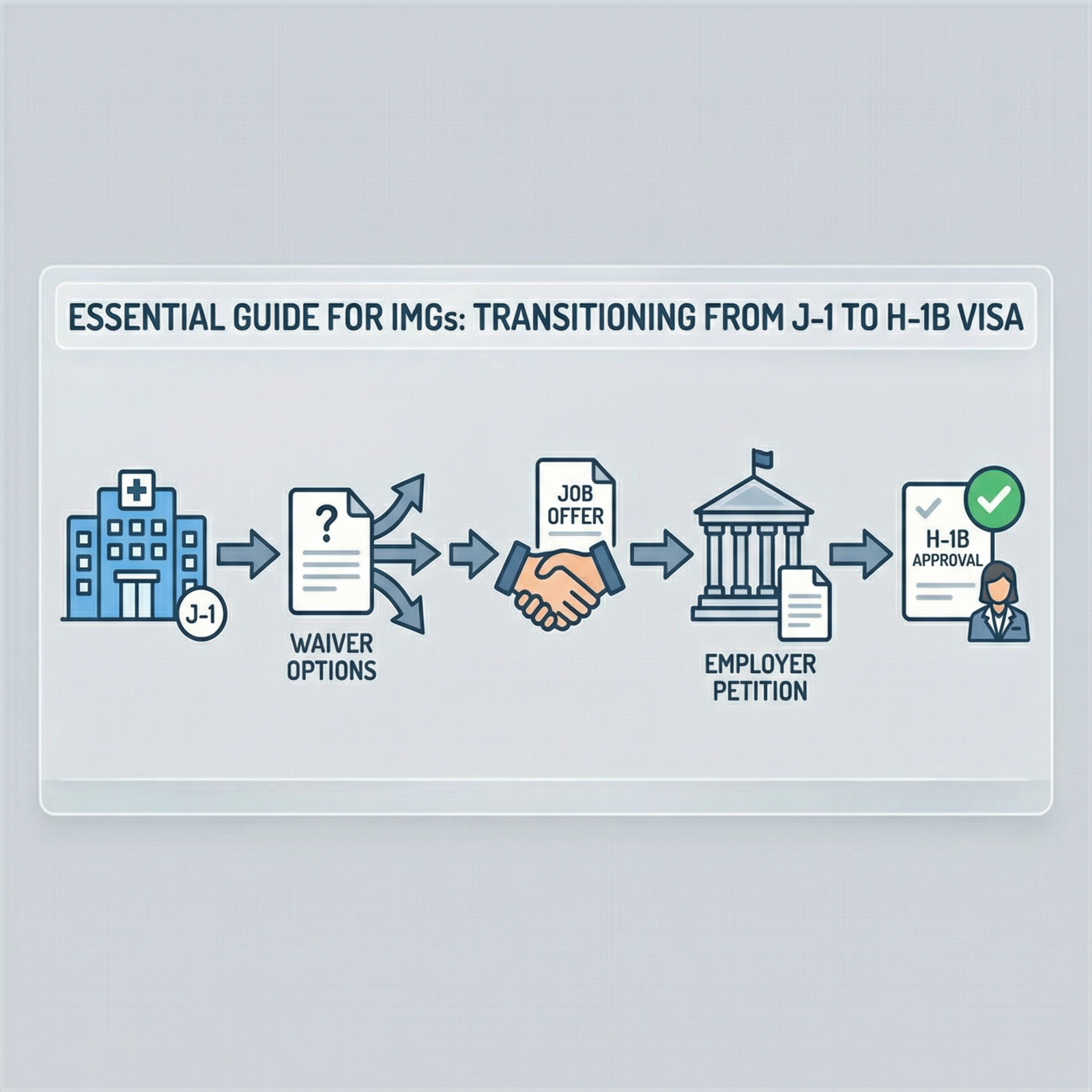
Why IMGs Pursue a Visa Transition from J-1 to H-1B
For many International Medical Graduates, the transition from J-1 to H-1B is not just a legal step—it’s a strategic career move.
Professional and Career Motivations
Continuing to Practice in the U.S.
After residency or fellowship, many IMGs secure attending positions, academic appointments, or hospital-employed roles that require H-1B sponsorship.Greater Flexibility and Stability
- No two-year home-country requirement tied to future status changes.
- Ability to pursue dual intent (maintain non-immigrant H-1B status while applying for a Green Card).
- Potential to move between qualifying employers (with proper H-1B transfer) and negotiate better terms.
Pathway to Permanent Residency
- H-1B is often the preferred status for launching the Green Card process (via PERM labor certification, National Interest Waiver, or other employment-based categories).
- J-1 status (with an active 212(e) requirement) significantly limits these options unless a waiver is obtained.
Personal and Family Considerations
Spousal and Family Options
- On H-1B, dependents hold H-4 status.
- In some scenarios (particularly if the H-1B holder has an approved I-140), H-4 spouses may be eligible for work authorization (EAD).
- This can be a major factor in your long-term family planning.
Geographic Freedom (Post-Waiver)
- Many J-1 waivers (e.g., Conrad 30) require service in underserved or specific geographic locations for a minimum term (often 3 years).
- After satisfying the waiver obligation on H-1B, physicians typically have more freedom to move to other regions or practice settings.
Step-by-Step Guide: Transitioning from J-1 to H-1B for IMGs
This section walks through the visa transition process in detail, tailored to IMGs nearing the end of residency or fellowship.
Step 1: Confirm Your J-1 Status and Home Residency Requirement
Before you can plan a move to H-1B, clarify:
Are you subject to the two-year home residency requirement?
Nearly all ECFMG-sponsored J-1 clinical physicians are, but confirm via:- Your DS-2019 forms
- Your J-1 visa stamp annotation
- Your initial J-1 documentation and ECFMG sponsorship letters
Have you already fulfilled the requirement?
- If you have physically lived in your home country (or country of last legal permanent residence) for a total of 24 months after your J-1 program, you may already satisfy the requirement.
- Keep evidence (flight records, employment records, utility bills, etc.) in case USCIS or a consular officer requests proof.
Have you obtained a waiver, or do you plan to?
- Without satisfying or waiving 212(e), you cannot:
- Change status to H-1B inside the U.S., nor
- Obtain an H-1B visa stamp.
- Without satisfying or waiving 212(e), you cannot:
For most IMGs, securing a J-1 waiver is the crucial first step in their visa transition.
Step 2: Pursue an Appropriate J-1 Waiver (If Required)
If you are subject to the two-year rule and have not already satisfied it, you must pursue a waiver before an H-1B transition is feasible.
Common waiver routes for physicians:
Conrad 30 Program (State Health Department Waiver)
- Each U.S. state can sponsor up to 30 J-1 physician waivers per year.
- Typically requires:
- A job offer in a Health Professional Shortage Area (HPSA), Medically Underserved Area (MUA), or for a medically underserved population.
- A minimum three-year full-time contract (usually on H-1B) in that position.
- Widely used for primary care and some specialties, especially in underserved communities.
Interested Government Agency (IGA) Waivers
- Federal agencies such as HHS, VA, or DoD may sponsor waivers for specific clinical or research needs.
- Often relevant for academic or research-heavy roles.
Hardship or Persecution Waivers
- Available when returning to your home country would cause:
- Exceptional hardship to a U.S. citizen or permanent resident spouse/child, or
- Risk of persecution based on race, religion, or political opinion.
- These are more complex and often take longer; strong documentation and attorney guidance are essential.
- Available when returning to your home country would cause:
No-Objection Statement (NOS)
- Many clinical J-1 physicians cannot rely on NOS alone due to ECFMG policies and U.S. legal limitations.
- More commonly applicable to non-clinical J-1 categories.
Practical tip:
Begin the waiver process 12–18 months before the end of your training. Many employers will not finalize H-1B sponsorship without clear indication that a waiver is approved or likely.
Step 3: Secure an H-1B-Eligible Job Offer
Once your waiver path is identified and progressing:
Find an employer willing and able to sponsor H-1B
- Academic medical centers, university hospitals, and large health systems often have experience with IMGs and are cap-exempt H-1B employers.
- Community hospitals and private groups may be cap-subject and require planning around the H-1B lottery cycle.
Ensure the role meets H-1B “specialty occupation” criteria
- Clinical attending physician, hospitalist, specialist, or academic faculty roles almost always qualify.
- The job description should clearly reflect professional-level physician duties requiring an MD or equivalent and residency/fellowship training.
Contract and timing considerations
- Align your start date with:
- Completion of residency/fellowship
- Your anticipated waiver approval
- H-1B petition processing timelines
- For Conrad 30 jobs, confirm that your contract:
- Specifies the required three-year service
- Meets all state-specific program requirements.
- Align your start date with:
Step 4: Gather Required Documentation for H-1B Petition
Both you and your employer must assemble a thorough and accurate packet for the H-1B petition.
Typical physician-side documents:
- Valid passport
- Copies of all DS-2019 forms and J-1 visa stamps
- Evidence of J-1 waiver approval (if applicable) from USCIS or Department of State
- Medical degree and diploma (and translations if needed)
- Evidence of ECFMG certification
- USMLE scores and transcripts
- Residency/fellowship completion certificates (or anticipated completion letters, if filing before graduation)
- State medical license, or confirmation of eligibility/pending licensure
- Detailed CV and any board certifications or eligibility documentation
Employer-side documentation:
- Job offer letter with:
- Exact job title
- Detailed job description
- Salary and employment terms
- Work location(s)
- Labor Condition Application (LCA) details:
- Position wage level
- Attestation the employer will pay at least the prevailing wage
- Confirmation of working conditions
- Proof of employer’s eligibility (tax ID, corporate documents, academic affiliation if claiming cap-exempt status)
- Any relevant support letters describing:
- Institutional mission
- Clinical need in the community
- Your qualifications and role
Step 5: Employer Files LCA and Form I-129 (H-1B Petition)
The H-1B petition is employer-driven. You cannot file it yourself.
Labor Condition Application (LCA)
- Filed with the U.S. Department of Labor (DOL).
- Employer attests to:
- Paying you at least the prevailing wage
- Providing working conditions that do not adversely affect U.S. workers.
- LCA approval typically takes about 7–10 business days, but employers should plan extra time.
Form I-129 (Petition for a Nonimmigrant Worker)
- Filed by the employer with USCIS, including:
- Approved LCA
- All supporting documentation
- Filing fees (including any optional premium processing fee).
- If you are in the U.S. and eligible, the employer may file a change of status from J-1 to H-1B on the same petition.
- If you are outside the U.S. or need consular processing, the petition will be filed for consular notification.
- Filed by the employer with USCIS, including:
Step 6: Monitor Processing and Respond to RFEs
Once the petition is filed:
Standard Processing vs Premium Processing
- Standard USCIS processing can take several months, depending on case type and workload.
- Premium processing (for an additional fee) generally guarantees an initial response within 15 calendar days (approval, denial, or Request for Evidence [RFE]).
Requests for Evidence (RFEs)
- USCIS may request clarification or more documentation regarding:
- Your qualifications (training, licensure, board eligibility)
- Employer’s status (cap-exempt vs cap-subject)
- Prevailing wage or job duties
- Work closely with your employer and immigration attorney to respond thoroughly and promptly.
- USCIS may request clarification or more documentation regarding:
Step 7: Change of Status vs Consular Processing
Your path from J-1 to H-1B will follow one of two main routes, depending on timing and waiver status:
Change of Status within the U.S.
- Possible only if:
- Your J-1 waiver is approved or you are not subject to 212(e), and
- You remain in valid J-1 status until the requested H-1B start date.
- If approved:
- You do not need to leave the U.S. to start working.
- Your status automatically changes on the effective date (e.g., July 1).
- Possible only if:
Consular Processing Abroad
- Required if:
- You are subject to 212(e) and do not yet have a waiver, or
- You cannot maintain valid status until H-1B start date, or
- Strategic or personal reasons lead you to process the visa abroad.
- Steps:
- H-1B petition is approved with consular notification.
- You schedule a visa interview at a U.S. embassy/consulate.
- Upon H-1B visa issuance, you enter the U.S. in H-1B status and begin employment.
- Required if:
Step 8: Maintaining and Protecting Your H-1B Status
Once your visa transition is complete and you are in H-1B status:
Work Only as Authorized
- Only for the sponsoring employer.
- Only in the role and locations listed in the H-1B petition.
- Significant changes (e.g., location changes, hours, role changes, employer changes) often require filing an amended or new H-1B petition.
Keep Documentation Updated
- Maintain copies of:
- I-797 approval notices
- Pay stubs
- Updated contracts
- State licensure renewals
- These will be important for future extensions, transfers, or Green Card filings.
- Maintain copies of:
Plan Ahead for Extensions and Next Steps
- File H-1B extensions well before expiration.
- Discuss long-term plans with your employer:
- Will they sponsor a Green Card (EB-2 or EB-3 via PERM, or NIW if applicable)?
- What is the anticipated timeline for starting the immigration process?
Practical Tips for IMGs Navigating the J-1 to H-1B Transition
- Start Early
- Begin exploring waiver options and H-1B-eligible positions 12–18 months before training completion.
- Use Expert Help
- Immigration laws change; consult an experienced immigration attorney familiar with physician cases and the J-1 to H-1B transition.
- Coordinate Carefully with GME and HR
- For those going straight from J-1 residency to H-1B fellowship or attending roles, work closely with:
- Your Graduate Medical Education office
- Institutional HR and legal departments
- For those going straight from J-1 residency to H-1B fellowship or attending roles, work closely with:
- Understand State and Institutional Nuances
- Conrad 30 requirements vary by state.
- Institutional requirements for H-1B sponsorship differ (some prefer J-1 for training; others are comfortable with H-1B for fellowship).

FAQs: J-1 to H-1B Visa Transition for International Medical Graduates
1. Can I move from a J-1 Visa to an H-1B Visa if I am subject to the two-year home residency requirement?
Yes, but not directly. If you are subject to the two-year requirement (212(e)), you must first either:
- Fulfill the two-year home-country physical presence requirement, or
- Obtain an approved J-1 waiver (e.g., Conrad 30, IGA waiver, hardship, or persecution).
Only after that can you change status to H-1B in the U.S. or obtain an H-1B visa stamp at a U.S. consulate.
2. How long does the H-1B application process typically take for IMGs?
Timelines vary, but a general range is:
- LCA approval: ~1–2 weeks
- USCIS regular processing: several weeks to several months, depending on service center and case load
- Premium processing (optional): initial decision or RFE within 15 calendar days
You should begin planning at least 6–9 months in advance of your intended H-1B start date, and even earlier if you also need a J-1 waiver.
3. What happens if my J-1 Visa expires before my H-1B petition is approved?
To avoid gaps in status or unlawful presence:
- File your H-1B change-of-status petition while your J-1 status is still valid.
- If your J-1 status ends before H-1B approval and you do not have a change of status pending or approved, you may:
- Need to leave the U.S. and complete consular processing once the H-1B petition is approved, or
- Explore whether a short grace period applies, depending on your specific circumstances.
Discuss timing with your employer and attorney as early as possible to prevent status issues.
4. Can I change employers while on an H-1B Visa, and how does that impact my prior J-1 waiver obligations?
Yes, you can change employers while in valid H-1B status, but:
- The new employer must file an H-1B transfer petition (new I-129).
- In many cases, you may start working for the new employer once the transfer petition is properly filed (H-1B portability), but risk reduction strategies should be discussed with an attorney.
If you obtained a J-1 waiver (e.g., Conrad 30):
- You are typically required to fulfill the full three-year service obligation with the waiver employer or under specific conditions approved by the state/federal agency.
- Leaving too early or without following required procedures can jeopardize your waiver and future immigration benefits.
5. Is H-1B or J-1 better for residency or fellowship, and does that affect my future Green Card options?
Both have pros and cons:
J-1 for Training
- Often easier and more standardized for residency/fellowship (especially ECFMG-sponsored).
- But it comes with the two-year home residency requirement, which must later be addressed.
H-1B for Training
- Some programs sponsor H-1B for residency/fellowship (more common for fellowship).
- Avoids the two-year requirement and is more compatible with long-term Green Card planning.
- However, it may be harder to secure, and some programs prefer not to use H-1B for trainees.
From an immigration process standpoint, H-1B is generally more favorable for long-term U.S. practice and the Green Card process, but availability depends heavily on institutional policies and your specific situation.
A well-planned transition from J-1 to H-1B can be the bridge between training and a stable, long-term medical career in the United States. Understanding your obligations under J-1, choosing the right waiver path, securing an H-1B-eligible position, and coordinating timelines with your employer and legal counsel are critical steps in this visa transition.
By starting early, staying informed, and leveraging professional guidance, you can move through the immigration process strategically and position yourself for a successful and sustainable career as an IMG in the U.S.