
Introduction: Why the H-1B Visa Matters for International Medical Graduates
For International Medical Graduates (IMGs), the journey to practicing medicine in the United States involves not just exams and residency applications, but also navigating a complex immigration landscape. One of the most critical components of that journey is the H-1B Visa, a common pathway for IMGs seeking to work and build a long-term career in the U.S. after training.
While many IMGs begin training on a J-1 visa, an increasing number pursue or transition to H-1B status due to its advantages for US employment and long‑term immigration planning, including the possibility of a Green Card. Unfortunately, the H-1B visa process can be confusing and time‑sensitive, with intricate rules, annual caps, and institutional policies that vary widely by program.
This enhanced guide breaks down the H-1B process step-by-step with an IMG-specific lens, highlights common pitfalls, and offers practical strategies to improve your chances of success—whether you are:
- A residency applicant deciding between J-1 and H-1B
- A resident planning to switch from J-1 to H-1B for fellowship or attending roles
- An IMG completing fellowship and seeking an H-1B for your first attending job
Throughout, keep in mind that immigration regulations evolve. Use this as a structured roadmap, but always verify details with your institution’s GME office and an experienced immigration attorney.
Understanding the H-1B Visa for Physicians
What Is the H-1B Visa?
The H-1B Visa is a nonimmigrant, employment-based visa that allows U.S. employers to hire foreign workers in “specialty occupations” that typically require at least a bachelor’s degree (often a professional degree or higher) in a specific field.
For International Medical Graduates, this usually applies to:
- Residents and fellows in ACGME-accredited programs (at institutions willing and able to sponsor H‑1B)
- Hospitalists, specialists, and subspecialists entering US employment after training
- Academic faculty positions at medical schools and teaching hospitals
Key features for IMGs:
- Initial duration: Up to 3 years
- Maximum standard duration: 6 years total in H-1B status (with possible extensions in certain Green Card situations)
- Employer-specific: You are authorized to work only for the sponsoring employer and only in the position described in the petition
- Location-specific: Major changes in worksite or duties usually require an amended petition
Unlike some other visas, the H-1B is a dual-intent visa, which means you can pursue permanent residency (a Green Card) without violating your nonimmigrant status. This is a major advantage for IMGs planning a long-term career in the U.S.
H-1B vs. J-1 for IMGs: Why It Matters Early
For residency applicants, understanding the difference between J-1 and H-1B early in the medical residency application process is crucial:
- J-1: Sponsored by ECFMG; generally requires a 2-year home-country physical presence after training, unless waived.
- H-1B: Sponsored directly by the employer (hospital/university); no automatic 2-year home-return requirement.
Many residency programs do not sponsor H‑1B visas for residents, citing cost and administrative burden. Some will only consider H‑1B for fellowship or faculty roles. Because of this, IMGs with long-term plans for US employment often proactively target programs and institutions that have a track record of sponsoring H-1B visas.
H-1B Visa Eligibility Requirements for International Medical Graduates
To qualify for an H-1B as an IMG, you and your employer must meet several criteria.
1. Specialty Occupation Requirement
Your position must qualify as a specialty occupation, meaning:
- The role normally requires at least a bachelor’s degree (for physicians, this is the MD/DO or equivalent foreign medical degree); and
- The degree must be in a specialty directly related to the job.
For IMGs, common qualifying roles include:
- Resident physician in an ACGME-accredited program (where the institution uses H‑1B)
- Clinical fellow in a subspecialty program
- Attending physician in a hospital, clinic, or academic department
The job description must clearly reflect advanced, specialized clinical duties—not generic or non-professional roles. Poorly drafted job descriptions are a frequent cause of RFEs (Requests for Evidence) and denials.
2. Valid Employment Offer from a U.S. Employer
You must have a concrete job offer from a U.S. employer willing to:
- Sponsor your H-1B visa petition (Form I-129)
- Comply with Department of Labor (DOL) wage and working condition requirements
- Pay all required employer-side USCIS and DOL fees (by law, they cannot require you to pay certain fees yourself)
Common H‑1B sponsors for IMGs include:
- Academic medical centers and university hospitals
- Community hospitals
- Federally Qualified Health Centers (FQHCs)
- Large private practices or multi-specialty groups
3. Medical Licensing and Examination Requirements
Physicians must meet specific licensing requirements to be eligible for an H‑1B for clinical work:
- USMLE Steps: Typically USMLE Step 1, Step 2 CK, and often Step 3 are required.
- Some states or institutions require USMLE Step 3 to file H‑1B for residency or fellowship.
- ECFMG Certification: For IMGs, ECFMG certification is usually required before starting residency or fellowship.
- State Medical License or appropriate permit:
- For residents/fellows: a training license or equivalent may be sufficient.
- For attendings: an unrestricted state medical license is mandatory.
Your employer’s legal and GME offices will reference state board rules when preparing the petition.
4. Evidence and Documentation
Your employer must submit robust documentation to USCIS to establish your eligibility, including:
- Copy of your medical diploma and translations if applicable
- ECFMG certificate
- Detailed CV with relevant training and experience
- USMLE score reports
- Current and/or prospective state license or training permit
- Detailed employment contract or offer letter
- Thorough job description outlining clinical, educational, and research duties, call responsibilities, and reporting structure
Organizing these documents early will reduce delays and lower the risk of RFEs.

Step-by-Step Guide to the H-1B Visa Process for IMGs
Step 1: Secure an Eligible Job Offer
Your first milestone is obtaining a qualifying offer of employment. For most IMGs, this happens through:
- Residency Match (NRMP) or SOAP
- Fellowship Match or direct fellowship offers
- Post-training attending positions after residency/fellowship
Actionable tips:
- During interviews, ask programs directly:
- “Do you sponsor H-1B visas for residents/fellows?”
- “Do you require USMLE Step 3 for H-1B sponsorship?”
- Review program websites and institutional GME policies on visa sponsorship.
- Connect with current IMGs in the program to understand real-world experiences with H‑1B.
Once you match or sign an offer, notify the GME office and HR early about your need for H‑1B sponsorship so they can plan timelines and legal support.
Step 2: Employer Files a Labor Condition Application (LCA)
Before filing the H-1B petition, your employer must obtain a certified Labor Condition Application (LCA) from the U.S. Department of Labor (DOL).
The LCA includes key attestations:
- The employer will pay you at least the prevailing wage (or actual wage for similar employees), as determined by DOL or an acceptable wage survey.
- Hiring you will not adversely affect the working conditions of U.S. workers in similar positions.
- There is no strike or lockout in your occupation at the worksite.
Practical implications for IMGs:
- The wage level must meet or exceed DOL standards; this can affect H‑1B feasibility in some settings.
- For physicians working at multiple sites (e.g., clinics plus hospital), LCAs may need to cover each worksite.
Typical timeline: 7–10 business days or longer for DOL to certify, though this can vary.
Step 3: Employer Prepares and Files Form I-129 (H-1B Petition)
After LCA certification, your employer’s attorney prepares Form I‑129: Petition for a Nonimmigrant Worker, which formally requests H‑1B classification from USCIS.
The petition will include:
- Completed Form I-129 and H Classification Supplement
- Certified LCA
- Detailed job offer letter or employment contract
- Elaborate job description explaining:
- Specialty nature of the role
- Required education and credentials
- Clinical setting and supervision (especially for trainees)
- Copies of your:
- Passport
- Medical degree and transcripts
- ECFMG certificate
- USMLE scores
- State license or training permit
- Curriculum vitae
- Supporting documentation to show the employer’s ability to pay and institution’s legitimacy (for some cases)
Filing Fees and Premium Processing
H-1B petitions require multiple fees, typically paid by the employer:
- Base filing fee for Form I-129
- ACWIA fee (training fee; varies by employer size)
- Fraud prevention and detection fee
- Optional premium processing fee, which—if requested—guarantees a USCIS action (approval, denial, or RFE) within 15 calendar days
Residency and fellowship programs often opt for premium processing due to strict start dates in July.
Step 4: USCIS Processing and Possible RFEs
Once filed, USCIS will:
- Issue a receipt notice confirming they have received the petition.
- Conduct initial review and background checks.
Processing scenarios:
- Regular processing: Can range from several weeks to several months.
- Premium processing: 15 calendar days for initial decision or RFE.
If USCIS needs more information, they will issue a Request for Evidence (RFE). Common RFE reasons for physician H‑1Bs include:
- Questions about whether residency/fellowship is a specialty occupation
- Insufficient evidence of licensing or examination requirements
- Unclear job duties or training supervision details
- Issues with wage level or job classification
How to respond:
- Work closely with your employer and attorney.
- Provide additional supporting documents quickly (updated contracts, letters from program directors, clarifications from state medical boards, etc.).
Step 5: Approval and Form I-797 Notice of Action
If USCIS approves the petition, they issue Form I-797, Notice of Action, which:
- Confirms your H-1B classification and validity dates
- Specifies employer, position, and work location(s)
- Serves as the primary approval document for:
- Visa stamping at a U.S. consulate (if outside the U.S.)
- I-9 employment verification (if inside the U.S.)
Keep multiple copies of your I-797; it is a critical document throughout your H-1B status.
Step 6: Consular Processing (If Outside the U.S.)
If you are outside the U.S. or require a new visa stamp, you must apply for an H‑1B visa at a U.S. consulate or embassy.
Steps include:
- Complete DS-160 (Online Nonimmigrant Visa Application).
- Pay the visa application fee.
- Schedule a visa interview at a U.S. consulate in your home country or designated region.
- Prepare documentation:
- Passport
- DS-160 confirmation page
- I-797 approval notice
- Employment offer letter/contract
- Medical credentials (diploma, ECFMG certificate, USMLE); bring copies
- CV or resume
- Any additional supporting documents requested by the consulate
During the interview, the consular officer will assess:
- That you are qualified for the H-1B classification granted by USCIS
- Security and background checks
- Your prior immigration history and compliance
After approval, your passport will be returned with an H‑1B visa stamp, allowing you to travel to the U.S. in H‑1B status.
Step 7: Entry to the U.S. and Starting Your Position
At the port of entry, U.S. Customs and Border Protection (CBP) officers will review:
- Your passport with H-1B visa
- Your I-797 approval notice
- Sometimes employer letter or contract
Upon admission, CBP will issue an I-94 record (now electronic) reflecting your status (H‑1B) and expiration date. Always download and verify your I-94 shortly after arrival (from the CBP website) to ensure it matches your approval notice.
You can typically be admitted up to 10 days before your H‑1B start date, but you may not start work until the authorized start date.
Once inside the U.S.:
- Provide HR with your documents for I-9 verification.
- Keep all visa-related documents (passport, I-797, I-94, DS-160 confirmation, consular stamp) in a secure place and scan them for digital backup.
Common Pitfalls and How IMGs Can Avoid Them
Even strong candidates can run into preventable problems. Awareness and early planning are your best defenses.
1. Starting the Visa Process Too Late
The H-1B timeline is unforgiving—especially for residency and fellowship positions with immovable July start dates.
Risks of delay:
- Inability to begin on time
- Gaps in employment or training
- Visa processing backlogs and consular delays
Practical strategies:
- Inform your program and GME office about your visa needs immediately after matching or receiving an offer.
- Complete licensing and USMLE Step 3 requirements early where needed.
- Ask specifically about internal deadlines for initiating H‑1B petitions.
2. Misunderstanding the H-1B Cap and Cap-Exempt Options
Many H-1Bs are subject to an annual numerical cap:
- Regular cap: 65,000 visas per fiscal year
- Advanced degree exemption: Additional 20,000 for U.S. master’s or higher degrees
However, many physician positions are cap-exempt, including:
- Jobs at universities or their affiliated nonprofit hospitals
- Nonprofit research organizations
- Certain hospital systems affiliated with higher education institutions
Benefits of cap-exempt status:
- You can apply any time of year, not just during the annual H‑1B lottery window.
- You are not affected by the cap’s numerical limit.
When evaluating positions, clarify whether the employer is cap-exempt or cap-subject, as this affects timing and long-term flexibility.
3. Poorly Prepared Documentation and RFEs
Incomplete or inconsistent documentation can lead to RFEs or denials.
Common documentation errors:
- Job descriptions that do not clearly show specialty occupation level duties
- Inconsistent titles between the employment contract and petition
- Outdated or missing license or training permit
- Failure to document full credentialing for IMGs
How to prevent this:
- Provide updated CVs, licenses, and certificates promptly.
- Review draft job descriptions (if allowed) to ensure they accurately reflect specialized medical duties.
- Maintain an organized digital folder with all your key documents.
4. Employer Inexperience with IMG H-1B Filings
Not all employers or GME offices are familiar with the nuances of physician H‑1B petitions, especially for training positions.
Warning signs:
- HR is uncertain whether they’ve ever sponsored an IMG H‑1B.
- There is no in-house or contracted immigration attorney involved.
- Confusion about ECFMG, USMLE, or state licensing rules.
What you can do:
- Ask whether the institution uses specialized immigration counsel for physician H‑1Bs.
- Talk with senior IMGs at the institution about their experiences.
- Encourage early coordination between GME, legal counsel, and yourself.
5. Not Planning Long-Term Immigration Strategy
H-1B is often an important bridge to permanent residency, but there are strategic considerations:
- H‑1B has a 6-year standard maximum (with exceptions if you are in certain stages of the Green Card process).
- IMGs transitioning from J‑1 to H‑1B after a J‑1 waiver (e.g., Conrad 30) must comply with specific service requirements.
- Changing employers, locations, or job roles may require amended petitions.
Begin discussing long-term options early:
- With potential employers (particularly for attending positions)
- With an experienced immigration attorney specializing in physicians
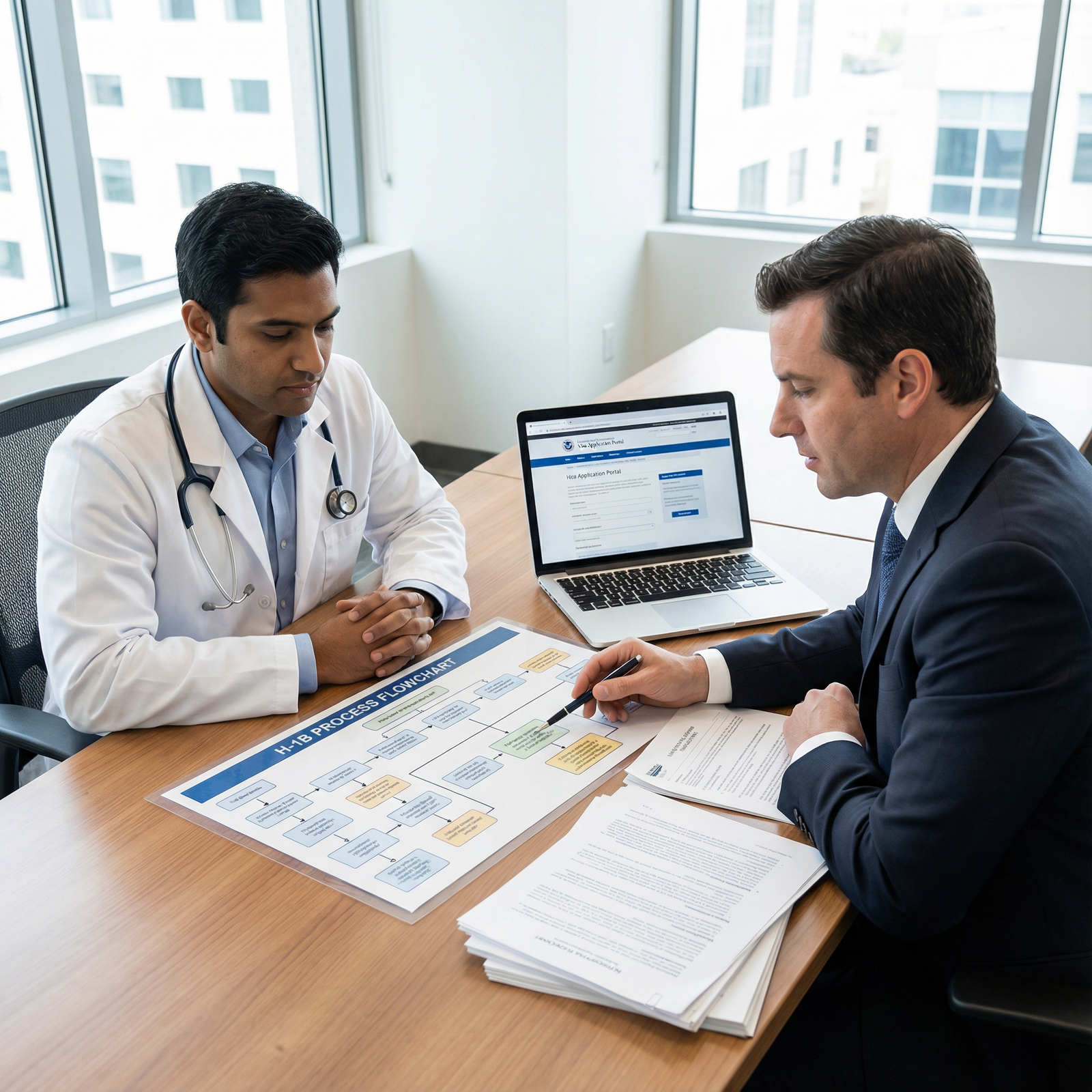
Advanced Considerations: Changing Employers, Extending Status, and Paths to a Green Card
As your career progresses, you may need to change employers, extend your H‑1B, or transition to permanent residency.
Changing Employers: H-1B Portability
You can change employers while in H‑1B status through a process often called an H‑1B transfer (formally, a new I-129 petition by the new employer).
Key points:
- The new employer must file its own H-1B petition and LCA.
- In many cases, you may begin working for the new employer once USCIS receives the new petition (portability), but many physicians and institutions prefer waiting for approval depending on risk tolerance.
- Always maintain valid, continuous status; avoid gaps between positions without legal guidance.
Extending H-1B Status
Standard maximum is six years in H‑1B, but you may qualify for extensions beyond six years if:
- You have an approved employment-based immigrant petition (Form I‑140) and are waiting for an immigrant visa number, or
- You have a labor certification or immigrant petition pending for at least 365 days.
For IMGs on H‑1B who are pursuing a Green Card, these rules are crucial to avoid having to leave the U.S. mid-career.
Transitioning from J-1 to H-1B After Waiver
Many IMGs complete residency and fellowship on a J‑1 and later obtain a J‑1 waiver (e.g., Conrad 30, VA, or hardship/persecution waivers), which allows them to avoid the two-year home residence requirement in exchange for service in underserved areas.
Key considerations:
- The waiver often requires 3 years of service in a specific location and specialty.
- That employment is frequently arranged on an H‑1B Visa, making your H‑1B petition timing and job description tightly tied to waiver obligations.
- Changing locations or employers during the waiver commitment typically requires careful legal planning and sometimes government approvals.
Green Card Pathways for Physicians on H-1B
Common permanent residency options for IMGs include:
- EB-2 National Interest Waiver (NIW) for physicians serving in underserved areas
- EB-2 or EB-3 employer-sponsored Green Cards
- EB-1 in rare cases (e.g., outstanding researchers, certain academic faculty)
The H-1B’s dual-intent nature makes it compatible with pursuing these options without undermining your nonimmigrant status.
FAQs: H-1B Visa for International Medical Graduates
1. What is the H-1B Visa Cap and does it apply to residents and fellows?
The standard H‑1B cap is 65,000 visas per fiscal year, plus an additional 20,000 for individuals with U.S. master’s or higher degrees. However, many IMGs in residency and fellowship are employed by cap-exempt institutions (such as universities and affiliated teaching hospitals), so the cap often does not apply in that context.
If you later move from a cap-exempt employer (university hospital) to a cap-subject employer (certain private practices or community hospitals), you may then need to go through the cap and lottery process.
2. Can I apply for a Green Card while on an H-1B Visa?
Yes. The H‑1B is a dual-intent visa, meaning you can apply for an immigrant visa (Green Card) while maintaining H‑1B status. Many IMGs pursue:
- EB-2 NIW (National Interest Waiver), particularly for service in medically underserved areas
- EB-2/EB-3 employer-sponsored petitions
Discuss your long-term immigration strategy with both your employer (or potential employers) and an immigration attorney early in your career.
3. Can I change employers or jobs while on an H-1B Visa?
You can change employers, but you must go through a new H‑1B petition process—commonly referred to as an H‑1B transfer. The new employer must:
- File a new LCA and Form I-129
- Ensure your new role meets specialty occupation and wage requirements
You typically cannot simply “move” your H‑1B without this process, and significant changes in duties or location may require an amended petition, even with the same employer.
4. What happens if my H-1B petition is denied?
If USCIS denies your H‑1B petition, options may include:
- Filing a motion to reopen or reconsider (if there were errors or new evidence)
- Re-filing with stronger documentation or clarifications
- Considering alternative visa classifications (e.g., J‑1, O‑1 in some cases)
- Adjusting your timeline or employer plans
The best approach depends on why the petition was denied. Carefully review the denial notice with your attorney and employer to develop a strategy.
5. Do all residency programs sponsor H-1B Visas for IMGs?
No. Visa sponsorship policies vary widely. Some programs:
- Sponsor only J-1 visas
- Sponsor H‑1B only for fellowship or attending roles
- Sponsor H‑1B for residents but require USMLE Step 3 and early completion of licensing
Before ranking programs or accepting offers, explicitly clarify:
- Whether they sponsor H‑1B for your training level
- Any additional requirements (Step 3, specific timelines)
- Institutional policies on H‑1B extensions and long-term employment
Conclusion: Strategic Steps for IMGs Navigating the H-1B Process
For International Medical Graduates, the H-1B Visa is more than just paperwork—it is a key that can unlock residency, fellowship, and long-term US employment opportunities. While the visa process is complex, you can significantly improve your chances of success by:
- Understanding how H‑1B differs from J‑1 and what that means for your career goals
- Targeting employers and residency programs with clear, IMG-friendly visa policies
- Starting the process early and staying ahead of licensing, exams, and documentation
- Collaborating closely with GME offices, HR, and immigration counsel
- Thinking strategically about cap-exempt vs. cap-subject options and your Green Card pathway
With deliberate planning, clear communication, and attention to detail, the H‑1B can provide a stable foundation for your medical career in the United States—from residency all the way to attending practice and beyond.