
Introduction: Why Your Visa Choice Matters as an IMG
For International Medical Graduates (IMGs), securing a U.S. residency position is only part of the journey. Equally critical is choosing the right visa pathway. Most IMGs enter residency on either an H-1B Visa or a J-1 Visa, and this decision can shape:
- Where you can work during and after training
- How easily you can pursue a green card
- Whether you must leave the U.S. after training
- The opportunities available to your spouse and family
Both visas are widely used and legitimate pathways for IMGs, but they are very different in long‑term consequences, flexibility, and immigration strategy. Understanding these differences early—before you apply—or at least before you rank programs can help you avoid surprises later.
This guide breaks down:
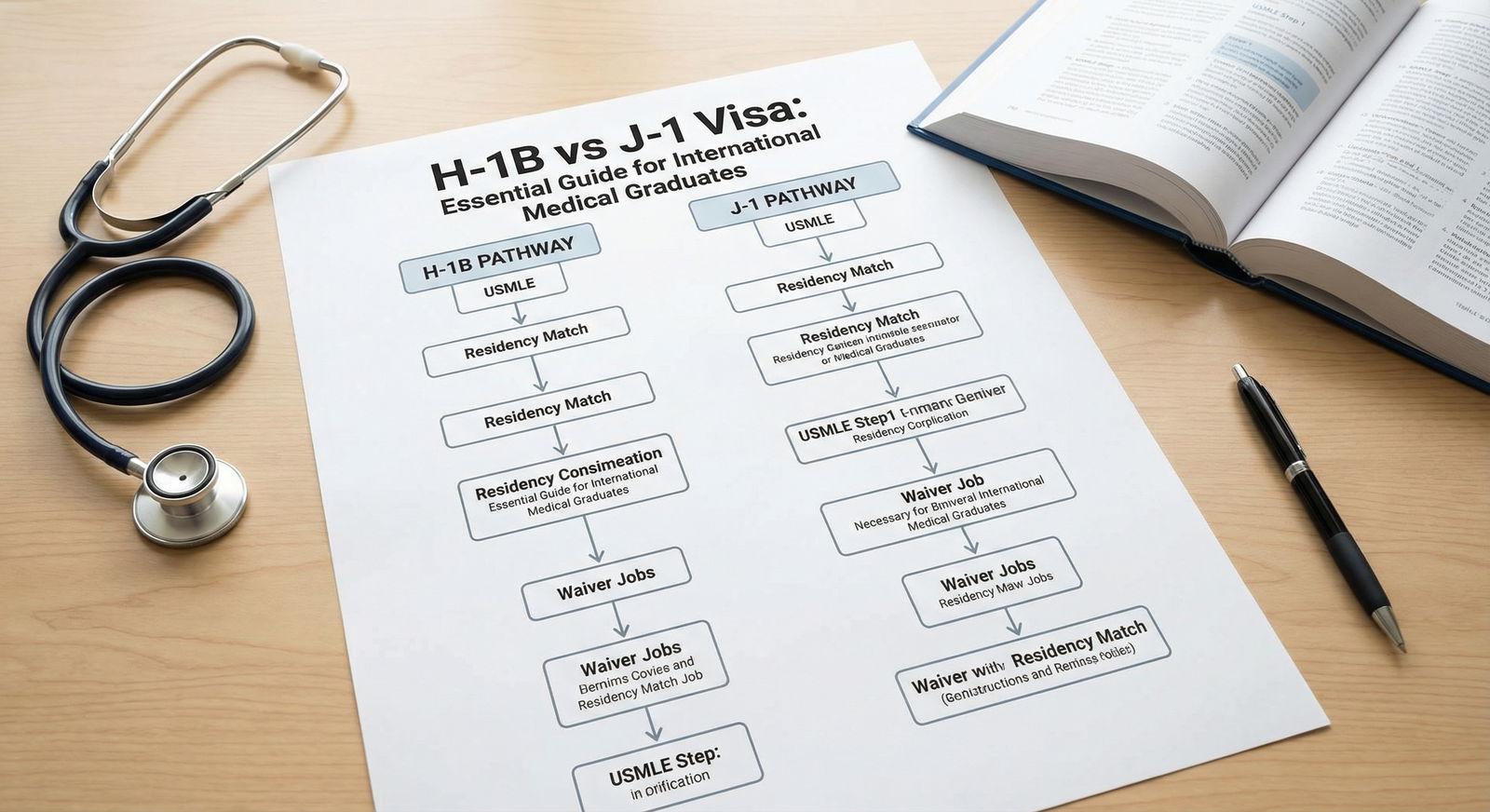
- Core features, pros, and cons of H-1B and J-1
- Side‑by‑side visa comparison focused on residency and fellowship
- Practical factors to consider (career goals, family, timing)
- Common scenarios and strategies used by successful IMGs
Understanding the H-1B Visa for Residency and Fellowship
What Is the H-1B Visa for IMGs?
The H-1B Visa is a non-immigrant visa for “specialty occupations” that require at least a bachelor’s degree, and in medicine, typically an MD/MBBS or equivalent plus required exams and licenses. For IMGs, H-1B is often used for:
- ACGME-accredited residency positions
- Fellowships in recognized subspecialties
- Attending/consultant positions after training
A key feature: H-1B is a dual-intent visa. This means you can legally be in the U.S. on H-1B while pursuing permanent residency (a green card) without violating your status.
Key Features of the H-1B Visa for IMGs
Duration
- Initially granted for up to 3 years
- Renewable to a typical maximum of 6 years
- Extensions beyond 6 years may be possible if you are in the green card process (e.g., approved I-140, pending adjustment of status)
Employer-Specific
- The visa is tied to a particular employer and position
- To change hospitals or job types, a new H-1B petition must be filed
Cap vs. Cap-Exempt
- General H-1B visas are subject to an annual cap (65,000 + 20,000 for U.S. advanced degrees)
- Many residency programs and academic hospitals are cap-exempt if they are:
- Non-profit institutions
- Affiliated with universities
- Government or research organizations
- Cap-exempt status significantly reduces competition and lottery risk
Family Members (H-4)
- Spouse and unmarried children under 21 can enter on H-4 visas
- Spouses on H-4 may be able to work in certain circumstances, typically if:
- You (the H-1B holder) have an approved I-140 immigrant petition
- Children can attend school but cannot work on H-4
Licensing and Exams
- Most states and programs require:
- USMLE Step 1 and Step 2 CK (and sometimes Step 3 before H-1B filing)
- A state training license or equivalent
- Many programs will only sponsor H-1B if you have USMLE Step 3 passed before a certain deadline, so timing is crucial.
- Most states and programs require:
Advantages of the H-1B Visa for IMGs
Direct, Cleaner Path to a Green Card (Dual Intent)
You can:- Start or join a green card process while in training or afterward
- Travel internationally during the process (with appropriate documentation)
This is attractive if your goal is to settle permanently in the U.S..
Better Long-Term Job Mobility in the U.S.
After residency or fellowship:- Any qualified employer (hospital, private group, academic center) can sponsor an H-1B (cap or cap-exempt depending on the employer)
- You are not bound by a 2-year home return requirement, giving more flexibility in job choices and timing.
Stability for Those Planning Multiple Fellowships
You can typically:- Complete residency on H-1B
- Move to fellowship on a new H-1B (often cap-exempt if at academic centers)
- Progress to an attending job without leaving the U.S. for a mandated period.
Predictable Immigration Strategy with Early Planning
Because H-1B aligns well with employment-based immigration, many IMGs strategically:- Use H-1B for residency/fellowship
- Transition smoothly into EB-2 or EB-3 green card sponsorship with their employer.
Disadvantages and Challenges of the H-1B Visa
More Stringent Requirements and Processing Complexity
Programs that sponsor H-1B often require:- USMLE Step 3 passed early
- Additional legal and filing fees
- Detailed wage and labor condition documentation
As a result, many community programs do not sponsor H-1B or limit it to exceptional circumstances.
Cap and Lottery (for Cap-Subject Employers)
If your employer is subject to the annual H-1B cap:- You may have to enter an H-1B lottery
- There is no guarantee of selection in a given year
- This can create anxiety around start dates and long-term planning
Fortunately, most large academic residency programs are cap-exempt, but post-training jobs in private practice may be cap-subject.
Employer Dependence
- Your legal status is tightly tied to your employer
- Job changes require new H-1B filings; gaps or terminations can jeopardize status
- Moonlighting is restricted and must typically be specifically authorized on your H-1B petition.
Costs and Administrative Burden
- H-1B petitions are more costly and administratively demanding than J-1 sponsorship
- Some programs prefer J-1 because ECFMG handles most of the logistics
Understanding the J-1 Visa for IMGs
What Is the J-1 Visa for Physicians?
The J-1 Visa is an exchange visitor visa designed to promote educational and cultural exchange. For physicians, the J-1 is managed primarily through the Educational Commission for Foreign Medical Graduates (ECFMG).
Most IMGs in residency programs in the U.S. are sponsored on a J-1 Visa, Physician Category, which covers:
- ACGME-accredited residency programs
- ACGME-accredited fellowships and recognized subspecialties
Key Features of the J-1 Visa for IMGs
Duration of Stay
- Typically valid for the length of your training program
- Many IMGs complete:
- 3-year internal medicine or pediatrics
- 4–7 years for surgical specialties
- Maximum total J-1 physician training time is generally 7 years, with limited exceptions
Two-Year Home Country Physical Presence Requirement (212(e))
- Most J-1 physicians are subject to a 2-year home-country residence requirement after training
- Before applying for:
- H-1B Visa
- L Visa
- Green card (permanent residency)
- They must either:
- Fulfill this 2-year requirement, or
- Obtain a J-1 waiver
Family Members (J-2)
- Spouse and children under 21 can join on J-2 visas
- J-2 spouses can apply for work authorization (EAD) and generally have more flexible employment options than H-4 spouses (before I-140 approval)
Program and Institution Specific
- The J-1 is sponsored for a specific training program at a specific institution
- Any changes in training site, level, or specialty must be approved by ECFMG
Advantages of the J-1 Visa for IMGs
No Annual Cap and Broad Availability
- There is no numerical cap on J-1 physician visas
- Most U.S. residency programs are accustomed to sponsoring J-1 through ECFMG
- Programs often find the J-1 process simpler and more predictable than H-1B
Streamlined Application via ECFMG
- ECFMG serves as the centralized sponsor and liaison
- Programs and applicants follow a set, well-established process
- Less variation and less employer-side paperwork compared to H-1B
Widespread Acceptance Among Residency Programs
- Many community and university programs only sponsor J-1 for IMGs
- As an applicant, being open to J-1 can greatly expand the number of programs you can realistically match into
J-2 Spouse Employment Flexibility
- J-2 spouses can obtain work authorization in a wide variety of roles
- This can significantly help family finances during residency and fellowship
Disadvantages and Complexities of the J-1 Visa
Two-Year Home Country Requirement
- The most significant drawback: the 212(e) rule
- Without a waiver, you cannot:
- Change to H-1B or L-1 within the U.S.
- Obtain a green card or immigrant visa
- This requirement can delay long-term U.S. career plans by at least two years
Need for a J-1 Waiver to Stay in the U.S. After Training
- Many J-1 physicians pursue waivers, such as:
- Conrad 30 waivers (state-sponsored, usually in underserved areas)
- Interested Government Agency (IGA) waivers (e.g., VA, HHS)
- Hardship or persecution waivers (less common, complex)
- Securing a waiver is competitive and often geographically restrictive
- Many J-1 physicians pursue waivers, such as:
Limited Job Flexibility During Training
- You must remain in the ECFMG-approved program and site
- Significant changes (switching specialty, prolonged research years, or multiple transfers) may be difficult or not permitted
- Moonlighting is often restricted and must comply with J-1 rules and ECFMG policies
More Complex Path to Permanent Residency
- Most J-1 physicians must:
- Complete training
- Obtain a J-1 waiver job (often in a medically underserved area)
- Work there for at least 3 years
- Then transition to H-1B or another status, and only then proceed with green card sponsorship
This is entirely feasible—thousands of IMGs do it—but it requires multi-step planning.
- Most J-1 physicians must:
H-1B vs J-1 Visa Comparison: What IMGs Need to Weigh
Side-by-Side Comparison
| Feature | H-1B Visa (for IMGs) | J-1 Visa (Physicians) |
|---|---|---|
| Primary Use | Employment in specialty occupations (residency, fellowship, attending) | Training and exchange in residency and fellowship |
| Intent | Dual intent (can pursue green card) | Non-immigrant, no immigrant intent |
| Duration | 3 years initial, up to 6 (or longer with green card process) | Length of training, typically 3–7 years (overall cap usually 7 years) |
| Cap | Annual cap for cap-subject employers; many academic hospitals are cap-exempt | No annual numerical cap |
| Two-Year Home Requirement | No | Yes, for most J-1 physicians (212(e)) unless waived |
| Post-Training Options | Can transition directly to H-1B jobs, then green card | Often must get a J-1 waiver job (e.g., Conrad 30) before H-1B/green card |
| Job Flexibility During Training | Possible with new H-1B petition, but employer-specific | Limited to ECFMG-approved program and site |
| Spouse Work Authorization | H-4 spouse can work only after certain green card milestones | J-2 spouse can apply for EAD and work broadly |
| Common Among Programs | Fewer programs sponsor H-1B, many limit sponsorship | Widely accepted; many programs sponsor only J-1 |
Key Factors to Consider When Choosing Between H-1B and J-1
1. Long-Term Career and Immigration Goals
If your top priority is permanent settlement in the U.S., ask:
Do you want the most direct path to a green card?
- H-1B may be better because of dual intent and no mandatory 2-year return.
Are you comfortable with working in an underserved or rural area for a few years after training?
- J-1 with a Conrad 30 waiver can be an excellent route, especially in primary care, psychiatry, or other high-need specialties.
Are you open to returning home temporarily?
- If you are planning to eventually return home anyway, the J-1’s 2-year requirement may be less of an issue.
2. Specialty and Competitiveness
Your chosen specialty affects which visa pathway is realistic:
Highly competitive specialties (e.g., dermatology, plastic surgery, certain surgical subspecialties)
- May have limited IMG positions overall, and even fewer H-1B sponsors
- Being open to J-1 could increase your options
Primary care specialties (Internal Medicine, Family Medicine, Pediatrics, Psychiatry):
- More positions sponsor J-1
- Also more J-1 waiver job opportunities after training
If your specialty is already narrow and competitive, you might prioritize maximizing your match chances (often via J-1) over visa-specific preferences.
3. Residency Program Policies and Flexibility
Each program has its own visa policy:
- Some only sponsor J-1 for IMGs
- Some sponsor both J-1 and H-1B, but H-1B might:
- Require Step 3 by a certain date
- Be limited to certain departments or only in rare cases
- A smaller subset strongly prefer H-1B or are well-known for it
Actionable advice:
- Check program websites carefully (Visa and IMG sections)
- Email program coordinators if the policy is unclear:
- Ask explicitly: “Do you sponsor H-1B Visa for residency for IMGs?”
- When creating your rank list, weigh visa policy if you have a strong preference.
4. Exam Timeline and Preparedness (Especially for H-1B)
To be a realistic candidate for H-1B sponsorship:
- Plan to:
- Complete USMLE Step 3 early (ideally before residency starts or soon after Match)
- Obtain necessary state training licenses efficiently
Delays in Step 3 can prevent H-1B filing in time, forcing some applicants to:
- Accept a J-1 instead, or
- Postpone start dates (which may not be allowed by the program)
If you are still early in your exam journey and unsure you can complete Step 3 on time, remaining open to J-1 sponsorship may be wise.
5. Family Situation and Spousal Career
If you have a spouse or plan to bring family:
On H-1B (H-4 dependents):
- Spouse’s ability to work may be delayed until your green card process reaches specific milestones (e.g., approved I-140)
- This can mean several years with limited work opportunities for them
On J-1 (J-2 dependents):
- Spouse can apply for a work permit (EAD) relatively quickly
- They can work in almost any field (not limited to a specific employer)
For many IMGs whose spouse has a strong professional background or needs to support the family financially, this can be a major consideration.
6. Risk Tolerance and Flexibility
- If you want a highly predictable, straightforward pathway during residency, J-1 (via ECFMG) is often smoother.
- If you are comfortable navigating more complex immigration steps up front in exchange for a more flexible long-term path, H-1B can be worth the effort.
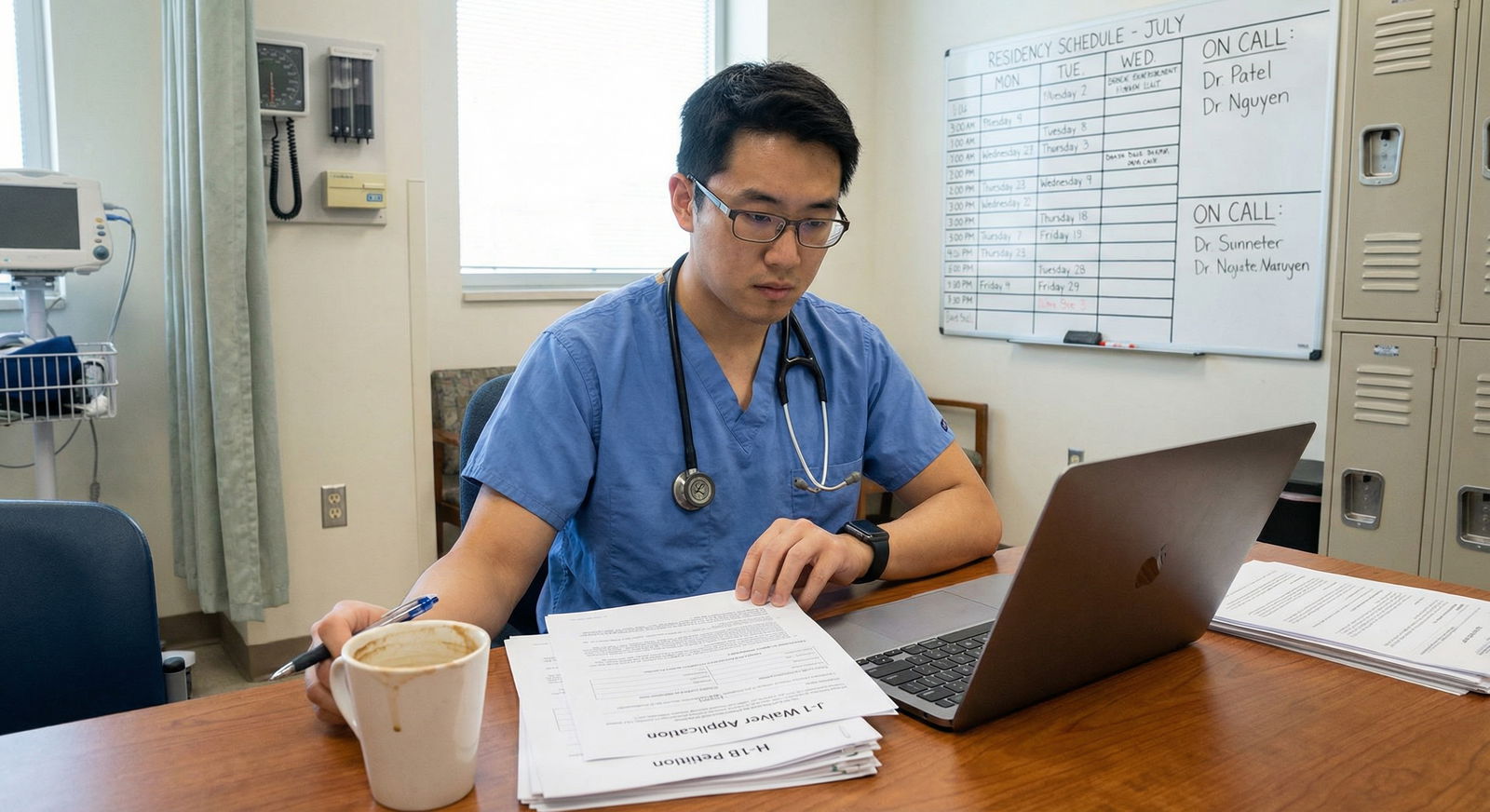
Practical Scenarios: How IMGs Commonly Navigate H-1B vs J-1
Scenario 1: IMG Focused on U.S. Academic Career and Research
- Goal: Long-term academic position, research, possible multiple fellowships
- Likely Best Fit: H-1B, if available
- Easier to:
- Transition between residencies/fellowships at academic centers
- Start the green card process early
- Remain in large academic cities without a compulsory underserved-area stint
- Easier to:
Scenario 2: Primary Care IMG Open to Underserved Areas
- Goal: Internal Medicine, Family Medicine, or Pediatrics; open to working in rural or underserved communities after training
- Likely Path: J-1 → J-1 Waiver Job → H-1B → Green Card
- Common steps:
- Residency on J-1
- Secure a Conrad 30 waiver or other J-1 waiver job in an underserved area
- Work 3 years in that job (on H-1B)
- Employer sponsors you for a green card
- Common steps:
This route is very common and absolutely viable but requires geographic flexibility.
Scenario 3: IMG With Strong Preference to Avoid the 2-Year Home Requirement
- Goal: Remain in the U.S. continuously after training without being obligated to leave or seek a waiver
- Likely Strategy:
- Target programs known to sponsor H-1B
- Prioritize completing USMLE Step 3 early
- Narrow the rank list to H-1B-friendly programs (even if that means fewer choices)
This strategy can limit the number of programs you apply to or rank, so consider the trade-off with match probabilities.
Conclusion: Making an Informed Visa Choice as an IMG
Choosing between the H-1B Visa and J-1 Visa is much more than checking a box on an application—it is a strategic decision that can influence:
- Where you Match
- How easily you switch jobs or pursue fellowships
- Whether you must work in underserved areas post-training
- Your spouse’s employment options
- Your path to a green card and long-term stability in the U.S.
Key takeaways:
H-1B Visa
- Best aligned with long-term U.S. immigration plans and direct green card strategies
- Requires more upfront preparation (especially Step 3 and program selection)
- Fewer programs sponsor it, but it offers greater long-term flexibility
J-1 Visa
- More widely available, simpler for programs to sponsor, and often easier to obtain
- Involves the two-year home requirement, usually resolved by a J-1 waiver job
- Can still lead to permanent residency, but via a more stepwise route
Start your planning early:
- Review the visa policies of target residency programs
- Map your exam timeline to visa requirements (particularly for H-1B)
- Discuss your long-term goals with mentors, advisors, and if needed, an experienced immigration attorney
With thoughtful preparation and a clear understanding of each option, you can choose the visa pathway that best supports both your professional ambitions and your personal life as an International Medical Graduate pursuing residency in the United States.
FAQ: H-1B vs J-1 Visa for International Medical Graduates
1. What is the primary difference between H-1B and J-1 visas for IMGs?
The core difference lies in immigration intent and post-training obligations:
H-1B Visa:
- Dual intent (you can pursue a green card while on H-1B)
- No automatic requirement to return home for two years
- Often a more straightforward path to permanent residency
J-1 Visa:
- Non-immigrant, exchange-visitor status
- Most J-1 physicians are subject to a 2-year home-country physical presence requirement after training
- To stay in the U.S. and move to H-1B or a green card, you usually must first obtain a J-1 waiver or complete the 2-year return
2. Can I switch from a J-1 Visa to an H-1B Visa?
Yes, but it is conditional:
- If you are subject to the 2-year home requirement (212(e)), you must either:
- Fulfill the 2 years in your home country, or
- Obtain an approved J-1 waiver (e.g., Conrad 30, IGA waiver, hardship/persecution waiver)
Only after that can you change to H-1B or apply for an immigrant visa/green card. This transition is common but often tied to specific employment commitments (e.g., 3 years in an underserved area).
3. Which visa is generally easier to obtain for residency: H-1B or J-1?
In practice, for most IMGs:
J-1 Visa is generally easier and more common because:
- There is no annual numerical cap
- ECFMG provides a well-established process
- Many residency programs only sponsor J-1
H-1B Visa may be more competitive due to:
- Program limitations (not all sponsor H-1B)
- Additional requirements such as USMLE Step 3
- Employer costs and paperwork
However, “easier” must be balanced against long-term career and immigration goals.
4. Can my spouse work in the U.S. if I am on H-1B or J-1 during residency?
Yes, but the conditions differ:
If you are on H-1B (spouse on H-4):
- Your spouse may only work if certain conditions are met in your green card process (e.g., approved I-140)
- Until then, H-4 spouses usually cannot work but can study
If you are on J-1 (spouse on J-2):
- Your spouse can apply for an Employment Authorization Document (EAD)
- Once approved, they can work in most jobs not limited to a specific employer
This difference is important if your spouse’s career or income is a major factor in your decision.
5. Which visa do U.S. residency programs prefer: H-1B or J-1?
Preferences vary by program:
- Many university and community programs routinely sponsor J-1 and may list it as their standard visa option for IMGs.
- Some larger academic centers sponsor both J-1 and H-1B, but may:
- Limit H-1B to certain specialties or candidates
- Require early completion of USMLE Step 3
- A few programs are known for robust H-1B sponsorship, particularly those focusing on long-term recruitment of IMGs into faculty roles.
Always verify each program’s policy on their website or by contacting the program coordinator, and factor this into your application and rank list strategy.