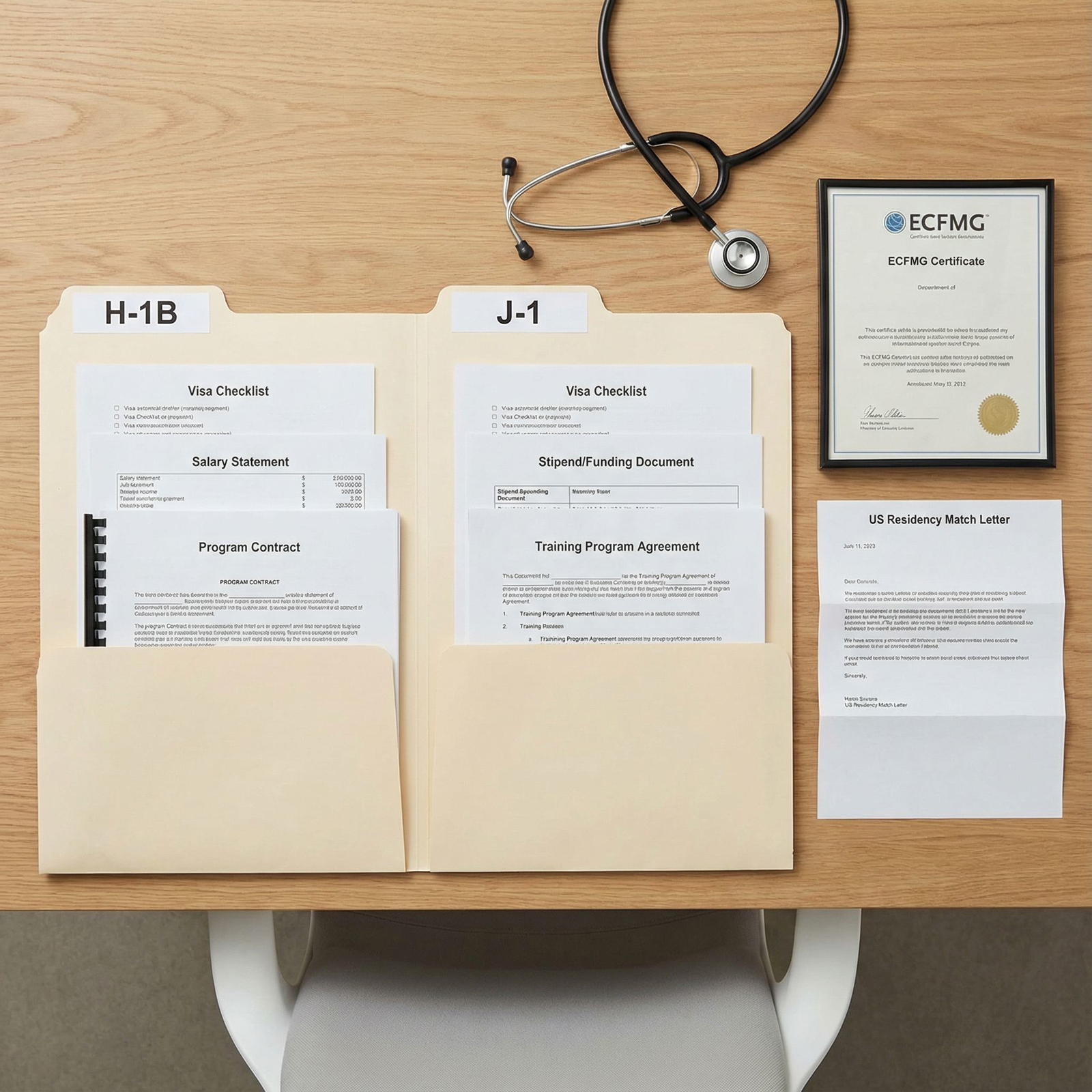
For International Medical Graduates (IMGs) planning to complete medical training and practice in the United States, choosing between the H-1B Visa and the J-1 Visa is one of the most consequential early decisions you will make. Both visa options open doors to residency and fellowship training, but they lead to very different immigration and career trajectories.
This guide walks through the key differences, practical implications, and strategic considerations of the H-1B vs. J-1 Visa for IMGs navigating the residency match and beyond.
Understanding Core Visa Options for IMGs in U.S. Medical Training
Why This Choice Matters So Much
For IMGs, the visa category you enter with is more than just a travel document—it shapes:
- How easily you can change programs or jobs
- Your options to remain in the U.S. after training
- The timeline and feasibility of obtaining a green card
- Whether you must return to your home country before progressing
- Where you may be required to work (e.g., underserved areas) to stay in the U.S.
Because residency and fellowship applications often require you to declare or at least consider your preferred visa type, it is wise to understand the landscape well before ERAS submissions and ranking programs.
H-1B Visa for International Medical Graduates
The H-1B Visa is a non-immigrant visa for “specialty occupations” requiring at least a bachelor’s degree (and in practice, for physicians, an MD/MBBS or equivalent, plus appropriate licensing exams). Many academic and large community programs use the H-1B to sponsor residents, fellows, and attending physicians.
Key Features of the H-1B Visa
- Nature of visa: Employment-based visa for a specific employer and position
- Typical duration:
- Initial approval up to 3 years
- Renewable for up to a total of 6 years (with exceptions if you are in the green card process)
- Sponsorship:
- Petition filed by the employer (hospital, university, health system, or practice)
- Includes a Labor Condition Application (LCA) attesting to appropriate wage and working conditions
- Dual intent:
- H-1B is a “dual intent” visa, meaning you can pursue permanent residency (green card) while in H-1B status without violating the terms of your stay
H-1B and Medical Training: Practical Realities
For resident and fellow physicians, H-1B use has some particular requirements:
- USMLE requirements: Many programs require that you have all three Steps (1, 2 CK, 3) completed before H-1B filing. This makes timing critical, as you may need Step 3 completed before starting residency if using H-1B.
- State licensing: Some states require temporary or training licenses that are compatible with H-1B rules; your program’s GME office will usually coordinate this.
- Cap-exempt status for training programs:
- Academic medical centers and many teaching hospitals are “cap-exempt” employers, meaning their H-1B petitions are not subject to the national annual H-1B cap or lottery.
- This is a major advantage over typical private-sector H-1B employment.
Advantages of H-1B for IMGs
Clear pathway to a green card
Because of dual intent, it is usually straightforward for employers to sponsor you later for permanent residency (via EB-2, EB-3, or other categories). You do not need to depart the U.S. to start the green card process.No two-year home residency requirement
Unlike most J-1 physicians, H-1B IMGs are not subject to the J-1 two-year home-country physical presence rule, which can be a major barrier to staying in the U.S.Flexibility to change employers (with caveats)
- You can change employers if a new employer files a new H-1B petition (often called an “H-1B transfer”).
- Cap-exempt status may not automatically carry over if you leave academic medicine for a purely private practice; this is a subtle but critical point to clarify with an immigration attorney.
Potentially higher compensation post-training
Many employers offering H-1B positions for attending roles may provide higher salaries, especially in in-demand specialties or geographic areas.
Drawbacks and Limitations of H-1B for IMGs
Not all residency programs sponsor H-1B
Many programs accept only J-1 Visa trainees due to lower administrative burden, cost, and institutional policy. This can significantly limit your program options if you insist on H-1B only.Administrative complexity and cost
- Higher legal and filing fees for the employer
- More documentation (e.g., LCAs, wage determinations)
- Some programs are reluctant to commit to this extra work, especially for preliminary or transitional years.
Time limitation
The base 6-year maximum can be a constraint if you complete:- A long residency (e.g., neurosurgery) plus
- One or more fellowships
That said, if a green card petition is in process at specific stages, extensions beyond 6 years may become possible.
J-1 Visa for IMGs in U.S. Residency and Fellowship
The J-1 Visa for physicians is an exchange visitor category managed for most trainees by the Educational Commission for Foreign Medical Graduates (ECFMG). It is designed specifically to facilitate medical education and training in the U.S.
Key Features of the J-1 Physician Visa
Nature of visa:
- Exchange visitor visa with a primary goal of education and cultural exchange
- For IMGs, administered via ECFMG sponsorship as the “J-1 physician” category
Duration and limits:
- Generally granted for the length of your ACGME-accredited training program
- Total maximum duration for physician training is typically 7 years, with limited exceptions (e.g., advanced fellowship structures with special approval)
Sponsorship:
- Your direct sponsor is ECFMG, not the hospital itself
- You must:
- Hold a valid ECFMG certificate
- Have an offer from an ACGME-accredited residency or fellowship program
- Meet other ECFMG and consular requirements
Two-year home-country physical presence requirement (212(e)):
- Most J-1 physician trainees incur a mandatory 2-year foreign residency requirement
- You must spend a total of 2 years in your country of nationality or most recent residence before you are eligible for
- H-1B, L-1, K visas, or
- Permanent residency (green card)
- This requirement can be waived under specific conditions (see below).
Advantages of the J-1 Visa for IMGs
Widely accepted by residency and fellowship programs
- Many U.S. programs prefer or exclusively use J-1 for IMGs
- That means more programs to apply to and rank, especially in competitive specialties
No federal numeric cap
- Unlike most H-1B categories, the J-1 physician visa is not subject to an annual numerical cap or lottery
- If you meet requirements and your program and ECFMG support you, you are not competing for limited national visa numbers
** Designed specifically for medical training**
- ECFMG and program GME offices are very familiar with the process
- Extensions, transfers between programs, and support are standardized and structured through ECFMG policies
Reduced immediate pressure about green card strategy
- For many IMGs who are initially focused on obtaining quality training and board eligibility, J-1 offers a well-established route without needing an employer ready to sponsor an H-1B from day one.
Disadvantages and Risks of the J-1 Path
Two-year home-country requirement
This is the single biggest drawback for most IMGs who hope to remain in the U.S. long-term.- Without a waiver, you must return to your home country (or country of last residence) for a total of 2 years.
- During that time, you cannot obtain:
- H-1B or L-1 visas
- A green card
- You can apply for certain other nonimmigrant visas (e.g., B-1/B-2 or F-1), but these do not solve the long-term practice issue.
Dependence on a J-1 waiver for U.S. practice
The most common route to stay in the U.S. after J-1 training is to obtain a J-1 waiver job. Typically this means:- Serving in an underserved or shortage area
- Working full-time for 3 years in a designated setting (e.g., Conrad 30 programs, VA programs, federal agencies)
- Only after completing this service can you freely move toward green card processing or other jobs
Less flexibility in mid-training changes
- Transfers between programs or specialties require ECFMG approval and new DS-2019 forms
- Switching specialties mid-training can be more complex than with H-1B, especially if it risks exceeding the 7-year cap
Head-to-Head Comparison: H-1B vs. J-1 Visa Options for IMGs
Eligibility and Entry Requirements
H-1B Visa
- Must have a U.S.-equivalent medical degree
- Typically need:
- USMLE Step 1, Step 2 CK, and often Step 3 completed before starting
- State eligibility for licensure or training license
- Employment must qualify as a specialty occupation with appropriate wage levels
J-1 Visa (Physician)
- Must have an ECFMG certificate (which requires USMLE Step 1 and Step 2 CK, among other components)
- Acceptance into an ACGME-accredited residency or fellowship
- No Step 3 requirement for initial visa issuance (though Step 3 is later needed for licensure/board certification in many states)
Financial and Career Considerations
Residency and fellowship salaries
- In most ACGME programs, stipends are similar whether you are on J-1 or H-1B; they follow PGY levels set by the institution, not visa type.
- Differences may arise in:
- Ability to moonlight (often more feasible on H-1B, but varies by state and institution)
- Post-training job offers (many employers are more comfortable sponsoring H-1B attendings)
Cost to you vs. your employer
- H-1B: Higher filing and legal fees (usually borne by the employer). Some smaller programs or practices avoid H-1B for this reason.
- J-1: ECFMG charges some fees, but these are generally lower and the process is standardized.
Long-Term Immigration Strategy and Green Card Path
H-1B
- You can start the green card process at almost any point once you and your employer are ready, after meeting typical requirements.
- No need to leave the U.S. or fulfill a home residency requirement.
- Common path:
- H-1B for residency/fellowship
- H-1B for attending position
- Employer-sponsored PERM (if needed) → I-140 → Adjustment of Status (I-485)
J-1
- Two main routes:
- Return home for 2 years, then become eligible to pursue H-1B/green card
- Obtain a J-1 waiver by:
- Conrad 30 programs through states
- Federal agencies (e.g., VA, HHS, NIH)
- Hardship or persecution waiver (for special circumstances)
- After receiving a J-1 waiver and changing to H-1B, you typically must complete 3 years of service in the approved job before moving freely into other green card options.
- Two main routes:
Flexibility in Employment and Location
H-1B Visa
- More flexible for post-training employment in non-underserved, desirable urban or academic settings
- Job changes require new petitions but not a waiver or service commitment
- However, moving from cap-exempt training to a cap-subject private employer can introduce complexity regarding the H-1B cap.
J-1 Visa
- During training, location is tied to your residency/fellowship program and ECFMG’s DS-2019.
- After training, a J-1 waiver job may strongly restrict your location to underserved or designated areas for several years.
How to Choose: Strategic Considerations for IMGs
1. Clarify Your Long-Term U.S. Career Goals
Ask yourself:
- Do you hope to settle long-term in the United States and ultimately obtain a green card?
- Are you open to returning to your home country for at least two years after training?
- Would you be willing to work in a rural or underserved area for 3+ years if that is the clearest path to remaining in the U.S.?
If long-term U.S. practice is a high priority and you prefer maximum flexibility in location, H-1B is often the better match—if you can secure it. If your primary priority is access to the widest range of residency programs, J-1 may be more practical.
2. Assess Your Competitiveness and Specialty Choice
- Highly competitive specialties or elite academic programs may only offer J-1 for IMGs.
- Some community or mid-sized academic programs are more open to H-1B sponsorship, especially in high-need fields (e.g., internal medicine, family medicine, psychiatry).
A realistic appraisal of your competitiveness (scores, research, clinical experience) and desired specialty can guide how strongly you can insist on H-1B when contacting or ranking programs.
3. Timing of Exams and Documentation
- If you are leaning strongly toward H-1B, prioritize completing USMLE Step 3 early, ideally before Match or soon after, to avoid delays in starting residency.
- For J-1, the focus is on ECFMG certification and program acceptance; Step 3 timing is less critical for entry, though it will matter later for licensing.
4. Program Policies and Communication
Always verify each program’s visa policy:
- Check their website and FREIDA listing
- Email the program coordinator or director if unclear
- Ask explicitly:
- “Do you sponsor H-1B Visa for IMGs, or only J-1 Visa?”
- “Do you require USMLE Step 3 for H-1B sponsorship?”
Use this information to shape your application list and ranking strategy.
J-1 Waivers: A Critical Concept for Long-Term Planning
For many J-1 IMGs who hope to remain in the U.S., obtaining a J-1 waiver becomes the central challenge after residency or fellowship.

Common J-1 Waiver Pathways
Conrad 30 Program (State-based waivers)
- Each U.S. state can sponsor up to 30 J-1 physicians per year to work in Health Professional Shortage Areas (HPSAs) or Medically Underserved Areas (MUAs).
- Typically requires:
- Full-time employment (often 40 hours/week)
- 3-year contract
- Service in a qualifying location
- Very common for primary care and often available in some specialties in high-need regions.
Federal Agency Waivers
- Certain federal agencies (e.g., VA, HHS, Department of Defense, Appalachian Regional Commission) can sponsor waivers for physicians working in their systems or projects.
- Useful if you secure a job at a VA hospital, research institution, or other eligible employer.
Hardship or Persecution Waivers
- If returning to your home country would cause exceptional hardship to a U.S. citizen or permanent resident spouse or child, or if you fear persecution, you may apply for a waiver on those grounds.
- These are more complex, case-specific, and generally require experienced legal support.
Life After a J-1 Waiver
Once your waiver is approved, you typically:
- Change to H-1B status for the waiver job
- Complete the required 3-year service commitment
- During or after that period, your employer may start a green card process (e.g., PERM → I-140 → I-485)
- After fulfilling the required service, you can change employers more freely or move into different roles while continuing green card processing
Planning ahead—ideally during your final years of training—makes this transition smoother.
Summary: Matching Visa Options to Your IMG Career Path
Choose H-1B Visa if:
- You can secure a program/employer willing to sponsor it
- You have (or will soon have) USMLE Step 3
- You want the most direct and flexible route to permanent residency
- You want to minimize restrictions such as home residency requirements or mandatory rural service
Choose J-1 Visa if:
- Your priority is broad access to ACGME-accredited programs, especially those that do not sponsor H-1B
- You are prepared for:
- The two-year home-country rule, or
- Pursuing a J-1 waiver in an underserved area
- You need a streamlined, structured route into U.S. medical training without complex H-1B demands during residency entry
Regardless of the path, consult with:
- Your prospective residency/fellowship program’s GME office
- An experienced immigration attorney familiar with physician visas
- Senior residents, fellows, or attendings who have gone through the same process
Their insights, combined with a clear understanding of H-1B and J-1 mechanics, will help you choose the visa route aligning best with your professional trajectory and personal priorities.
FAQs: H-1B vs. J-1 Visa for IMGs
1. Can I switch from J-1 to H-1B without completing the two-year home residency requirement?
Not directly. If you are subject to the J-1 two-year home-country physical presence requirement, you cannot change to H-1B status or obtain an H-1B visa until you either:
- Complete the 2 years in your home country, or
- Obtain an approved J-1 waiver (e.g., Conrad 30, federal agency, hardship, persecution)
Once a waiver is granted and you have an H-1B petition approved, you can change to H-1B status and begin working in the waiver job.
2. Is it harder to match into U.S. residency with H-1B than with J-1?
In many cases, yes. Fewer programs sponsor H-1B Visa for IMGs compared to J-1 Visa. Programs may:
- Prefer J-1 because it is administratively simpler and less costly
- Require USMLE Step 3 for H-1B sponsorship, which some applicants have not yet completed
If you insist on H-1B only, you will likely need to narrow your program list to those explicitly open to H-1B, which can reduce your match opportunities.
3. Can my family accompany me on both H-1B and J-1 visas, and can they work?
Yes, both visa types allow dependents:
H-1B dependents come on H-4 status
- Spouses on H-4 may be able to get work authorization (EAD) only in specific circumstances, such as when the H-1B principal has reached certain stages of the green card process.
- Children (under 21) on H-4 cannot work but can attend school.
J-1 dependents come on J-2 status
- J-2 spouses and children may apply for work authorization (EAD) in many cases and can work once it is approved, subject to USCIS and consular regulations.
4. How early should I decide between aiming for H-1B or J-1 as an IMG?
You should begin considering this at least a year before applying to residency, ideally during:
- USMLE planning
- Clinical electives or observerships in the U.S.
- Preparation of your ERAS application
Early planning helps you:
- Schedule USMLE Step 3 if you want to keep the H-1B route open
- Build a realistic list of programs based on their visa sponsorship policies
- Have informed discussions with mentors and potential program directors
5. Do I need an immigration lawyer, or can I navigate this on my own?
While many IMGs complete the initial J-1 or H-1B process without hiring personal legal counsel (because the employer or ECFMG handles much of it), you should strongly consider consulting an immigration attorney when:
- Evaluating complex situations (e.g., prior visa history, inadmissibility issues)
- Planning a J-1 waiver strategy
- Transitioning from J-1 to H-1B or starting a green card process
- Changing employers from a cap-exempt to cap-subject H-1B environment
An attorney who regularly works with physicians and IMGs can help you avoid missteps that might delay or derail your U.S. medical career.
By understanding the nuances of H-1B Visa and J-1 Visa options for International Medical Graduates, you position yourself to make a strategic, informed decision that aligns with both your training goals and your long-term vision for practicing medicine in the United States.