Introduction: Why the J-1 Visa Matters for International Medical Graduates
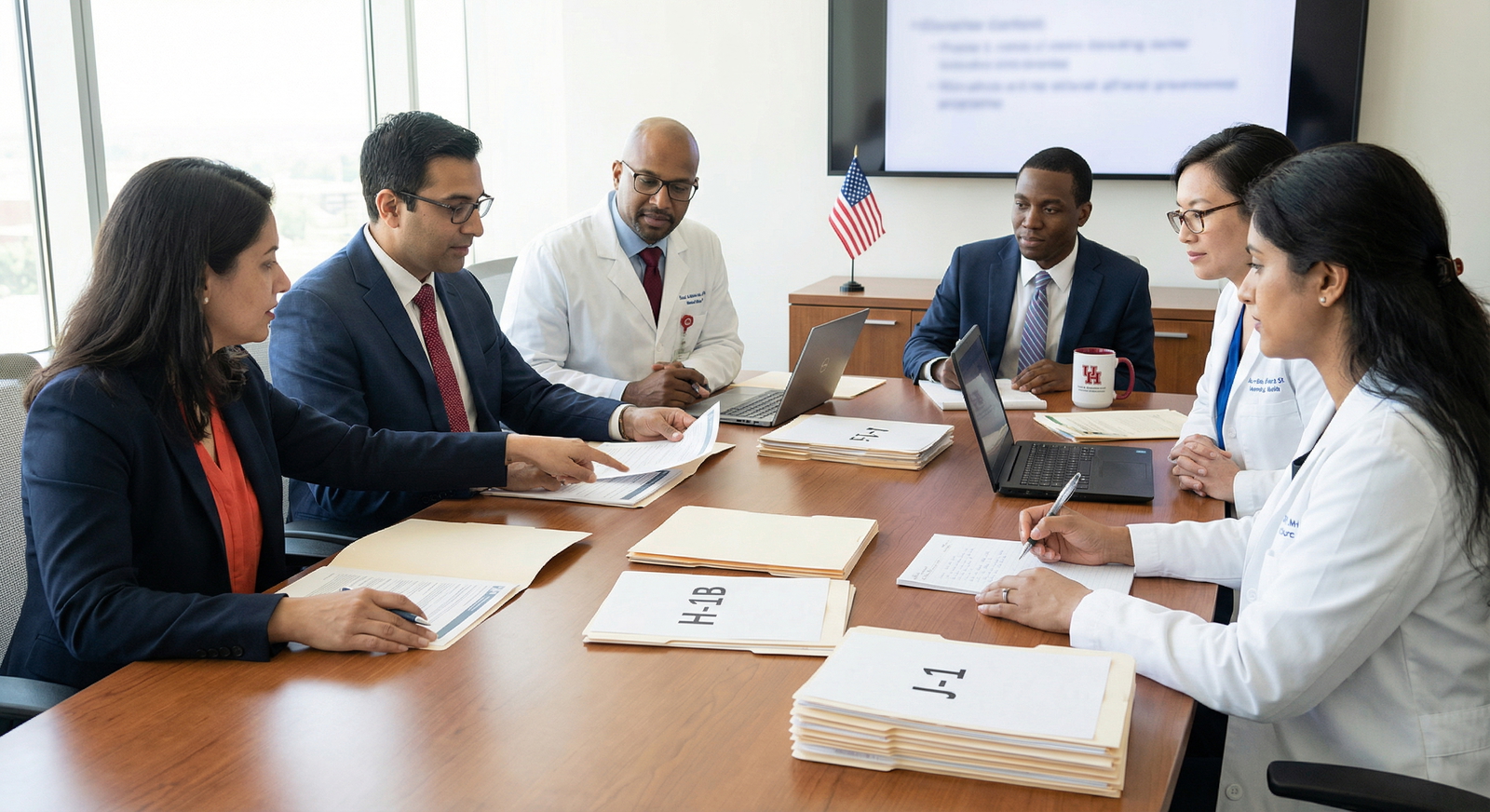
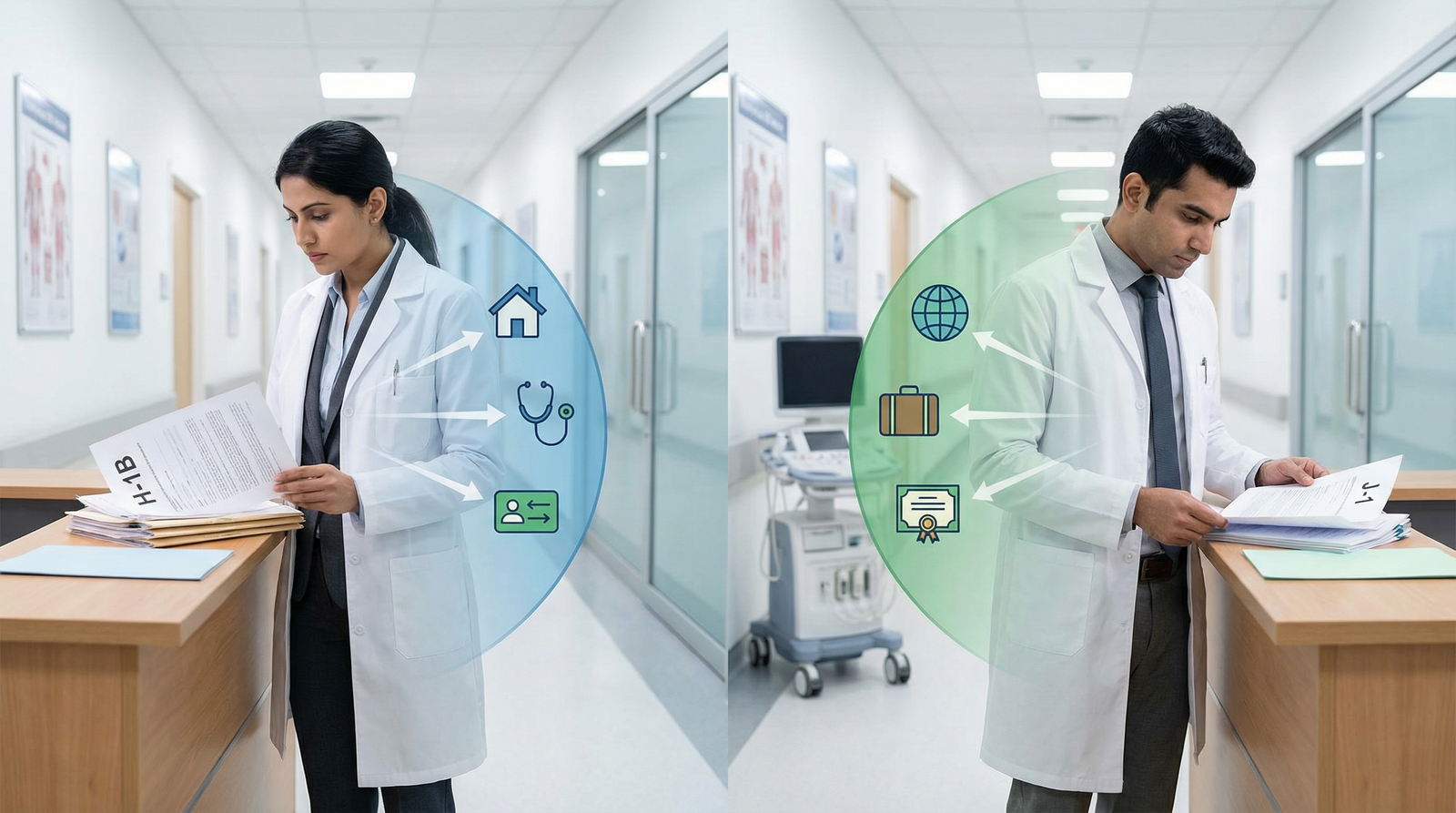
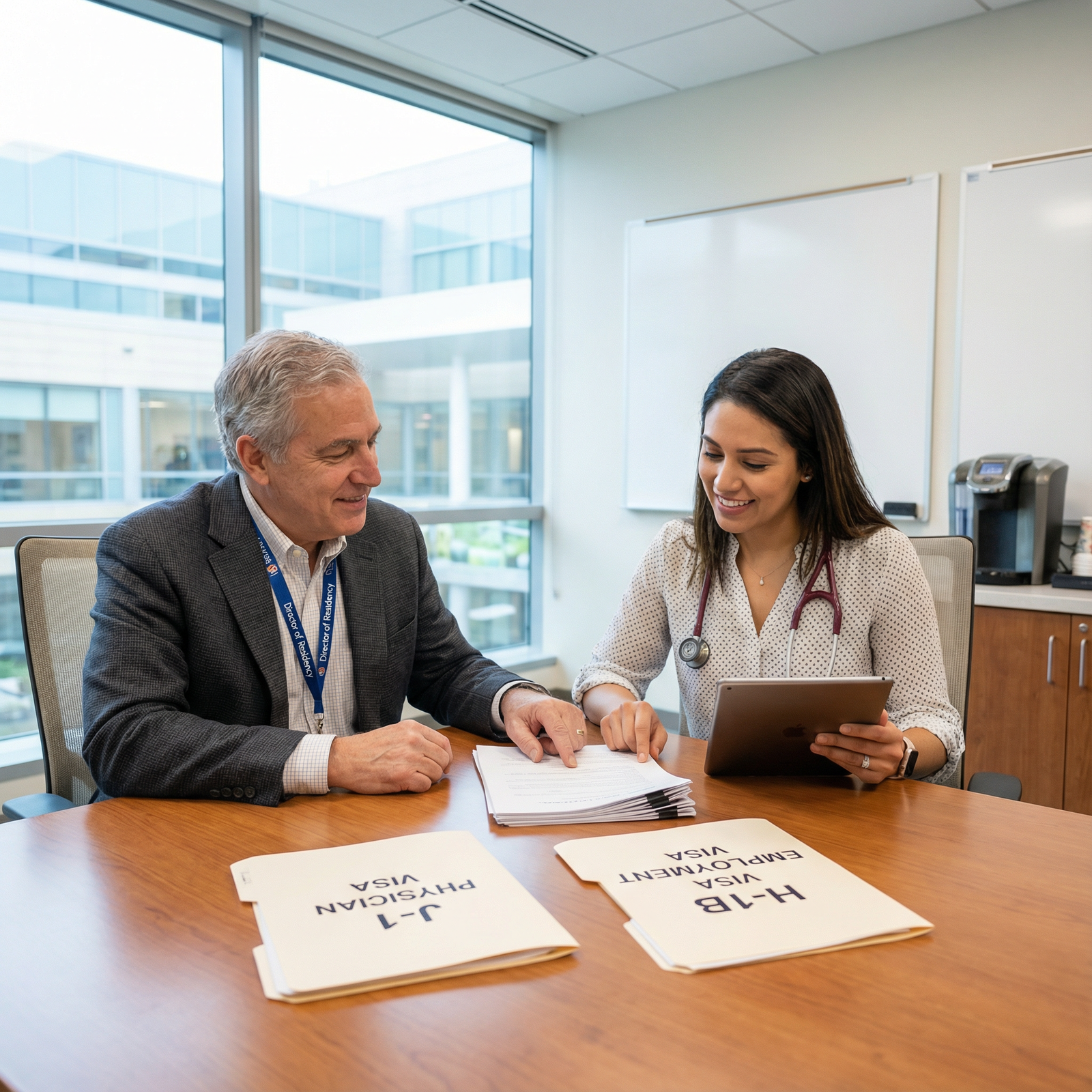
For many International Medical Graduates (IMGs), training in the United States is a major career goal—and often a life-changing experience. Alongside USMLE exams, ERAS, and the Match, one of the most critical and often confusing pieces of the puzzle is immigration status. For most IMGs entering U.S. Residency Training, the two main options are the J-1 Visa and the H-1B Visa.
This guide focuses on the J-1 Visa for physicians, which is the most commonly used pathway for IMGs in U.S. graduate medical education. It will walk you through:
- What the J-1 Visa is and how it fits into U.S. Medical Education
- Eligibility requirements specific to IMGs
- Step-by-step Visa Application Process
- Benefits and limitations of the J-1 physician visa
- The two-year home residency requirement and waiver options
- Practical tips and FAQs tailored for residency and fellowship applicants
By the end, you should have a clear, realistic understanding of how the J-1 Visa works and how to plan your training and career around it.
Understanding the J-1 Visa for Physicians
What Is the J-1 Visa?
The J-1 Visa is a U.S. non-immigrant visa for exchange visitors. Its purpose is to promote cultural, educational, and professional exchange between the United States and other countries. Participants come to the U.S. for a temporary period to gain skills and experience and are then expected to bring that knowledge back home.
For IMGs, the relevant category is the J-1 Physician (or Alien Physician), which allows foreign medical graduates to participate in:
- ACGME-accredited residency programs
- ACGME- or other recognized-accredited clinical fellowships
- Certain non-standard clinical training programs approved by sponsors
The J-1 physician category is strictly tied to graduate medical education or training. It is not a general employment visa.
J-1 Categories Relevant to Medical Graduates
While there are multiple J-1 categories (au pairs, teachers, interns, research scholars, etc.), three are commonly relevant to medical graduates:
J-1 Physician (Clinical)
- For IMGs participating in U.S. residency or fellowship training that involves direct patient care.
- Sponsored primarily by the Educational Commission for Foreign Medical Graduates (ECFMG).
J-1 Research Scholar
- For physicians and scientists engaged in research without direct clinical care (or with strictly limited patient contact for research protocols).
- Typically sponsored by universities or research institutions, not ECFMG.
J-1 Intern/Trainee
- May apply to structured non-clinical internships or training programs, but not to ACGME-accredited residency training.
This article focuses on the J-1 Physician Visa through ECFMG, as this is the most important category for IMGs entering U.S. residency and fellowship programs.
Core Eligibility Requirements for the J-1 Physician Visa
To qualify for a J-1 Physician Visa as an IMG, you must meet specific medical education, credentialing, English proficiency, and program acceptance criteria. While individual circumstances vary, the major requirements are relatively standard.
1. Medical Education Credentials
You must:
- Graduate from a medical school listed in the World Directory of Medical Schools (WDOMS)
- The school must be recognized as meeting ECFMG eligibility criteria.
- Hold a medical degree equivalent to the U.S. MD or DO (e.g., MBBS, MBChB, MD depending on your country’s system).
In most cases, you also need:
- ECFMG Certification
- This generally requires passing:
- USMLE Step 1
- USMLE Step 2 CK
- Meeting ECFMG’s English language and primary source verification requirements
- This generally requires passing:
Some applicants may be conditionally sponsored while final steps are pending, but full, timely compliance is essential for visa issuance and continued training.
2. English Language Proficiency
Effective communication is critical in U.S. clinical settings. J-1 physicians typically demonstrate English proficiency through:
- Meeting ECFMG’s English requirements (as part of certification)
- Performance in interviews
- Sometimes providing additional documentation requested by the sponsor or program
Sponsors must certify that you possess sufficient English skills to successfully participate in your training and communicate safely with patients and colleagues.
3. Residency or Fellowship Program Acceptance
To qualify as a J-1 physician, you must:
- Secure a position in an ACGME-accredited residency or fellowship program, or
- Be accepted into a recognized non-standard clinical training program approved by ECFMG, and
- Receive a formal offer letter/contract from the institution indicating:
- Position (specialty, PGY level)
- Start and end dates
- Salary and benefits
You cannot apply for a J-1 physician visa without a training position. The visa type depends on your program type and sponsor, not simply on your degree.
4. Sponsorship Requirements
For clinical J-1 physicians, the principal sponsor is ECFMG, not your hospital directly. The training institution works with ECFMG, but:
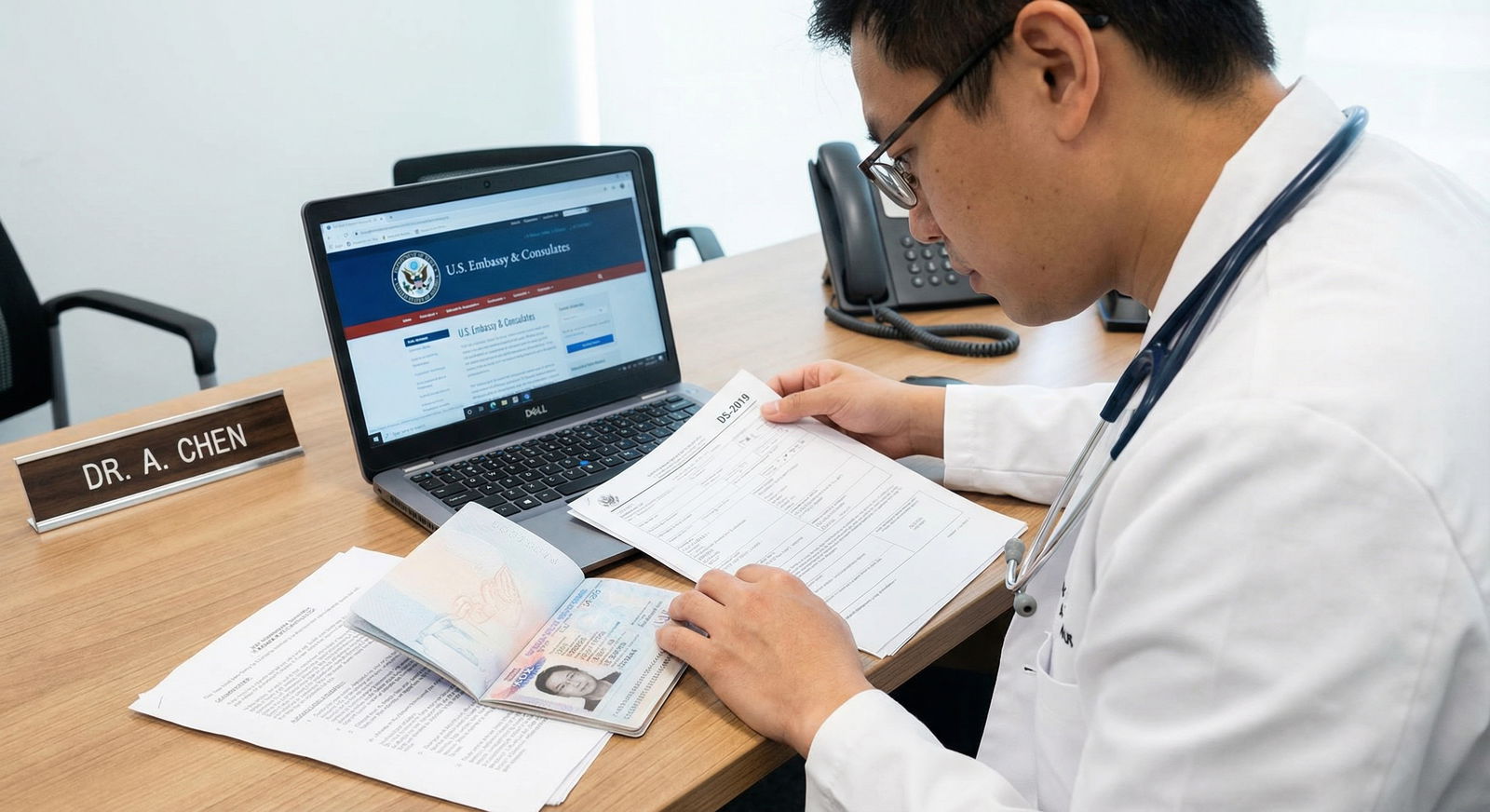
- ECFMG issues the Form DS-2019, which is your Certificate of Eligibility for Exchange Visitor Status.
- ECFMG oversees compliance, monitors progress, and approves extensions or program changes.
Your responsibilities include:
- Maintaining good standing in your training program.
- Following all ECFMG and U.S. Department of State regulations.
- Reporting changes (address, program adjustments, leave beyond policy limits) promptly.
Step-by-Step J-1 Visa Application Process for IMGs
Understanding the timeline and sequence of tasks is essential to avoid delays that could affect your start date.
Step 1: Secure a Residency or Fellowship Position
Before any visa steps:
- Apply to programs through ERAS (or SF Match, NRMP, NRMP-Specialties, etc. depending on specialty).
- Complete interviews and obtain a matched or offered position.
- Receive an official appointment letter or contract from your program.
Programs will then notify ECFMG that they intend to train you under J-1 sponsorship.
Step 2: Apply for ECFMG Sponsorship and Obtain Form DS-2019
Once your position is confirmed, you (and your program’s GME office) will initiate the sponsorship process with ECFMG:
- Create or access your ECFMG OASIS/EVNet account (for Exchange Visitor services).
- Submit required sponsorship documents, which may include:
- Copy of your medical diploma and transcripts
- ECFMG certificate (if already issued)
- Program description and verification forms completed by your training program
- Statement of need from your home country’s Ministry of Health (for many countries)
- CV and passport biographical page
- ECFMG reviews your file, verifies eligibility, and, once complete, issues the Form DS-2019.
The DS-2019 details:
- Your sponsor (ECFMG)
- Training program and institution
- Program dates and funding information
- Exchange visitor category (Physician)
You must sign and keep this form safe—it is crucial for your visa interview and travel.
Step 3: Complete the Online Visa Application (Form DS-160)
With your DS-2019 in hand:
- Go to the U.S. Department of State’s CEAC website to complete Form DS-160 (Online Nonimmigrant Visa Application).
- Upload a compliant visa photo.
- Print the DS-160 confirmation page with the barcode; you’ll need it for scheduling your interview.
During DS-160, you will enter:
- Your personal and passport details
- Intended U.S. address and training institution
- SEVIS ID (found on DS-2019)
- Security and background information
Step 4: Pay Fees and Schedule the Visa Interview
Next:
- Pay the SEVIS I-901 fee, if applicable (often required for J categories).
- Pay the visa application (MRV) fee as instructed by your local U.S. embassy/consulate.
- Use the DS-160 confirmation number to schedule a visa interview at the U.S. embassy or consulate in your home country or country of residence.
Check current wait times and schedule as early as allowed to avoid delays to your training start date.
Step 5: Attend the Visa Interview
On the day of your visa interview, typically bring:
- Valid passport (meeting validity requirements)
- DS-160 confirmation page
- Original DS-2019 signed by you and ECFMG
- Visa fee payment confirmations
- Passport-size photos (if required)
- Appointment letter/contract from your residency or fellowship program
- ECFMG certificate or exam results (if available)
- Financial documentation if requested
- Any additional documents specified by the embassy (e.g., proof of ties to home country)
During the interview, consular officers may ask about:
- Your medical education and training plans
- Your understanding of the temporary nature of the J-1 Visa
- Your intention to comply with the two-year home residency requirement (if applicable)
If approved, your J-1 Visa is stamped in your passport, allowing entry for your training program.
Step 6: Travel to the U.S. and Complete Check-In
Once your visa is issued:
- You can enter the U.S. up to 30 days before the program start date listed on DS-2019.
- Upon arrival, you must complete SEVIS/ECFMG check-in as instructed (usually online, sometimes with support from your GME office).
- Attend orientation with your program and follow any institutional onboarding requirements (licensing, credentialing, training modules).
Timely check-in is critical to “activate” your J-1 status.
Key Benefits of the J-1 Visa for IMGs
Despite its restrictions, the J-1 Visa offers important advantages for International Medical Graduates pursuing U.S. Medical Education.
1. Broad Access to Residency and Fellowship Positions
Many teaching hospitals prefer or exclusively sponsor J-1 Visas for IMGs, particularly academic centers. Benefits include:
- Access to a wide range of ACGME-accredited residency and fellowship programs
- Standardized sponsorship and oversight through ECFMG
- Relative predictability for institutions familiar with J-1 processes
In some specialties and institutions, the J-1 may be more accessible than H-1B due to:
- No need for USMLE Step 3 as a prerequisite (unlike many H-1B positions)
- No requirement that the program itself sponsor the work visa
2. Immersive Clinical and Cultural Exchange
The J-1 program emphasizes cultural exchange as well as professional development:
- You’ll work with diverse patient populations in complex U.S. healthcare settings.
- You’ll interact with colleagues from various backgrounds and training systems.
- You can bring unique perspectives and skills from your home country to your team.
These exchanges enrich both your own education and that of your colleagues, and align with the program’s mission of mutual understanding.
3. Potential Post-Training Options Through Waivers
Although the J-1 carries the two-year home residency requirement, certain paths allow you to:
- Obtain a J-1 waiver (e.g., through the Conrad 30 program or an Interested Government Agency),
- Transition to H-1B status,
- Later pursue permanent residency (green card) under specific conditions.
Many IMGs successfully remain in the U.S. after training by:
- Working in underserved areas under a J-1 waiver contract
- Serving in positions aligned with U.S. federal or state public interest needs
4. Professional Networking and Career Development
As a J-1 physician, you will:
- Build a network of attendings, mentors, and peers who can support your future career.
- Gain experience in U.S. research, quality improvement, leadership, and teaching.
- Position yourself for fellowships, academic positions, or leadership roles—whether in the U.S. or abroad.
These relationships and experiences are valuable regardless of where you ultimately practice.
Challenges, Limitations, and Strategic Considerations
While the J-1 is a strong pathway for Residency Training, IMGs must understand its limitations and plan accordingly.
1. The Two-Year Home Residency Requirement (212(e))
Most J-1 physicians are subject to INA §212(e): after completing J-1 training, you must:
- Return to your home country or country of last permanent residence for a total of two years, or
- Obtain an approved J-1 waiver before becoming eligible for:
- H-1B or L-1 visas
- Permanent residency (in most categories)
- Some other nonimmigrant visa types
Important notes:
- The two years do not need to be continuous, but must add up to 24 months.
- Simply staying in another country (not your home or last residence) generally does not count.
- This requirement is not waived by time, marriage to a U.S. citizen, or having U.S.-born children—only by an approved waiver or fulfillment of the obligation.
2. Limitations on Employment and “Moonlighting”
J-1 physician status is program- and sponsor-specific:
- You are authorized to participate only in the approved training program listed on your DS-2019.
- Any additional clinical work (“moonlighting”) typically requires specific authorization from ECFMG and must meet strict criteria.
- Unauthorized employment can jeopardize your status and future immigration options.
Always confirm with:
- Your program’s GME office, and
- ECFMG guidelines
before accepting any additional work.
3. Time Limits on Training
J-1 physician sponsorship has maximum duration limits, often:
- Up to 7 years total of clinical training (though policies can evolve and some exceptions exist).
This means:
- Prolonged fellowships or multiple sequential fellowships may require careful planning and justification.
- Extensions beyond standard timelines must align with ECFMG and Department of State rules.
4. Family Considerations (J-2 Dependents)
Your spouse and unmarried children under 21 may qualify for J-2 dependent status. While this offers benefits, there are also considerations:
- J-2 dependents can typically study and may apply for work authorization (EAD) in many cases.
- Their status is entirely dependent on your J-1 status; if your J-1 ends, so does theirs.
- The two-year home requirement often also applies to J-2 dependents if it applies to the J-1 principal.
Careful planning is important if your family will accompany you.
Common J-1 Waiver Pathways for IMGs
For many J-1 physicians, especially those wishing to continue practicing in the U.S. after training, a key strategic decision is how to address the two-year home residency requirement.
Here are common J-1 waiver options:
1. No Objection Statement (NOS)
Your home country government issues a formal statement to the U.S. Department of State indicating it has no objection to:
- You not returning for the required two years, and
- You potentially changing to another status (e.g., H-1B) or pursuing permanent residence.
However, for most J-1 physicians in clinical training, especially those sponsored by ECFMG, a No Objection Statement is generally not accepted as a basis for waiving the 212(e) requirement. It is more relevant to other J categories.
2. Exceptional Hardship Waiver
You can apply for a waiver based on exceptional hardship to your:
- U.S. citizen or permanent resident spouse, and/or
- U.S. citizen or permanent resident child.
You must demonstrate that requiring you to fulfill the two-year home stay would cause exceptional hardship beyond normal family separation or relocation difficulties, such as:
- Serious medical conditions requiring care available primarily in the U.S.
- Significant educational or social impacts on children with special needs
- Country-specific risks or conditions that would disproportionately harm the qualifying relatives
These waivers are case-specific, complex, and often require legal assistance.
3. Persecution Waiver
If you can demonstrate that you would likely face persecution in your home country based on:
- Race
- Religion
- Political opinion
you may qualify for a waiver on that basis. This is distinct from standard asylum processes and also typically requires specialized legal support.
4. Interested Government Agency (IGA) Waivers
For many IMGs, the most practical waiver routes are Interested Government Agency (IGA) waivers, including:
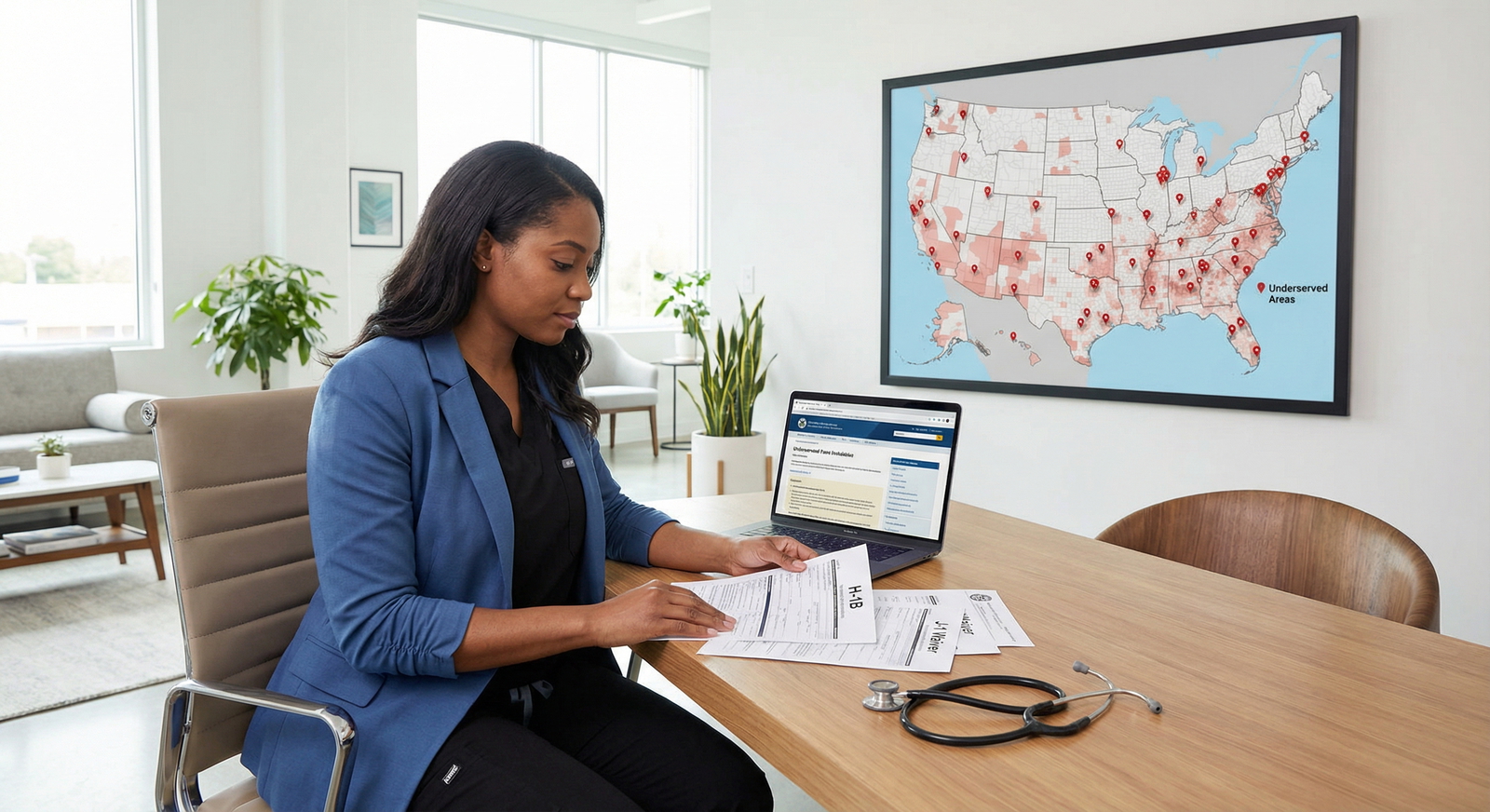
- Conrad 30 Waiver Program (State Health Department Waivers)
- Each U.S. state (and some territories) can sponsor up to 30 J-1 physician waivers per year.
- Physicians typically must agree to work:
- In a medically underserved area,
- In a health professional shortage area (HPSA), or
- In a facility that serves underserved populations,
- For three years full-time on an H-1B visa.
- Federal Agency Waivers
- Certain federal agencies (e.g., VA, HHS, DoD, ARC, Delta Regional Authority) may sponsor waivers for physicians whose work serves U.S. public interest or specific populations.
Under most IGA waiver programs:
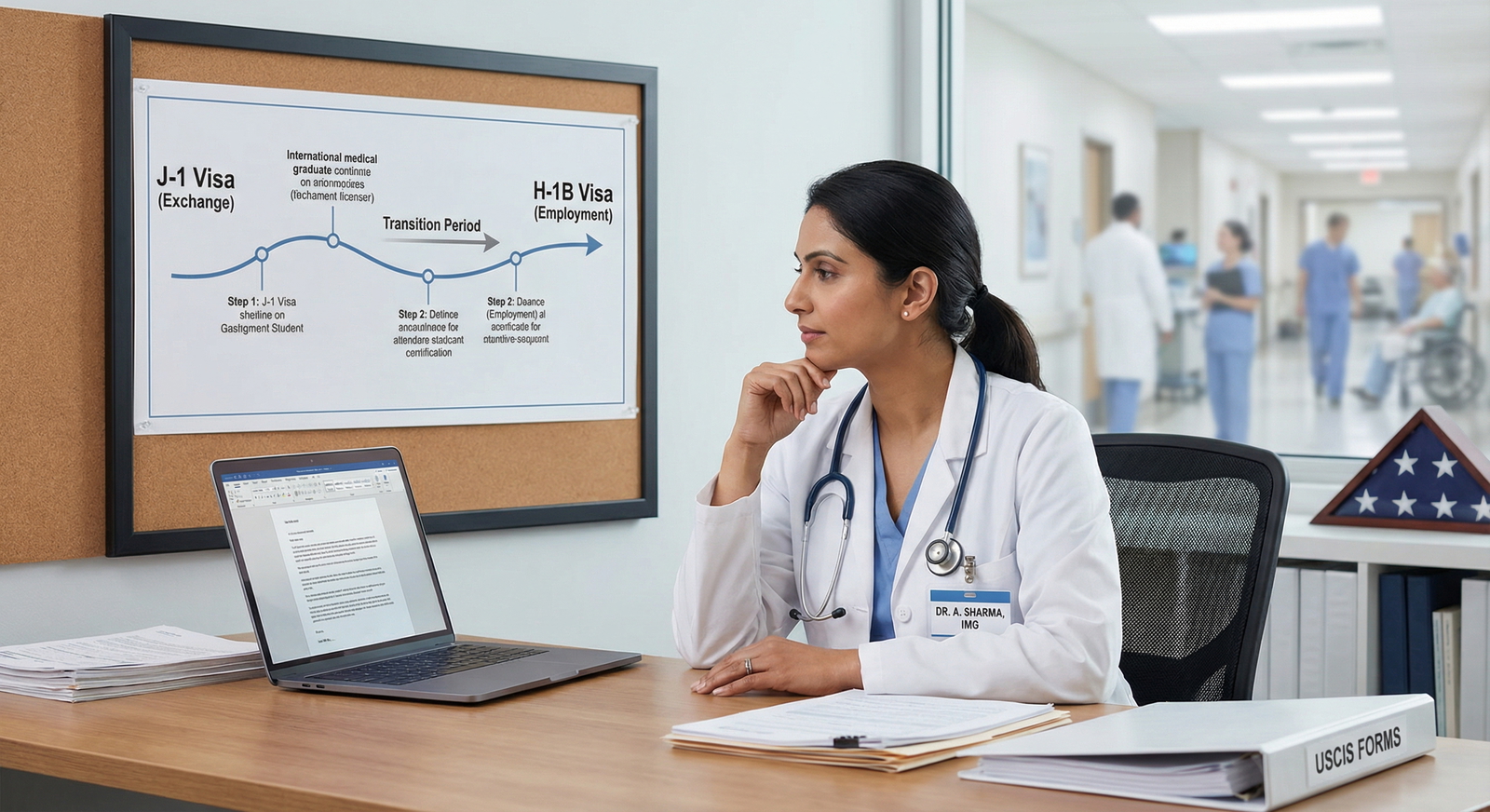
- After your J-1 training, you switch to H-1B status for the obligated service period.
- Once you meet the waiver obligations, you regain freedom to change employers (subject to visa rules) and may pursue permanent residency routes.

Strategic Tips for IMGs Considering a J-1 Visa
Plan Early and Align Your Long-Term Goals
Before ranking programs in the Match:
- Clarify your long-term goals (e.g., returning home vs. remaining in the U.S.).
- Understand your home country’s policies (many require a Statement of Need and may expect return).
- Consider specialties and states known to offer more Conrad 30 or IGA waiver opportunities if your goal is to stay in the U.S.
Communicate with Programs About Visa Sponsorship
When researching and applying to programs:
- Check whether they sponsor J-1, H-1B, or both for IMGs.
- Ask GME or program coordinators how many current IMGs are on J-1 vs. H-1B.
- Confirm that they are familiar with and comfortable managing J-1 sponsorship.
This information can help you make more informed rank list decisions.
Stay in Status and Maintain Documentation
Throughout training:
- Track your DS-2019 expiration date and ensure timely extensions through ECFMG.
- Keep copies of all forms (DS-2019, ECFMG correspondence, SEVIS records).
- Report address changes and major program changes promptly.
- Avoid unauthorized employment or prolonged time outside the U.S. without sponsor approval.
Maintaining clean, consistent status will be critical if you later seek a waiver or a change to H-1B/green card.
Seek Expert Guidance for Waivers and Complex Cases
J-1 waiver pathways and long-term immigration planning are legally complex and evolve over time. Consider:
- Consulting with your institution’s international office or GME immigration specialist.
- Seeking advice from a U.S. immigration attorney experienced with physician immigration and J-1 waivers.
This is especially important if:
- You are considering multiple fellowships,
- You have unique family or hardship circumstances, or
- You know you want to pursue a waiver in a specific state or program.
Frequently Asked Questions (FAQs) About the J-1 Visa for IMGs
1. Can J-1 Visa holders change residency programs or switch specialties?
Yes, J-1 physicians can change programs or specialties, but this is not automatic:
- You must obtain approval from ECFMG and a new DS-2019 reflecting the new program.
- The new program must meet J-1 sponsorship requirements and agree to support the transfer.
- Changes should generally occur at logical transition points (e.g., end of PGY-1) and require institutional and sponsor justification.
Frequent or late-stage changes can be more challenging, particularly within maximum training time limits.
2. What happens if I do not complete my residency or fellowship?
If you leave or are dismissed from your program:
- Your J-1 status will typically end shortly after your training terminates (often a standard grace period of 30 days).
- You may still be subject to the two-year home residency requirement if it applied to your original J-1 status.
- Failure to maintain status can negatively impact future visa applications and any potential waiver or immigration benefits.
If you anticipate difficulties, talk early with your program leadership, GME office, and ECFMG to explore options.
3. How long is the J-1 Physician Visa valid?
The J-1 physician visa is valid for the duration of your approved training, as listed on your DS-2019, plus:
- A short grace period (typically 30 days) after training ends to prepare for departure.
For longer programs or additional fellowships:
- Your program must request annual or periodic extensions from ECFMG.
- Total training time is usually limited (often around 7 years), although policies and exceptions can change.
Always confirm the current rules on maximum duration with ECFMG and your institution.
4. Can my spouse work or study in the U.S. while I am on a J-1 Visa?
Yes, J-2 dependents (spouse and eligible children):
- Can study in the U.S. without needing a separate student visa.
- May be eligible to apply for employment authorization (EAD), allowing them to work in many fields.
However:
- J-2 status depends entirely on your J-1 status. If your J-1 ends or is terminated, their status ends too.
- They may also become subject to the two-year home requirement if you are.
Check USCIS and Department of State guidelines or consult an immigration specialist for up-to-date details.
5. What should I do if my J-1 Visa application is denied?
If your visa is denied at the embassy/consulate:
- Ask whether the officer can explain the specific reason (e.g., missing documents, security checks, concerns about intent).
- Review your documentation with your program’s international office or GME and, if available, ECFMG support resources.
- Consult an immigration attorney if the reason is complex (e.g., security-related, prior status violations).
- If allowed, you may be able to reapply with additional documentation or clarification.
Time is often critical when a training start date is approaching, so act quickly.
For more on navigating U.S. training as an IMG, you may also find helpful:
- Navigating the Visa Options for IMGs
- Residency Application Process for IMGs
- Tips for Successful Interviews as an IMG
Understanding your J-1 Visa options, obligations, and opportunities early in your journey will help you make stronger choices about programs, specialties, and long-term career paths within U.S. Medical Education and beyond.