

Not matching feels like a door slamming shut. For a lot of IMGs, the immediate assumption is brutal and simple: it’s over. That’s the myth.
The reality is less dramatic and more annoying. Usually, the problem isn’t that your career ended. It’s that you now need to make a fast, disciplined visa decision that protects three things at once: employability, speed to start, and your odds of getting into training without poisoning your future options.
And this is where people get misled.
They start asking the wrong question: “Which visa is better, H-1B or J-1?” That question sounds smart. It isn’t. There is no universally “better” backup. There’s only the visa you can actually secure, in a specialty that will actually consider you, at an institution that actually sponsors it, on a timeline that doesn’t collapse under paperwork.
I’ve seen applicants burn precious days chasing H-1B because it sounds more prestigious, more permanent, more “safe.” Then they discover the ugly truth: many residency programs won’t sponsor H-1B at all, many require Step 3 completed before ranking or appointment, and many don’t want the legal cost and administrative drag if a J-1 candidate is sitting right next to you.
On the other side, people talk about J-1 like it’s a trap door to nowhere. Also wrong. J-1 is often the visa that keeps an IMG in the game because programs already know how to process it. It’s familiar. It’s standard. It moves. The catch comes later: the two-year home residency requirement or the need for a waiver pathway after training. Easier entry. Harder exit.
So let’s strip the mythology away.
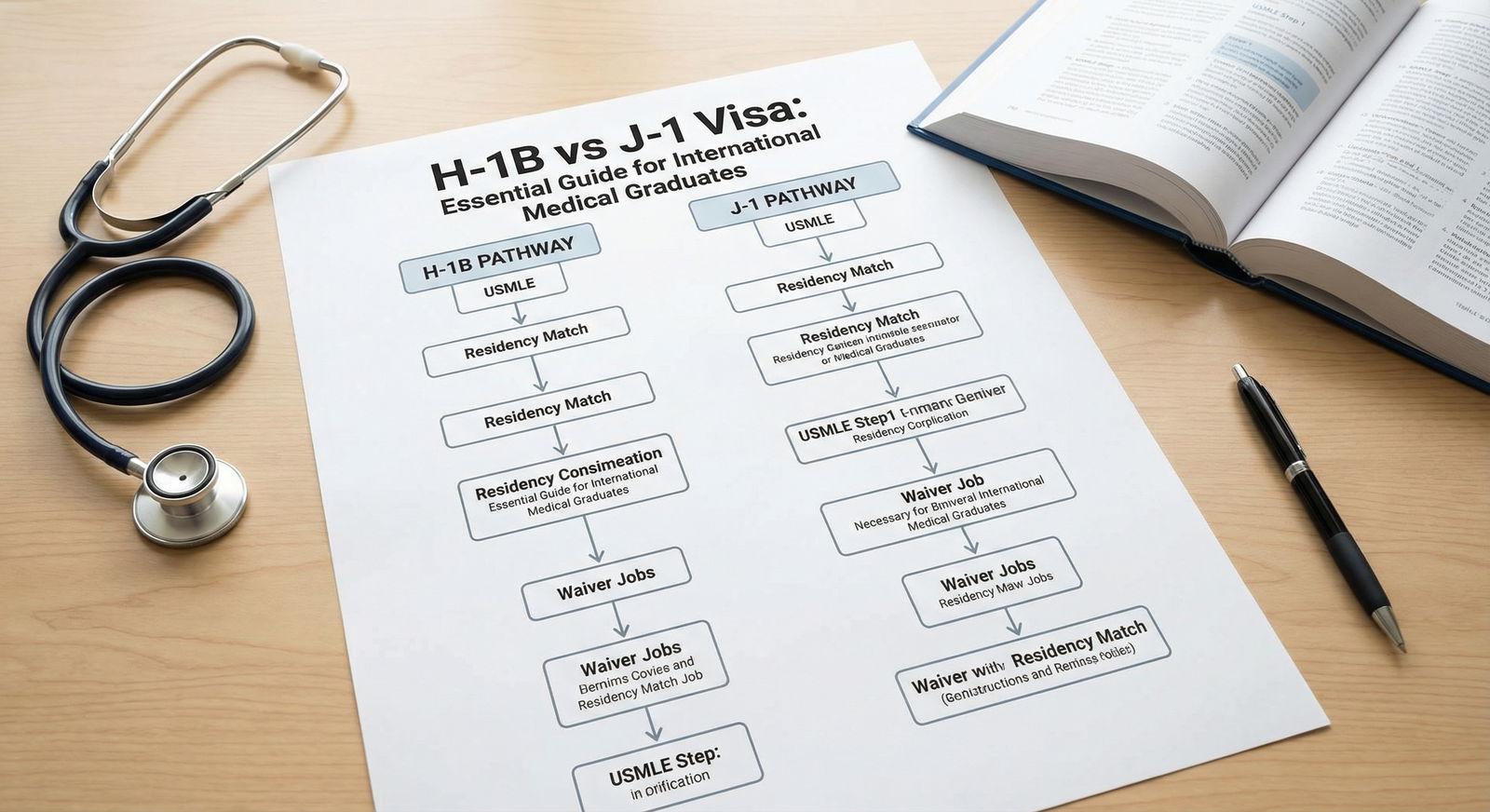
At a high level, H-1B is an employer-sponsored work visa. More flexible long term, often more attractive if you want to stay in the U.S. after residency, but harder to get because the bar is higher and the program has to want the hassle. J-1 is a training visa, usually much easier for residency programs to sponsor, but it carries future obligations that too many applicants ignore until fellowship or attending-job time. That’s when the bill comes due.
H-1B After a Non-Match: What Actually Makes It Work
Here’s the part people hate hearing: H-1B doesn’t work because you prefer it. It works because you line up the requirements early enough and target places that have already shown they’re willing to sponsor it.
That usually means three things.
First, you need a sponsoring employer. Not theoretically. Not “maybe if they like me enough.” An actual program with an actual H-1B process.
Second, specialty fit matters. Some specialties and institutions have a routine H-1B workflow. Others act like every petition is a constitutional crisis. Guess which ones are easier to move through fast after a non-match.
Third, Step 3 often matters a lot. In many residency settings, it’s effectively the entry ticket for H-1B consideration. No Step 3, no serious H-1B path for that cycle in many places. People love pretending this is negotiable. Usually it’s not.
What makes H-1B a strong backup? Simple. It helps applicants who are thinking beyond just surviving this month. If you want to avoid the J-1 two-year home residency rule, if you’re aiming for a long-term U.S. career, or if you already completed Step 3 and can present yourself as a low-friction hire, H-1B can be excellent.
But let’s kill another bad idea: H-1B is not “better” by default. That’s prestige thinking, not strategy.
If only 15 programs in your realistic specialty and geography will sponsor H-1B, while 150 will sponsor J-1, then H-1B is not your superior option. It’s your narrower option. Sometimes dramatically narrower. I’ve seen applicants cut their own opportunity pool in half—or worse—because they got emotionally attached to the visa label instead of the match math.
The practical playbook is boring, which is why it works:
- Apply broadly to programs with a documented history of H-1B sponsorship.
- Ask directly, early, and without apology: “Do you sponsor H-1B for residents this cycle?”
- Verify whether Step 3 must be completed before application, ranking, or contract issuance.
- Focus on institutions with established GME immigration workflows. Experience matters.
- Don’t assume a hospital’s general H-1B policy applies to residency. GME is its own ecosystem.
And yes, timing matters. A lot. If you’re trying to build an H-1B backup after not matching, delay is poison. Programs don’t become more flexible because you’re stressed.
The applicants who make H-1B work after a non-match usually aren’t the most optimistic. They’re the most organized. Big difference.
J-1 After a Non-Match: Easier Entry, Harder Exit
Now for the visa people love to dismiss until it saves them.
J-1 is often the more accessible backup because many residency programs are already built around it. Their coordinators know the process. Their GME offices know the process. ECFMG-linked workflows are familiar. That matters more than applicants realize. Institutional familiarity is a huge hidden advantage.
So if H-1B doors are limited, J-1 is often the path that gets you into training fastest. Not glamorous. Effective.
And no, J-1 is not a dead end. That’s lazy advice from people who reduce complicated immigration planning into bumper-sticker talking points. Plenty of physicians train on J-1 and go on to fellowship, waiver jobs, and long U.S. careers. The issue isn’t that J-1 blocks success. The issue is that it pushes the complexity downstream.
That downstream complexity is the two-year home residency requirement under INA 212(e), unless you qualify for and secure a waiver. That’s the part too many people postpone thinking about because they’re understandably focused on getting a residency seat now. I get it. But future-you still has to live with present-you’s shortcuts.
Who should seriously consider J-1 as the better backup?
- Applicants prioritizing immediate placement over long-term visa elegance
- Applicants without Step 3 or with limited H-1B-eligible options
- Applicants targeting programs that routinely sponsor J-1 but rarely touch H-1B
- Applicants willing to tolerate future waiver planning in exchange for better current odds
That last point matters. J-1 is often the rational choice when the alternative is not training at all.
Still, let’s not sugarcoat the waiver reality. Waivers commonly come through Conrad 30 programs, interested government agency pathways, or other specific routes depending on specialty and circumstances. Translation: your future choices may depend on geography, underserved-area work, employer type, and willingness to be flexible. If your dream is “ultra-specific city, ultra-specific academic niche, zero compromise,” J-1 may eventually make that harder.
That doesn’t make J-1 bad. It makes it real.
I’ve seen IMGs make excellent careers after choosing J-1 strategically. I’ve also seen people stumble because they treated the visa as a temporary technicality instead of a training-to-practice roadmap. Huge mistake. If you take J-1, plan several years ahead. Residency isn’t the finish line. It’s the setup.
How to Choose Fast: Decision Criteria That Beat Panic
Panic makes people romantic. Strategy makes people match later.
If you didn’t match, your backup choice should come from five facts, not vibes:
Step 3 status
If Step 3 is done, H-1B may be realistic. If not, your H-1B field may shrink fast.Specialty competitiveness and fit
Some specialties offer more visa flexibility than others. Don’t pretend every field behaves the same.Number of programs with each sponsorship type
Count actual options. Don’t chase a visa that leaves you with a tiny pool unless you have a strong reason.Timeline and administrative speed
A legally elegant plan that misses deadlines is useless.Your post-residency plan
If long-term U.S. practice flexibility matters most, H-1B has obvious appeal. If starting training now is the priority, J-1 often wins.
Here’s the tradeoff most applicants miss: H-1B can preserve future flexibility, but it’s harder to secure in the present. J-1 can improve immediate placement odds, but it may constrain later choices. That’s the real comparison. Not “good visa” versus “bad visa.”
For non-match week, your checklist should be ruthless:
- Identify programs with prior H-1B and J-1 sponsorship history
- Update CV, personal statement, Step transcripts, ECFMG status, and references
- Confirm credentialing and visa processing deadlines
- Prepare one realistic H-1B plan and one realistic J-1 plan
- Prioritize programs that fit your profile, not your ego
The contrarian truth? The best backup is the one you can actually execute before the window closes. Prestige on paper doesn’t start residency. Paperwork, timing, and sponsor behavior do.
What to Do in the Next 72 Hours if You Didn’t Match
Forget elaborate reinvention. You need movement.
In the next 72 hours:
- Contact programs with open spots or late-cycle needs
- Verify, immediately, whether they sponsor H-1B, J-1, or both
- Be explicit about your visa status, ECFMG status, and Step 3 status
- Send clean, complete documents fast
- Prioritize realistic specialty and geography fits over fantasy targets
- Keep both visa pathways alive until one becomes clearly unworkable
Your communication should be direct. Not vague. Not apologetic. Program coordinators and directors don’t want a mystery box. They want to know: Are you eligible? Which visa do you need? Do you have Step 3? Can you start on time?
Say it plainly.
A weak message sounds like this: “I’m exploring options and would be grateful for consideration.”
A useful message sounds like this: “I am ECFMG certified, available immediately, completed Step 3, and am seeking programs that sponsor H-1B.” Or: “I am eligible for J-1 sponsorship and can provide all documents today.”
That kind of clarity gets responses. Uncertainty gets archived.
And while you’re waiting, prepare the backup to the backup. If H-1B is your preference, get your J-1 documents ready anyway. If J-1 looks likely, still verify any H-1B-friendly openings. Momentum matters. Losing three days to indecision is how people turn a setback into a wasted cycle.
The Bottom Line
Not matching is a setback. It is not automatically the end. But bad visa strategy absolutely can make it worse.
H-1B is not the superior backup just because people talk about it that way. It’s better only if you meet the requirements, have Step 3 when needed, and can target programs that actually sponsor it. Otherwise, it becomes a vanity choice with a shrinking opportunity pool.
J-1 is often the more accessible non-match option. That’s the data-backed reality. More programs know it, more programs use it, and more applicants can move on it quickly. The price is future planning: the home residency requirement, the waiver strategy, and the need for flexibility later.
So don’t ask which visa sounds best. Ask which one you can execute now without wrecking your options later.
That’s the myth busted.


