

The worst mistake an IMG can make is treating J-1 vs. H-1B as a last‑minute paperwork choice instead of a multi‑year career decision.
You cannot fix this in PGY-3. You barely can in PGY-2. The real leverage is years earlier—how you build your CV, what you prioritize, which programs you target, and when you move on each step.
I’m going to walk you through a year‑by‑year, then season‑by‑season plan, side‑by‑side for J‑1 and H‑1B, so you know exactly what you should be doing this year and next year.
Big Picture: How J‑1 and H‑1B Shape Your Next 10 Years
Before we go chronological, you need the high‑altitude view.
J‑1 for IMGs (ECFMG-sponsored):
- Easier to get for residency (more programs accept)
- Requires you to return home or do a 3‑year J‑1 waiver job in an underserved area before staying in the US long term
- Tied to two‑year home residency requirement (unless you secure a waiver)
- Very common path for IMGs going into internal medicine, pediatrics, FM, psych, etc.
H‑1B for IMGs:
- Harder to get for residency (fewer programs sponsor; more institutional barriers)
- No 2‑year home residency requirement
- Counts toward the 6‑year H‑1B maximum (some or all of residency may use it)
- Often preferred by IMGs who plan a long‑term US career and have strong scores/credentials
At this point you should accept a harsh truth:
Your visa type will dictate where you can train, where you will work your first 3–6 years after training, and how smoothly you can stay in the US. So you plan backwards from that.
| Factor | J-1 (ECFMG) | H-1B (Residency/Fellowship) |
|---|---|---|
| Residency Sponsorship | Very common | Limited |
| USMLE Step 3 Required Before Match | No | Usually Yes |
| 2-Year Home Residency Rule | Yes (unless waived) | No |
| Post-Training Options | J-1 waiver job or return home | H-1B job, O-1, or green card path |
| Easiest for First Residency? | Yes | No |
Phase 0 (1–3 Years Before Applying): Pre‑Application Years
You’re still outside the Match. Maybe doing internship at home, research in the US, or finishing med school.
At this point you should decide your likely visa strategy, not just your specialty.
Year -3 to -2 (early planning)
If you’re leaning J‑1:
You mainly need to:
- Build a competitive CV (USCE, research, scores)
- Understand that J‑1 is your likely default if you match at a typical community or academic program
- Start reading about:
- Conrad 30 waivers
- State waiver programs
- “Hardship” vs “Persecution” vs “Interested Government Agency (IGA)” waivers
(No need to act yet. Just don’t discover this in PGY‑3.)
If you’re aiming for H‑1B:
You must plan more aggressively:
- Target specialties and programs known to sponsor H‑1B (internal medicine, neurology, psych, some surgery)
- Start a short list of H‑1B‑friendly institutions by:
- Reading program websites
- Emailing coordinators directly:
“Do you currently sponsor H‑1B visas for incoming residents?”
- Prioritize USMLE timing:
- You’ll likely need Step 3 done before ranking for many H‑1B‑sponsoring programs
- That means Step 3 by December–January of the Match year, not after graduation
Year -2 to -1 (intensive prep year)
At this point you should align exam timing with your visa goal.
J‑1 track in this year:
- Focus: strong Step 1/Step 2 CK, USCE, letters
- Step 3 timing:
- Optional pre‑Match
- Helpful later for waiver jobs and some fellowships, but not required for J‑1 residency
- Use this year for:
- US observerships/externships
- Networking with community programs that are historically J‑1 friendly
H‑1B track in this year:
You’re on a clock.
- Make a Step 3 plan:
- Schedule exam so score is available by December–January of application year
- Leave buffer for possible retake (no one plans to fail Step 3—but people do)
- Heavily prioritize:
- Research at H‑1B‑friendly university hospitals
- Clinical experiences in programs that have sponsored H‑1B recently
- By the end of this year you should:
- Have clear list of “H‑1B target programs”
- Know their stance on visa types and exam deadlines
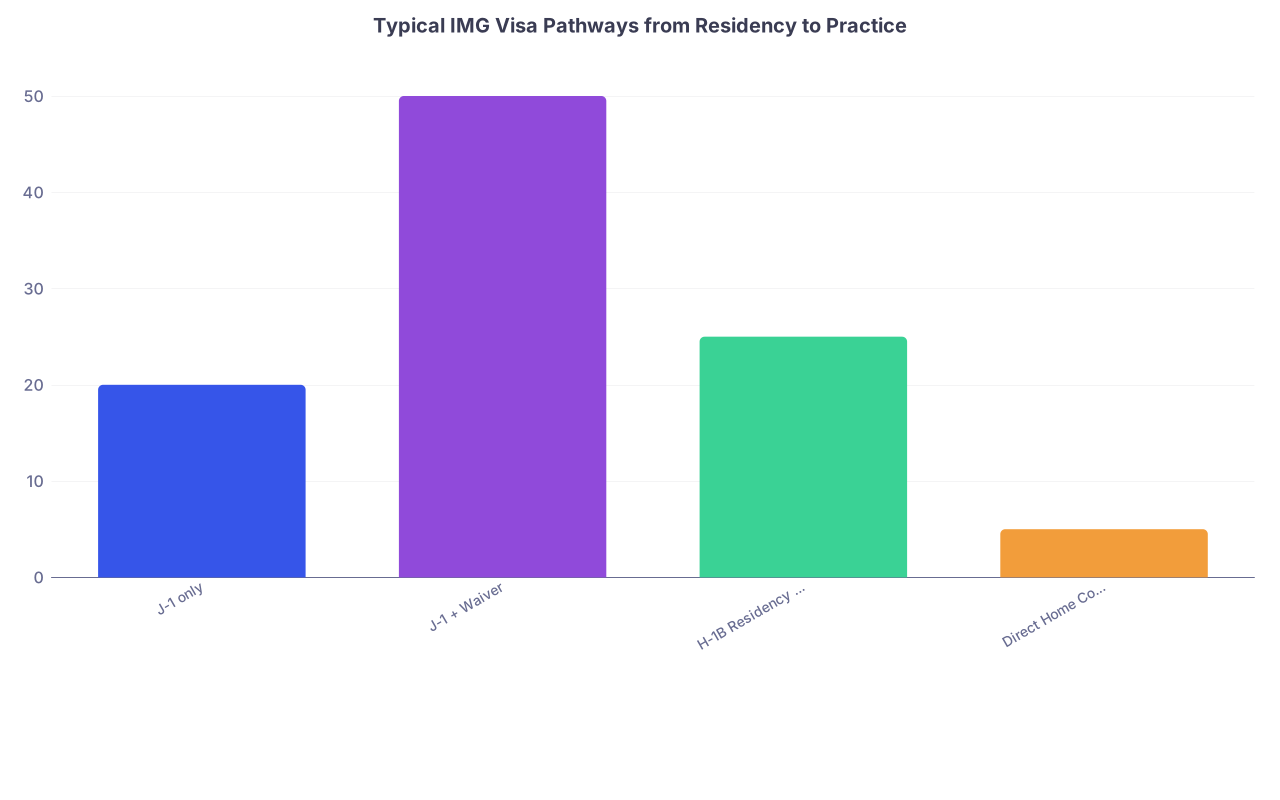
| Category | Value |
|---|---|
| J-1 only | 20 |
| J-1 + Waiver | 50 |
| H-1B Residency to H-1B Job | 25 |
| Direct Home Country Return | 5 |
Application & Match Year: Month‑by‑Month Focus
Let’s call this Year 0 – the ERAS submission / Match year.
January–March (before ERAS season)
At this point you should lock in your visa priority and exam schedule.
If targeting H‑1B:
- Confirm Step 3 exam date, aiming for:
- Exam done by September–October
- Score available by November–December
- Email target programs:
- Ask:
“For H‑1B sponsorship, do you require Step 3 passed before ranking, or before starting residency?” - Take notes. Requirements vary more than you think.
- Ask:
If comfortable with J‑1:
- You have more flexibility with Step 3
- Use these months to:
- Expand your program list (community + academic, J‑1 accepting)
- Identify programs that do not sponsor any visas and remove them
June–September (ERAS Opens → Applications Submitted)
ERAS opens (June)
At this point you should:
- Categorize your programs:
- “H‑1B only”
- “J‑1 or H‑1B”
- “J‑1 only”
- You need redundancy:
- Even if you prefer H‑1B, most IMGs should apply heavily to J‑1‑sponsoring programs for safety
September (application submission)
For H‑1B hopefuls:
- Your Step 3 should be scheduled.
Preferably done, but scheduled is the minimum. - In your personal statement or email follow‑ups, you can mention:
- “I’m particularly interested in institutions that sponsor H‑1B visas…”
For J‑1 track:
- Visa doesn’t change your ERAS content much
- Still smart to mention:
- Willingness to work in underserved areas later (waiver relevance)
- Interest in primary care or shortage specialties if that’s true
October–February (Interview Season)
At this point you should ask clear visa questions on interview day—politely, but directly.
During or after interviews, ask coordinators or PDs:
- “Do you anticipate sponsoring J‑1 and/or H‑1B visas for this incoming class?”
- For H‑1B:
- “Do you require Step 3 results before ranking, or only before starting residency?”
Keep a private spreadsheet. Programs change policies year‑to‑year; you cannot trust old forum posts.
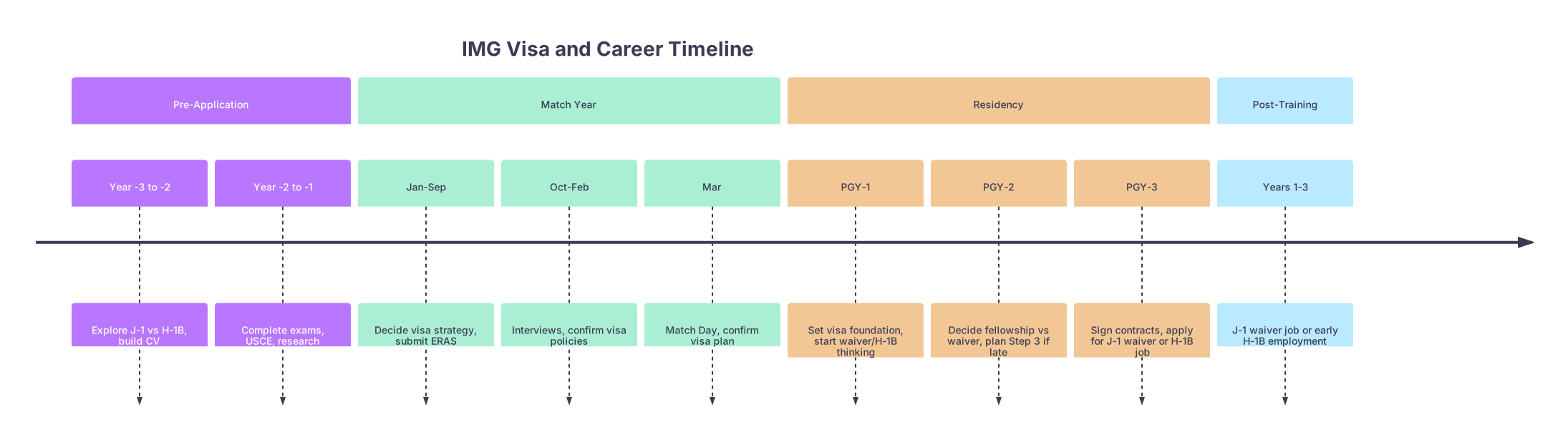
| Period | Event |
|---|---|
| Pre-Application - Year -3 to -2 | Explore J-1 vs H-1B, build CV |
| Pre-Application - Year -2 to -1 | Complete exams, USCE, research |
| Match Year - Jan-Sep | Decide visa strategy, submit ERAS |
| Match Year - Oct-Feb | Interviews, confirm visa policies |
| Match Year - Mar | Match Day, confirm visa plan |
| Residency - PGY-1 | Set visa foundation, start waiver/H-1B thinking |
| Residency - PGY-2 | Decide fellowship vs waiver, plan Step 3 if late |
| Residency - PGY-3 | Sign contracts, apply for J-1 waiver or H-1B job |
| Post-Training - Years 1-3 | J-1 waiver job or early H-1B employment |
Match Day and Pre‑Residency: Locking in Your Visa Path
Match Week (March)
You matched. Good. Now the visa realities hit.
If your program sponsors only J‑1:
- You’re going J‑1, full stop
- At this point you should:
- Read ECFMG J‑1 physician guidelines
- Understand the 2‑year home residence rule
- Start an informal list of states with strong Conrad 30 programs (TX, NY, WA, etc.)
If your program sponsors H‑1B:
- Now the Step 3 deadline matters:
- If you haven’t passed Step 3, the program may insist on J‑1 or may withdraw H‑1B sponsorship
- You should:
- Confirm with GME office:
- “Are you planning to file for my H‑1B this year?”
- “What exact documents and deadlines do you need from me?”
- Confirm with GME office:
April–June (pre‑residency paperwork)
J‑1 pre‑residency:
You’ll work with ECFMG and your program to get DS‑2019. At this point:
- Keep your DS‑2019 start date aligned with your contract
- Keep all copies of:
- DS‑2019
- SEVIS fee receipts
- I‑94s
These will matter later for waiver applications and attorney reviews.
H‑1B pre‑residency:
You’re in the immigration weeds:
- Program (or their attorney) will file:
- Labor Condition Application (LCA)
- H‑1B petition (cap‑exempt for teaching hospitals)
- Your job:
- Provide diplomas, ECFMG cert, exam scores, CV, passport
- Respond to document requests immediately
(A slow resident can lose weeks on a petition.)
PGY‑1: Foundation Year – Your Real Visa Strategy Starts Now
Residents waste PGY‑1 assuming “I’ll deal with visas later.” That’s how you end up scrambling in PGY‑3.
PGY‑1 on J‑1: Quiet Setup Year
At this point you should:
- Understand your J‑1 clock
- Residency years = J‑1 time
- Usually limited to training length + 1 year for exam attempts
- Start soft research on:
- Which states you’d be willing to work in for a 3‑year waiver job
- Which specialties get waiver spots more easily (primary care, psych, peds)
- Save documents:
- Every contract
- Every DS‑2019
- Performance evaluations (waiver employers sometimes ask)
No, you’re not applying for waivers yet. But you’re choosing rotations and mentors that align with future jobs—particularly in primary care, rural outreach, or underserved clinics.
PGY‑1 on H‑1B: Protecting Options
For H‑1B residents:
- Confirm the H‑1B validity period (start and end dates)
- Understand:
- Years used in residency count toward your 6‑year cap
- Time spent outside the US can sometimes be recaptured
- At this point you should:
- Keep an updated CV and case log
- Start noting attendings in your future specialty who might help with:
- Fellowship spots
- Job introductions after training
PGY‑2: Decision Year – Fellowship vs. Waiver vs. Fast Employment
PGY‑2 is not just about picking a fellowship. It’s also where your post‑training visa path hardens.
PGY‑2 on J‑1: Choosing Between Fellowship and Early Waiver
At this point you should ask:
“Do I go straight to a J‑1 waiver job after residency, or do I add fellowship first?”
Option A – Go straight to waiver after residency:
- Pros:
- Start the 3‑year waiver clock earlier
- Reach long‑term immigration stability faster
- Cons:
- May limit subspecialty options later (especially competitive fields)
Option B – Do fellowship on J‑1:
- Pros:
- Get subspecialty training (cards, GI, heme/onc, etc.)
- Often better long‑term job offers
- Cons:
- More years on J‑1 before waiver
- You still owe 3‑year waiver after fellowship
During PGY‑2 you should:
- Talk to recent graduates who:
- Finished J‑1 residency → J‑1 waiver job
- Finished J‑1 fellowship → J‑1 waiver job
- Start mapping states for Conrad 30 programs by specialty
PGY‑2 on H‑1B: Fellowship vs. Direct Employment
Now your main question is:
“Do I go to fellowship (often J‑1 or H‑1B) or straight into an attending job on H‑1B?”
At this point you should:
- Count remaining H‑1B years:
- Example: 3‑year IM residency on H‑1B = 3 years used
→ 3 years left on standard 6‑year cap
- Example: 3‑year IM residency on H‑1B = 3 years used
- If planning fellowship:
- Many fellowships prefer J‑1 (cheaper, simpler for them)
- Some will sponsor H‑1B, but fewer
- Think ahead:
- H‑1B for fellowship + H‑1B for job = very tight with the 6‑year cap, unless you have:
- PERM labor certification started early, or
- I‑140 approved (for cap extension)
- H‑1B for fellowship + H‑1B for job = very tight with the 6‑year cap, unless you have:
You should be meeting immigration counsel by late PGY‑2 if your long‑term goal is US permanent residency and you’re on H‑1B.
PGY‑3 (or Final Residency Year): Contract and Paperwork Year
This is where people panic. Do not be one of them.
PGY‑3 on J‑1: Actively Securing a Waiver Path
At this point you must:
- Decide: Fellowship vs. waiver job now
- If going straight to waiver job:
- Start applying for jobs 12–18 months before training ends
- Specifically ask employers:
- “Do you sponsor J‑1 waiver positions?”
- “Do you have experience filing Conrad 30 or other waivers?”
- Typical PGY‑3 J‑1 timeline:
- July–October:
- Interview for waiver‑eligible positions
- Focus on underserved / rural / safety‑net hospitals
- October–January:
- State Conrad 30 programs open (varies by state)
- Employer’s attorney submits waiver application
- January–June:
- DS‑2019 ends with training
- Waiver approval → change of status or consular processing
- Transition to H‑1B at waiver site
You should not be “exploring” waiver options in March of your final year. By then you should be under contract.
PGY‑3 on H‑1B: Job or Fellowship – Then Green Card Strategy
At this point you should:
- If going to fellowship:
- Lock in whether it’ll be J‑1 or H‑1B
- Confirm how it interacts with your current H‑1B time
- If going to an attending job:
- Negotiate immigration support in writing:
- H‑1B filing and extensions
- PERM and I‑140 timelines
- Ideal: employer starts your green card process in Year 1 of employment
- Negotiate immigration support in writing:
You’re not dealing with any 2‑year home requirement on H‑1B, but you are dealing with the 6‑year H‑1B limit and the slow permanent residency pipeline.
Post‑Training Years 1–3: Early Career Reality
J‑1 Waiver Job Years (Your First 3 Years as Attending)
At this point you’re:
- On H‑1B at a waiver site (Conrad 30 or similar)
- Committed to working full‑time for 3 years in an underserved area
You should:
- Track:
- Exact start and end dates of waiver service
- Hours worked and job duties (occasionally needed for proof)
- Push employer to:
- File PERM and I‑140 early (year 1–2)
- So you can extend H‑1B beyond 6 years if needed
After you complete the 3‑year waiver:
- You’re released from the 2‑year home requirement
- You can:
- Change employers more freely
- Continue on H‑1B, shift to O‑1, or complete green card process
H‑1B Post‑Training Job Years
If you trained and then worked on H‑1B (no J‑1):
At this point you should have:
- Clear timeline of:
- When your 6‑year limit hits
- When PERM and I‑140 will be filed
- Strategy if:
- Your country of origin has long green card backlogs (India, China especially)
Your biggest risk isn’t a 2‑year home rule. It’s being stuck at year 6 of H‑1B with no I‑140 and no way to extend.
Quick Snapshot: When You Should Decide What
| Stage | J-1 Priority | H-1B Priority |
|---|---|---|
| Pre-Application (Year -2) | Learn waiver concepts | Plan Step 3 timing |
| Application Year | Apply widely to J-1 programs | Target H-1B sponsors, finish Step 3 |
| PGY-1 | Understand J-1 rules | Track H-1B years used |
| PGY-2 | Decide fellowship vs early waiver | Plan fellowship vs direct job, meet lawyer |
| PGY-3 | Sign waiver or fellowship contract | Lock job/fellowship with immigration terms |
| Post-Training 1–3 | Complete 3-year waiver, start green card | Secure PERM/I-140, manage H-1B limit |
Final 3 Takeaways
- Visa is not paperwork; it’s a 10‑year career structure. Treat J‑1 vs. H‑1B as early as Year -2, not as a PGY‑3 emergency.
- Step 3 timing and program selection are where H‑1B lives or dies. If you want H‑1B, you plan exams and target programs ruthlessly.
- For J‑1, PGY‑2 and early PGY‑3 are your waiver setup window. By then you should already know your likely waiver states, employers, and whether you’ll do fellowship before or after.
If you know what stage you’re in right now, I can map out a more granular month‑by‑month checklist for your situation.


