
The biggest mistake IMGs make between residency graduation and their first job is pretending immigration rules will “work themselves out.” They will not.
If you are choosing between a J‑1 waiver job and an H‑1B path, your real enemy is timing. Not the exam. Not the interview. The calendar.
What you need is a month‑by‑month roadmap from late PGY‑2/PGY‑3 through your first attending paycheck. That is what I am going to lay out: at this point you should…, by this date you must…, or you are in trouble.
Big Picture: How J‑1 Waiver vs H‑1B Changes Your Timeline
Before we go month‑by‑month, you need the 30,000‑foot view. Otherwise all the dates blur together.
| Path | Core Goal | Critical Filing Window | “Safe” Job Start Window |
|---|---|---|---|
| J-1 Waiver | Conrad/state or federal IGA | Sep–Mar PGY-3 (waiver filing) | Jul–Oct after graduation |
| H-1B Cap | Lottery-based, Oct 1 start | Mar (cap registration), Apr (petition) | Oct 1 or later |
| H-1B Cap-Exempt | University/affiliate, research | Anytime, rolling | Jul–Oct after graduation |
Core realities you cannot ignore:
- J‑1 Clinical → you must do a waiver job or return home for 2 years. No H‑1B, no green card, no shortcuts without that 212(e) waiver.
- J‑1 waiver jobs demand early action (often 12–18 months before you finish). Many PGY‑3s wake up in November and discover all the good waiver slots are gone.
- H‑1B cap‑subject jobs revolve around the March–April lottery cycle and an October 1 start. That gap between graduation in June and H‑1B start in October can destroy your income plans if you do not plan status properly.
- H‑1B cap‑exempt (university, university‑affiliated hospital, nonprofit research) is dramatically easier on timing. You can often go straight from residency to attending with minimal gap.
Now we build the actual roadmap.
18–12 Months Before Graduation: Pre‑Decision Phase
This is late PGY‑2 for a 3‑year program, or early PGY‑3 for a 4‑year program. At this point you should not be “seeing what comes up.” You should be gathering hard data and locking in your path.
At 18 months before graduation (roughly January of your second‑to‑last year)
At this point you should:
Clarify your current status:
- Are you on J‑1 clinical?
- Are you on H‑1B already in residency?
- Are you F‑1 → OPT → residency (rare but happens)?
Decide your likely direction:
- If you are J‑1:
- 90%+ will need a Conrad 30 waiver or a federal IGA waiver (VA, HHS, ARC, DRA, etc.).
- If you are H‑1B already:
- You can move to another H‑1B employer without the cap. Totally different, and much easier.
- If you are thinking of fellowship first, your waiver/job timeline shifts 1–3 years later. But the steps are the same.
- If you are J‑1:
Schedule a paid consult with an immigration attorney who works extensively with physicians. Not your friend’s cousin who “does visas.” Someone who talks daily about:
- J‑1 waivers (Conrad, HHS, VA)
- H‑1B for physicians
- Physician NIW green cards
You want concrete answers, not vague encouragement.
At 15–12 months before graduation
This is where the two paths diverge.
If you are J‑1 and leaning toward a waiver job
At this point you should:
Research states and waiver programs:
- Look at:
- Conrad 30 program rules for your top 3–5 states
- Whether they accept primary care vs subspecialists
- Whether they allow flex slots (non‑HPSA but serving underserved)
- Their opening date and typical fill dates
- Some states:
- Open October 1 and fill in days (e.g., popular East Coast states).
- Others accept applications year‑round and never hit 30.
- Look at:
Define your geographic flexibility:
- Rank:
- Must‑have states
- Acceptable states
- States you will only consider if desperate
- Rank:
Update your CV and prepare a short “visa paragraph” you can send to recruiters:
- Example: “Current J‑1 clinical visa, graduating June 2027 in Internal Medicine. Seeking Conrad 30 waiver position, open to HPSA/MUA sites in [regions]. Employer must sponsor J‑1 waiver and H‑1B.”
Start exploratory networking and job hunting:
- Contact hospital recruiters directly.
- Attend specialty conferences and explicitly ask about J‑1 waiver positions.
- Use phrases that signal you understand timing: “Are you planning to sponsor any Conrad 30 J‑1 waiver positions for July 2027 starts?”
If you are targeting an H‑1B job (not on J‑1)
You still need to think early, but the pressure is different.
At this point you should:
Decide: cap‑subject vs cap‑exempt target.
- Cap‑exempt employers:
- Universities
- University‑affiliated teaching hospitals
- Some nonprofit research institutions
- If you want a private group job in the community → almost always cap‑subject.
- Cap‑exempt employers:
If you want cap‑exempt (safer timing):
- Prioritize academic centers and teaching hospitals.
- Ask early: “Are you cap‑exempt for H‑1B? Have you sponsored H‑1B physicians before?”
If you want cap‑subject:
- Understand you must hit the March H‑1B registration before you graduate or you are likely sitting idle after residency.
12–9 Months Before Graduation: Commit to a Path
This is the danger window where procrastinators lose options.
For J‑1 Waiver Candidates
By 12 months before graduation (around July of your final year) you should:
- Have a shortlist of real job leads (not just “I sent my CV out”).
- Know the Conrad timelines for your chosen states:
- Example:
- State A: Opens October 1, fills by November.
- State B: Year‑round, but they prioritize applications received by January.
- Example:
- Have created a checklist with your attorney of documents to gather:
- Copies of all DS‑2019s
- Residency verification letters
- Licensing progress (state license applications, USMLE scores, etc.)
- Medical school diploma, translations if needed
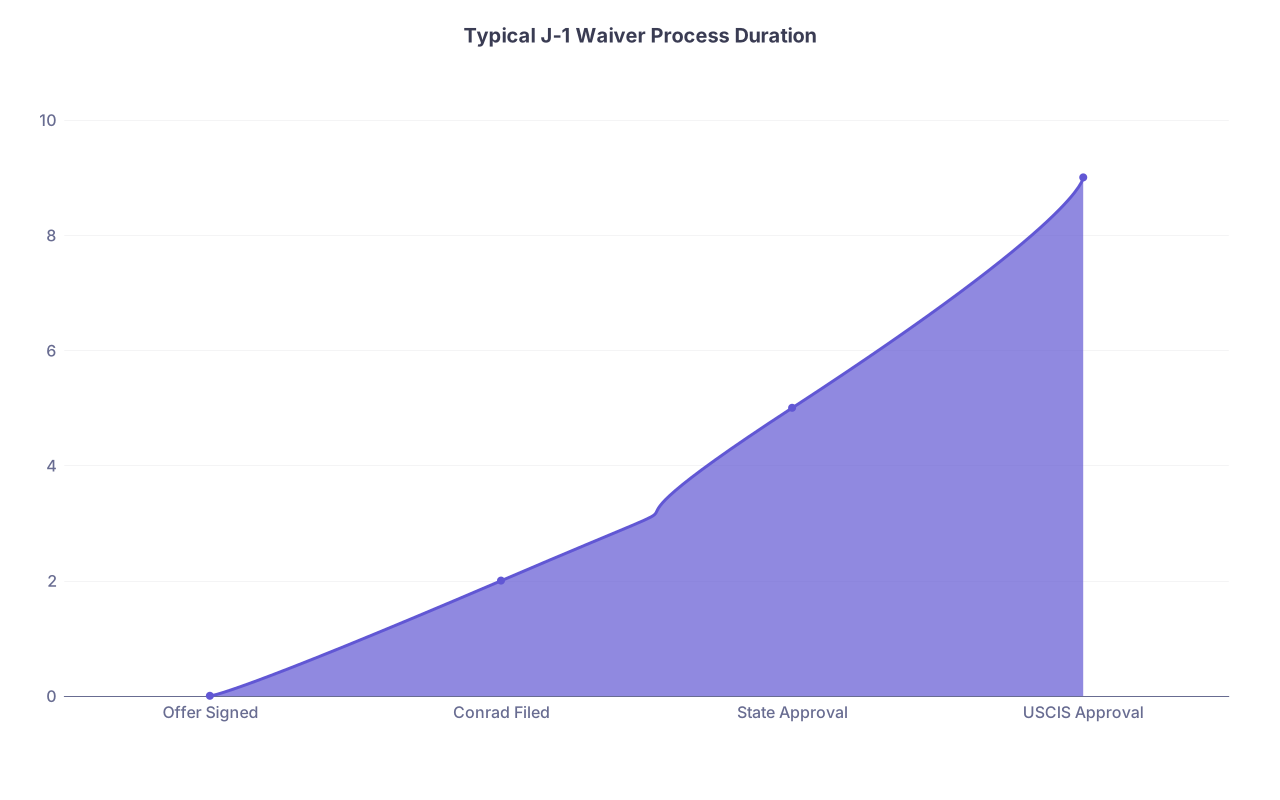
| Category | Value |
|---|---|
| Offer Signed | 0 |
| Conrad Filed | 2 |
| State Approval | 5 |
| USCIS Approval | 9 |
By 9–10 months before graduation (around September–October):
At this point you should:
Lock in an offer for your top waiver job, or at least one serious backup.
- This means Letter of Intent (LOI) or contract in hand, not just “we like you.”
Coordinate with your employer and attorney to hit the state opening window:
- If your state opens October 1:
- Your full packet should be ready to ship day 1.
- If rolling:
- File as soon as your contract and documentation are ready. Early is always better.
- If your state opens October 1:
Start state license applications if you have not already.
- Many states want license in progress or issued before they support your waiver.
- Some boards move at the speed of bureaucracy. Months.
For H‑1B Candidates (Cap‑Exempt)
If you are targeting a university or cap‑exempt hospital:
By 9–10 months before graduation you should:
- Have:
- A clear job offer.
- Confirmation from HR/immigration that they will file H‑1B cap‑exempt.
- Be working backward on:
- State medical license
- DEA (often after the license)
- Hospital credentialing
Cap‑exempt timing is more forgiving, but do not be relaxed. Credentialing can easily take 3–6 months.
For H‑1B Cap‑Subject Candidates
This is the group that most often gets burned.
By 9–10 months before graduation you should:
Confirm your employer:
- Understands the H‑1B cap.
- Is committed to registering you in the March lottery.
- Has an immigration attorney already engaged.
Put critical dates on a shared calendar:
- March: H‑1B registration window.
- April: H‑1B petition filing for selected cases.
- October 1: Earliest H‑1B start.
9–3 Months Before Graduation: Filing, Approvals, and Backup Plans
Now the calendar gets tight.
For J‑1 Waiver Jobs
9–6 months before graduation
At this point you should:
- Have your Conrad 30 or IGA waiver application filed by your employer/attorney.
- Be tracking:
- State receipt notice.
- Approximate state processing time.
Once the state approves:
- They forward their support letter to the Department of State (DOS).
- DOS then sends a recommendation to USCIS.
- USCIS adjudicates the actual waiver.
This chain can easily take 6–9 months. That is why waiting until January of PGY‑3 to start is reckless.
6–3 months before graduation
By now, in an ideal world:
- You should have:
- State approval in hand.
- DOS recommendation done.
- Your employer should have:
- Filed your H‑1B petition (for the waiver job).
- Ideally requested premium processing so you get approval faster.
You are aiming for:
- Waiver approval + H‑1B approval before your current J‑1 ends (typically June 30).
If processing is dragging:
- Talk with your attorney about:
- Bridge status options.
- Whether premium processing is being used.
- Whether there are any missing documents slowing things down.
For H‑1B Cap‑Exempt Jobs
By 6–3 months before graduation you should:
- Have your H‑1B petition filed (cap‑exempt).
- Be juggling:
- H‑1B approval timing.
- State license finalization.
- Hospital credentialing start and completion.
A realistic sequence:
- State license in progress 9–6 months out.
- H‑1B filed 6–4 months out.
- Credentialing starts once license + H‑1B receipt/approval are available.
- All ready for a July–August attending start.
For H‑1B Cap‑Subject Jobs
This is more rigid.
Timeline around your graduation year looks roughly like this:
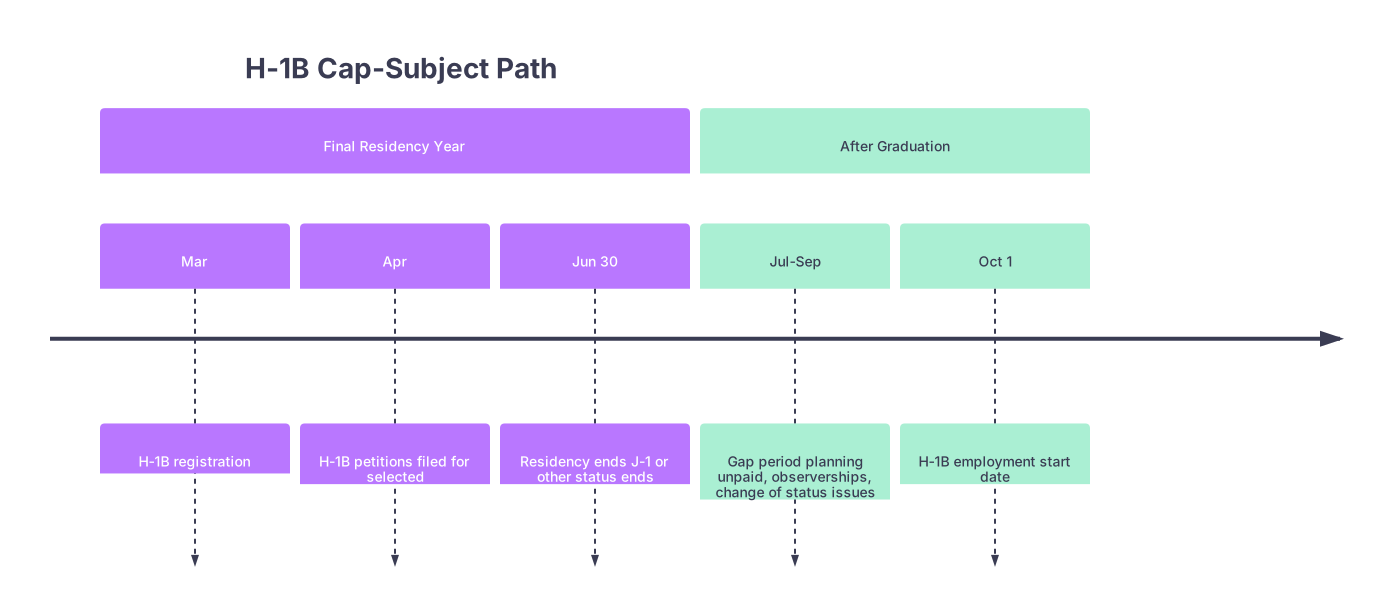
| Period | Event |
|---|---|
| Final Residency Year - Mar | H-1B registration |
| Final Residency Year - Apr | H-1B petitions filed for selected |
| Final Residency Year - Jun 30 | Residency ends J-1 or other status ends |
| After Graduation - Jul-Sep | Gap period planning unpaid, observerships, change of status issues |
| After Graduation - Oct 1 | H-1B employment start date |
By 3 months before graduation you should:
- Know:
- Whether your H‑1B registration was selected.
- Whether your H‑1B petition was filed and, ideally, approved.
If you are not selected in the lottery:
- You need a Plan B immediately:
- Another cap‑exempt H‑1B job (e.g., academic hospital) that can hire you instead.
- For non‑J‑1 folks, sometimes a change of status option (e.g., back to F‑1 for further study) but this rarely keeps your clinical path clean.
If you are a former J‑1 (clinical) without a waiver and you fail to secure an H‑1B through some speculative route, you are simply stuck. The 2‑year home requirement does not vanish. This is why trying to skip the J‑1 waiver via H‑1B is usually fantasy.
3 Months Before Graduation to Start Date: Final Transitions
This is the “do not screw it up” period.
For All Paths: 3 Months Before Graduation
At this point you should:
Confirm:
- Your visa approval notice (I‑797) is in hand or imminently expected.
- Your state license is issued or clearly on track.
- Hospital credentialing is in progress.
Nail down your start date:
- J‑1 waiver H‑1B usually: July–September.
- H‑1B cap‑exempt: often July–August.
- H‑1B cap‑subject: October 1.
For J‑1 Waiver Jobs
You must ensure:
- Your waiver is approved before you begin work.
- Your status change to H‑1B (if filing inside the U.S.) is effective by your job start date.
- There is no unauthorized work. No early moonlighting outside what is explicitly allowed under your visa.
If DOS or USCIS is running late:
- Talk urgently with your attorney about:
- Whether you need to delay your start date.
- Whether consular processing is smarter (travel, get H‑1B stamp, re‑enter).
For H‑1B Cap‑Subject Jobs
You need to bridge the gap from June 30 to October 1.
Depending on your prior status:
If you are finishing residency on H‑1B tied to the hospital:
- Sometimes you can extend with that employer to cover July–September (e.g., chief year, hospitalist, research).
- Then switch to the new H‑1B employer on October 1.
If you are finishing J‑1:
- You usually cannot simply stay and wait in the U.S. without appropriate status.
- Trying to use B‑1/B‑2 or “observership” as a cover for a 3‑month employment gap is risky and often scrutinized.
You must design this gap deliberately, not improvise it two weeks before graduation.
First 90 Days in Your New Job: Do Not Ignore Long‑Term Strategy
Once you start working, you will be swamped. But immigration strategy cannot go into hibernation.
For J‑1 Waiver Physicians
By 30–90 days into your job you should:
- Have:
- A clear understanding of your 3‑year J‑1 waiver service requirement:
- Exact start date.
- Full‑time hours definition.
- What counts toward service (no, locums in a different state usually does not).
- A clear understanding of your 3‑year J‑1 waiver service requirement:
- Confirm:
- The employer is tracking your work sites and duties in line with the waiver terms.
- Any changes in site, hours, or role are cleared by your immigration counsel first.
You also want to start thinking about:
- Permanent residency path (e.g., EB‑2 NIW, employer‑sponsored PERM).
- Many smart physicians start NIW filing in the first year of the waiver job.
- That way your green card clock is running while you serve the 3 years.
For H‑1B Physicians (Both Cap‑Exempt and Cap‑Subject)
Within the first 90 days:
- Clarify your maximum time on H‑1B and how much you have already used.
- Many physicians underestimate how quickly they burn through the 6‑year limit.
- Outline with counsel:
- Plan for a green card:
- NIW (strong for physicians in underserved areas).
- Employer‑sponsored PERM.
- Rough filing window (usually in the first 1–2 years if you are serious).
- Plan for a green card:
Do not wait until year 5 of H‑1B to start caring. That is how you end up in “H‑1B max‑out” panic.
Putting It Together: Sample Parallel Timelines
To make this concrete, here is a side‑by‑side comparison for someone graduating June 2027 from residency.
| Timepoint | J-1 Waiver Path | H-1B Cap-Exempt Path |
|---|---|---|
| Jan 2026 (18 mo out) | Choose waiver states, consult attorney | Decide on academic/cap-exempt focus |
| Oct 2026 (9 mo out) | Job offer signed, Conrad packet ready | Job offer signed, license applications in |
| Nov–Dec 2026 | Conrad filed, state review | H-1B petition prep, license progressing |
| Jan–Mar 2027 | State + DOS approval, H-1B filed (premium) | H-1B filed, credentialing begins |
| Jun 30 2027 | J-1 ends, waiver + H-1B ideally approved | Residency ends, H-1B approved |
| Jul–Aug 2027 | Start waiver job in H-1B status | Start academic attending on H-1B |
And for cap‑subject H‑1B:
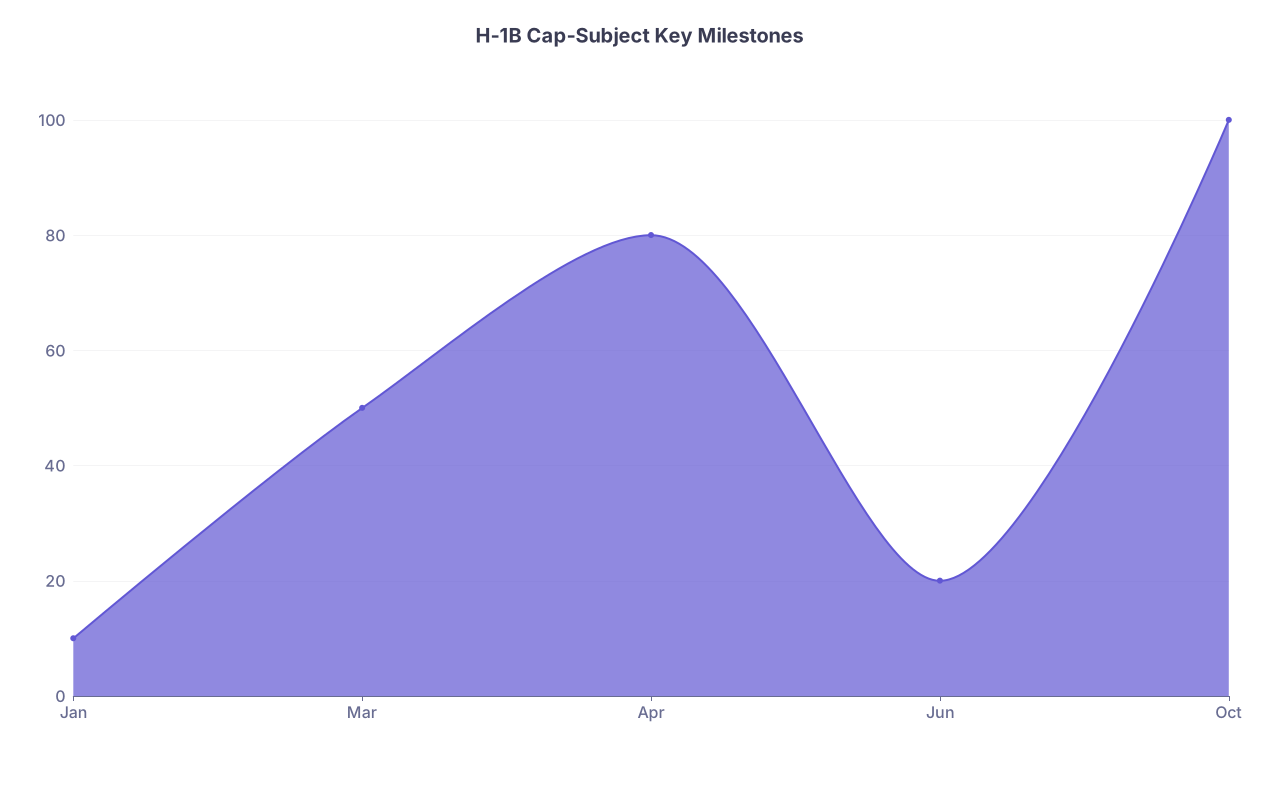
| Category | Value |
|---|---|
| Jan | 10 |
| Mar | 50 |
| Apr | 80 |
| Jun | 20 |
| Oct | 100 |
(Think of the values as “intensity of immigration activity” peaking in March–April and again at October start.)
Daily / Weekly Micro‑Tasks in Critical Windows
You do not need a daily checklist for three years. You do need one during crunch periods.
During the 4–6 Weeks Before a Conrad Opening Date
At this point you should, every week:
- Confirm with your attorney:
- All DS‑2019 copies are complete.
- All signatures (employer, physician) are done.
- Double‑check:
- State‑specific forms.
- Hospital support letters.
- Site addresses match HPSA/MUA data.
- Build a simple one‑page timeline sheet:
- Date filed
- Contact at state program
- Expected review time
- Backup state/program if this one fails
During March of H‑1B Cap Registration (Cap‑Subject)
Weekly tasks:
- Confirm:
- Employer/attorney actually registered you during the window.
- Your personal details are correct (passport, name spelling, etc.).
- Once lottery results are out:
- If selected:
- Immediately move to gather H‑1B documents (license, contracts, credentials).
- If not selected:
- Start daily outreach to potential cap‑exempt employers.
- If selected:
One Critical Reality Check
There is no “perfect” choice between J‑1 waiver and H‑1B. But there are absolutely stupid timing choices that sabotage options:
- Waiting until December of PGY‑3 on J‑1 to start thinking about waivers.
- Assuming any community hospital will “figure out” H‑1B for you.
- Ignoring the H‑1B cap cycle and waking up in April.
Do not do that to yourself.
Open your calendar right now and block off 60 minutes this week to map your own dates: graduation month, likely state(s), Conrad opening dates, H‑1B registration month, and a target job start window. Put those as non‑negotiable milestones, then build everything else—applications, interviews, licensing—around them.