
You open your inbox and there it is. The subject line reads: "Quick question about your letter draft." Your stomach drops before you even click.
The message is from your mentor, the attending you've been cultivating for months. They invested in you. They watched you grind through their subspecialty clinic, and they genuinely want to see you succeed. But the draft you sent them yesterday, the one for your primary specialty application, was accompanied by a brief, honest note: "I'm also applying to a backup specialty. Would you be comfortable writing a letter for that too?"
That backup specialty is completely unrelated. Think Dermatology → Internal Medicine. Orthopaedic Surgery → Family Medicine. Neurosurgery → Psychiatry.
Before you approach your mentor, it helps to understand how closely related should my backup specialty be to make your reasoning transparent and logical.
Now their email stares back at you: "I'm happy to support you, but I'm confused. How can you be passionate about both? This makes me worried your primary commitment isn't real."
The question is not malicious. It is a protective reflex. Faculty members guard their reputations. They do not want to attach their name to a scattered, incoherent application. They have seen students flame out because they looked indecisive. And they know, correctly, that residency selection committees punish an applicant who appears unfocused.
You have a problem. And you have about 24 hours to fix it before the seed of doubt takes root in your writer's mind.
Here is the step-by-step fix.
Step 1: Own Your Narrative Without Undermining Your Primary Goal
The first move is de-escalation. Do not craft a 500-word defensive email. Pick up the phone, or if you are in the same institution, walk to their office. A brief, in-person conversation diffuses tension faster than any written reply. If logistics force you to email, follow this script:
Subject: Re: Quick question about your letter draft
Dear Dr. Smith,
Thank you for asking the question, it is exactly the kind of clarity I want to provide. I am 100% committed to [Primary Specialty]. My backup plan is not a sign of wavering; it is a risk-management strategy given the competitiveness of the match. I would love 10 minutes to walk you through the logic so you feel confident in the letters you write. Would tomorrow at 3 p.m. work?
Being prepared for these discussions also means knowing how do i explain my backup specialty choice during high-stakes residency interviews.
This does three things: acknowledges the concern without defensiveness, reaffirms your primary goal, and requests a low-stakes conversation. Faculty respect directness.
During that conversation, deploy what I call the Dual-Track Narrative Framework. You frame your backup as a parallel skill-building interest, not a panicked fallback. Example:
"I've spent the last three years building my CV around [Primary Specialty]. The research, the electives, the mentorship, all of it. But I'm also a realist. The match rate for [Primary Specialty] is [X]%, and I've seen strong candidates go unmatched. My backup is [Backup Specialty], which lets me continue caring for complex patients and sharpening the diagnostic reasoning I love. I'm not splitting my focus; I'm building a contingency that still aligns with my core values."
Reassure them about the letter itself. Tell them: "The letter you write for my primary application will be entirely focused on my performance in [Primary Specialty]. It will not mention the backup. I will use your backup letter only if you feel comfortable writing a separate, more general version highlighting my clinical skills. I will assign it exclusively to the backup programs in ERAS." This eliminates the fear that their strongly worded Dermatology endorsement will end up in front of an Internal Medicine program director.
The communication workflow for this entire process should look like this:
Step 2: Drafting the Bridge Between Unrelated Specialties
The core of the problem is your letter writer cannot see the connection between the two fields. You must build that bridge for them. It does not need to be a majestic suspension bridge; a sturdy, logical plank will do.
Start by identifying legitimate thematic overlaps. Even seemingly disparate specialties share transferable competencies. Here is a quick matrix of skills that can bridge the gap:
The chart highlights that surgical fields and primary care both demand diagnostic reasoning and patient communication, albeit at different intensities. A Dermatology applicant can argue that their meticulous procedural training for biopsies translates to the procedural competence needed in an Internal Medicine residency's central line placements or lumbar punctures. An Orthopaedic Surgery applicant can point to the chronic disease management they practiced in post-op follow-ups, the same long-term care relationships that define Family Medicine.
Use this plug-and-play template to explain your choice, both in a personal statement addendum and when talking to letter writers:
"My primary commitment to [Primary Specialty] is unwavering. However, I have also developed a deep appreciation for [Backup Specialty] because of its emphasis on [Skill A] and [Skill B]. During my [Primary Specialty] rotations, I often found myself most engaged when managing [Overlap Patient Population or Procedure]. Pursuing [Backup Specialty] as a parallel track allows me to continue building those competencies while ensuring I serve patients regardless of the match outcome."
Red flags to avoid at all costs:
- Never say: "I just want to match anywhere." That signals desperation, not strategy.
- Do not mention lifestyle, burnout, or "easier path." Faculty hear that as laziness.
- Never frame the backup as a "backup plan" in the letter itself. The word "backup" should never appear in any written materials. Use "concurrent pathway" or "alternative training pathway" if you must refer to it.
Your letter writer needs to believe that your backup is a deliberate, intellectually honest parallel, not a surrender.
Step 3: Protocol for Handling Writers Who Refuse to Write Both
Sometimes, despite your best narrative, the mentor says: "I cannot, in good conscience, write a letter that supports two different career paths."
This is not a failure. It is a clarity moment. Do not plead, do not argue, do not imply they are letting you down. Thank them immediately for their candor. Then pivot to a triage protocol that preserves the primary letter and secures a backup writer.
Step-by-step triage:
Secure the primary letter immediately. Confirm: "I completely understand, and I respect your position. Your letter for my [Primary Specialty] application remains my top priority. Can I still count on that strong, focused letter?" Get that yes.
Identify a more flexible writer for the backup. Target faculty who worked with you on core clerkships, Internal Medicine, Family Medicine, or General Surgery, where your clinical skills were on full display across diverse patient populations. These attendings are often more comfortable writing a letter that highlights general medical excellence without a subspecialty lens.
Use the following script to release the original writer from the backup request gracefully:
"Dr. Smith, I've given your feedback a lot of thought. You're right, your letter should stay laser-focused on my [Primary Specialty] performance. I've identified another faculty member who can speak to my clinical skills in a broader context for the backup pathway. I'm grateful you pushed me to think this through. Thank you for protecting the integrity of my application."
This approach does three things: it validates the mentor's judgment, keeps the relationship intact, and ensures you still get the letter you need for your primary application. Burning bridges here is not an option, these are the same people who will champion you for fellowships and jobs later.
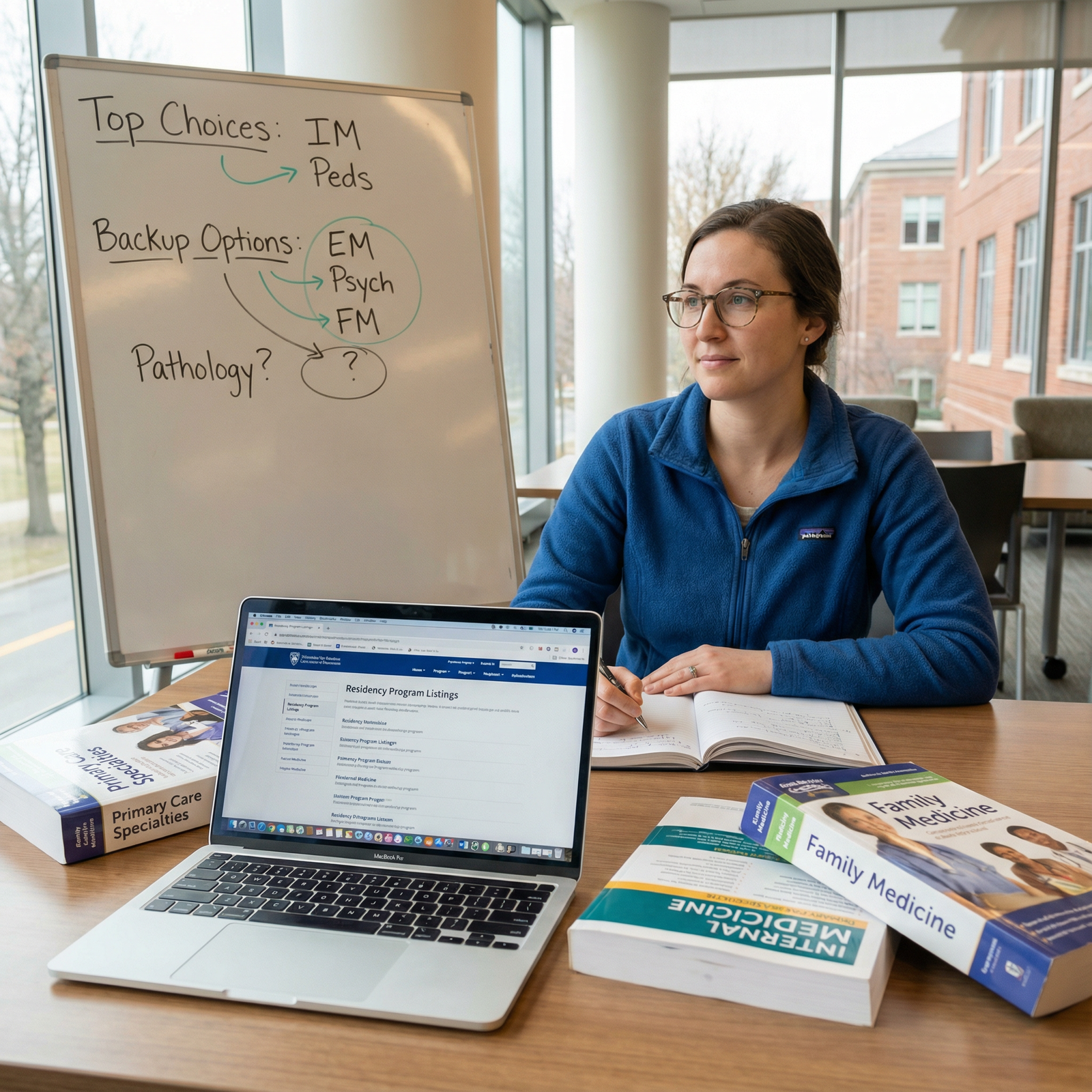
Now, with your primary letter safe and a backup writer in hand, you shift to the technical execution.
Step 4: Executing the Split ERAS Strategy Safely
The mechanical side of ERAS can sink you if you are sloppy. A single misassigned letter can send your Dermatology-focused recommendation to a Family Medicine program director. The cognitive dissonance will get your application binned.
Here is the exact protocol:
A. Letter segregation in ERAS
- Create two distinct letter entries. Label them internally, but know that the label you assign in ERAS is not visible to programs. I use the format: "Smith_Derm_Primary" and "Smith_IM_Clinical" in my personal tracking spreadsheet.
- Upload each letter as a separate document. If the same writer is providing both, they must produce two different files, one tailored to each specialty.
B. Assignment logic
- For each program on your primary list, assign only the primary-specific letter. Do not batch-assign all letters to all programs. ERAS allows you to customize which letters go to which program. Use that feature relentlessly.
- For backup programs, assign the general clinical letter and any other letters that speak to clinical competence without specialty language. If you have a letter from a core clerkship director that praises your work ethic and patient care, it works for both.
C. Quality control checks
48 hours before the deadline, perform a spot-check audit. Open each program's letter assignment screen. Verify that the primary specialty programs see only primary letters, and backup programs see only backup letters. One common mistake: a student assigns a letter from a subspecialty surgeon to a backup Internal Medicine program because the letter writer said "excellent student" and "hard worker." But the letterhead and the entire narrative scream surgery. That is a red flag. Do not do it.
D. A final note on confidence
You are not being dishonest. You are being strategic. The match algorithm is a brutal, numbers-driven system. Dual-applying with a coherent, well-separated plan is the mark of a professional who understands risk management. Carry that confidence into every conversation with faculty. They will mirror your tone. If you treat your backup as a thoughtful, legitimate pathway, they will too.

Summary
When a letter writer questions your unrelated backup, they are not trying to sabotage you. They are protecting their own credibility, and yours. The fix is a series of intentional, scripted moves:
- Acknowledge the concern immediately and request a live conversation.
- Frame the backup as a strategic parallel track built on transferable skills, using concrete overlaps.
- Reassure the writer that their primary letter remains untouched and specialty-specific.
- If a writer refuses, triage gracefully: lock the primary letter, pivot to a more flexible writer for the backup, and preserve the relationship.
- Execute ERAS assignments with surgical precision, auditing every program 48 hours before submission.
The students who handle this badly are the ones who panic, apologize, and make their backup sound like a desperate last resort. The ones who handle it well walk away with two solid letters, a mentor who respects their maturity, and an application that tells a compelling, unified story on both tracks.