
Understanding Geographic Flexibility as a Caribbean IMG in the Texas Triangle
For a Caribbean IMG aiming to match into residency in the Texas Triangle (Houston–Dallas–San Antonio–Austin corridor), geographic flexibility can be your single biggest strategic advantage. While many U.S. graduates narrow their target to one city or even one hospital system, you can often improve your odds dramatically by being realistic, open-minded, and strategic about where you are willing to train.
This article focuses on how to think about geographic flexibility as a Caribbean IMG interested in Texas residency programs—especially in and around the Houston, Dallas, and San Antonio residency hubs. We’ll also touch on Caribbean medical school residency outcomes, the SGU residency match experience as an example, and how a regional preference strategy can help you craft a smart, targeted, but still flexible application list.
Why Geographic Flexibility Matters So Much for Caribbean IMGs
The reality of being a Caribbean IMG
As a Caribbean IMG, you’re competing in a system where:
- Many programs are IMG-neutral or IMG-friendly, but some are still IMG-averse
- U.S. MD/DO applicants often get priority at more competitive sites
- Scores, clinical performance, and letters matter—but so does where you are willing to go
Programs in the Texas Triangle vary widely in:
- Volume of IMG residents
- Level of competition
- Preference for U.S. grads vs. IMGs
- Familiarity with Caribbean schools such as SGU, AUC, Ross, etc.
Caribbean medical school residency outcomes often show a pattern: students who are flexible about location tend to match at higher rates compared to those who restrict themselves to just one city or one highly competitive system.
Texas: High opportunity, but highly localized expectations
Texas is unusual in several ways:
- It has a large and growing population, meaning:
- Lots of clinical volume
- Expanding residency positions
- Many programs are community-based or hybrid academic–community settings that can be more IMG-friendly.
- There’s a long tradition of regional loyalty—programs often like applicants who:
- Express genuine interest in Texas
- Show some geographic connection or commitment to the region
For a Caribbean IMG, this means:
- If you’re only willing to go to, say, downtown Houston or a single hospital in Dallas, your odds are far lower.
- If you’re open to Houston + Dallas + San Antonio + nearby smaller cities, your chances in Texas residency programs start to look much better.
The Texas Triangle Landscape: Where the Opportunities Are
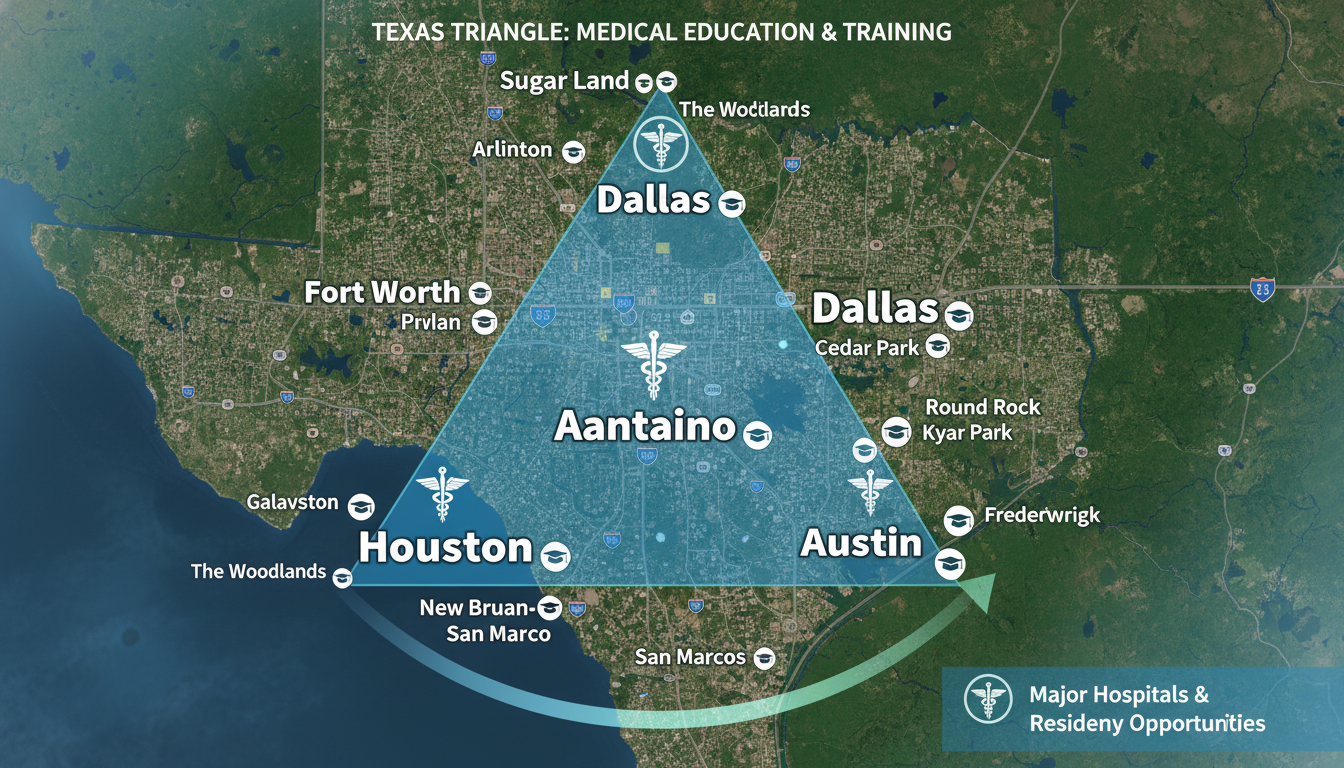
The Texas Triangle roughly connects four major metros:
- Houston
- Dallas–Fort Worth
- San Antonio
- Austin
But from a residency strategy standpoint, you should think more broadly: major city + suburbs + satellite communities.
1. Houston and surrounding areas
Houston is one of the largest medical hubs in the U.S., anchored by the Texas Medical Center. For Caribbean IMGs:
- The major academic programs can be more competitive, especially for fields like dermatology or radiology.
- However, there are many community and community-affiliated residency programs in:
- Suburban Houston
- Surrounding cities (e.g., Baytown, Conroe, Sugar Land, Katy, The Woodlands)
Key takeaway:
Don’t think “Houston = 3 big-name hospitals.” Think “Houston region = 10+ potential residency sites,” some of which are more open to IMGs.
2. Dallas–Fort Worth Metroplex
DFW is sprawling, with many hospitals and training sites. Similar pattern:
- Central academic programs in Dallas can be highly competitive.
- Peripheral and community programs around:
- Arlington
- Fort Worth
- Plano
- Irving
- Other outlying communities may be more receptive to Caribbean grads.
Many programs here are looking for:
- Consistent, reliable residents
- Strong work ethic
- Evidence that you really intend to live and stay in the area (or in Texas generally)
3. San Antonio and I-35 corridor
San Antonio has:
- Several established residency programs
- A mix of academic and community opportunities
- Some programs that have historically been willing to take qualified IMGs
Don’t overlook nearby areas along the I‑35 corridor (e.g., New Braunfels, Seguin, smaller systems around San Antonio) where new or growing programs may exist.
4. Austin and adjacent communities
Austin is increasingly popular but smaller in pure residency slot numbers than Houston or DFW. It tends to be:
- More competitive relative to its size
- Attractive to many U.S. grads for lifestyle reasons
Still, consider:
- Community-based programs in Round Rock, Temple, or smaller cities within commuting or drivable distance.
- New or expanding programs that may not be on everyone’s radar yet.
Practical example: Two applicants
Applicant A (Caribbean IMG) applies only to:
- One marquee academic program in Houston
- One in Dallas
- One in Austin
Result: Very low chance of interview invites; list is too narrow and too competitive.
Applicant B (Caribbean IMG) applies broadly across:
- Major teaching hospitals + community hospitals in Houston, DFW, and San Antonio
- Several mid-sized city programs within 1–2 hours of these metros
Result: Much higher interview yield because they used a regional preference strategy that’s broad within Texas, rather than hyper-focused on “name brands.”
Geographic Preference vs. Geographic Flexibility: Striking the Right Balance
Defining the key terms
- Geographic preference residency: Expressing that you prefer a certain city, state, or region (e.g., “Texas Triangle”).
- Location flexibility match: Being open to multiple cities, hospital types, and even surrounding rural or suburban locations to maximize match odds.
- Regional preference strategy: Combining these two—making it clear you love a region (Texas Triangle) while showing flexibility among multiple specific locations within that region.
For a Caribbean IMG, you typically want:
- Strong regional focus (e.g., “I really want to be in Texas for personal and professional reasons.”)
- High intra-regional flexibility (e.g., “I am open to training anywhere within the Houston–Dallas–San Antonio corridor and nearby communities.”)
Why programs care about geography
Programs want residents who:
- Are less likely to leave mid-training
- Understand the patient population and local culture
- May stay in the region as attendings
When you craft a geographic preference residency narrative that focuses on Texas and the Texas Triangle, you make yourself a more attractive candidate—as long as you don’t make it so narrow that programs suspect you won’t be happy outside one city block.
How to show flexibility without sounding desperate
You don’t want to say:
“I’ll go anywhere, I just need a spot.”
Instead, say something like:
“My long-term goal is to build my career in Texas. I have a strong interest in serving diverse patient populations like those in the Houston–Dallas–San Antonio corridor. I am especially drawn to programs that offer exposure to both urban tertiary care and community-based practice settings, and I am flexible within the region regarding specific city or hospital system.”
This approach:
- Highlights regional commitment (Texas)
- Signals geographic flexibility (multiple cities and practice settings)
- Keeps your tone confident and purpose-driven
Building a Smart Application Strategy: Texas Triangle for Caribbean IMGs

Step 1: Decide on your “home base” region
If Texas is a priority, start by deciding:
- Is Texas your primary focus, with other states as backup?
- Or is the Texas Triangle one of several regions you’re open to?
For Caribbean IMGs seriously targeting Texas residency programs, it’s often wise to:
- Treat Texas Triangle as your core region
- Add secondary regions where Caribbean IMGs historically do well (e.g., certain Midwest or Northeast community programs) to protect your overall match odds
Step 2: Map out specific programs by IMG-friendliness
Within Houston, Dallas, and San Antonio residency clusters:
Identify programs that:
- Have current or recent Caribbean IMG residents
- Have historically taken graduates from your specific school (e.g., look at SGU residency match lists if you’re from SGU, or your own school’s match data)
- State clearly that they accept IMGs and sponsor visas (if applicable to you)
Categorize programs:
- Category A: Strongly IMG-friendly (regularly take Caribbean grads)
- Category B: IMG-neutral (interview some IMGs; outcomes possible but not guaranteed)
- Category C: IMG-averse (almost no track record of Caribbean IMGs)
Focus your energy on A and B categories. You can still apply to a small number of aspirational programs, but don’t let them dominate your list.
Step 3: Balance academic vs. community programs
As a Caribbean IMG:
- Academic university hospitals in major metros may be reach programs, especially for competitive specialties.
- Community and hybrid programs around Houston, DFW, and San Antonio can offer:
- Better chances of interviews
- High patient volume
- Strong clinical training
- Sometimes a more collegial, close-knit culture
An effective strategy:
- 20–30% of your applications to academic or university-affiliated programs
- 70–80% to community, hybrid, or newer programs within and around the Texas Triangle
Step 4: Use your school’s match data (e.g., SGU as a model)
Whether you’re from SGU or another Caribbean school, pay close attention to the Caribbean medical school residency outcomes from your institution:
- Look specifically for:
- Graduates who matched in Texas residency programs
- Patterns of Houston Dallas San Antonio residency placements
- Example (modeled on SGU residency match data patterns):
- Year after year, you might see:
- 2–3 graduates in Houston community programs
- 3–5 graduates in DFW-area hospitals
- 1–2 in San Antonio or nearby areas
- Year after year, you might see:
Use that information to:
- Prioritize programs that have clearly taken grads from your school
- Reach out to recent alumni there for advice on:
- How they framed their regional preference strategy
- What the program values in Caribbean applicants
Step 5: Incorporate “near-Triangle” opportunities
Don’t ignore cities just outside the main hubs. Many IMGs match into programs in:
- Mid-sized cities 1–3 hours from Houston, Dallas, or San Antonio
- Systems that serve both urban and rural populations
These programs may:
- Be less saturated with applicants
- Provide strong training and great case variety
- Still allow you to network and move within Texas after residency
Example: Two-list comparison
Overly narrow list
- 5 applications: 3 big-name Houston programs, 2 in downtown Dallas.
Strategic, flexible list
- 30–40 applications:
- 5–8 in Houston proper (mix of academic and community)
- 8–10 in suburban Houston and nearby communities
- 8–10 in Dallas–Fort Worth (including Fort Worth, Arlington, Plano, etc.)
- 4–6 in San Antonio and nearby cities
- Additional protective applications in other IMG-friendly states
The second list aligns with a location flexibility match philosophy while still honoring a strong Texas focus.
Communicating Your Geographic Flexibility Effectively
Geographic flexibility isn’t just about what you’re thinking; it’s about what you say and write in your application materials and interviews.
1. Personal statement
Use your personal statement to:
- Express a clear connection to Texas or the Texas Triangle, if you have one:
- Family or close friends in the state
- Prior schooling, clinical rotations, or work experience in Texas
- Cultural or language ties relevant to local populations (e.g., Spanish-speaking communities)
- Show that you’ve researched the region:
- Understanding of diverse patient populations (urban, suburban, immigrant, rural)
- Interest in specific local health challenges (e.g., diabetes, obesity, chronic liver disease, border medicine if relevant)
Subtle but powerful phrasing:
“I am particularly drawn to Texas for residency because of its rapidly growing and diverse population, the opportunity to care for patients across both urban and community settings, and a strong culture of teamwork I observed during my clinical rotations in the region. Within the Texas Triangle, I am excited by the range of programs—from large referral centers in Houston and Dallas to high-volume community hospitals in surrounding cities—where I can become a well-rounded clinician.”
This frames your geographic preference residency in a thoughtful way while signaling that you are open to multiple types of programs.
2. ERAS geographic sections and program signaling
If the application season includes:
- A geographic preference signal or similar feature:
- Use it to indicate “Texas” or “South” if that aligns with your goals.
- Avoid using it to narrow to just one city within Texas unless you have an overwhelmingly strong reason.
- Special program signaling (if applicable for your specialty):
- Signal a few key Texas programs that you truly want, but apply broadly beyond them.
3. Interviews: verbalizing flexibility thoughtfully
When asked, “Where else are you applying?” or “Do you have a geographic preference?” aim for:
- Honesty + focus:
- “I’m focusing primarily on the Texas Triangle, with some additional applications in neighboring states that serve similar patient populations.”
- Reinforcing regional ties:
- Mention any long-term plan to live and practice in Texas.
- Specific but not restrictive answers:
- “I’d be very happy to train anywhere within the Houston–Dallas–San Antonio corridor or nearby cities. I’m looking for strong clinical training and a collaborative culture more than a specific ZIP code.”
Avoid sounding like:
- You’re only using Texas as a backup
- You dislike other regions
- You’re so rigid about one city that you might not be satisfied elsewhere
Long-Term Perspective: Career Growth After a Texas Residency
Choosing flexibility now doesn’t mean you lose control later. In fact, it often creates more options.
If you match in a smaller or less “famous” program
As a Caribbean IMG, matching in any solid ACGME-accredited program within Texas can be a powerful step:
- You gain:
- U.S. residency credentials
- Texas-specific clinical experience
- Networking opportunities across the state
- You can:
- Apply to fellowships anywhere, including big centers in Houston, Dallas, or beyond
- Move to a different Texas city for your attending job
- Use connections from state conferences and rotations to expand your opportunities
Texas-specific advantages
Training in Texas offers benefits that last beyond residency:
- High patient volumes = strong clinical exposure
- Many health systems expanding = potential jobs after residency
- If you plan to stay in Texas:
- Programs often look favorably on in-state residency graduates
- Local networking (preceptors, faculty, alumni) helps with job placement
Being geographically flexible at the residency stage can place you in a strong position to later choose:
- Your preferred Texas city
- Private practice vs. academic vs. hospital-employed roles
- Fellowship vs. primary care vs. hospitalist paths
FAQs: Geographic Flexibility for Caribbean IMGs in the Texas Triangle
1. As a Caribbean IMG, is it realistic to focus mainly on the Texas Triangle?
Yes, especially if you use a regional preference strategy that’s broad within the Texas Triangle rather than limited to one or two marquee hospitals. Many Caribbean graduates successfully match into Texas residency programs, especially in internal medicine, family medicine, pediatrics, and some other primary care fields. Your chances improve if you:
- Apply to a wide range of programs (academic + community)
- Include suburban and satellite city programs near Houston, Dallas, and San Antonio residency hubs
- Add some backup programs in other IMG-friendly regions outside Texas
2. How can I prove my commitment to Texas if I haven’t lived there before?
You can demonstrate commitment through:
- Clinical rotations or observerships in Texas (even short experiences count)
- Clear explanations in your personal statement about:
- Why Texas appeals to you (patient population, culture, long-term goals)
- Any personal connections (family, friends, mentors)
- Knowledgeable interview answers about:
- The local healthcare needs
- The diversity of the Texas Triangle
- Your long-term plan to live and work in the state
Programs want to see that your interest is genuine and informed, not random.
3. Should I prioritize programs that have previously taken Caribbean IMGs like SGU, Ross, or AUC?
Yes. Look at your own school’s match outcomes (or model from SGU residency match patterns if you’re from SGU) to see where students are consistently matching in Texas. Programs with a track record of taking Caribbean medical school residency grads are:
- More likely to understand your training background
- Often more comfortable evaluating Caribbean transcripts and letters
- Frequently more open to interviewing new Caribbean applicants
That said, don’t completely ignore IMG-neutral programs, especially if your scores, clinical performance, and letters are strong.
4. If I apply broadly within Texas, will it hurt me to also apply to other states?
No. This is part of a smart location flexibility match strategy. You can:
- Focus your narrative and interviews on Texas as a preferred region
- Still apply to other IMG-friendly states (e.g., certain Midwest or Northeast regions) as backups
- Tailor each interview and communication to the specific region and program
Programs do not see your entire application list, so applying broadly does not count against you. What matters is that when you’re engaging with a Texas program, you clearly convey why their program and their region make sense for your career.
By combining geographic flexibility with a focused, well-researched commitment to the Texas Triangle, you can turn a potential disadvantage—as a Caribbean IMG—into a strategic strength. Instead of competing only for a handful of ultra-visible programs, you open doors across Houston, Dallas, San Antonio, Austin, and surrounding communities, giving yourself the best possible chance to match, train well, and build a long-term career in Texas.