
Understanding the Med-Psych Landscape as a Caribbean IMG
Medicine-Psychiatry is a small but growing niche, and researching programs strategically is critical—especially if you’re a Caribbean IMG. Your goal is not just to find any program, but to identify where you are realistically competitive and where you will thrive over five years of combined training.
Before you dive into spreadsheets and website tabs, anchor yourself in three realities:
Combined Medicine-Psychiatry is highly specialized and limited in number.
There are far fewer med psych residency programs than categorical internal medicine or psychiatry programs. Each program is unique in structure, culture, and openness to IMGs.Being a Caribbean IMG is not a dealbreaker—but it changes your strategy.
Caribbean medical school residency outcomes vary widely. You must treat program research strategy as a high-yield, data-driven project, not a last-minute task.You should research both combined and categorical options.
Even if your dream is medicine psychiatry combined, most wise applicants—especially Caribbean IMGs—create a balanced list with:- Med psych residency programs
- Categorical internal medicine
- Categorical psychiatry
This increases your overall chance of a successful match.
The rest of this guide walks you step-by-step through how to research residency programs specifically as a Caribbean IMG interested in combined Medicine-Psychiatry.
Step 1: Clarify Your Goals and Constraints Before You Start
Before you open FREIDA or start Googling “evaluating residency programs,” define your non-negotiables and preferences. This will keep you from drowning in options and help you filter intelligently.
1.1 Define Your Career Vision in Med-Psych
Ask yourself:
- Do you see yourself primarily as:
- A hospitalist with strong psych expertise?
- A consultation-liaison psychiatrist?
- An outpatient integrative care physician?
- An academic physician in a combined department?
- How important are:
- Research and academic work?
- Community psychiatry or underserved care?
- Addiction or psychosomatic medicine?
- Global mental health or cross-cultural care?
Your answers influence what you look for in a medicine psychiatry combined program:
- Programs strong in consult-liaison and inpatient medicine may fit hospitalist-oriented goals.
- Programs with robust outpatient psychiatry and integrated behavioral health clinics support long-term outpatient Med-Psych careers.
- Academic goals mean prioritizing programs with NIH funding, publications, and fellowships.
1.2 Identify Personal Constraints (Especially Important for Caribbean IMGs)
Clarify:
- Geography
- Visa-friendly states (e.g., New York, New Jersey, Michigan, Texas)
- Proximity to family or support systems
- Cost of living limitations (NYC vs. Midwest vs. South)
- Visa Requirements
- Do you need J‑1 or H‑1B?
- Are you open to J‑1 waiver obligations later (e.g., working in underserved areas)?
- Step Scores and Attempts
- Step 1 (pass/fail, but attempts and context still matter)
- Step 2 CK score and any failures
These will heavily impact Caribbean medical school residency prospects and help you decide how competitive you are for certain Med-Psych programs.
Write this down in a simple one-page “Profile Summary”:
- USMLE scores and attempts
- Graduation year
- Visa status/needs
- Research experience
- US clinical experience (USCE)
- Location preferences
- Career focus within Med-Psych
You’ll refer to this repeatedly while evaluating residency programs.
Step 2: Build Your Initial Program List Systematically
Now you’re ready to research programs. This phase is about broad discovery, not yet about deep ranking. The goal is to generate a comprehensive but realistic list of:
- Medicine-Psychiatry combined programs
- Backup categorical Internal Medicine and Psychiatry programs

2.1 Identify All Medicine-Psychiatry Programs
Use multiple sources to ensure your list is complete and current:
ACGME / AMA FREIDA
- Use the combined training filters (Internal Medicine/Psychiatry).
- Export or copy the full list of med psych residency programs.
NRMP Program Directory and Past Match Lists
- Look up combined Internal Medicine/Psychiatry.
- Confirm which programs actually participate in the SGU residency match or in matches with other Caribbean schools (if you can access those reports from your school).
Program Websites
- Some combined programs are not well indexed; Google search:
"Internal Medicine-Psychiatry residency""Medicine Psychiatry combined residency program"
- Some combined programs are not well indexed; Google search:
Create a spreadsheet (Excel, Google Sheets, Notion—whatever you prefer). Basic columns:
- Program name
- City, state
- University/health system
- Number of Med-Psych positions per year
- Categorical IM and Psych programs present (Y/N)
- Website link
You’ll expand this spreadsheet over time.
2.2 Add Categorical Internal Medicine and Psychiatry Programs
Because med-psych residency is small and competitive, Caribbean IMGs almost always need categorical backups.
Use:
- FREIDA (AMA)
- Filter by:
- Specialty: Internal Medicine / Psychiatry
- Accepts IMGs: Yes (if available)
- Visa sponsorship: J‑1 and/or H‑1B
- Filter by:
- ERAS Participating Specialties & Programs list
Add another sheet or section for:
- Categorical IM programs in states you’d actually live in
- Categorical Psychiatry programs in the same regions
You don’t need to list every categorical program—focus on IMG-friendly and visa-sponsoring ones.
2.3 Tag Programs That Have Taken Caribbean IMGs Before
This is crucial for a Caribbean medical school residency applicant.
Use:
- Your school’s match list (e.g., SGU residency match data if you’re from St. George’s)
- Alumni networks (WhatsApp, Facebook, LinkedIn groups)
- School career services
For each program, add columns:
- “Has taken Caribbean IMG?” (Y/N)
- “Which school?” (e.g., SGU, AUC, Ross, Saba)
- “Year(s)” (if known)
This doesn’t guarantee you’ll match there—but it signals openness to Caribbean graduates, which is a powerful filter.
Step 3: Deep-Dive into Each Med-Psych Program
Once you have your broad list, start evaluating residency programs in depth. For combined Medicine-Psychiatry, you must research both the overall institution and the specific combined track.
3.1 Examine the Program Website Critically
For each medicine psychiatry combined program, systematically look at:
1. Structure of Training
- Total years (usually 5)
- Rotation breakdown (IM inpatient, psych inpatient, outpatient, consult-liaison, electives)
- How integrated the experience is vs. separated blocks
- Example: Some programs alternate blocks of 3–6 months in IM and Psych; others have longitudinal clinics in both disciplines.
2. Clinical Sites
- Academic medical center vs. community hospitals vs. VA
- Level-1 trauma center? Large safety net hospital?
- Variety of patient populations (urban, rural, underserved, diverse ethnic backgrounds)
3. Med-Psych Identity
- Is there a Med-Psych division, or is it a small track inside IM/Psych?
- Faculty with combined training? (MDs who are dual-boarded)
- Presence of Med-Psych clinics, integrated care clinics, or collaborative care models
4. Resident Profiles
- Check current residents’ bios:
- Are there IMGs? Caribbean grads?
- Are there combined residents active in research, advocacy, or leadership?
5. Outcomes and Career Paths
- Do graduates:
- Work as hospitalists?
- Become C-L psychiatrists?
- Enter fellowships (e.g., C‑L, addiction, geriatrics)?
- Stay on as faculty?
Make notes for each program in your spreadsheet under a “Notes” or “Fit” column.
3.2 Evaluate IMG-Friendliness and Visa Policies
As a Caribbean IMG, how to research residency programs always includes a visa and IMG-friendliness check.
Look for:
- Explicit statements on the program’s site:
- “We accept international medical graduates”
- “We sponsor J‑1 / H‑1B visas”
- Residency class pictures/bios:
- Any non-US schools listed?
- Any Caribbean schools by name?
- GME Office pages:
- Many institutions list visa policies at the GME level (not on each program page).
Add to your sheet:
- Visa type sponsored: J‑1 / H‑1B / Both / None
- Number of IMGs in current resident classes (rough estimate)
- Any Caribbean grads specifically (if visible)
If this info isn’t online, email or call the Residency Coordinator with a concise, polite question:
- “Do you currently sponsor J‑1 or H‑1B visas for residents?”
- “Do you consider applications from Caribbean graduates?”
3.3 Assess Competitiveness for Each Program
You must be realistic. Use:
USMLE score expectations
Look for:- Program’s stated minimums or “preferred” scores
- Forum threads for approximate ranges (take with caution but use as context)
Your profile vs. current residents
- If nearly all residents are AMG/USMD with publications, you’ll need a very strong profile to be competitive as a Caribbean IMG.
- If multiple residents are Caribbean grads, the program is more likely to review your application seriously.
Create a simple competitiveness rating in your sheet:
- 1 = Reach
- 2 = Possible
- 3 = Likely
Base this on: - Step 2 CK vs. known/suspected thresholds
- Presence of Caribbean grads
- Your research/USCE compared to what’s typical there
Step 4: Compare Program Quality and Fit Using Clear Criteria
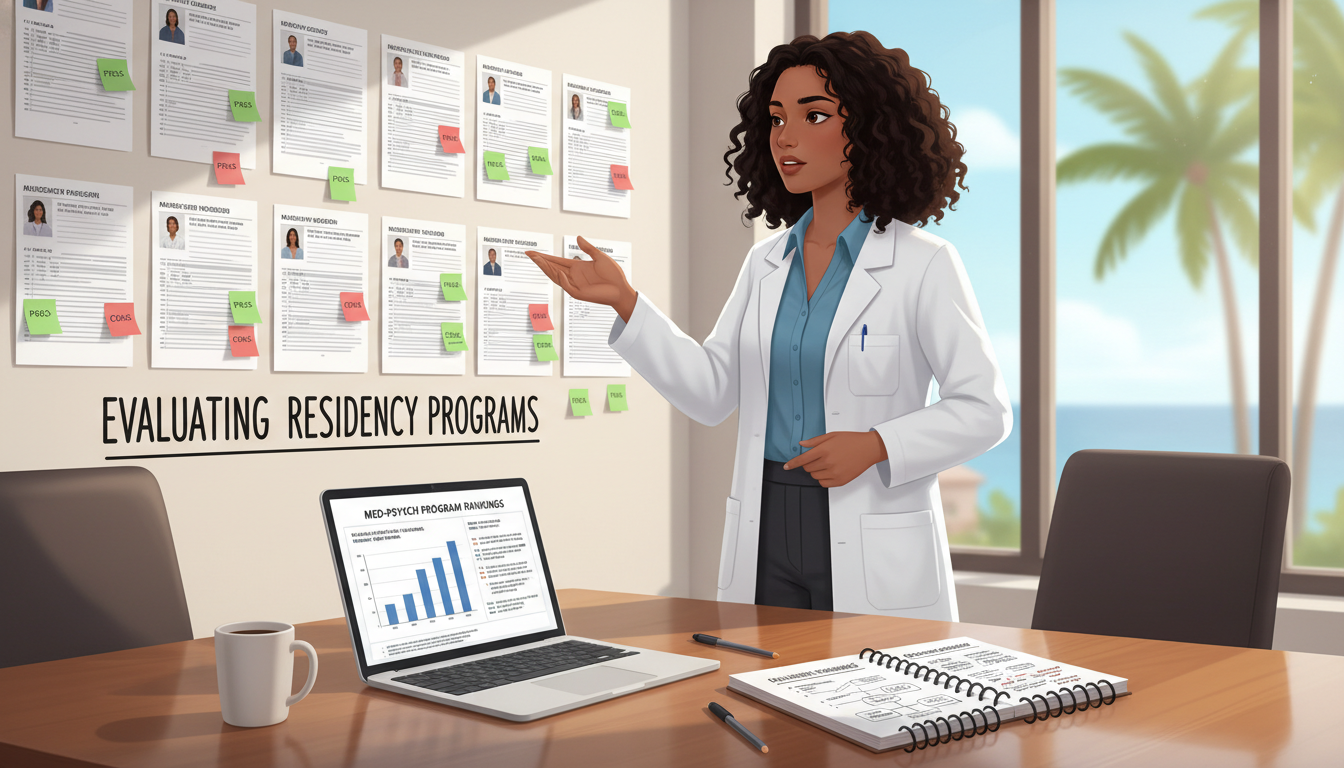
Now you’ve gathered data. The next part of your program research strategy is to systematically evaluate and compare programs, not just react emotionally to names or locations.
4.1 Clinical Training Quality in Both Disciplines
You are training in two specialties simultaneously. You need strong, not superficial, exposure to each.
Key questions:
Internal Medicine:
- Is there a strong inpatient service (ICU, cardiology, nephrology, oncology)?
- Are there robust ambulatory IM clinics?
- Do residents pass ABIM boards consistently?
Psychiatry:
- Breadth of rotations (inpatient, outpatient, addictions, child/adolescent, forensic, C‑L)
- Balanced exposure to medication management and psychotherapy
- ABPN board pass rates?
Integration:
- Are there true Med-Psych rotations (e.g., medical-psychiatric units, consult-liaison rotations that blend both perspectives)?
- Are there formal Med-Psych conferences or case conferences?
If the combined program seems like an afterthought to two large categorical programs, consider the risks to your identity and mentorship.
4.2 Academic Environment and Mentorship
Especially if you’re interested in:
- Academic medicine
- Fellowship (C‑L, addiction, geriatrics, etc.)
- Leadership positions
Look for:
- Faculty with dual training (Internal Medicine & Psychiatry)
- Active research in:
- Psychosomatic medicine
- Behavioral health in primary care
- Depression/anxiety in chronic medical illness
- Opportunities for:
- Case reports
- QI projects
- Resident teaching roles
Caribbean IMGs sometimes worry they’ll be sidelined academically. Use research productivity and mentorship structures as a proxy for how supported you might be.
4.3 Culture, Wellness, and Workload
Five years is a long time. Burnout in combined programs can be significant if the program is poorly structured.
When evaluating residency programs, pay attention to:
- Call schedules in both IM and Psych
- Feedback from residents (more in the next section)
- Program policies on:
- Wellness days
- Mental health resources for residents
- Schedule flexibility for immigration/visa appointments (important for IMGs)
Take notes on:
- “Supportive vs. malignant atmosphere”
- “Work hours: sustainable vs. extreme”
Even if this is subjective, pattern recognition across your research will help.
4.4 Location, Cost of Living, and Lifestyle
As a Caribbean IMG relocating (likely on a visa), location matters more than you think:
Cost of living
- Big cities (NYC, Boston, SF) vs. mid-size or smaller cities (Cleveland, Rochester, Indianapolis)
- Will your salary cover rent, transportation, childcare if applicable?
Weather and climate
- Moving from the Caribbean to harsh winters can be a significant adjustment; not a reason to avoid entirely, but think about your resilience and support systems.
Diversity and community
- Presence of Caribbean or broader immigrant communities
- Cultural familiarity (food, churches, language communities)
Fit here doesn’t need to be perfect, but do not ignore it—this is your life for 5 years.
Step 5: Use External Data and Real Voices
Once you’ve done primary website-based research, your program research strategy should include validation from external sources and real people.
5.1 Use Official Data Where Available
- NRMP Program Director Survey (specialty trends)
- Understand what Med and Psych PDs value (Step 2 CK, clerkship grades, letters, research, etc.).
- Program-specific outcomes (if posted):
- Board pass rates
- Fellowship match lists
- Job placement locations
5.2 Talk to Current or Recent Residents
This is often the single most valuable step, especially for Caribbean IMGs.
How to approach:
- Use LinkedIn:
- Search “[Program Name] Medicine-Psychiatry resident”
- Filter by “Current” and “Past”
- Use your school’s alumni database or SGU residency match / Caribbean school match pages:
- Find alumni at those hospitals
- Request introductions if your school offers that
What to ask (briefly, respectfully):
- “How supportive is the program towards IMGs / Caribbean grads?”
- “What is the culture like—collaborative vs. competitive?”
- “How is the integration between Medicine and Psychiatry? Do you feel like ‘half a doctor’ in each, or fully trained in both?”
- “Would you choose the same program again, and why or why not?”
Keep your message short, show you did your homework, and thank them for any time they can offer.
5.3 Cross-Check Forums and Online Reviews (With Caution)
Potential sources:
- Reddit (r/Residency, r/medicalschool)
- Student Doctor Network (SDN)
- Specialty-specific forums
Use these to:
- Spot major red flags (consistent reports of mistreatment, chronic understaffing)
- Hear multiple perspectives
Do not overreact to a single negative anecdote. Look for patterns and corroboration.
Step 6: Prioritize and Finalize Your Application List
After all this research, you’ll have a large volume of information. Now you must convert it into a realistic, strategic application plan.
6.1 Categorize Programs into Tiers
Use your spreadsheet to assign each Med-Psych, IM, and Psych program to categories:
- Reach:
- Highly academic centers
- Limited or no history of Caribbean IMGs
- Score expectations higher than your profile
- Target:
- Some Caribbean or IMG presence
- Your Step scores and experiences are roughly on par
- Safety (relative):
- Clear track record of Caribbean IMGs
- VISA-friendly
- Less competitive geographic locations or reputation
For Caribbean IMGs, almost no programs are truly “safe,” but some are more realistic.
6.2 Balance Combined vs. Categorical Applications
For a Medicine-Psychiatry–focused Caribbean IMG, a common structure might be:
- 8–15 Med-Psych programs (if available to apply)
- 15–25 Categorical Internal Medicine programs
- 10–20 Categorical Psychiatry programs
Adjust based on:
- Your competitiveness
- Geographic flexibility
- Financial constraints (ERAS fees)
Your goal: at least one match in a pathway that still allows you to work in the Med-Psych interface (e.g., categorical psych + strong C‑L exposure, or categorical IM + behavioral health interest).
6.3 Keep Updating as You Learn More
Program availability and details can change:
- New Med-Psych tracks open, some close.
- Visa policies shift.
- A program that looked great on paper may feel wrong after a resident conversation.
Revisit your spreadsheet every few weeks:
- Archive any program that clearly does not fit you (e.g., no visas, strongly anti-IMG).
- Upgrade or downgrade competitiveness tiers based on new information.
Putting It All Together: A Sample Research Workflow
Here’s a practical, step-by-step program research strategy you could follow over 4–6 weeks:
Week 1–2: Build the Master List
- List all Med-Psych programs from ACGME/FREIDA.
- Add 40–60 categorical IM and Psych programs that:
- Accept IMGs
- Sponsor visas
- Are in your target regions
- Add columns: location, visa, IMG history, website link.
Week 2–3: First-Pass Filtering
- Eliminate programs that:
- Clearly do not sponsor visas
- State “US graduates only”
- Highlight programs with known Caribbean IMG residents (from your school’s match list).
Week 3–4: Deep Dive Into Top Med-Psych Programs
- Review each Med-Psych website:
- Structure, clinical sites, faculty, resident bios
- Rate competitiveness (Reach/Target/Safety)
- Email 1–2 alumni or current residents per top-choice program.
Week 4–5: Categorical Backups
- Repeat a lighter version of the same process:
- Visa, IMG presence, culture
- Rank by fit and likelihood.
Week 5–6: Finalize Application List
- Lock in a balanced list of:
- Med-Psych programs
- Categorical IM
- Categorical Psych
- Use your notes to tailor your personal statement and letters to the Med-Psych narrative.
FAQs: Researching Medicine-Psychiatry Programs as a Caribbean IMG
1. As a Caribbean IMG, is it realistic to match into a Medicine-Psychiatry residency?
Yes, but it is competitive and requires strategy. Many Med-Psych programs are small and often favor US graduates. However, some programs have demonstrated openness to Caribbean grads through past matches (check your school’s data, such as SGU residency match outcomes, and resident rosters online). Your chances improve if you:
- Have strong Step 2 CK and a clean attempt history
- Obtain solid US clinical experience and letters in both IM and Psych
- Apply broadly and intelligently, including categorical IM and Psych as backup options
2. How can I tell if a Med-Psych program is truly IMG- or Caribbean-friendly?
Look for a combination of indicators:
- Current or recent residents from Caribbean schools listed on the program website or LinkedIn
- Explicit statements about considering IMGs and sponsoring J‑1 or H‑1B visas
- Responses from residents or coordinators indicating openness to non-US grads
- Your school’s match history showing prior Caribbean medical school residency placements there
No single factor is decisive, but several positive signals together suggest a program is more IMG-friendly.
3. Should I prioritize program reputation or IMG-friendliness when building my list?
You need a balanced approach:
- Include some “reach” programs with strong reputations if they somewhat align with your profile.
- Heavily populate your list with “target” and relatively safer programs that:
- Have taken Caribbean IMGs
- Match your score profile
- Offer the kind of Med-Psych training you want
Prestige alone doesn’t guarantee a good experience or a match. As a Caribbean IMG, probability of matching plus quality of training matters more than name recognition alone.
4. If I don’t match into a combined Med-Psych program, can I still build a Med-Psych career?
Absolutely. Many physicians build Med-Psych style careers via:
- Categorical Psychiatry + strong consultation-liaison or psychosomatic focus
- Categorical Internal Medicine + behavioral health interest and integrated care work
- Fellowship training (e.g., C‑L psychiatry, addiction medicine) after either IM or Psych
When evaluating residency programs, look for categorical IM or Psych programs that offer:
- Strong C‑L or psychosomatic services
- Integrated care clinics
- Faculty interested in medicine-psychiatry intersections
This way, even if you don’t match into a formal medicine psychiatry combined program, you can still align your training and career with Med-Psych principles.
By treating program research as a structured, data-driven project—and tailoring it to your reality as a Caribbean IMG—you maximize both your match chances and your long-term satisfaction in Medicine-Psychiatry.