
Understanding the Landscape: Vascular Surgery and Caribbean IMGs
Researching residency programs is not just about making a list; it’s about strategically finding places where you have a realistic chance to match and to thrive. For a Caribbean IMG aiming for a vascular surgery residency, the stakes are higher and the path is narrower—but it is not impossible.
Vascular surgery is:
- Highly specialized and procedurally intense
- Competitive, with relatively few positions
- Increasingly structured through integrated vascular programs (0+5) and fellowship pathways after general surgery (5+2)
As a Caribbean medical school residency applicant, especially from places like SGU, AUC, Ross, Saba, etc., you face:
- More scrutiny of your academic record
- Increased emphasis on US clinical experience and letters
- Potential bias toward US MD/DO applicants for integrated vascular positions
That’s why your program research strategy must be deliberate, realistic, and data-driven. You’re not just asking, “Where do I want to go?” but more importantly, “Where can I realistically match, learn well, and progress into vascular surgery?”
Before you start, clarify your primary goal:
- Is it to match directly into an integrated vascular surgery program (0+5)?
- Or to match into a categorical general surgery residency with a path to a vascular surgery fellowship (5+2)?
For most Caribbean IMGs, the more realistic and ultimately safer route is:
- Match into a strong, IMG-friendly general surgery residency
- Build a vascular profile (research, electives, mentors)
- Apply to vascular surgery fellowships
You can still keep an eye on integrated vascular programs—but your program research should prioritize places where you can develop into a competitive vascular fellowship candidate.
Step 1: Clarify Your Profile and Target Pathway
Before diving into how to research residency programs, you need to understand what you bring to the table and how that fits into the vascular landscape.
1.1 Analyze Your Application Profile Honestly
Key components:
- USMLE/Step scores (or pass/fail context, plus Step 2 CK)
- Step 2 CK is now critical for differentiation
- Medical school performance
- Class rank, honors, failed or repeated courses
- Clinical experience
- US clinical rotations, especially in surgery
- Research background
- Any vascular, surgery, or outcomes research?
- Abstracts, posters, publications
- Letters of recommendation
- From US vascular surgeons or general surgeons?
- Visa status
- US citizen/Green Card vs. requiring J-1 or H-1B
For a Caribbean IMG targeting vascular surgery:
- Strong Step 2 CK (ideally > 240) significantly improves your odds
- A clean academic record (no remediations) is helpful, especially for integrated positions
- At least 1–2 letters from US surgeons is highly beneficial
- US citizenship/permanent residency can widen your list of potential programs
If you’re from a well-established Caribbean school with a solid SGU residency match track record in surgery and subspecialties, you may have better structural support and more alumni connections, but you still need strong personal metrics.
1.2 Decide on Your Primary Application Strategy
For Caribbean IMGs, consider three broad strategies:
High-risk, high-ambition:
- Apply to a large number of integrated vascular surgery programs (0+5)
- Plus categorical general surgery programs as a backup
- Requires strong scores, research, and compelling vascular exposure
Balanced, realistic:
- Primary focus on categorical general surgery programs with vascular surgery fellowships and faculty
- Target a smaller, carefully curated list of more IMG-friendly integrated vascular spots
Stepping-stone approach:
- Broad application primarily to general surgery residencies, including community programs
- Develop a vascular profile during residency, then apply to 5+2 fellowships
Your program research strategy will differ somewhat depending on which of these you choose, but the core principles—data, fit, and feasibility—stay the same.
Step 2: Build a Structured Master List of Programs
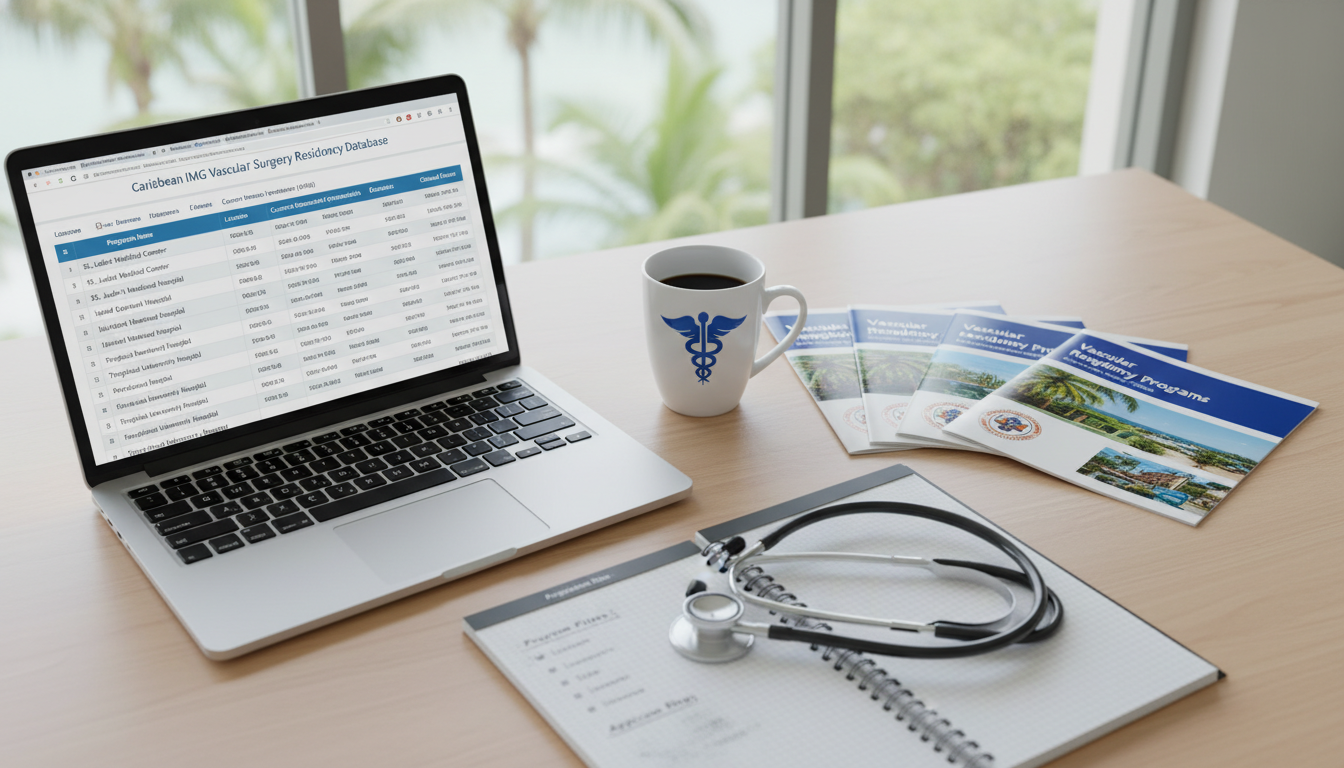
You can’t research programs effectively if you’re bouncing randomly between websites. Start by building a master spreadsheet and a methodical process.
2.1 Tools and Databases to Use
Use multiple sources and cross-check them:
FREIDA (AMA Residency & Fellowship Database)
- Filter by:
- Specialty (Vascular Surgery – Integrated; Surgery – General)
- Program type
- Visa sponsorship
- Program size
- Pay attention to information like:
- Total positions
- USIMG/IMG presence (if noted)
- Program setting (academic, community, hybrid)
- Filter by:
ERAS Program Directory
- Check current application requirements, including:
- Required documents
- Minimum score thresholds (if listed)
- Visa policy
- Check current application requirements, including:
NRMP Data & Charting Outcomes
- Look at:
- Match rates for IMGs in surgery specialties
- Average scores and experiences of matched applicants
- Number of programs ranked vs. match probability
- Look at:
Program Websites & Institutional GME Pages
- Verify:
- Current residents
- Vascular faculty
- Research opportunities
- Hospital case volume
- Verify:
Caribbean school match lists (e.g., SGU residency match outcomes)
- Identify:
- Where prior graduates matched for general surgery
- Any who went on to vascular fellowships
- Any direct vascular surgery matches (0+5)
- Identify:
2.2 Organize Your Spreadsheet
Create columns for:
- Program name
- Location (city/state, region)
- Type (integrated vascular vs. general surgery)
- Setting (academic, university-affiliated community, pure community)
- Visa sponsorship (J-1, H-1B, none)
- Historical IMG friendliness (Y/N/Unknown)
- Caribbean IMG presence or alumni connections
- Minimum score or eligibility criteria (if stated)
- Vascular surgery faculty & fellowship on site (Y/N)
- Resident list: any MD/IMG/Caribbean grads noted
- Call schedule & case volume (if available)
- Program strengths (your notes)
- Potential concerns (“red flags”)
- Level of interest (High/Medium/Low)
- Contact/alumni notes
This framework turns a vague idea of “evaluating residency programs” into a systematic research process.
Step 3: Identify IMG‑Friendly and Vascular‑Supportive Programs
As a Caribbean IMG, you must prioritize places that both:
- Accept and train IMGs successfully, and
- Offer strong vascular exposure, mentorship, and research.
3.1 Read Resident Rosters Strategically
On each program’s website, look at current and recent residents:
- Check medical schools:
- Do you see international graduates?
- Any Caribbean schools listed, such as SGU, Ross, AUC, Saba?
- Check vascular fellows or graduates:
- Where did they come from?
- Did any come from community or mid-tier programs, not just top-tier name brands?
If a program has never had a Caribbean IMG or foreign graduate in surgery, your odds—especially for an integrated vascular spot—are likely low. For general surgery, look for:
- At least a handful of IMGs in the roster
- Evidence that IMGs are not all in preliminary only tracks
When you see Caribbean IMGs in general surgery who later matched into vascular fellowships, mark that program as high-yield for your path.
3.2 Evaluate Visa and Policy Details Carefully
Many Caribbean IMGs need visa support. While policies may not be clearly stated, use the following:
- Check FREIDA/ERAS notes on:
- “Accepts J-1” or “Accepts H-1B”
- “Sponsorship not provided” = likely not IMG friendly
- Look at current residents:
- Any clearly international graduates (from non-US schools)?
- Ask yourself: if they have IMGs, they almost certainly provide J-1 support at minimum
If you need a visa, prioritize J-1 friendly programs; don’t waste too many applications on programs that explicitly do not sponsor visas.
3.3 Assess Vascular Surgery Strength within General Surgery Programs
If you’re primarily applying to categorical surgery with a plan for vascular fellowship, assess the vascular environment:
On program or department websites, look for:
- A vascular surgery division or section with:
- Multiple vascular faculty (not just one)
- A formal vascular surgery fellowship (5+2)
- Evidence of:
- Endovascular suite and hybrid ORs
- Robust case numbers in open and endovascular procedures
- Resident rotation on vascular services
- Research and mentorship:
- Ongoing clinical trials or outcomes research in vascular
- Resident presentations at SVS, VESS, or other vascular meetings
Programs with a dedicated integrated vascular program on campus may be more competitive, but they also:
- Offer built-in vascular mentors
- Have infrastructure and research pipelines
- Often encourage motivated general surgery residents toward vascular fellowships
These are valuable training environments for a Caribbean IMG who wants to build a vascular CV.
Step 4: Deep Dive – How to Research Each Program Effectively
Once you have a broad list, you must narrow it down through deeper research that goes beyond the name and location.
4.1 What to Look for on Program Websites
Go beyond the homepage. Carefully review:
Curriculum and rotations
- How many months on vascular surgery during PGY2–5?
- Are there elective rotations in vascular or endovascular?
- Do residents get early operative exposure?
Case volume
- Number of major vascular cases per year (if reported)
- Resident logs or case averages
Faculty interests
- Look at vascular faculty profiles:
- Research areas: PAD, aneurysms, dialysis access, carotid disease, venous disease
- Are they publishing regularly?
- Are they involved in national societies (SVS, etc.)?
- Look at vascular faculty profiles:
Resident achievements
- Do residents present at vascular or surgical conferences?
- Are there publications or QI projects in vascular topics?
Program culture and support
- Diversity statements or evidence of inclusion
- Wellness initiatives
- Mentorship structure (assigned mentors vs. ad hoc)
As a Caribbean IMG, you benefit from programs where you can:
- Get hands-on operative experience
- Access vascular mentors who understand the fellowship pathway
- Participate in research projects that make you competitive later
4.2 Use Social Media and Unofficial Sources Wisely
Many programs maintain active presence on:
- Twitter/X
Use these to:
- See resident life, camaraderie, and culture
- Identify vascular research projects, journal clubs, or QI initiatives
- Note whether IMGs are visible and integrated in the group
Be cautious with anonymous online reviews. They can reveal:
- Persistent themes (e.g., malignant culture, poor operative exposure)
- Chronic issues like under-staffing or high attrition
…but they can also be biased and unbalanced. Treat them as supplemental, not definitive.
4.3 Leveraging Alumni and Networking (Especially from Caribbean Schools)
If you are at a school with a strong global footprint (e.g., SGU), take advantage of:
- Alumni directories and match lists
- Faculty who routinely help students into surgery/vascular pathways
- SGU residency match or similar reports that show:
- Which surgery programs have historically taken your graduates
- Where those graduates went on to fellowship
Reach out to alumni:
- Ask for 10–15 minutes to discuss:
- Their experience with the program
- Program culture, operative exposure, and vascular opportunities
- Whether they think the program is genuinely IMG-friendly
- Be respectful of their time; ask focused, specific questions
Your goal: build a sense of where Caribbean IMGs have historically done well, and identify potential mentors or advocates at those sites.

Step 5: Evaluate Fit, Competitiveness, and Create Tiers
Once you gather data, you need to convert it into decisions—where to apply, where to prioritize, and where not to waste energy.
5.1 Develop a Program “Fit” Score
To make evaluating residency programs more objective, create a simple scoring system (e.g., 1–5) in your spreadsheet for:
IMG-friendliness
- Evidence of current or recent IMGs in surgery
- Explicit openness in program description
Vascular strength
- On-site vascular fellowship
- Multiple vascular faculty
- Documented vascular research or conference presence
Location and lifestyle
- City size, cost of living, support systems
- Proximity to family or friends (important for resilience)
Academic and operative environment
- Case volume and early operative opportunities
- Faculty engagement and teaching culture
Visa compatibility (if applicable)
- J-1 or H-1B support
Assign each program a composite score, and rank-order your list.
5.2 Match Your Competitiveness to Program Type
Be realistic about your competitiveness:
If you have solid scores, strong surgery letters, some vascular research, and are a US citizen, you may target:
- A few integrated vascular programs (0+5)
- A strong core of academic general surgery programs with vascular fellowships
- Some medium-tier or community academic programs as a safety net
If your profile is more average (e.g., lower scores, fewer publications), cluster around:
- IMG-friendly general surgery programs with vascular exposure
- University-affiliated community programs with historically matched IMGs into fellowships
If you have major weaknesses (exam failures, limited US experience), first stabilize your foundation:
- Consider a research year in surgery/vascular outcomes
- Strengthen your Step 2, letters, and CV
- Then apply more broadly, focusing on programs with clear IMG inclusion
5.3 Build “Tiers” of Programs
To prevent over- or under-shooting, classify programs into approximate tiers:
Reach programs
- Highly competitive academic or integrated vascular programs
- Historically low IMG intake
- You apply to a limited number, based on appeal and your best-fit factors
Target programs
- Academic or hybrid community programs
- Regularly interview or train IMGs
- Clear vascular presence (faculty, fellowship, or strong rotations)
Safety programs
- Known IMG-friendly community surgery programs
- Solid operative volume, perhaps fewer research opportunities
- Reasonable track record of placing residents into fellowships (not necessarily top-tier)
Your application strategy might look like:
- 10–15% reach
- 50–60% target
- 25–35% safety
The goal is to ensure a high likelihood of at least one categorical match, with enough vascular exposure to keep your long-term goal alive.
Step 6: Refine Your List and Prepare for Program-Specific Applications
Once you’ve done deep research and tiered your programs, complete the cycle by making your application more program‑informed.
6.1 Program-Specific Tailoring
For highly desired programs (whether integrated vascular or surgery with strong vascular components), integrate what you learned into:
Personal statement emphasis
- Mention your interest in a program’s:
- Integrated vascular program (if applying directly)
- Vascular faculty research that aligns with your interests
- Commitment to underserved vascular populations, limb salvage, or dialysis access
- Show that your career goal is clearly vascular surgery, but framed realistically through general surgery→vascular fellowship if applicable
- Mention your interest in a program’s:
Supplemental ERAS program signals (if available)
- Use signals on programs that:
- Are IMG-friendly
- Have quality vascular mentorship
- You would honestly rank highly
- Use signals on programs that:
Email outreach (selectively)
- If you have a concrete connection (alumni mentor, prior rotation, research collaboration), a polite email to the program director or coordinator noting your interest and connection can sometimes help.
- Avoid mass, generic emails; they tend to be ignored.
6.2 Continuously Update Information
Program characteristics change:
- New faculty join or leave
- Vascular divisions may expand
- Visa policies may shift
- Programs can gain or lose accreditation or fellowships
Re-check your highest-priority programs closer to application and interview time:
- Verify the most recent resident rosters
- Look for new publications or announcements (especially in vascular)
- Adjust your ranking of interest and fit as needed
6.3 Protect Your Mental Health and Perspective
The research process can feel overwhelming, especially when you see how competitive vascular surgery is. Remember:
Plenty of vascular surgeons started with:
- Community general surgery residencies
- IMG backgrounds
- Non-linear paths to fellowship
Focus on:
- Finding a program that will train you well as a surgeon
- Exposure to vascular mentors and cases
- An environment where you will be supported, not just tolerated
A realistic, data-based program research strategy maximizes your chances of matching, growing, and eventually achieving your vascular surgery goals.
FAQs: Program Research for Caribbean IMGs in Vascular Surgery
1. Can a Caribbean IMG realistically match directly into an integrated vascular surgery program?
It is possible but uncommon. Integrated vascular programs are:
- Small in number
- Highly competitive
- Often biased toward US MDs with strong research
A Caribbean IMG with a realistic shot usually has:
- High Step 2 CK
- Robust vascular or surgery research (abstracts, publications)
- Strong US vascular surgery letters
- Proven commitment to vascular (electives, SVS involvement)
For most Caribbean IMGs, targeting categorical general surgery programs with strong vascular exposure, then pursuing a 5+2 fellowship, is a safer and more reliable path.
2. How do I know if a surgery program is truly IMG-friendly?
Use multiple indicators:
- Resident roster: Are there current or recent IMGs? From where?
- Program history: Has your Caribbean school matched students there before?
- Visa support: Do they accept/sponsor J-1 (and H-1B if needed)?
- Communication tone: Do they explicitly welcome IMGs, or is there silence or discouragement?
Programs with multiple IMGs in categorical positions—not just prelim—are more likely to be IMG-friendly.
3. Should I prioritize academic programs over community programs if I want vascular surgery?
Not automatically. Consider:
- Academic programs
- Often have vascular fellowships, research infrastructure, and subspecialty exposure
- Can be more competitive and sometimes less IMG-friendly
- Community or hybrid programs
- May offer high operative volume and a tight-knit learning environment
- Some have strong relationships with vascular fellowships and allow residents to do vascular electives or research
For a Caribbean IMG, a high-volume community or hybrid program with vascular ties can be an excellent stepping-stone to a vascular fellowship.
4. How many programs should I apply to as a Caribbean IMG interested in vascular surgery?
Numbers change by cycle, but generally:
- If targeting integrated vascular:
- Expect to apply to almost all programs (there are few), plus:
- A substantial number of categorical general surgery programs as backup (40–70+ depending on competitiveness)
- If primarily targeting general surgery with a vascular focus:
- Many Caribbean IMGs apply to 60–100+ general surgery programs, then narrow based on interviews
Your exact number depends on:
- Your metrics (scores, CV)
- Visa status
- Strength of your vascular profile
What matters most is not only volume but quality of program selection—targeting places where your profile fits and vascular opportunities exist.
By approaching how to research residency programs in a systematic, data-driven way—and by focusing on IMG-friendly surgery programs with strong vascular resources—you give yourself the best chance to move from a Caribbean medical school to a successful career as a vascular surgeon.