
As a Caribbean IMG, your residency outcome will be shaped as much by your program research strategy as by your USMLE scores or clinical evaluations. Thoughtful, systematic program research is what turns a long, confusing list of programs into a targeted, realistic and high-yield application list.
This guide walks you step-by-step through how to research residency programs specifically as a Caribbean graduate, with practical strategies, tools, and examples tailored to your situation.
Understanding Your Starting Point as a Caribbean IMG
Before you dive into databases and spreadsheets, you need clear self-knowledge. Caribbean medical school residency outcomes can be excellent, but they vary widely depending on:
- Your USMLE scores and exam attempts
- Your clinical performance and letters of recommendation
- Your graduation date and any gaps
- Your visa status
- The reputation and history of your specific school (e.g., SGU, AUC, Ross, Saba, etc.)
1. Clarify Your Applicant Profile
Create a short “profile snapshot” for yourself:
- Medical school: Name and country (e.g., SGU, AUC, Ross)
- Year of graduation (or expected graduation)
- USMLE Step 1: Pass/Fail (+ score if you took it before pass/fail change)
- USMLE Step 2 CK: Score and attempts
- Any failed attempts on Steps or CS (if applicable)
- Research: Publications, posters, QI projects (Y/N, brief)
- U.S. clinical experience (USCE): Core rotations vs. electives, settings, specialties
- Visa status: Citizen/Green Card/J‑1/H‑1B need
- Specialty interests: Primary and backup (e.g., Internal Medicine primary, Family Medicine backup)
This snapshot will guide how you approach evaluating residency programs and what “realistic” looks like for you.
2. Understand the Caribbean IMG Landscape
Caribbean medical school residency matches tend to cluster in:
- Primary care specialties: Internal Medicine, Family Medicine, Pediatrics
- Some Transitional Year (TY) and Preliminary positions (especially IM/Surgery preliminary)
- Select programs open to IMGs in Psychiatry, Neurology, Pathology, and others
The SGU residency match statistics, and those from other major Caribbean schools, show that:
- High pass rates on Step exams
- Strong clinical evaluations
- Early planning and targeted program lists
…all significantly improve outcomes.
Your program research must therefore be data-driven and specialty-aware so you’re not wasting applications on programs that almost never interview Caribbean IMGs.
Step 1: Define Your Specialty and Competitiveness
Researching programs without a chosen specialty is like looking for housing without knowing what city you’re moving to. The first step: nail down your specialty (plus a backup, if needed).
Choose a Primary Specialty
Ask yourself:
- Where do you have the strongest clinical evaluations and letters of recommendation?
- What did you enjoy most on rotations?
- Where do your exam scores fit best relative to typical IMG matched applicants?
For Caribbean IMGs, the most common—and often most realistic—primary specialties are:
- Internal Medicine
- Family Medicine
- Pediatrics
- Psychiatry
- Neurology
- Pathology
More competitive specialties (e.g., Dermatology, Orthopedics, Plastic Surgery, ENT, Radiation Oncology, Ophthalmology) are typically very difficult from Caribbean schools unless you have extraordinary credentials and strong U.S.-based research.
Assess Your Competitiveness
Use objective metrics and honest self-assessment. For your chosen specialty, look up:
- NRMP “Charting Outcomes in the Match” (for IMGs, by specialty)
- NRMP “Program Director Survey” (what PDs value most)
- Historical score ranges for matched IMGs in your target specialty
Then place yourself in one of three broad categories:
Highly competitive
- Strong Step 2 CK score (well above mean for IMGs in that specialty)
- No exam failures
- Strong letters from U.S. teaching hospitals
- Some research or scholarly output
Average competitive
- Step 2 CK around the mean for IMGs in that specialty
- Possibly one minor red flag (e.g., older graduation year, limited research)
- Solid clinical performance
At risk / “resilient applicant”
- Low Step 2 CK or failed attempts
- Gaps in training or older graduation year
- Limited USCE or letters
- Need for visa in a visa-skeptical region
Your program research strategy will differ for each category in terms of:
- How broad your application list should be
- How heavily you focus on community vs university programs
- How much emphasis you place on IMG-friendliness and visa support
Step 2: Learn the Core Tools for Program Research
You’ll use a mix of official data, program websites, and informal sources (forums, word-of-mouth) to perform high-yield research.
Essential Databases and Tools
FREIDA (AMA Residency & Fellowship Database)
- Filter by specialty, state, program type
- Shows if programs accept IMGs and visa types
- Provides contact info, program size, and characteristics
NRMP Data Reports
- “Charting Outcomes in the Match”
- “Results and Data”
- Shows match rates for IMGs by specialty and sometimes program characteristics
ERAS Program List & Filters
- During season, ERAS allows you to view participating programs and some criteria
- Use filters for specialty, state, etc.
Program Websites
- Often more up-to-date than databases
- Reveal resident biographies, call schedule, curriculum, benefits, and IMG presence
Student/Alumni Resources from Your School
- SGU residency match lists, as an example, are published each year
- Other Caribbean schools often publish match lists by specialty and program
- Alumni networks and mentoring programs are gold for inside information
Supplementary Tools (use judiciously)
- Match A Resident, Residency Explorer (though somewhat limited for IMGs)
- Forums (Reddit r/IMGreddit, Student Doctor Network, etc.)—use for clues, not as final authority
Step 3: Build a Structured Program Research Strategy
Randomly clicking through programs wastes time. You need a repeatable process that moves you from:
- A master list of all possible programs in your specialty
- To a shortlist of realistic, IMG-friendly programs
- To a final list categorized into “high-yield,” “reach,” and “backup” programs
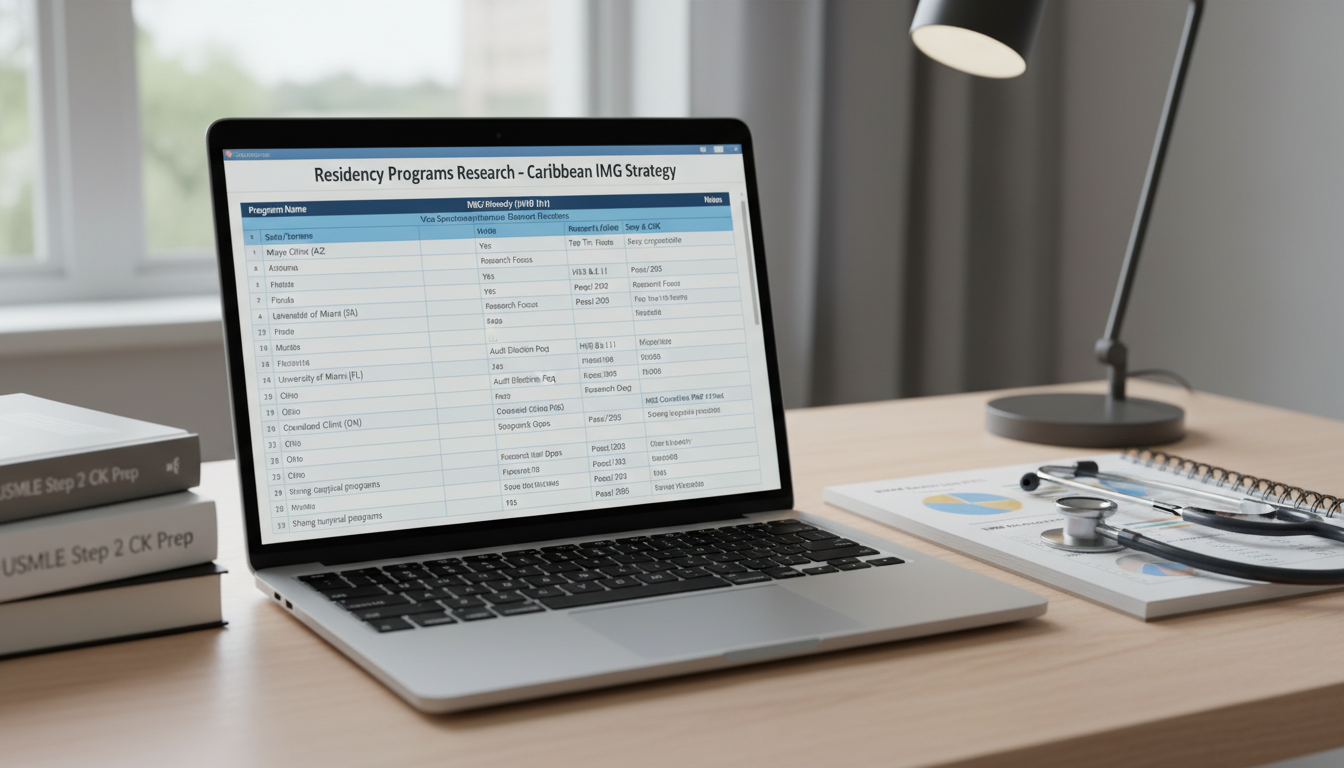
Step 3A: Create Your Master Spreadsheet
Open a spreadsheet and prepare columns such as:
- Program Name
- ACGME ID
- State / City
- Program Type (Community / University / Community-University affiliation)
- Program Size (Number of residents per year)
- IMG-Friendly? (Y/N/Unknown)
- Caribbean IMG presence? (Y/N)
- Visas Sponsored (H‑1B, J‑1, None)
- USMLE Step 2 CK cutoff (if listed)
- Number of IMGs in current residents
- Minimum year of graduation (e.g., within 5 years)
- Notes (e.g., “prefers U.S. clinical experience”, “often takes SGU grads”)
- Tier (Reach / Target / Safer)
This spreadsheet becomes your central command center.
Step 3B: Generate a Big Initial List
Using FREIDA (and/or ERAS during the season):
- Filter by specialty (e.g., Internal Medicine)
- Check all states you are willing to consider (be flexible; geography is often a luxury for IMGs)
- Export or manually compile all programs into your spreadsheet
At this stage, do not filter based on competitiveness. Just capture everything.
Step 3C: Apply “Hard Filters”
Next, eliminate programs that are definite no’s based on:
Visa policy
- If you need a J‑1 or H‑1B and the program clearly states “No visa sponsorship,” remove it
- If policy is unclear, leave it for now and mark “Unknown”
Graduation year limit
- Some programs state “within 3–5 years of graduation”
- If you fall outside their limit and there are no exceptions mentioned, they are low yield
IMG policy
- If a program clearly states “We do not accept IMGs” or you see zero IMGs over multiple years, deprioritize or remove
Your list will shrink but still likely be large—this is normal.
Step 4: Evaluating Residency Programs as a Caribbean IMG
Now that you have a manageable pool, focus on evaluating residency programs for fit and feasibility.
Key Factors to Assess
1. IMG-Friendliness (Especially Caribbean-Friendly)
Indicators of IMG-friendliness:
- Current residents: Look at program website and check resident bios
- How many are IMGs?
- Are any from Caribbean schools (SGU, AUC, Ross, Saba, etc.)?
- Program website statements: Some explicitly state that they welcome IMGs
- Match lists from your school:
- If your school’s SGU residency match or equivalent shows several matches at a program over multiple years, that’s a good sign
Score programs on a simple scale in your notes:
- 2 = Strongly IMG-friendly (multiple IMGs/Caribbean grads)
- 1 = Mixed (few IMGs or unclear)
- 0 = Rarely or never IMGs
2. Visa Sponsorship
As a Caribbean IMG, visa can be a major bottleneck.
- J‑1 only: Most common; many community and university programs offer this
- H‑1B possible: More restrictive; often requires higher Step scores and U.S. licensure exam completion before start date
- No visas: Usually off-limits unless you have U.S. citizenship/Green Card
Check both FREIDA and the program’s own website, as FREIDA can be outdated.
3. Program Type and Training Environment
- University programs:
- More research, subspecialty exposure
- Often more competitive and less IMG-friendly, but not always
- Community programs:
- Often more IMG-friendly
- Strong clinical exposure, sometimes fewer academic resources
- Hybrid / Community-University affiliated:
- Many Caribbean IMGs match here; offer a good balance
As you research:
- Note whether the program is at a major academic center or community hospital
- Consider your goals: Fellowship vs. general practice; location preferences; family needs
4. USMLE Score Requirements and Screening
Many programs use score and attempt filters:
- Some list minimum Step 2 CK scores (e.g., “Minimum 220” or “Preference for 230+”)
- Some clearly state “No failed attempts”
- Others say “We review applications holistically” (but still may screen unofficially)
Align this with your profile:
- If your Step 2 CK is 215, applying to programs with a posted minimum of 230 is low-yield
- If you have a failed attempt, prioritize programs that explicitly mention holistic review or have historically accepted applicants with non-perfect records
5. Location, Cost of Living, and Lifestyle
As a Caribbean IMG, you might be tempted to ignore geography in the name of matching anywhere. However, you’ll spend 3+ years in this environment:
- Cost of living vs. residency salary
- Safety and transportation (especially if you don’t drive)
- Support systems (friends, family, communities)
- Climate (winters can be a big adjustment)
Location should not trump match probability, but it does matter for your day-to-day life.
Step 5: Deep-Dive Research on Shortlisted Programs
After filtering and preliminary evaluation, you should have a shortlist (often 80–150 programs for major IMG specialties, depending on your competitiveness).
Now move into qualitative research.
Use Program Websites Strategically
For each shortlisted program, review:
Current residents
- Where did they go to medical school?
- Is there a mix of U.S. grads and IMGs?
- Do you see Caribbean alumni?
Curriculum & Rotations
- Inpatient vs. outpatient balance
- ICU exposure
- Subspecialty rotations and elective time
Fellowship outcomes (especially for Internal Medicine, Pediatrics)
- Do graduates match into fellowships you might want?
- Are they mostly hospitalists, primary care, or subspecialists?
Program culture clues
- Program director’s message: Does it emphasize education, wellness, diversity, service?
- Resident life section: Are residents described as happy and engaged?
Add key findings and red/green flags into your spreadsheet notes.
Leverage Alumni and Mentors
Your Caribbean medical school residency network is a powerful resource:
- Use your school’s match list to identify alumni at programs you’re considering
- Ask your school’s clinical deans or advisors to connect you with recent graduates
- Reach out respectfully via email or LinkedIn:
“I’m a current [School Name] student interested in [Program Name]. I saw you are a PGY‑1 there. Would you be willing to share any advice on applying as a Caribbean IMG and what the program is like?”
Ask targeted questions:
- How friendly is the program to IMGs/Caribbean IMGs?
- What do they seem to value most in applicants?
- Any red flags or issues current residents are facing?
- Would they recommend applying there given your profile?

Step 6: Structuring Your Final Program List
By this point, your research should allow you to categorize each program:
- Reach programs
- Target (realistic) programs
- Safer (backup) programs
How Many Programs Should a Caribbean IMG Apply To?
This varies by specialty and competitiveness, but approximate ranges:
Internal Medicine / Family Medicine / Pediatrics
- Strong Caribbean IMG: 60–80 programs
- Average: 80–120 programs
- At risk: 120–150+ programs (balanced across regions)
Psychiatry / Neurology / Pathology (still competitive)
- Strong: 50–80
- Average: 80–100
- At risk: 100–120+
More competitive specialties
- Often need a dual strategy (competitive specialty + safer backup like IM/FM)
These are ballpark figures; always cross-check with your advisors and the most recent NRMP data.
Balancing the Tiers
Aim for something like:
- 15–25% reach programs
- 50–60% realistic programs
- 20–30% safer programs
For example, a Caribbean IMG applying in Internal Medicine with an average profile might:
- Apply to 100 programs total:
- 20 reach (university and strong hybrids)
- 55 realistic (IMG-friendly community/university-affiliated programs)
- 25 safer (very IMG-friendly, multiple Caribbean residents)
Step 7: Common Mistakes Caribbean IMGs Make—and How to Avoid Them
Mistake 1: Using Only School Reputation
Relying solely on your school’s name (even a strong one like SGU) is risky. Not every program that accepted an SGU residency match candidate last year will be open or suitable for you this year.
Solution: Use your school’s match list as one data point, not the entire strategy. Verify each program’s current policies and resident composition.
Mistake 2: Ignoring IMG and Visa Filters
Applying blindly to every program in your specialty wastes money and emotional energy.
Solution: Always check for:
- IMG acceptance
- Visa sponsorship
- Graduation year limits and known score cutoffs
Mistake 3: Over-focusing on Location or Prestige
Prioritizing big cities or big-name institutions can dramatically reduce your chances.
Solution: Be open to:
- Smaller cities
- Community-based programs
- Regions historically more open to IMGs (Midwest, some South and Northeast communities)
Mistake 4: Underestimating the Time Needed for Research
Program research, when done properly, is time-consuming.
Solution: Start months before ERAS opens. Dedicate consistent weekly blocks:
- 2–3 hours, 2–3 times per week
- Build and refine your spreadsheet gradually
- Adjust based on newly available information (e.g., updated websites, new accreditation, closure notices)
Step 8: Turning Research into Stronger Applications
Program research not only tells you where to apply—it helps you show programs why they should interview you.
Tailored Personal Statements (when appropriate)
For your top-tier programs (reach or favorite realistic ones), you can:
- Mention specific program strengths that align with your goals
- Reference unique curriculum or patient population features that excite you
- Highlight relevant rotations, experiences, or research that fit their environment
Do not overdo it—generic statements with a few tailored lines are often enough, but avoid copy-paste errors (wrong program name, wrong specialty).
Program-Specific Emails (Post-Submission)
If you have genuine connections:
- Alumni at the program
- A rotation there
- Faculty who know the PD or faculty
You can send professional, concise emails reaffirming interest:
- Highlight that you are a Caribbean IMG with strong USCE and a genuine interest in their patient population and training environment
- Attach CV if appropriate
Your research will inform what you mention and which programs you prioritize for such outreach.
Putting It All Together: A Sample Timeline
Here’s a sample timeline for a Caribbean IMG planning to apply in September:
January–March (6–9 months before ERAS opens)
- Finalize target specialty and backup specialty
- Take or schedule Step 2 CK
- Start building your master program list via FREIDA and NRMP data
April–June
- Apply “hard filters” (IMG/visa/graduation year)
- Begin preliminary website checks and spreadsheet notes
- Reach out to alumni at top-interest programs
July–August
- Deep-dive into shortlisted programs
- Categorize into reach/realistic/safer
- Finalize the number of programs per tier
- Draft personal statement (possibly create one or two minor variations)
September
- Final check on program websites for any significant updates
- Submit ERAS early in the opening window
- Track interviews and adjust strategy for SOAP backup planning if needed
FAQs: Researching Residency Programs as a Caribbean IMG
1. How can I tell if a program is truly Caribbean IMG-friendly?
Look for:
- Multiple Caribbean graduates listed among current residents (SGU, Ross, AUC, Saba, etc.)
- Your school’s historical presence in that program’s match list
- Clear, welcoming language for IMGs on the program’s website
- Positive feedback from alumni or mentors who trained there
No single factor is definitive, but a combination of these strongly suggests Caribbean IMG-friendliness.
2. Should I use services like Match A Resident or paid lists?
They can be supplemental tools, but do not rely on them exclusively. Many Caribbean IMGs report:
- Some useful filtering for IMG-friendly programs
- Some inaccuracies or outdated data
Always verify program details through FREIDA and the program’s own website, and cross-check with your school’s advising office if possible.
3. How important is it to include “safer” backup specialties (like Family Medicine) in my program research?
If your profile includes major risk factors—low scores, multiple exam attempts, big time gaps, or visa needs—researching a backup specialty is wise. Family Medicine and some Internal Medicine programs may be more open to Caribbean IMGs.
You do not have to commit immediately, but beginning research early gives you options if your primary specialty appears unrealistic.
4. I’m applying from a smaller Caribbean school, not one of the “Big 4.” Does this change my research strategy?
The core program research strategy is the same, but you should:
- Place extra emphasis on IMG- and Caribbean-friendly programs
- Rely more heavily on objective filters (IMG presence, visa sponsorship, graduation year limits)
- Be especially realistic with program tiers and numbers of applications
Your structured research and smart program selection can partially offset differences in school name recognition.
By approaching program research as a systematic, data-driven process, you dramatically improve your odds of converting your Caribbean medical education into a successful U.S. residency match. The earlier and more deliberately you start, the more targeted—and effective—your residency applications will be.