
Choosing where to apply can shape your entire career—especially if you’re a Caribbean IMG aiming for a global health–focused residency. The good news: with a structured program research strategy, you can turn an overwhelming task into a clear, step‑by‑step process that aligns with your goals in international medicine.
Below is a comprehensive guide on how to research residency programs specifically for Caribbean IMGs interested in global health tracks and careers.
Understanding Your Goals as a Caribbean IMG in Global Health
Before you dive into websites and spreadsheets, you need clarity on what you actually want from a global health residency track.
Clarify Your Global Health Vision
Ask yourself:
- Do you want to practice clinical medicine abroad (e.g., low- and middle-income countries)?
- Are you more interested in policy, advocacy, and systems-level work?
- Do you want academic global health (research, teaching) or field-based clinical work?
- Are you aiming for infectious diseases, primary care, emergency medicine, or another specialty that integrates well with international medicine?
Write down:
- Your top 3 global health priorities (e.g., “field work,” “research,” “refugee health”).
- Your preferred career settings (academic center vs. NGO vs. government/public health).
- Any geographic preferences (e.g., Caribbean region, Latin America, Sub-Saharan Africa).
Consider Your IMG and Caribbean-Specific Context
The phrase Caribbean medical school residency has a very specific meaning in program directors’ minds. They know SGU, AUC, Ross, Saba, etc., and many have established patterns:
- Some programs regularly accept Caribbean IMGs, especially large community or university-affiliated community programs.
- Some academic global health programs are more selective and take fewer IMGs.
- Others have strong histories of SGU residency match success or other Caribbean schools’ matches, particularly in primary care specialties (Internal Medicine, Family Medicine, Pediatrics).
When defining your target programs, consider:
- USMLE scores and attempts
- Visa needs (if applicable)
- Clinical rotation locations (Did you rotate in the US? Which states?)
These factors will heavily influence how to research residency programs realistically and efficiently.
Step 1: Build a Clear Program Research Strategy
A solid program research strategy is essential, especially with limited time and application budgets.
1. Define Your “Program Tiers”
Create three categories:
Reach programs
- Strong global health reputation, often academic centers.
- May be IMG-friendly but competitive.
- Example: University-affiliated residencies with formal global health residency tracks, funded international electives, MPH partnerships.
Target programs
- Consistently interview and match Caribbean IMGs.
- Have genuine global health opportunities (electives, faculty interests, local underserved work).
Safety programs
- Historically IMG-friendly (including Caribbean schools).
- Less formal global health brand, but you can build your own path (e.g., underserved US communities, diverse immigrant populations).
Distribute your list roughly as:
- 20–30% Reach
- 40–50% Target
- 20–30% Safety
Adjust based on your competitiveness.
2. Decide on Your Data Sources Upfront
Use a mix of:
- Official databases (FREIDA, AAMC tools, NRMP data)
- Program websites
- Alumni match lists from your school (e.g., SGU residency match list)
- Networking sources (residents, faculty, mentors)
- Reputation among Caribbean grads (forums, school advisors—used cautiously)
Clarifying sources early keeps you from getting lost in endless browsing.
Step 2: Use Databases and Match Data Effectively
As a Caribbean IMG, you need to research not just the quality of training, but also the probability of matching there.
Using FREIDA for Global Health and IMG-Friendliness
FREIDA (AMA’s residency database) is a major starting point for evaluating residency programs:
Search by specialty
- For global health–oriented careers, common specialties include:
- Internal Medicine
- Family Medicine
- Pediatrics
- Emergency Medicine
- Preventive Medicine
- OB/GYN (for maternal health pathways)
- For global health–oriented careers, common specialties include:
Filter for IMG information (if available)
- Look for:
- Percentage of IMGs
- Whether they sponsor visas (J-1, H-1B)
- Number of positions per year
- Look for:
Search for key terms in program descriptions:
- “Global health”
- “International health”
- “International medicine”
- “Refugee health”
- “Health equity”
- “Underserved populations”
Programs that mention these explicitly are more likely to support your interests.
Leveraging NRMP and School Match Data
Study:
- NRMP Charting Outcomes for IMGs
- Understand step score ranges, attempts, and match rates by specialty.
- Your school’s annual match booklet (e.g., SGU residency match lists or similar if you are from another Caribbean school).
- Identify:
- Which programs have taken grads from your school.
- Which specialties and regions are most common.
- Programs that have matched your seniors into global health residencies or global health tracks.
- Identify:
Make a “Programs with Caribbean grads” column in your spreadsheet; these often go from “Reach” to “Target” or “Target” to “Safety.”
Step 3: Deep Dive into Program Websites for Global Health Opportunities
Once you identify a broad list, it’s time to dive into how to research residency programs at the individual program level.
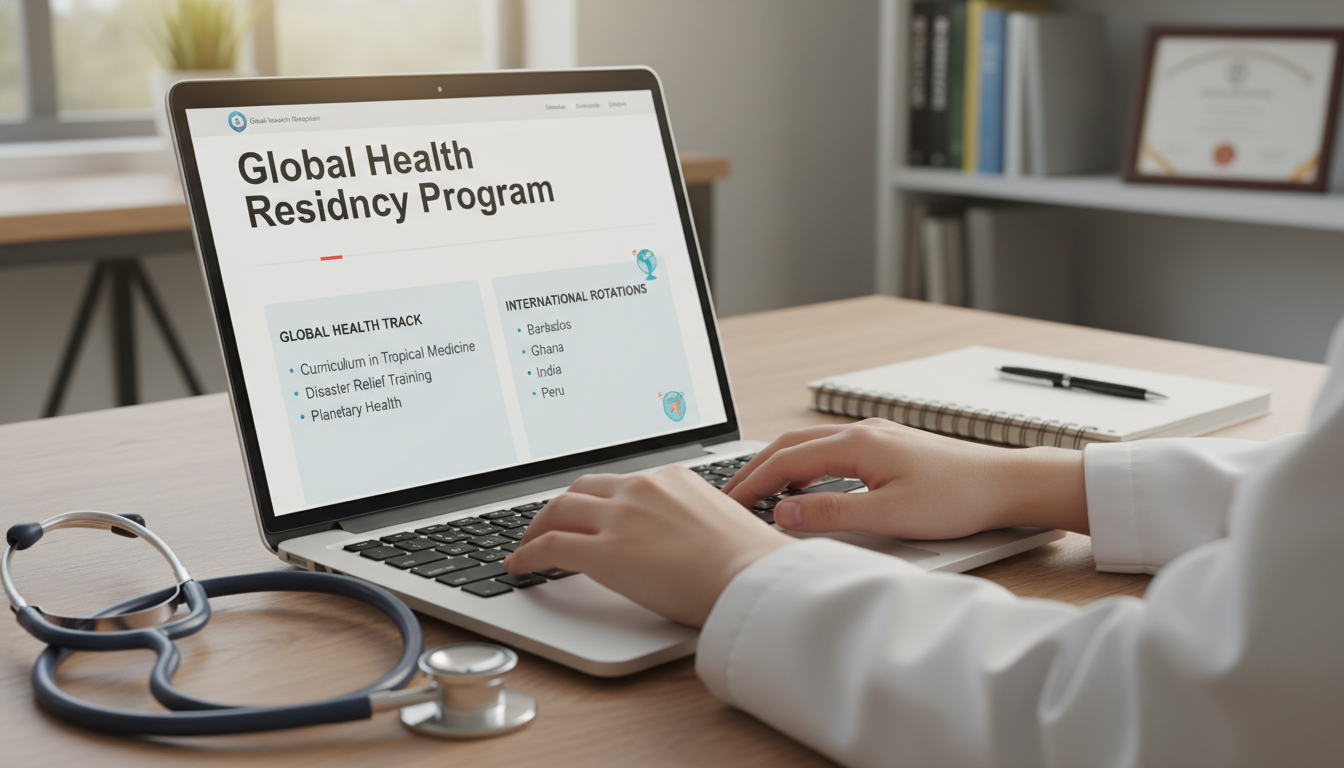
What to Look for on Program Websites
Visit the official site for each program and look specifically for:
1. Explicit Global Health / International Medicine Tracks
Clues that the program aligns with international medicine:
- A dedicated Global Health Residency Track or pathway
- A Global Health or International Health curriculum section
- Options for:
- Overseas rotations or electives
- Longitudinal global health projects
- Certificate or MPH opportunities
- Affiliation with:
- Global health centers or institutes
- Schools of public health
- NGOs or overseas partner hospitals
Example wording you might see:
- “Residents may participate in a global health track with 2–4 weeks per year of international rotations.”
- “Partnership with [Country] hospital, with faculty-led trips annually.”
- “Optional MPH or global health certificate through [School of Public Health].”
2. Local “Global Health at Home” Opportunities
Not all international medicine happens abroad. Valuable options include:
- Refugee/immigrant clinics
- Travel medicine clinics
- Neighborhoods with large Caribbean, Latin American, African, or Asian communities
- Rotations in:
- Public health departments
- Community health centers
- FQHCs (Federally Qualified Health Centers)
This is especially practical for Caribbean IMGs who may later work in underserved communities in the US or abroad.
3. Faculty Interests and Research
Scan faculty bios:
- Look for:
- Phrases like “global health,” “international health,” “tropical diseases,” “refugee health,” “HIV medicine,” “TB,” “health systems strengthening.”
- Faculty with dual appointments in global health centers or schools of public health.
- Check for resident publications or presentations related to:
- Global health projects
- International rotations
- Health equity work
Faculty mentors are essential if you want to build an academic global health career.
4. Resident Profiles and Alumni Destinations
Many sites list:
- Current residents’ interests and projects
- Graduates’ fellowship placements and jobs
Look for:
- Alumni entering global health fellowships, ID fellowships, EM global health tracks, or MPH programs.
- Graduates working at:
- WHO, CDC, MSF, academic global health centers, NGOs.
This tells you whether the program truly launches global health careers or just uses the term as a buzzword.
Step 4: Assessing IMG-Friendliness and Caribbean-Specific Fit
As a Caribbean IMG, you must combine your global health goals with a realistic assessment of your chances of matching.
Indicators of IMG-Friendliness
Look for:
- Percentage of IMGs in the program:
- If 20–40% of residents are IMGs, that’s typically friendly.
- Caribbean graduates specifically:
- Residents from SGU, AUC, Ross, Saba, or other Caribbean schools.
- Program FAQs that explicitly mention:
- “We welcome IMGs”
- “We sponsor J-1/H-1B visas”
- Minimum USMLE scores or specific criteria
Use LinkedIn or program photos to cross-check where current residents graduated from. This can reveal patterns not clearly stated on the website.
Using Your School’s Network
Your school (e.g., SGU, AUC, Ross) likely has:
- Residency advisors who track where graduates go.
- Alumni networks (Facebook groups, LinkedIn, alumni offices).
- Lists of programs with long-standing relationships with Caribbean medical schools.
Ask specifically:
- “Which programs with global health opportunities have consistently taken our grads?”
- “Can you connect me with alumni in global health residency tracks?”
These connections are particularly valuable for learning “unwritten” information about how the program treats IMGs.
Step 5: Systematically Organize and Compare Programs
You’ll be looking at dozens of programs; without structure, details quickly blur together.
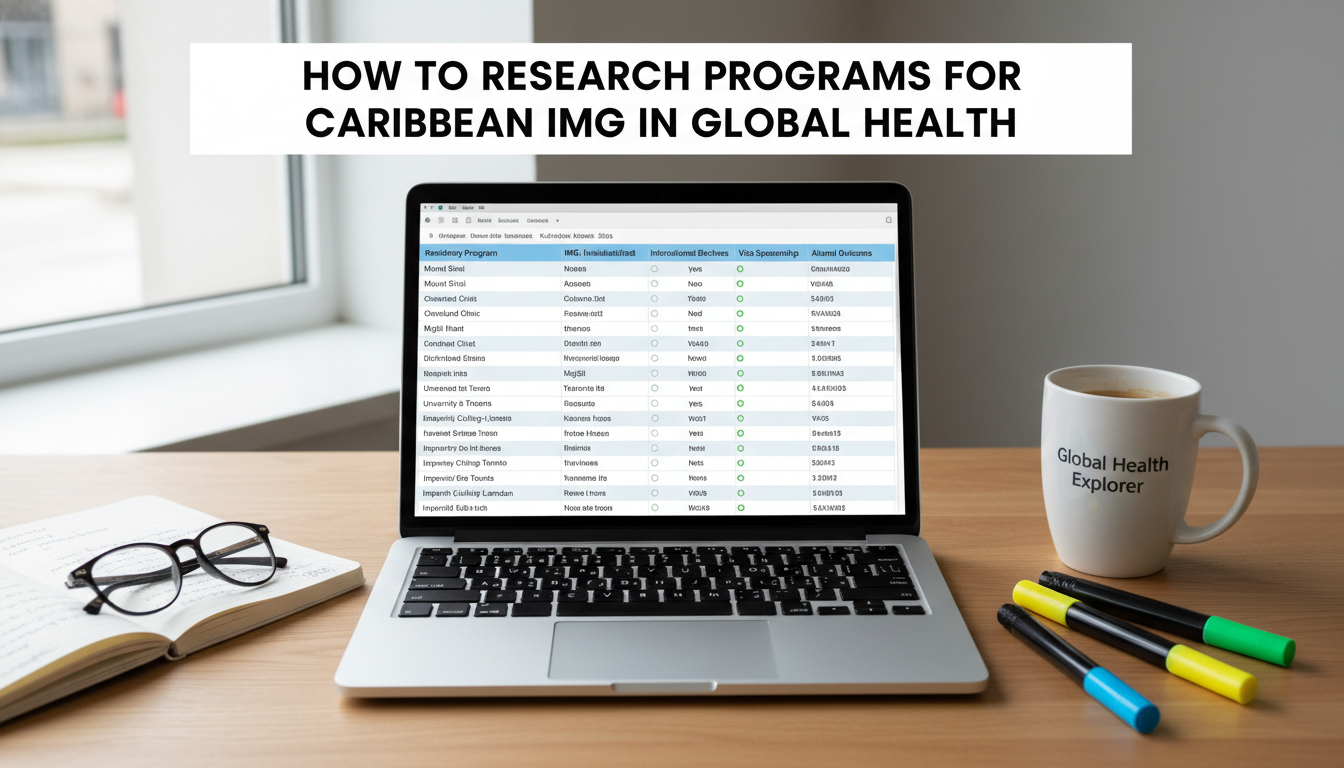
Build a Residency Research Spreadsheet
Create a spreadsheet with columns like:
- Program Name
- City/State
- Specialty (IM, FM, Peds, EM, etc.)
- Global Health Track? (Yes/No)
- International Rotations? (Yes/No/Unclear)
- Global Health Curriculum (structured vs. only electives)
- Local Underserved/Refugee Clinics?
- Faculty with Global Health Focus (0–3+)
- IMG Percentage / Caribbean grads present
- Visa Sponsorship (J-1 / H-1B / None)
- USMLE Requirements (if stated)
- Your Tier (Reach/Target/Safety)
- Notes / Red flags / Strengths
Update this systematically as you review each program.
Use a Scoring System (Optional but Powerful)
You can rank programs using a simple 1–5 scale for:
- Global Health Strength
- IMG-Friendliness
- Location Personal Fit
- Academic/Training Quality
Then calculate:
- Overall Fit Score = (2 × Global Health) + (2 × IMG-Friendliness) + Training Quality + Location
This makes comparing programs more objective when decisions become emotionally complex.
Step 6: Direct Outreach and Networking Around Global Health
The most accurate information often comes from residents and faculty, not websites.
How to Contact Programs About Global Health
You can reach out if:
- You have specific questions about global health opportunities.
- You are genuinely interested, not just mass-emailing.
Who to contact:
- Program coordinator – logistics, how to connect with current residents.
- Chief residents – honest insights on what actually happens.
- Global health track director or faculty with global health focus.
Sample email template (shortened):
Subject: Question About [Program Name] Global Health Opportunities
Dear [Dr./Mr./Ms. Last Name],
I am a [Caribbean medical school] student applying to Internal Medicine this cycle with a strong interest in global health and international medicine. I’ve read about your program’s [global health track / international electives / refugee clinic] and had a few brief questions regarding how residents typically engage in this work.
If you or a current resident involved in these activities would be willing to share a few insights by email, I would be very grateful.
Sincerely,
[Name]
[School, Expected Graduation Year]
Be respectful of time; ask 2–3 specific questions rather than sending a long list.
Questions to Ask Residents or Alumni
When you get a chance to speak with a resident (especially a fellow Caribbean IMG), consider:
- “How active is the global health track in practice? Do most interested residents get to participate?”
- “Are international rotations regularly funded and approved, or only occasional?”
- “Do residents realistically have time for global health projects?”
- “How supportive is the program toward IMGs in terms of career mentorship and fellowship?”
- “Have any recent graduates pursued global health fellowships, MPH, or international work?”
Their answers will help you distinguish between marketing language and real-world support.
Step 7: Evaluating Programs for Long-Term Global Health Career Impact
When evaluating residency programs, don’t just focus on matching; focus on where the program can take you.
Training Quality in Core Specialty
Strong core training is essential before you can be useful abroad or in global health leadership roles. Ask:
- Does the program provide broad exposure to complex pathology?
- Are there opportunities in:
- Infectious diseases
- HIV clinics
- TB clinics
- Immigrant/refugee health
- Tropical medicine (if available)
Global health work often requires managing high-acuity conditions in resource-variable settings; your residency should prepare you clinically.
Research and Academic Opportunities
If you’re interested in academic global health:
- Are there global health research projects you can join?
- Are there mentors with:
- Grants in global or international medicine
- Publications in global health journals
- Does the program support:
- Conference presentations
- Time to work on projects
- Access to MPH or certificate programs
Even as a Caribbean IMG, a strong research profile can open doors to global health fellowships and leadership roles.
Flexibility and Support for International Work
Look for policies about:
- Time for away rotations or international electives
- Malpractice coverage abroad
- Logistical support (paperwork, contacts, supervision)
Some programs have established partner sites abroad, which makes all of this much smoother.
Step 8: Balancing Practical Realities with Global Health Ambitions
You may face trade-offs:
- A program with excellent global health but low IMG acceptance.
- A very IMG-friendly program with minimal formal global health structure.
For a Caribbean IMG, the question is often:
“Do I prioritize matching safely, or do I aim higher for a global health-focused program?”
A Practical Framework
First Priority: Match into a residency.
Without a residency, there is no path to global health practice in the US system.Second Priority: Choose the most global-health-friendly programs within your realistic range.
Even if they don’t have a formal global health track, look for:- Diverse underserved populations
- Faculty with interest in international work
- Flexible electives you can tailor (e.g., global health away rotations, MPH after residency)
Third Priority: Plan your long-term global health trajectory.
Options after residency:- Global health fellowship
- Infectious Disease, EM, or other subspecialty with global focus
- MPH or DTM&H (Diploma in Tropical Medicine & Hygiene)
- Work with NGOs or academic global health teams
Your residency does not have to be perfect; it should give you solid clinical training and some pathway to global health—even if you build much of it yourself.
Putting It All Together: A Sample Research Timeline
6–9 months before ERAS opens:
- Clarify goals and global health interests.
- Review NRMP data and your school’s match lists (including SGU residency match–style reports if available).
- Start a preliminary list of 60–80 programs.
4–6 months before ERAS:
- Deep-dive on websites for global health content.
- Narrow list to ~40–60 programs.
- Reach out to a few key programs for clarification.
1–3 months before ERAS:
- Finalize your tiers: reach/target/safety.
- Ensure each program is:
- IMG-friendly enough for your profile.
- At least somewhat aligned with global health or underserved care.
During interview season:
- Ask targeted questions about:
- International electives
- Global health track logistics
- Past IMG experiences
- Update your spreadsheet post-interview with impressions.
Rank list time:
- Use your scoring system + gut feeling.
- Ask: “Which programs will best support me as a Caribbean IMG future global health physician?”
FAQs: Researching Global Health Programs as a Caribbean IMG
1. How many global health–focused programs should I realistically apply to as a Caribbean IMG?
Aim for a balanced list. For most Caribbean IMGs:
- 10–20 programs with strong or formal global health options, depending on your competitiveness.
- The rest should be IMG-friendly programs that at least:
- Serve diverse or underserved populations
- Allow electives you can tailor toward global health
Do not apply only to highly academic, selective global health programs; mix them with community and university-affiliated programs that regularly take Caribbean graduates.
2. If a program doesn’t advertise a global health track, is it still worth considering?
Yes, if:
- The program is IMG-friendly.
- It serves diverse communities, refugees, or immigrants.
- There is at least one faculty member with a global or international medicine interest.
- You have room for electives, away rotations, or research.
You can often build a “global health” profile through local underserved work and later add formal global health fellowships or an MPH.
3. How can I tell if a program truly supports global health, not just marketing it?
Look for:
- Specifics rather than buzzwords:
- Named partner sites abroad
- Detailed curriculum descriptions
- Photos or descriptions of past trips with residents
- Evidence of outcomes:
- Graduates in global health fellowships or international jobs
- Resident publications or presentations in global health
- Resident feedback:
- Ask current residents how many people actually participate and what the barriers are.
If everything is vague and no resident can recall anyone actually going abroad or doing projects, be cautious.
4. As a Caribbean IMG, will focusing on global health hurt my chances of matching?
No, as long as:
- You don’t limit your list only to elite academic global health residencies.
- You maintain a broad application strategy with IMG-friendly programs.
- You frame your global health interest clearly and maturely in your personal statement and interviews (not as “wanting to travel,” but as sustainable, patient-centered work).
In fact, a coherent interest in global health can differentiate you positively, especially when connected to your Caribbean background, language skills, and experience with resource-variable settings.
By combining a structured program research strategy with realistic expectations and a clear vision of your global health career, you can create a strong, targeted application list. As a Caribbean IMG, your path to international medicine is absolutely achievable—if you match wisely, train well, and keep building global health experiences step by step.