
Navigating where to train is one of the most strategic decisions you’ll make as a DO graduate. For those considering residency in Alaska and Hawaii, geographic flexibility can be your biggest asset—or your biggest limitation—depending on how you approach it. Understanding how geographic preference and location flexibility influence the osteopathic residency match is especially important in these unique markets, where programs are fewer, competition is concentrated, and lifestyle factors weigh heavily.
This guide is designed specifically for DO graduates evaluating Alaska residency and Hawaii residency programs, and wondering how flexible they should be with location. You’ll learn how to use geographic preference residency signals wisely, how to balance dream locations with match safety, and how to craft a regional preference strategy that maximizes your chances of matching while honoring your personal and professional goals.
Understanding Geographic Flexibility in the Residency Match
Geographic flexibility in the residency match refers to your willingness to consider a range of locations—regions, states, or specific cities—rather than focusing only on a narrow set of places.
For DO graduates looking at Alaska residency and Hawaii residency programs, this includes:
- Whether you are open to both states or just one
- Whether you are willing to train elsewhere on the mainland if you don’t match in AK/HI
- How many regions you’re willing to rank highly
- How you signal geographic preferences in ERAS and interviews
Why Geographic Flexibility Matters More for DO Graduates
DO graduates often need to be particularly intentional about geography because:
- Some academic or highly competitive programs (especially in certain specialties) still favor MD applicants, narrowing options.
- Osteopathic recognition programs and community-based residencies are unevenly distributed across the country.
- Alaska and Hawaii have a small number of residency positions relative to population and demand, making them inherently more competitive by geography alone.
For a DO graduate residency applicant, rigid location demands (e.g., “only Honolulu” or “only Anchorage”) can convert a reasonable match profile into a high-risk strategy.
The Special Geography of Alaska & Hawaii
Both Alaska and Hawaii offer training environments that are:
- Geographically isolated: Far from the continental U.S., limiting easy access to family, conferences, and away rotations.
- Resource-variable: Some training sites have outstanding breadth; others require you to work creatively within limited subspecialty support.
- Mission-driven: Many programs heavily prioritize applicants committed to underserved, rural, or island populations.
- Lifestyle-specific: The day-to-day reality of winter darkness in Alaska or high cost of living in Hawaii is very different from most mainland settings.
This means that “liking the idea” of Alaska or Hawaii isn’t enough. Your geographic flexibility strategy must reflect a realistic understanding of training and living in these locations—while also keeping backup regions in play.
Overview of Residency Training in Alaska & Hawaii for DO Graduates
Before you plan your regional preference strategy, you need a clear sense of what the training landscape actually looks like.
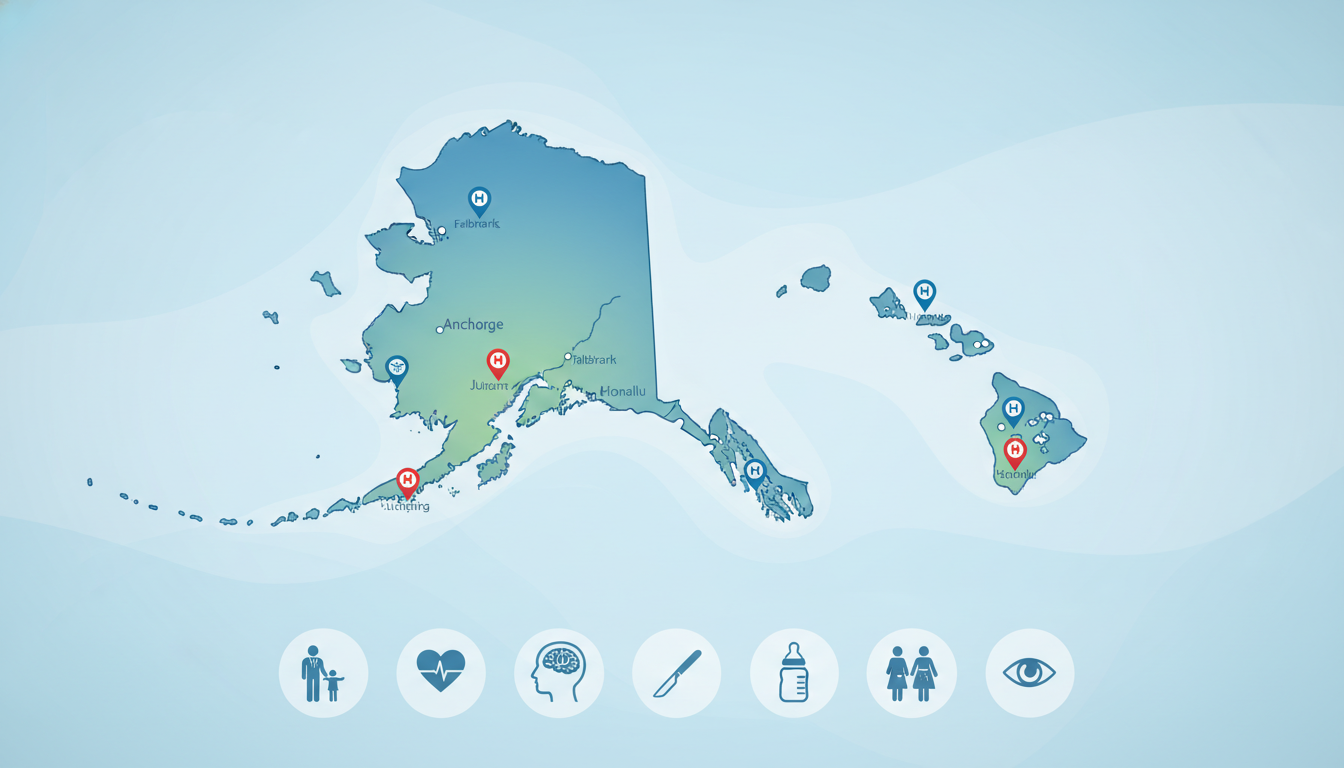
Alaska Residency Landscape
Alaska’s residency options are limited but strategically important, especially for DOs interested in:
- Family Medicine & Primary Care:
- Strong emphasis on rural and frontier medicine
- Broad-scope training (procedures, emergency care, inpatient and outpatient)
- Heavy focus on serving remote Native and rural communities
- Rural Training Tracks (RTTs):
- Often linked to universities or health systems in the Pacific Northwest
- May split time between Anchorage and smaller communities
- Behavioral Health / Psychiatry (where available):
- Focus on underserved populations, substance use disorders, trauma, and limited access settings
Characteristics relevant to DO graduates:
- Community-based, service-driven: Programs often place high value on applicants with previous rural or underserved experience and a visible commitment to stay or return.
- Small program sizes: Means fewer positions and more variability year to year.
- DO-friendly environment: Many sites are accustomed to DO graduates, especially in primary care.
Hawaii Residency Programs
Hawaii, particularly Oahu (Honolulu), hosts a more diverse—but still limited—set of residency options:
Common residency specialties include:
- Internal Medicine
- Family Medicine
- Psychiatry
- General Surgery
- Pediatrics
- OB/GYN (in some years/programs)
- Transitional Year/Preliminary programs
Key features for DO graduates:
- Single major academic hub: Many programs are centered around Honolulu, with affiliations covering multiple islands.
- Broad patient mix: Local communities, military populations, tourists, and Pacific Islander/Asian patient populations.
- High lifestyle interest: Many applicants nationwide are drawn to Hawaii, increasing competition, especially in lifestyle-driven specialties.
Implications for DO Graduate Residency Applicants
For DO graduates targeting Alaska and Hawaii:
- You are aiming at small, high-demand niches.
- The total number of residents per year in AK/HI is tiny compared to large mainland regions.
- A purely Alaska-or-Hawaii-or-bust strategy is statistically risky for most applicants, even with strong profiles.
Geographic flexibility—particularly being open to a backup region (e.g., Pacific Northwest, West Coast, or Mountain West)—can dramatically change your chances of matching into a program that still aligns with your values and training needs.
Building a Geographic Preference Strategy as a DO Graduate
A regional preference strategy is your planned approach to where you apply, interview, and rank programs. For a DO graduate, especially one eyeing Alaska and Hawaii, this strategy needs to blend aspiration with risk management.

Step 1: Clarify Your True Non‑Negotiables vs Preferences
Start by dividing location factors into two buckets:
Non‑negotiables (hard boundaries):
Examples:
- “I must be within a 6-hour flight of my dependent family member in poor health.”
- “I cannot tolerate extreme cold due to a medical condition.”
- “I must be in the U.S. (not international) due to immigration/visa issues.”
Preferences (flexible if needed):
Examples:
- “I’d like to be near the ocean.”
- “I prefer warm weather year-round.”
- “I’d love to live in Anchorage or Honolulu, but I’d consider similar settings elsewhere.”
Be honest with yourself. Alaska and Hawaii are both geographically and logistically intense: distance from family, time-zone differences, higher travel costs, and unique climates. If a requirement is truly non-negotiable, own it from the start; otherwise, classify it as a preference you’re willing to adjust for match safety.
Step 2: Understand the Role of Geographic Preference Signaling
ERAS and some specialties allow you to indicate geographic preference or send signals to specific programs. For DO applicants focused on AK/HI:
- Use geographic preference options (if available for your specialty) to:
- Indicate genuine interest in the Pacific or West regions.
- Avoid signaling only one tiny region (e.g., “Hawaii only”), which may negatively impact options elsewhere if programs interpret that as limited flexibility.
- Use program signals (if applicable) for:
- Your top residency choices in Alaska or Hawaii.
- A small number of strategically chosen mainland programs aligned with your goals.
Key principle: Signaling should demonstrate focused interest without making you appear closed to other reasonable regions.
Step 3: Structure Your Application Regions: Core, Aspirational, and Safety
A practical geographic flexibility match model for DO graduates:
Core Region(s):
Places you actively want and are a good fit for:- Example: Alaska, Hawaii, and the Pacific Northwest (Washington, Oregon, parts of northern California).
- These should account for a substantial portion of your applications.
Aspirational Region(s):
Highly desirable but competitive, or limited in positions:- For you, this might be specifically “Honolulu” or a particular Alaska rural track.
- These programs may be more competitive due to location, not just academic difficulty.
Safety/Expansion Region(s):
Places that are not your first choice but still acceptable and aligned with your training needs:- Could be Mountain West, Upper Midwest, or other DO-friendly regions with strong community training programs.
- These ensure you have a robust, realistic list of options.
Your number of applications and interviews should reflect this mix:
- Don’t devote 80–90% of your list solely to Alaska and Hawaii unless you are extremely competitive in a less competitive specialty (e.g., FM with excellent scores, strong letters, and a clear underserved mission).
- For moderate to competitive specialties (IM, Psych, some Surgery), Alaska/Hawaii should be part of a broader regional net.
Step 4: Align Specialty Choice with Region
Some specialties align particularly well with AK/HI:
- Highly aligned: Family Medicine, Internal Medicine, Psychiatry, Pediatrics
- Moderately aligned: General Surgery, OB/GYN (depending on year/program availability)
- Less available/less aligned: Many subspecialties, highly procedural fields (unless you are open to doing residency on the mainland and returning later for practice)
If you are set on training in Alaska or Hawaii but also aiming for an extremely competitive specialty (Dermatology, Plastic Surgery, etc.), you’ll almost certainly need:
- Primary training on the mainland
- A long-term plan to return after training, rather than residency itself being in AK/HI
Step 5: Decide Your “Location Red Lines”
Being flexible does not mean “anywhere, under any circumstances.” You can—and should—set realistic boundaries:
- Urban vs rural (or acceptance of mixed exposure)
- Maximum acceptable distance from family/support system
- Weather and climate limitations
- Program size and hospital resources you need for your learning style
Write these down early. They will guide where you apply while still allowing you to stretch beyond your comfort zone as needed.
Applying and Interviewing with Geographic Flexibility in Mind
Once your regional preference strategy is set, you need to translate it into your application materials, interview talking points, and rank list.
Using Your Personal Statement and Experiences Effectively
For Alaska and Hawaii, programs look for authenticity and staying power. In your personal statement and ERAS experiences:
- Demonstrate a clear understanding of local realities, such as:
- Rural Alaska access issues, bush communities, and Native health system challenges.
- Hawaii’s multi-ethnic patient populations, Pacific Islander and Native Hawaiian health disparities, cost-of-living pressures, and inter-island care dynamics.
- Highlight relevant experiences:
- Rural, underserved, or community health rotations.
- Work with Native, Indigenous, immigrant, or low-resource populations.
- Public health, telemedicine, or system-level quality improvement projects.
If you are open to both AK and HI and to backup regions, frame it like this:
“I am particularly drawn to training in regions that serve rural and island communities, such as Alaska and Hawaii, and I am also very interested in similar mission-driven programs across the Pacific and Mountain West.”
You’re signaling a mission-based geographic preference rather than naming a single city or state.
Communicating Geographic Flexibility in Interviews
During interviews, thoughtfully balance your enthusiasm for a specific location with your broader flexibility:
Do:
- Explain why you are drawn to Alaska/Hawaii specifically (mission, population, lifestyle fit, training style).
- Emphasize commitment to the type of work (rural, island, underserved), not just the scenery.
- If asked about other regions, express openness and focus on program characteristics (community-based, broad-scope training) rather than climate or lifestyle factors only.
Avoid:
- Statements that sound like you’re only interested in the location, not the work:
- “I just love Hawaii beaches” or “I’m mostly here because I ski/surf.”
- Overcommitting verbally to staying forever if you’re not sure. Instead say:
- “I could see myself staying long-term if the right opportunities align; my goal is to build the skills to serve communities like this.”
Programs are trying to gauge if you will adapt, contribute, and complete the program, not just enjoy the postcard.
Handling Questions About Family and Long-Distance Logistics
Alaska and Hawaii programs expect that many residents will have to navigate distance from family and high travel costs. When asked:
- Be honest but reassuring:
- “My family is on the mainland, but we’ve discussed this extensively and they are very supportive. I’m prepared for the distance and have thought through how I’ll maintain those connections.”
- Show planning:
- “I’ve looked into flight patterns and time-zone challenges; I understand it will require advance planning for visits, and I’m prepared for that.”
This signals maturity and realistic expectations—exactly what program directors want to see in a geographically isolated training site.
Creating a Smart Rank List with Location Flexibility
Once interview season ends, your geographic flexibility match strategy culminates in your rank list. For a DO graduate considering Alaska and Hawaii, you need a balance between reaching for your top locations and protecting your overall chance of matching.
Prioritizing Programs: Fit, Not Just Zip Code
When ranking, consider:
Training Quality and Fit:
- Breadth of clinical exposure
- Faculty support and culture
- Resident well-being and burnout indicators
- DO-friendliness and osteopathic recognition (if important to you)
Mission and Patient Population:
- Underserved communities, rural or island medicine, behavioral health focus, etc.
- Alignment with your stated career goals
Geographic Reality:
- Cost of living, commute, support systems
- Your realistic willingness to live there for 3–7 years
If you have multiple Alaska or Hawaii programs on your list, rank them according to fit and training quality first, then location. A weaker program in your dream city may not serve you as well long-term as a stronger program in a secondary-choice region.
Example Rank Strategy for a DO Graduate
Imagine you are a DO applying in Family Medicine with a strong interest in Alaska/Hawaii and rural care generally:
- Top Tier:
- A Hawaii FM program with robust outpatient and inpatient training
- An Alaska FM program with a rural track you loved during interview
- Second Tier (still highly desirable):
- Pacific Northwest FM programs with rural tracks
- Mountain West programs that emphasize frontier and Native health
- Safety Tier:
- DO-friendly community FM programs across multiple regions that still offer solid outpatient and inpatient training, even if they’re less “scenic” or well-known
Your rank order might look like:
1–3: AK/HI top choices
4–10: Pacific Northwest and Mountain West with strong rural focus
11+: Solid, DO-friendly FM programs aligned with your training needs
This way, you still reach for Alaska and Hawaii, but you avoid the all-or-nothing gamble.
Managing Emotional Attachment to a Single Location
It’s common to feel emotionally attached to training in Hawaii or Alaska. To manage this:
- Acknowledge it, but let data guide your final list.
- Talk with mentors or advisors who can provide an objective perspective on match odds.
- Remind yourself: matching into a program that trains you well—even outside Alaska/Hawaii—can still allow you to return later for practice, fellowships, or locums.
Frequently Asked Questions (FAQ)
1. Is it realistic to apply only to Alaska and Hawaii residency programs as a DO graduate?
For nearly all DO graduates, applying only to Alaska and Hawaii is a high-risk strategy, regardless of specialty. The number of positions is small, competition is high—especially in Honolulu—and year-to-year variability can leave strong applicants unmatched. It is much more realistic to:
- Include Alaska and/or Hawaii as priority regions,
- While also applying broadly to mission-aligned programs in the Pacific Northwest, Mountain West, or other DO-friendly regions.
2. Are Alaska and Hawaii residency programs DO-friendly?
Many programs in Alaska and Hawaii are very DO-friendly, particularly those in community-based or primary care specialties (Family Medicine, Internal Medicine, Psychiatry). However:
- Some academic programs may still lean MD-heavy depending on their historical applicant pool.
- As a DO, strengthening your application with solid COMLEX/USMLE scores (where applicable), strong letters, and clear mission alignment will matter at least as much as your degree.
Review program websites and past resident lists; if you see prior DO grads, that’s reassuring evidence of DO-friendliness.
3. How can I show genuine interest in Alaska or Hawaii without limiting my match options?
You can show genuine interest while maintaining location flexibility by:
- Highlighting experiences and goals that align with rural, island, or underserved care in your personal statement.
- Applying to a reasonable number of Alaska and/or Hawaii programs, plus similar mission-driven programs in nearby (or analogous) regions.
- Using geographic and program signals (if available) for your top AK/HI programs but also for a few strong mainland programs.
- In interviews, emphasizing the type of work and population you’re committed to, not just the geography.
4. If I don’t match in Alaska or Hawaii, can I still eventually work there as a DO?
Yes. Many physicians practicing in Alaska and Hawaii completed residency on the mainland and relocated later. For DO graduates, a realistic pathway often looks like:
- Match into a strong, mission-aligned residency program elsewhere (e.g., Pacific Northwest, rural Midwest, or Mountain West).
- Seek electives or rotations in rural/island medicine when possible.
- After residency (and possibly fellowship), apply for jobs in Alaska or Hawaii with a demonstrated track record of serving similar populations.
This approach allows you to keep your long-term geographic goals while prioritizing a solid, achievable residency match.
Geographic flexibility doesn’t mean abandoning your dreams of training in Alaska or Hawaii; it means structuring your strategy so that you keep those dreams in play while also protecting your overall chance of matching into a training environment where you’ll thrive as an osteopathic physician. As a DO graduate, thoughtful planning, honest self-assessment, and mission-driven regional choices will go much farther than any single zip code in defining your future.