
Understanding Geographic Flexibility as a DO Graduate in the Research Triangle
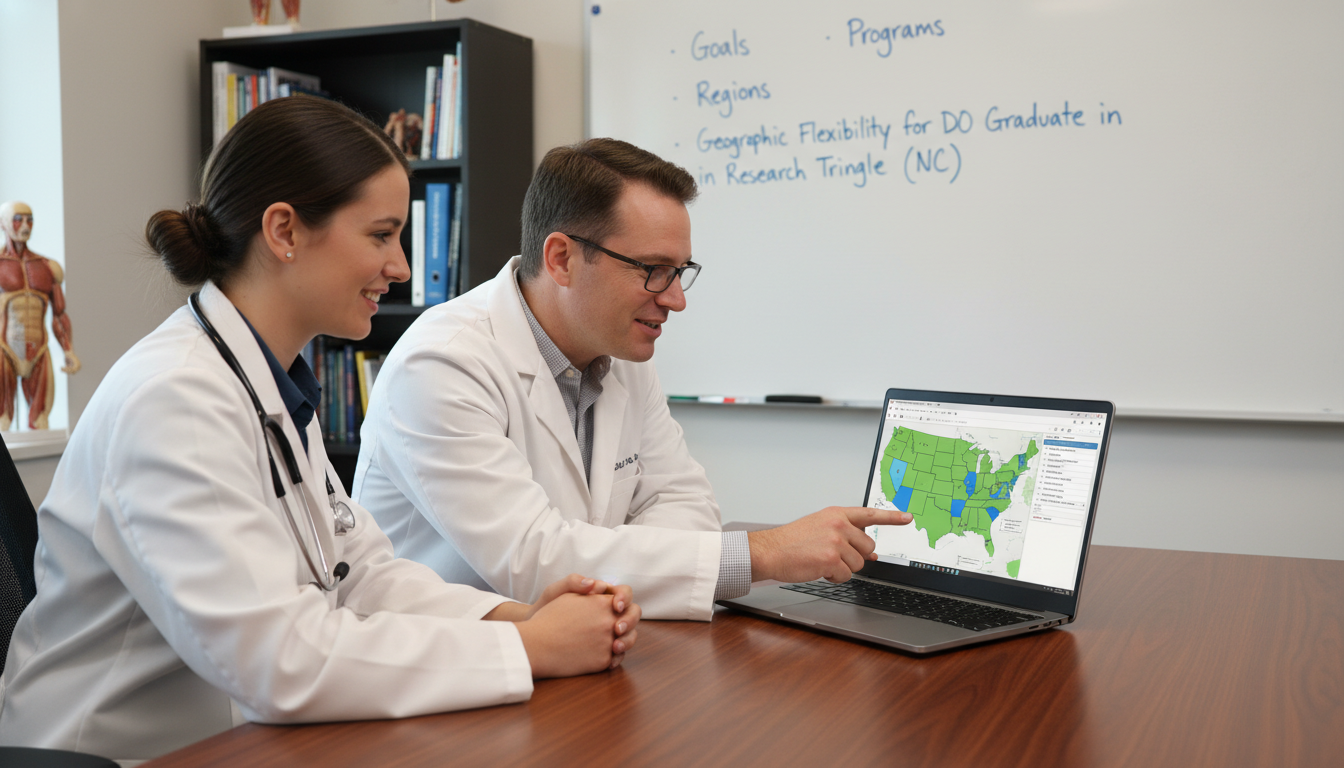
For a DO graduate in the Research Triangle (Raleigh–Durham–Chapel Hill), “geographic flexibility” during the osteopathic residency match is both a strategic advantage and a potential stressor. You may love North Carolina, dream specifically of Duke residency training, or feel anchored by family, relationships, or finances. At the same time, you know that a rigid geographic preference residency strategy can limit your match outcomes—especially in competitive specialties or academic centers.
This article walks through how to think about geographic flexibility in a structured, strategic way—especially if you are currently in or near the Research Triangle and considering DO graduate residency options locally, in the broader North Carolina residency market, or nationwide.
We’ll focus on:
- How geography affects your chances in the osteopathic residency match
- The specific dynamics of the Research Triangle and nearby North Carolina programs
- How to balance geographic preference with competitiveness and career goals
- Concrete frameworks and tools to build a smart, flexible rank list and application plan
Throughout, the emphasis is on practical decision-making for a DO graduate who wants to optimize match outcomes while still honoring geographic priorities.
Why Geographic Flexibility Matters in the Osteopathic Residency Match
Geographic flexibility means being genuinely willing to train in more than one city, region, or state. For a DO graduate, particularly one based in the Research Triangle, it can be one of the highest-yield levers you have for a successful match.
The Reality: Program Supply vs Applicant Demand
In any given specialty, the number of preferred programs (e.g., Duke residency, UNC, big-name academic centers) is far smaller than the number of applicants who want them. If you insist on one small region—say, only Research Triangle institutions and maybe Charlotte—you’re effectively shrinking your “match universe.”
Key implications for DO applicants:
- Fewer interviews if you restrict regions
- Higher risk of going unmatched in competitive specialties
- Less leverage to optimize for “best fit” (culture, training style, fellowship prospects)
Conversely, applicants with broader geographic flexibility:
- Cast a wider net, increasing total interview invitations
- Have more choices when building their rank list
- Are more likely to match in their desired specialty, even if not in their top city
The DO-Specific Angle
In the unified MD/DO Match era, DO graduates face additional considerations:
- Some historically MD-dominant programs, including in the Research Triangle, may still have implicit preferences (though this is variable and changing).
- Osteopathic-friendly programs are unevenly distributed geographically—some regions (e.g., parts of the Midwest and South) may be far more DO-welcoming than ultra-competitive coastal urban centers.
Therefore, a DO graduate who is willing to consider multiple regions—even if the Research Triangle is the starting point—often has a safer and more successful match trajectory.
The Research Triangle and North Carolina Residency Landscape for DO Graduates
Before deciding how flexible to be, you need a realistic understanding of what the local North Carolina residency market looks like for a DO applicant.
Major Training Hubs in and Near the Research Triangle
Within the Research Triangle (and very close by), you’ll find:
Duke University Hospital (Durham)
- Highly academic, research-oriented
- Competitive across most specialties
- Historically MD-heavy but does train DO residents in select programs
- Strong brand name, national fellowship reach
University of North Carolina Hospitals (Chapel Hill)
- Large academic medical center
- Strong primary care, pediatrics, and multiple subspecialties
- Competitive; historically MD-heavy but increasingly DO-inclusive in some specialties
WakeMed, UNC Rex, and regional community programs (Raleigh and surrounding areas)
- Community or community-academic hybrids
- Often more clinically focused and can be more DO-friendly
- May offer excellent hands-on experience with slightly lower competitiveness than pure academic giants
Beyond the Triangle but still within the North Carolina residency ecosystem:
- Atrium Health / Carolinas Medical Center (Charlotte)
- Novant Health and other community programs across the state
- Smaller community programs in Wilmington, Greenville, Winston-Salem, etc.
These can be good targets for DO graduates seeking balanced clinical training with a livable region.
Geographic Competition: What It Means for Your Strategy
Prospective residents often underestimate how geographically “popular” the Research Triangle is. It’s:
- A desirable region for lifestyle (cost of living, climate, culture)
- Home to two major academic powerhouses (Duke and UNC)
- Accessible to both East Coast and Southeast applicants
As a result, your geographic preference residency strategy must assume:
- High competition for Triangle-based spots, especially at Duke residency and UNC.
- High application volume from MD and DO applicants nationwide who also like this region.
- Limited total positions relative to demand—especially for lifestyle specialties (Derm, EM, PM&R, etc.) and elite academic tracks.
This doesn’t mean you shouldn’t try; it means you must be strategic:
- Use the Research Triangle as a core region but not your only region.
- Think about a “Research Triangle plus” approach (Triangle + broader North Carolina + one or more other regions).

Balancing Personal Ties and Geographic Flexibility
Most DO graduates in the Research Triangle have some mix of personal anchors and career ambitions. You might have:
- A spouse or partner with a job in the Triangle
- Children in local schools
- Family you rely on for support
- A strong identity attached to North Carolina residency training
At the same time, you want to match in your desired specialty, build a strong career, and avoid the stress and re-application risk of going unmatched.
Step 1: Clarify Your Realistic Priorities
Use a simple three-tier system:
Non-negotiables (must-haves)
- Example: “I must be within a 3-hour drive of the Research Triangle because of a partner’s job and shared custody arrangement.”
- Example: “I must match in psychiatry this cycle – I’m not willing to reapply.”
Strong preferences (nice-to-have but flexible)
- “I would strongly prefer North Carolina residency or at least the Southeast.”
- “I would like to stay close enough to visit family monthly.”
Negotiable items (open to compromise)
- “I’d rather not live in the Midwest, but I would if it improves my match odds.”
- “I prefer urban settings, but could tolerate suburban if the program is strong.”
Document this on paper. Many applicants are surprised to discover that what they thought was non-negotiable is actually a very strong preference, and vice versa.
Step 2: Define Your Geographic “Zones”
Create 3–4 “zones” of geographic preference residency regions:
Zone A: Ideal Locations (High Preference, Limited Geography)
- Example: Research Triangle (Durham, Chapel Hill, Raleigh), Charlotte, and coastal NC
- Programs: Duke residency, UNC, WakeMed, UNC Rex, Atrium, select community programs
Zone B: High-Acceptability Regions
- Example: Broader Southeast (Virginia, South Carolina, Georgia, Tennessee)
- Good mix of academic and community programs, many DO-friendly
Zone C: Acceptable But Less Preferred Regions
- Example: Midwest and parts of the Mid-Atlantic
- Often have abundant osteopathic-friendly programs, lower cost of living
Zone D: Last-Resort Regions (If Needed for Match Safety)
- Example: Areas far from support systems or climates you’re less excited about
- You might only apply here if your specialty is very competitive or your application is mid-tier
You don’t have to apply evenly across all zones; the idea is to avoid putting 90–100% of your applications in Zone A unless your profile is truly stellar for that market.
Step 3: Match Your Geographic Flexibility to Your Competitiveness
Assess your competitiveness realistically:
- Step/COMLEX scores
- Clinical grades / clerkship performance
- Letters of recommendation
- Research, leadership, and extracurriculars
- Specialty competitiveness (e.g., FM vs Ortho)
Then align flexibility:
Highly competitive DO applicant in a less competitive specialty (e.g., FM, Psych)
- Can afford a tighter geographic preference strategy (e.g., heavy emphasis on North Carolina residency and Southeast).
- Still wise to add a few “backup” regions.
Average applicant in a mid-competitive specialty (e.g., IM with academic interest, EM, Anesthesiology)
- Should combine Research Triangle + broader NC + multiple other regions (e.g., Southeast + Midwest).
- Geographic flexibility directly translates to more interviews.
Below-average metrics aiming for a competitive specialty OR reapplicant
- Needs high geographic flexibility and a “safety-first” mindset.
- The ability to move to a DO-friendly region might be the difference between matching and going unmatched.
Practical Strategies to Implement Smart Geographic Flexibility
Once you’ve clarified your zones and priorities, translate them into concrete actions across your application timeline.
1. Build a Tiered Program List
Start with a large spreadsheet. Columns might include:
- Program name
- City, state, region/zone
- Academic vs community
- DO-friendliness (e.g., % DO residents, historical acceptance)
- Your estimated competitiveness (reach / target / safety)
- Lifestyle factors (cost of living, proximity to family, climate)
For a DO graduate in the Research Triangle, one reasonable distribution might look like:
- 30–40% of applications in Zone A (Research Triangle + North Carolina residency + nearby states)
- 30–40% in Zone B (broader Southeast)
- 20–30% in Zone C (Midwest / other DO-friendly areas)
- 0–10% in Zone D (only if needed as extra safety)
Adjust these based on how competitive you are and how immovable your personal constraints truly are.
2. Use “Location Flexibility” in Your Personal Statement and Interviews Wisely
Some programs care a great deal about applicants’ commitment to their area. Others are reassured by hearing that you are adaptable.
For programs in your top geographic zones (A and B):
- Emphasize regional preference strategy:
- Mention specific reasons you value the Southeast or North Carolina.
- Highlight ties: family, prior schooling, rotations, long-term plans.
Example:
“I completed my clinical rotations in the Research Triangle and have deeply appreciated the patient population and collaborative culture here. My long-term goal is to build a career in North Carolina, ideally serving diverse communities like those I’ve come to know in Durham and Raleigh.”
For programs in less preferred but acceptable zones (C and D):
- Emphasize genuine location flexibility match mindset:
- Focus on what you find appealing about the region (training opportunities, scope of practice, cost of living).
- Avoid implying that you’re only there because you “couldn’t get into” your top region.
Example:
“While my clinical training has been in North Carolina, I am excited by the opportunity to serve communities in the Midwest. The strong osteopathic tradition in this region, combined with the program’s emphasis on hands-on learning, aligns closely with the type of physician I hope to become.”
3. Avoid Common Geographic Preference Mistakes
Being vague or generic
- Programs can tell when you’ve copy–pasted the same line about “loving the Southeast” into every application.
- Instead, mention a specific feature of that state or health system.
Overstating your connection
- If your only tie to a region is “I visited once on vacation,” don’t present it as a deep bond.
- Authenticity builds trust.
Contradictory signals
- Telling a North Carolina program that you are “100% committed to living in NC long-term” while simultaneously telling a Midwest program the same thing can backfire if it comes across as insincere.
- Better approach: emphasize that you can envision multiple regions as potential long-term homes.
4. Communicate Thoughtfully About Couples Matching and Family Constraints
If you are couples matching or have significant family obligations that limit your flexibility:
- Be honest but strategic.
- You can explain constraints without sounding inflexible or high-maintenance.
Example:
“My partner works in Raleigh, so we are focusing on programs within a half-day’s drive of the Research Triangle, including across the Southeast. Within that radius, I am very open to different types of hospitals and communities.”
This signals regional flexibility within clear, understandable boundaries.
Example Scenarios: Applying Geographic Flexibility as a DO Graduate in the Triangle
To make this more concrete, here are three sample profiles and how they might operationalize geographic flexibility.
Scenario 1: DO Graduate Targeting Internal Medicine with Academic Interests
- COMLEX/USMLE: Above average
- Research: A few poster presentations, some QI work
- Goal: Academic Internal Medicine, possibly fellowship
- Geographic goal: Strong preference for Duke residency or UNC, but open to others
Strategy:
- Apply broadly to academic and strong community IM programs within:
- Research Triangle and broader North Carolina residency market
- Southeast (VA, SC, GA, TN)
- Select Midwest cities with strong academic programs and DO-friendly cultures
- Prioritize interviews in:
- North Carolina and Southeast first
- Attend Midwest interviews as well, knowing they provide excellent training and safety
Rank list:
- Top: Duke, UNC, large NC academic or hybrid programs
- Middle: Strong Southeast academic/community programs
- Lower: Midwest DO-friendly academic/community programs
- Result: Maintains a real shot at the Triangle while minimizing risk of going unmatched.
Scenario 2: DO Graduate Targeting EM, Mid-Range Scores, Wants to Stay in NC if Possible
- COMLEX/USMLE: Average
- Goal: Emergency Medicine, comfortable in community or academic settings
- Geographic goal: Prefer to stay in NC or nearby states, but can move if needed
Strategy:
- Identify all EM programs in NC, SC, VA, GA, TN, plus a set of Midwest DO-friendly programs.
- Apply to a large number (EM is competitive—volume matters).
- Clearly communicate ties to the Southeast but signal openness to other regions (“I grew up in NC, but am excited by the opportunity to train wherever I can become the best EM physician.”)
Rank list:
- Top third: NC and surrounding states
- Middle: High-quality programs in the broader Southeast and selected Midwest cities
- Bottom: Additional DO-friendly programs in less-desired locations that still provide solid training
- This approach leverages geographic preference while preserving a safety net.
Scenario 3: DO Graduate with Strong NC Ties, Non-Competitive Specialty (FM)
- Specialty: Family Medicine
- Scores: Solid but not outstanding
- Geographic goal: Wants to live in or near Research Triangle long-term
Strategy:
- Focus heavily on North Carolina residency programs (academic and community).
- Add a modest number of programs in neighboring states as backup (Zone B).
- Because FM is less competitive and NC has multiple options, the applicant can afford a comparatively narrower location flexibility match strategy—though it’s still unwise to go “NC only.”
Rank list:
- Top: Triangle-adjacent FM programs, both academic and community
- Middle: Other North Carolina FM residencies
- Lower: Nearby states (VA, SC, GA)
- This balances sincere geographic preference with some protection against unexpected application variability.
Frequently Asked Questions (FAQ)
1. As a DO graduate in the Research Triangle, is it realistic to aim for Duke residency or UNC?
It can be realistic, but it depends heavily on your specialty and overall competitiveness. For core specialties like Internal Medicine, Pediatrics, and Family Medicine, strong DO applicants can and do match at major academic centers, including Duke and UNC. For highly competitive specialties (Dermatology, Orthopedics, some subspecialty tracks), these programs are extremely competitive for everyone, MD and DO alike.
A smart approach is to include Duke and UNC if they fit your goals, but to build a robust list of other North Carolina and regional programs so you’re not overly dependent on a few ultra-competitive slots.
2. How many geographic regions should I realistically target in my applications?
Most DO applicants will benefit from targeting at least 2–3 geographic regions:
- Your “home” or preferred region (e.g., Research Triangle + North Carolina residency + immediate neighbors)
- One or more additional regions known for DO-friendly training environments (often parts of the Southeast or Midwest)
Very competitive applicants can sometimes focus more narrowly. Applicants in competitive specialties or with mid-tier metrics usually need at least three regions to ensure sufficient interview volume.
3. Will programs think I’m less committed if I show a lot of geographic flexibility?
Not if you frame it well. Programs appreciate applicants who:
- Clearly articulate their interest in the local region (when genuine)
- Demonstrate a thoughtful, professional approach to where they apply
- Express openness to varied practice settings and populations
You don’t have to say, “I’m willing to go anywhere” verbatim. Instead, emphasize that you’re prioritizing training quality, patient population, and program culture, while also highlighting specific reasons you’d value training in their area.
4. If I have strong family ties to North Carolina, should I still apply outside the state?
In most situations, yes—particularly if:
- Your specialty is moderately or highly competitive
- Your metrics are average or below average
- You are a first-generation applicant with less predictable outcomes
You can prioritize NC and the Research Triangle on your list, but adding programs in neighboring states and at least one additional region provides a critical safety net. If your family situation truly makes relocation impossible, work closely with an advisor to build a very dense application list within your feasible radius and consider specialty flexibility if needed.
By approaching geographic flexibility as a deliberate, strategic element of your osteopathic residency match plan—not as an afterthought—you maximize your odds of landing strong training while still honoring what matters most to you. For a DO graduate in the Research Triangle, that usually means anchoring yourself in North Carolina and the Southeast, while wisely keeping doors open to other DO-friendly regions across the country.