
Choosing where to train is one of the most consequential decisions you will make in your medical career. For applicants considering a Kaiser residency, questions about geographic preference, location flexibility, and long‑term regional options often matter just as much as program prestige or case volume.
This article explores how geographic flexibility works specifically in Kaiser Permanente residency programs, and how you can build a strong regional preference strategy without closing doors too early.
Understanding Geographic Flexibility in Residency
Geographic flexibility refers to how open you are to training—and potentially practicing—in different locations. For most applicants, this sits on a spectrum:
- Highly flexible: “I’ll go almost anywhere for the right training.”
- Moderately flexible: “I have a few preferred regions but will consider others.”
- Region-locked: “I need to stay in a specific city or region for family, finances, legal status, or partner reasons.”
Kaiser Permanente adds an important layer: it is both a healthcare system and a training ecosystem. That means:
- You apply to individual Kaiser Permanente residency programs, not a single system-wide match.
- Each region—Northern California, Southern California, Pacific Northwest, Mid‑Atlantic States, Georgia, Hawaii, Colorado, etc.—has its own GME structure, leadership, and hospital sites.
- Geographic flexibility often means deciding which Kaiser regions, not just which cities, you are willing to consider.
Why Geography Matters More Than You Think
When planning where to train, consider how geography intersects with:
- Career trajectory – Kaiser regions often prefer candidates familiar with local patient populations, workflows, and community health priorities.
- Lifestyle – Cost of living, commute, climate, family proximity, and partner job markets differ dramatically between Kaiser regions (e.g., Los Angeles vs. Portland vs. Atlanta).
- Fellowship and job prospects – A strong residency in one Kaiser region can open jobs within that region’s Kaiser network, and sometimes elsewhere in the system.
- Board preparation and clinical exposure – Different locations see different case mixes and patient demographics (urban vs. suburban vs. more rural satellite clinics).
Understanding these variables helps you shape a location flexibility match strategy that fits both your training and personal needs.
The Kaiser Permanente Residency Landscape by Region
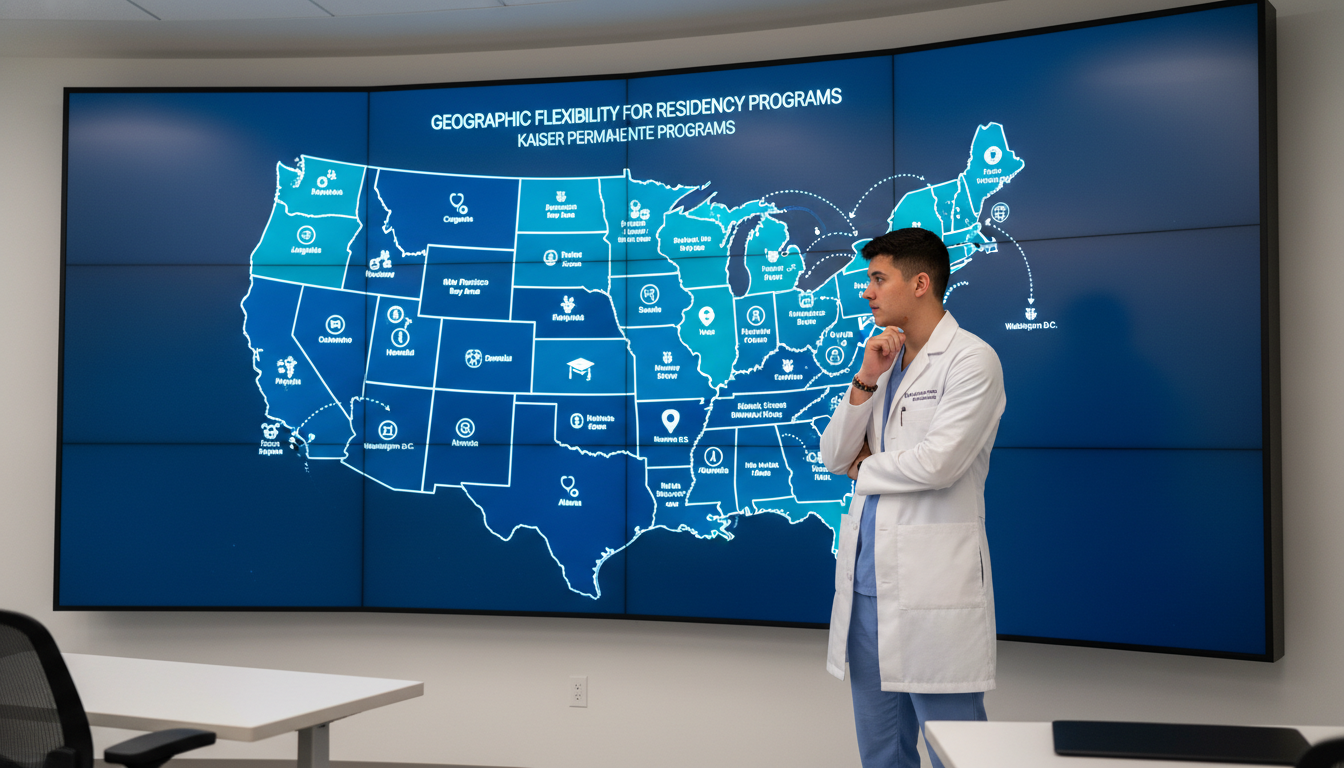
Before you decide how flexible you can be, it helps to understand what “Kaiser Residency” actually means across the map. While exact offerings change over time, you can think of Kaiser Permanente GME as a set of region-based ecosystems.
Major Kaiser Regions with Significant Residency Presence
Below are illustrative overviews; always verify specifics on regional GME websites:
Northern California (Kaiser Permanente Northern California)
- Large number of residency programs (e.g., Internal Medicine, Family Medicine, Pediatrics, Psychiatry, and multiple specialties).
- Training sites across the Bay Area, Sacramento, Central Valley, and other locations.
- Strong integration with community-based care and subspecialty services.
- Competitive for applicants who want academic-caliber training in a large integrated system.
Southern California (Kaiser Permanente Southern California)
- Extensive GME footprint with multiple hospitals (e.g., Los Angeles, San Diego, Orange County, Inland Empire).
- Broad specialty representation including primary care, surgical fields, OB‑GYN, and others.
- High-volume, diverse patient populations; strong emphasis on team-based care and quality improvement.
Northwest / Pacific Northwest
- Kaiser Permanente Northwest (e.g., Portland/Vancouver area) and partnerships in the broader region.
- Programs often emphasize community-oriented, primary care–heavy training with exposure to integrated population health.
Mid‑Atlantic States
- Centers in Maryland, DC, and Virginia.
- Growing GME presence; strong focus on ambulatory and integrated care models.
Georgia, Colorado, Hawaii, and Others
- Fewer programs than California regions but often highly sought for lifestyle and community reasons.
- May offer excellent access to outpatient integrated care and specific specialties.
What This Means for Your Geographic Preference
Instead of asking, “Do I want to do a Kaiser residency?” ask more specific questions:
- “Which Kaiser regions realistically fit my life and goals?”
- “Within a region, which cities or specific hospitals align with my needs?”
- “How many regions am I willing to rank, and how widely within each region?”
This shift from a generic Kaiser vs. non‑Kaiser decision to a region-aware strategy is central to using geographic flexibility to your advantage.
Building a Geographic Preference and Flexibility Strategy
You don’t need to be willing to move anywhere to match successfully at a Kaiser Permanente residency, but you do need a clear, honest strategy for geographic preference and flexibility.
Step 1: Clarify Your Non‑Negotiables
Before you plan which programs to apply to, define your absolute constraints:
- Family obligations (e.g., caregiving, co‑parenting in a specific city)
- Partner’s job or training location
- Visa limitations or immigration status
- Medical needs (you or close family) that require proximity to certain facilities
- Financial realities (cost of living, reliance on family support, ability to move)
If you truly cannot leave one metro area, own that reality. Your application strategy will focus on:
- All Kaiser and non‑Kaiser programs in that area.
- Neighboring regions only if they’re realistically commutable or reachable by short flights.
Being honest upfront is better than pretending flexibility you don’t have.
Step 2: Define Your “Flex Zones”
Next, identify where you could go, even if they’re not your first choice. Common categories:
- Preferred region(s): “I’d love to be in Northern or Southern California.”
- Acceptable regions: “I’d prefer California, but I’d be happy in the Pacific Northwest or Mid‑Atlantic.”
- Backup regions: “I’d consider Colorado or Georgia if programs match my training goals.”
For Kaiser Permanente residency planning, this might look like:
- Core target: Kaiser Southern California + Kaiser Northern California
- Flex extension: Add Kaiser Northwest and selected Mid‑Atlantic programs
- Outer ring: A small number of programs in other Kaiser regions or non‑Kaiser systems with similar integrated care models
Step 3: Align Geography with Specialty and Competitiveness
Your specialty choice changes how flexible you might need to be:
- Highly competitive specialties (e.g., Dermatology, Orthopedic Surgery, certain subspecialties):
- Greater geographic flexibility often helps.
- Consider multiple Kaiser regions plus non‑Kaiser programs to maintain a realistic match list.
- Moderately competitive specialties (e.g., Internal Medicine, Pediatrics, Family Medicine):
- You can afford to be more region-selective, but not overly rigid if your application has red flags or is average.
- Less competitive or higher‑volume specialties:
- Geographic preference can weigh more heavily as long as you maintain a healthy number of applications.
Ask yourself:
“If my first-choice Kaiser region fills with stronger applicants in my specialty, do I have enough location flexibility to keep my overall match chances strong?”
Step 4: Research Each Region in Depth
For each Kaiser region you consider, investigate:
- Program list and specialties available
- Rotational structure: inpatient vs. outpatient mix; continuity clinics
- Local living conditions: housing costs, commuting, public transit, schools (if you have a family)
- Culture and mission fit: Does the region emphasize community health, research, QI, or population management in ways that resonate with you?
Use:
- Official Kaiser Permanente GME websites for each region
- Virtual open houses and Q&A events
- Residents or alumni from your medical school who matched there
Document your findings so you can write region-specific personal statements or supplementals and speak intelligently on interview day.
Applying and Interviewing: How to Signal Geographic Preference (Without Overcommitting)
Once your geographic strategy is set, you need to communicate it effectively while preserving flexibility.
ERAS and Application Materials
Although ERAS does not have a system-wide “geographic preference” field for all specialties, you can signal your preferences through:
- Program selection: The pattern of which Kaiser regions you apply to communicates your priorities.
- Personal statement(s):
- Option A: Use one core statement and subtly adjust a paragraph for each Kaiser region (e.g., why integrated care in Northern California appeals to you).
- Option B: Create a separate Kaiser- or region-specific personal statement if you’re applying heavily to one Kaiser region.
- Experience sections: Highlight community work or language skills relevant to the region’s patient population (e.g., Spanish for many California regions).
On Interview Day
Program faculty often probe on geographic flexibility directly or indirectly. You might hear questions like:
- “What attracts you to this region and this Kaiser Permanente residency program?”
- “Do you have ties to this area?”
- “Where else have you applied or interviewed?”
You can answer honestly while preserving flexibility:
Focused but open example
“I’m particularly drawn to Kaiser Southern California because of its large, diverse patient population and strong integrated care model. I did my sub‑I in Los Angeles and could see myself building a long‑term life here. That said, I’m also interviewing within other Kaiser regions, like Northern California and the Northwest, because I’m committed to this style of care and open to different West Coast settings.”Region-constrained example
“For family reasons, I need to stay in the greater Bay Area. That’s why I’m applying specifically to programs in Northern California, including Kaiser Permanente residencies here. I want to be transparent about that so you understand I’m genuinely committed to this area and wouldn’t be ranking programs outside it.”
Avoiding Red Flags in How You Signal Preference
- Don’t tell every region, “This is my number one.” Programs speak to each other, and it sounds insincere.
- Don’t claim you have deep “ties to the area” if that simply isn’t true. Instead, talk about reasons you see yourself thriving there (clinical interests, lifestyle fit, partner’s job search).
- Do be consistent: if you describe strong Bay Area preference, it should make sense based on your application pattern (not 15 interviews on the East Coast and one in Oakland).

Ranking Kaiser Programs: Balancing Location and Training Quality
When the time comes to create your rank list, the tension between geographic preference residency choices and program quality fit usually intensifies. Many applicants struggle with:
“Do I rank my favorite city higher, or my best training fit even if it’s in a less ideal location?”
Principles for Constructing a Smart Rank List
Never rank a program you would be unhappy to attend.
- Geographic desperation (“I’ll go anywhere”) sometimes leads to ranking places that are a clear personal or professional mismatch. This can set up years of dissatisfaction.
Within your acceptable locations, rank based on overall fit, not just geography. Factors to weigh:
- Educational rigor and support
- Resident morale and culture
- Faculty mentorship
- Opportunities in your area of interest (e.g., hospitalist, outpatient primary care, subspecialty exposure)
- Alignment with your values (e.g., equity, QI, population health)
Account for long‑term regional impact.
Many Kaiser Permanente physicians remain in or return to the region where they trained, thanks to familiarity with the system and local hiring networks. If your dream is to practice long‑term in:- Northern California, training there gives you direct exposure to that region’s internal job market.
- Southern California, a Kaiser residency there can create a smooth transition to a staff role.
This doesn’t mean you can’t move between regions later, but:
- In‑region transitions are often simpler (existing mentors, reputation, and network).
- Cross‑region moves may require more initiative and networking to demonstrate fit with the new region’s needs.
Be realistic about competitiveness and backup options.
If you’re aiming for a particularly competitive Kaiser program in a desirable urban area, you may need:- Additional Kaiser programs in the same region (e.g., different campuses).
- Kaiser programs in more geographically flexible locations.
- Non‑Kaiser programs that still support your career goals.
Example: Two Rank List Approaches
Applicant A: Highly location-driven (Bay Area lock)
- Kaiser Permanente Northern California programs in the Bay Area ranked by best fit.
- Other Bay Area academic/community programs.
- No out-of-region programs.
- Risk: If they don’t match in that area, they’ll go unmatched—but they’ve decided geography is non‑negotiable.
Applicant B: Location-flexible with Kaiser focus
- Top ranks: Kaiser Southern California and Northern California programs that best match their clinical interests.
- Middle ranks: Kaiser Northwest and Mid‑Atlantic programs.
- Lower ranks: High-quality non‑Kaiser integrated health system residencies.
- Outcome: Strong overall match chances and multiple pathways into integrated, population-based care.
Long-Term Career Impact: Staying Within vs. Moving Between Kaiser Regions
When considering geographic flexibility, think beyond residency:
Staying in the same region post‑residency
- Pros:
- Established relationships with department leaders and mentors.
- Familiarity with local workflows and EHR.
- Often a smoother hiring process if positions are available.
- Cons:
- You might feel “locked in” if you never explore other systems or regions.
- Pros:
Moving to another Kaiser region after residency
- Possible, but you’ll need to:
- Network with physicians and leaders in the desired region.
- Highlight your alignment with Kaiser’s overall philosophy plus your understanding of regional differences.
- Be flexible on start dates and specific medical center locations.
- Advantage: Your experience with the Kaiser model of care translates, even though each region has its own governance.
- Possible, but you’ll need to:
Leaving Kaiser for other systems
- A Kaiser residency still positions you well for:
- Academic centers (especially if you’ve done research or scholarly activity).
- Community and safety-net hospitals that appreciate strong outpatient and population health training.
- Policy, quality, and administrative roles, given emphasis on integrated care and systems thinking.
- A Kaiser residency still positions you well for:
When you choose your geographic and regional preferences for a Kaiser residency, you’re not only deciding where you’ll spend 3–7 years; you’re setting the default geography of your early attending career.
FAQs: Geographic Flexibility and Kaiser Permanente Residency
1. If I train in one Kaiser region, can I easily get a job in another Kaiser region?
“Easily” is relative. It’s definitely possible, and your familiarity with the Kaiser model is an asset. However:
- Hiring is driven by local needs and openings.
- You’ll need to:
- Network and express clear interest in that specific region.
- Explain why you’re moving regions and what you bring that fits local priorities.
- Don’t assume automatic transferability, but view your training as strong internal experience that you can leverage across regions.
2. Will ranking multiple Kaiser regions make me look unfocused?
No. Applying to and ranking multiple Kaiser regions usually signals:
- You’re genuinely committed to integrated care and the Kaiser Permanente mission.
- You’re reasonably flexible on geography while still intentional about program culture and training quality.
It only becomes a concern if your messaging is inconsistent (e.g., telling each region it is your single, absolute top choice in ways that contradict).
3. How should I handle geographic constraints due to my partner (couples match) in Kaiser settings?
For couples matching, particularly if one or both of you are interested in Kaiser programs:
- Identify regions where:
- Both of your specialties are available in reasonable proximity.
- There are sufficient programs for each partner to build robust rank lists.
- Communicate your constraints professionally:
- Emphasize your commitment to the region as a shared life decision, not a reluctant compromise.
- Be ready to include a mix of Kaiser and non‑Kaiser programs in the same geographic areas to protect your match chances.
4. What if I start residency in one Kaiser region and realize I need to relocate for personal reasons?
Changing regions during residency is complex and not guaranteed, whether within Kaiser or to another system. If this becomes necessary:
- Speak early with your program director and GME office.
- Understand that:
- Transfers depend on visa, licensure, open positions, and program needs.
- You may need to repeat some training time.
- Geographic flexibility is usually easier to implement before you match, rather than via transfer later, so plan carefully up front.
Navigating geographic flexibility for residency programs in Kaiser Permanente means more than just picking a city; it’s about building an intentional regional preference strategy that supports your training, your life, and your long-term career. By understanding the Kaiser residency landscape, clarifying your constraints, and communicating your preferences honestly, you can use geography as a strategic advantage rather than a source of stress in the match process.