
Understanding Geographic Flexibility in the Texas Triangle
For an MD graduate residency candidate, especially from an allopathic medical school, “geographic flexibility” is more than a checkbox on ERAS—it’s a strategy. In the Texas Triangle (Houston–Dallas–San Antonio–Austin), where major Texas residency programs are densely clustered, how you express and operationalize geographic preference can significantly influence your allopathic medical school match outcome.
Geographic flexibility means you can:
- Seriously consider multiple cities or regions, not just one
- Adapt your personal and professional plans to different locations
- Articulate coherent reasons for preferring broader areas rather than a single zip code
- Align your application strategy with programs across the Houston, Dallas, San Antonio, and Austin corridors
This does not mean you must be “open to anywhere” with no preferences. Instead, it’s about having a well-thought-out regional preference strategy that balances:
- Your personal life and support systems
- Your training goals and career plans
- The competitiveness of your specialty
- The realities of the Texas GME landscape
If you’re an MD graduate aiming for a residency in the Texas Triangle, your ability to be clearly yet thoughtfully flexible can improve both your match probability and the quality of your ultimate fit.
Mapping the Texas Triangle: Regional Nuances That Matter
Before you can describe your geographic preference for residency, you need to understand what differentiates the major nodes of the Texas Triangle. While all four cities offer strong training environments, each has a distinct culture, healthcare ecosystem, and opportunity profile.
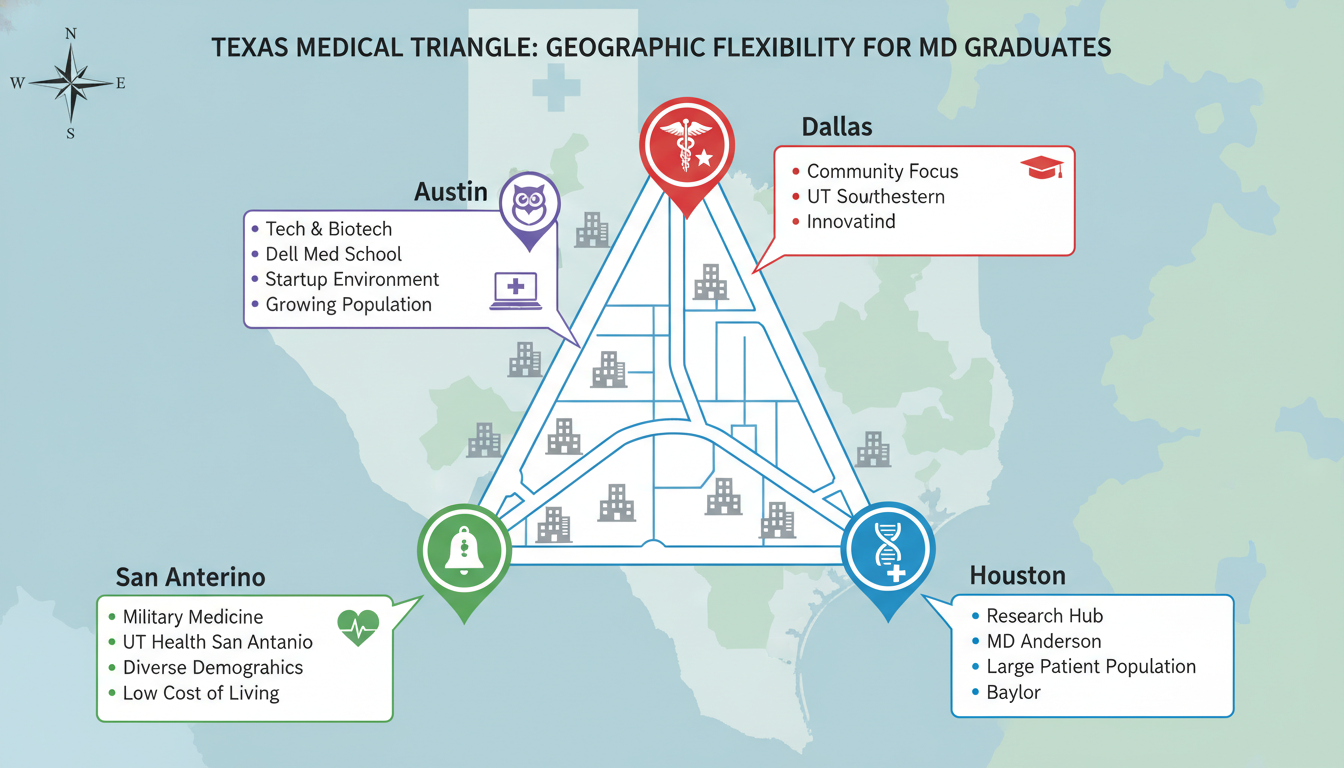
Houston: High-Volume, High-Complexity, Research-Intense
Key features:
- Home to the Texas Medical Center (TMC), one of the largest medical complexes in the world
- Numerous academic hospitals, quaternary-care centers, and subspecialty services
- Strong emphasis on research, complex pathology, and tertiary referrals
Ideal for MD graduates who:
- Want exposure to rare and highly complex cases
- Are considering academic medicine, research careers, or competitive fellowships
- Are comfortable in a large, dense medical ecosystem with fast-paced training
Tradeoffs to understand:
- Traffic, commute times, and urban density can affect lifestyle
- Housing costs vary substantially by neighborhood
- Some programs are very large; you may train with many co-residents
Dallas–Fort Worth (DFW): Diverse Training Settings with Broad Exposure
Key features:
- Mix of large academic centers, county hospitals, and strong community health systems
- Growing biotechnology and business sectors connected to healthcare
- Wide geographic spread—suburban and urban environments
Ideal for MD graduates who:
- Want broad case exposure across different health systems
- May be interested in a mix of academic and community practice or private practice prep
- Prefer a metropolitan area with strong family amenities and schools (if relocating with family)
Tradeoffs to understand:
- Commuting between systems can be time-consuming depending on program
- Culture and training style may differ significantly between institutions in the region
- Some programs may be more service-heavy; others more didactics-focused—research carefully
San Antonio: Military Presence, Community Focus, and Balanced Training
Key features:
- Significant military medical presence and VA influence (depending on program)
- Strong focus on community health and serving diverse populations
- Midsized city feel compared to Houston or Dallas
Ideal for MD graduates who:
- Appreciate a balance of academic resources and community orientation
- May have interest in military medicine, trauma, or VA-based care (program-dependent)
- Value a somewhat slower-paced city with lower cost of living
Tradeoffs to understand:
- Fewer ultra-sub-specialized centers compared with the TMC
- Research infrastructure is present but generally more limited than in Houston
- Fewer total programs and positions compared with Houston/DFW
Austin: Emerging Academic Hub with Lifestyle Appeal
Key features:
- Rapidly growing healthcare infrastructure and academic footprint
- Strong tech and innovation ecosystem; opportunities in digital health, health policy, and startup culture
- Highly desirable lifestyle city—music, outdoors, culture
Ideal for MD graduates who:
- Are interested in an emerging academic environment and innovation
- Might be drawn to health tech, policy, quality improvement, or leadership pathways
- Highly value lifestyle and a younger urban environment
Tradeoffs to understand:
- Fewer residency programs and positions compared with other Texas Triangle cities
- Very competitive due to lifestyle appeal and smaller GME footprint
- High housing costs and rising cost of living
Designing Your Geographic Preference Strategy as an MD Graduate
A smart regional preference strategy for a Texas MD graduate residency applicant balances aspiration, realism, and flexibility. Instead of thinking “Austin or bust,” frame your decisions around tiers, clusters, and what you truly need versus what you ideally want.
Step 1: Define Your Non-Negotiables
Before you decide how flexible to be, clarify what you cannot compromise:
Common non-negotiables:
- Partner’s job or spouse’s established career location
- Childcare, school systems, or proximity to specific family support
- Health needs requiring certain specialists or facilities
- Financial constraints (e.g., needing a certain cost-of-living range)
Example:
“If my partner must remain employed in Houston or DFW, then my Houston Dallas San Antonio residency strategy might prioritize Houston and Dallas programs, with San Antonio as a secondary option only if remote arrangements are feasible.”
Write down:
- Absolute must-haves
- Strong preferences
- Truly flexible points
Being honest about this list helps you present a coherent and ethical geographic story to programs.
Step 2: Understand Specialty Competitiveness vs. Location Limits
Your ability to constrain geography depends heavily on your specialty and competitiveness.
Highly competitive specialties (e.g., Derm, Ortho, ENT, Plastics, some subspecialty medicine):
- Narrow geographic targeting (e.g., “only Austin”) can drastically reduce your odds.
- You may need broad location flexibility match—consider all major Texas residency programs and potentially beyond.
Moderately competitive specialties (e.g., EM, Anesthesiology, General Surgery, OB/GYN, Radiology):
- You can usually have a regional preference, but still benefit from listing multiple locations.
- Triangle-wide strategy (Houston, Dallas, San Antonio, Austin) is usually prudent.
Less competitive specialties (e.g., FM, IM categorical, Pediatrics, Psychiatry, PM&R in some regions):
- You may afford more geographic selectivity without severely compromising your match probability, especially as an MD graduate from a U.S. allopathic medical school.
- Still, a broad Texas Triangle strategy remains advantageous if you want options.
Actionable rule of thumb:
The more competitive the specialty (and the more average your metrics), the more you should increase geographical flexibility.
Step 3: Build “Geographic Tiers” Instead of Single-City Fixations
Think in tiers, not single cities.
Example of a Texas Triangle tiered strategy:
Tier 1 (Top Priority):
- Houston and Austin programs (family and partner both have ties here; love big academic centers and innovation culture).
Tier 2 (Very Acceptable):
- Dallas residency programs (broad training, family-friendly, good career options for partner).
Tier 3 (Still Serious Consideration):
- San Antonio residency programs (good balance of training and cost of living; would move if Tier 1 and 2 options don’t work out).
Your application list then reflects your tier plan:
- Apply heavily across Tier 1 and 2
- Include a reasonable number of Tier 3 programs
- Clearly explain your regional preference strategy in personal statements/secondary communications where appropriate
Applying Geographic Flexibility During the Match Process
Once you understand your preferences and tiers, the next step is to apply that strategy across the major components of the allopathic medical school match process: applications, interviews, and rank list.

ERAS and Application Strategy
Program list construction:
- Include a geographically diverse but Texas-focused list if your priority is the Texas Triangle.
- Within Houston Dallas San Antonio residency options, mix:
- Large academic centers
- County or safety-net hospitals
- Strong community-based residencies
Tailoring your application:
- In personal statements, it’s acceptable to highlight Texas or the Texas Triangle as a desired region, if you remain open to multiple cities in that region.
- Use phrases that emphasize regional rather than single-city preference:
- “I am strongly interested in Texas residency programs, particularly within the Texas Triangle, because…”
- “My family and professional goals align well with remaining in the region that includes Houston, Dallas, San Antonio, and Austin…”
Avoid overly narrow statements like:
- “I am only willing to live in Austin” (unless this is truly non-negotiable and you accept the associated risk).
Signaling and Communication
If your specialty has signaling (e.g., preference signals), use them strategically:
- Signal at least one program in each of your top geographic tiers when possible.
- Ensure your signals support your geographic flexibility story—not contradict it.
You can also:
- Use geographic preference questions on ERAS (if offered) truthfully, recognizing they may influence program decisions.
- Clarify in supplemental applications if you have genuine ties to multiple Texas cities (e.g., grew up in Dallas, attended undergrad in Austin, medical school in Houston).
The Interview Phase: How to Talk About Location
During interviews, programs often ask about your geographic preference. Your goal is to sound:
- Sincere about their city
- Consistent with your application
- Realistically flexible
Example answers:
Broad regional focus:
“I’m hoping to remain within the Texas Triangle for residency. I have family in Dallas and friends in Houston and Austin, so this region feels like home. San Antonio offers the combination of training quality and cost of living that would be great for my family, which is why I’m excited to interview here.”Tiered but flexible:
“My top priority is staying in Texas, particularly within the major metropolitan centers. I’m especially drawn to the diversity and complexity here in Houston, but I’ve applied broadly across Houston, Dallas, and San Antonio because my main goal is strong training in this region.”
Avoid:
- Saying every city is your “number one” without meaningful explanation.
- Overcommitting (“I will definitely rank you #1”)—this is both unethical and unnecessary.
Instead, focus on what genuinely appeals to you about that city and program, while affirming your openness to the broader region.
Rank List Strategy: How Flexible Is Flexible Enough?
When constructing your NRMP rank list:
- Rank all programs in the true order of your preference, not strategic guesses.
- If you have strong Texas ties and primary preference for the Texas Triangle, rank those programs as high as is consistent with your real priorities.
- Consider including out-of-region programs if:
- Your specialty is very competitive
- You had fewer interviews within the Texas Triangle than expected
- You want to maximize the probability of matching this year
Practical scenario:
- You interviewed at:
- 3 programs in Houston
- 2 in Dallas
- 1 in San Antonio
- 1 in Austin
- 4 outside Texas
Your rank list might place your top 3–4 choices in your most desired Texas cities, followed by the remaining Texas programs, and then the best-fit out-of-state programs. This preserves your geographic priorities while respecting match probability.
Personal, Professional, and Long-Term Factors to Weigh
Geographic flexibility doesn’t mean ignoring lifestyle. Being deliberate about how each Texas Triangle city fits your broader life plan will keep you from feeling trapped later.
Cost of Living vs. Salary and Benefits
Even though resident salaries are similar within many Texas residency programs, cost of living can vary:
Houston & Dallas:
- Generally moderate cost of living, wide range of housing options
- Commute costs can be higher (gas, parking, longer distances)
San Antonio:
- Often more affordable, especially for housing
- Feels more manageable budget-wise for many residents
Austin:
- Highest cost of living among the four
- Attractive lifestyle but potentially more financial stress on a resident’s salary
Actionable step:
Use a cost-of-living calculator to compare expected rent and basic expenses in each city before finalizing your geographic strategy.
Support Systems and Well-Being
Residency is demanding; access to support matters:
- Family or close friends nearby can be a major resilience factor
- Cultural or faith communities in certain cities may have deep personal importance
- Consider whether you prefer:
- A bustling urban center (Houston, Dallas)
- A slightly smaller city (San Antonio)
- A more niche cultural fit (Austin’s arts/tech scene)
Write out how each potential city would impact:
- Your mental health
- Partner/family satisfaction
- Access to childcare and social support
Career Trajectory After Residency
Think beyond PGY-1:
Do you want to practice in Texas long term? Training in the Texas Triangle can be advantageous if you’re targeting:
- Texas-based fellowships
- Groups or systems in the same cities
- Statewide networking opportunities
For fellowship-bound candidates:
- Houston and Dallas may offer more abundant fellowship options and research connections.
For primary care/community practice:
- Training anywhere in the Triangle positions you well to work in urban, suburban, or even rural Texas settings.
Connecting the dots:
Your geographic flexibility during residency can keep doors open for future practice locations throughout the state.
Practical Examples of Geographic Flexibility in Action
To make these ideas concrete, consider three sample MD graduate profiles:
Example 1: Competitive Specialty, Strong Texas Preference
- Specialty: Dermatology
- Background: MD graduate from a Texas allopathic medical school, average Step scores, strong research but limited to one institution
- Geographic preference: Wants to stay in Texas, ideally Austin or Houston
Strategy:
- Apply to all relevant Texas Triangle programs plus well-regarded programs in nearby states
- Emphasize Texas-wide preference: “Texas is home; I have strong ties across the Triangle.”
- Rank order by program quality and fit, not just city allure—may end up preferring a Houston or Dallas program to a more competitive Austin option for match probability reasons.
Example 2: Family Considerations, Moderate Specialty
- Specialty: Internal Medicine
- Background: MD graduate married with two children, spouse works in IT and can find work in any major city
- Geographic preference: Prioritizes cost of living and schools
Strategy:
- Heavy focus on San Antonio and Dallas programs (balance of cost of living and job market)
- Still apply to Houston and Austin but with full awareness of cost/commute tradeoffs
- During interviews, explain: “I’m looking broadly within the Texas Triangle because my spouse’s job is flexible, but we are especially drawn to communities that balance affordability and strong schools.”
Example 3: Lifestyle-Driven but Realistic
- Specialty: Pediatrics
- Background: MD graduate in love with Austin’s culture, average to slightly below-average board scores
- Geographic preference: Austin > Houston > San Antonio > Dallas
Strategy:
- Applies broadly across all four cities and some out-of-state programs
- Avoids stating “Austin or nothing” in writing; instead says, “I’m deeply committed to remaining in Texas, especially within the Triangle, where my personal and professional communities are strongest.”
- Ranks Austin programs first if interviewed, followed by Houston and San Antonio, acknowledging that a Houston pediatrics program might offer greater match security than putting all hopes on Austin alone.
FAQs: Geographic Flexibility and the Texas Triangle
1. Will limiting myself only to Texas residency programs hurt my match chances as an MD graduate?
It depends on your specialty and competitiveness. As a U.S. MD graduate, focusing on Texas alone can be reasonable for less competitive specialties, especially IM, FM, Peds, and Psych, provided you apply broadly within the Texas Triangle and possibly beyond it (e.g., El Paso, Lubbock). For highly competitive specialties, restricting to Texas-only significantly increases your risk of not matching; in those cases, greater national geographic flexibility is wise.
2. How honest should I be about geographic preferences on ERAS and in interviews?
Be honest, but calibrated. It’s appropriate to say you prefer the Texas Triangle and plan to stay in Texas long term if that is true. It’s not advisable to give absolute guarantees (like “I will rank you #1”) or imply you would be unhappy elsewhere if that contradicts your application list. You can truthfully convey a regional preference strategy—e.g., “My priority is remaining in Texas, especially in the Houston, Dallas, and San Antonio corridor”—while preserving flexibility.
3. Does doing my MD at a Texas allopathic medical school help me with Texas Triangle programs?
Yes, typically. Texas residency programs are often familiar with local medical schools, curricula, and grading systems. They may also value applicants more likely to remain in-state long term. If you’re a Texas MD graduate residency applicant, leverage this by highlighting your ties to Texas and your commitment to serving its diverse patient populations—but still apply broadly within the Triangle to optimize your match outcome.
4. Should I rank a great program in a less-preferred city above a good program in my favorite city?
Rank in the order you truly prefer to train, weighing both program quality and geographic fit. If the city is critical to your family’s well-being, a “good” program there might genuinely be better for you than a “great” program elsewhere. However, you should not artificially reorder your list based on where you think you’re more likely to match; the NRMP algorithm is designed to favor your true preferences. Consider carefully, then rank accordingly.
By approaching the Texas Triangle with a clear, flexible, and honest geographic strategy, you can significantly improve your chances of a satisfying allopathic medical school match—one that supports not only your training objectives, but also your life outside the hospital.