Choosing where to apply for residency is never just about a city—it’s about your visa, your chances of matching, your long-term career, and your quality of life. For a non-US citizen IMG interested in Philadelphia, geographic flexibility is one of the most powerful tools you can use to improve your match odds while still keeping Philly in the picture.
This guide explains how to think strategically about geographic preference, how to build a smart application plan centered on Philadelphia, and how to communicate your flexibility to programs—especially Penn residency programs and other Philadelphia residency options.
Understanding Geographic Flexibility as a Non-US Citizen IMG
Geographic flexibility means you are open to multiple regions or cities rather than limiting your applications to one narrow area. For a foreign national medical graduate, this is not just a preference issue—it’s often a key match probability and visa viability issue.
Why geographic flexibility matters even if you love Philadelphia
As a non-US citizen IMG, you face additional constraints:
- Visa sponsorship (J-1 vs H-1B) varies widely by program and state
- Some regions and institutions have more IMG-friendly histories
- Some states have licensing or USMLE requirements that favor certain profiles
- Larger, famous cities (including Philadelphia) are often more competitive
If you apply almost exclusively to one city—even a relatively IMG-friendly one like Philadelphia—you risk:
- Not having enough interview offers
- Competing heavily with US grads and US-IMGs who have a home-field advantage
- Missing out on excellent but lesser-known programs that might be more welcoming to foreign national medical graduates
The goal is not to abandon Philadelphia. The goal is to anchor your application around Philadelphia while using geographic flexibility to:
- Boost your overall interview numbers
- Secure at least one match-safe region
- Keep more visa options open
How programs perceive geographic preference
Programs are asking themselves:
- “Will this applicant really come here if we rank them?”
- “Does this applicant have a rational story for why they want this region?”
- “Are they applying only locally, or do they have broader flexibility?”
For non-US citizen IMGs, programs also think about:
- Your long-term plan (fellowship vs community practice vs academic career)
- Whether you understand local living conditions (weather, cost, transportation)
- Whether your preference is genuine or simply chasing prestige
If you can clearly show why Philadelphia is appealing but also demonstrate location flexibility, you come across as mature, realistic, and easier to place.
Philadelphia as a Center Point: Pros, Cons, and Realities
Philadelphia is an excellent base region for non-US citizen IMGs, but it’s not the only one you should consider.
Why Philadelphia appeals to non-US citizen IMGs
Dense cluster of academic centers
- University of Pennsylvania (Penn residency programs)
- Thomas Jefferson University
- Temple University Hospital
- Drexel-affiliated programs
- Einstein, Cooper (Camden, right across the river)
- Multiple strong community and safety-net hospitals
Diverse patient population
- Urban underserved communities
- Large immigrant and minority populations
- High acuity, complex pathology (great for training and future fellowship)
Reasonable cost of living
- Cheaper than NYC, Boston, San Francisco, DC
- More realistic on a PGY-1 salary
- Good public transport relative to many US cities
Proximity to major East Coast hubs
- Easy train access to NYC, DC, Baltimore, Boston
- Attractive if you want to attend conferences, network, or consider fellowship in nearby academic centers
Generally IMG-friendly environment (depending on specialty)
- Many hospital systems historically match IMGs in Internal Medicine, Family Medicine, Psychiatry, Pediatrics, and some pre-lim/TY spots
Real challenges in targeting Philadelphia only
However, betting everything on Philadelphia residency programs carries risk:
- Highly competitive university programs (e.g., Penn, Jefferson, Temple)
- Large number of US MD and DO graduates staying in the region
- Strong preference for regional ties (medical school, undergrad, family, years of US experience)
As a non-US citizen IMG, you might be disadvantaged if:
- You lack US clinical experience (USCE) in the Mid-Atlantic/Northeast
- You don’t have strong US-based letters of recommendation
- Your USMLE scores, attempts, or graduation year are not top-tier
This is where your regional preference strategy becomes critical.
Building a Smart Regional Preference Strategy Around Philadelphia
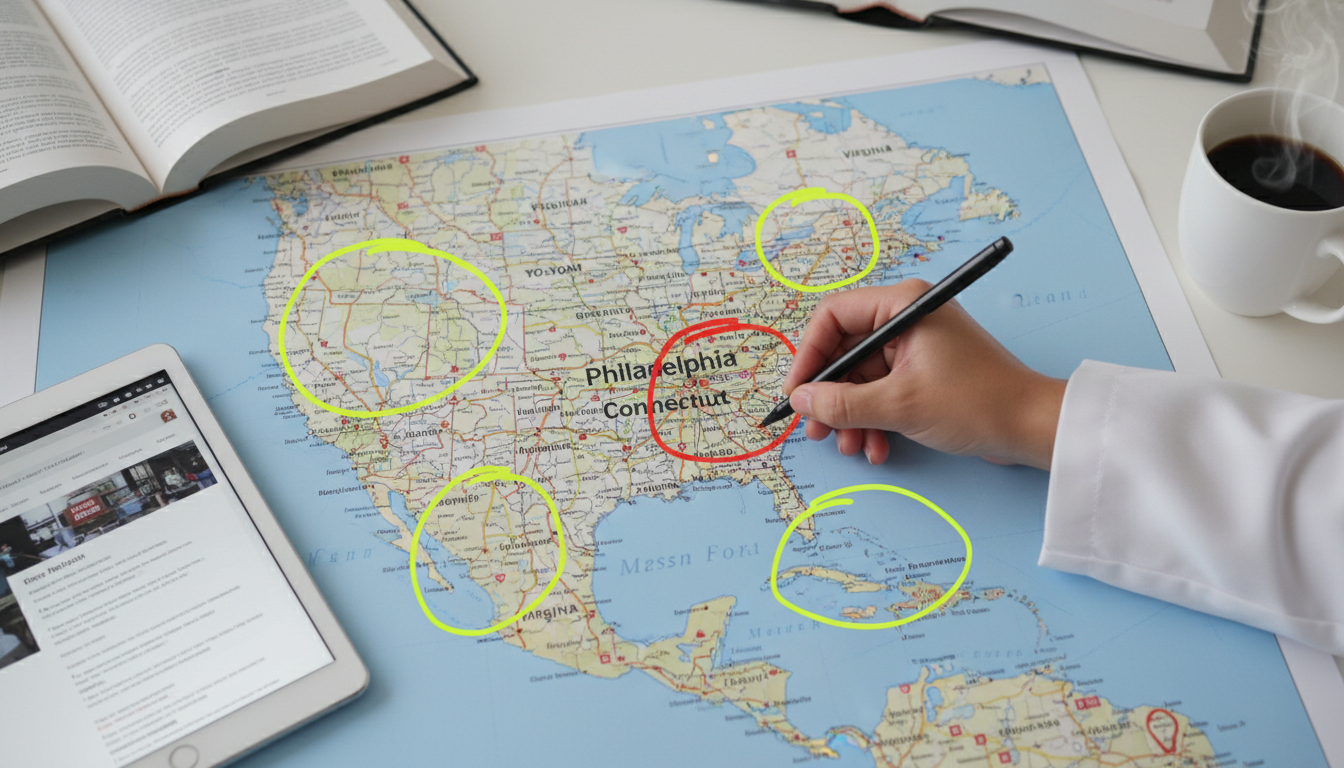
Instead of thinking “Philadelphia only” vs “Anywhere,” think in concentric circles:
- Core region: Philadelphia and immediate surroundings
- Extended region: Nearby states and cities with similar profiles
- Safety region(s): Areas more IMG-friendly or less competitive where you’d still be willing to live
1. Core Region: Philadelphia and Surrounding Areas
These should be your top-choice locations, where you invest more effort in:
- Tailored personal statements (when possible)
- Strong program research
- Networking or reaching out
Include:
- City of Philadelphia (all academic and community programs)
- Nearby Pennsylvania cities:
- Allentown, Reading, Lancaster, Harrisburg
- Community hospitals or smaller academic centers
- South Jersey and Camden/Cherry Hill area:
- Programs that often have clinical or academic links with Philadelphia systems
Even if you dream of Penn residency programs, balance your list with:
- Academic university-based IM programs
- Community-based university-affiliated programs
- Pure community hospitals
- Pre-lim/TY programs if that fits your strategy
2. Extended Region: Mid-Atlantic and Northeast
These are areas that are geographically close, often share similar healthcare ecosystems, and may be slightly less competitive than top-tier Philadelphia hospitals while still giving robust training.
Target regions might include:
- New Jersey (beyond immediate Philly suburbs)
- Many community and university-affiliated hospitals
- A long history of matching IMGs, especially in Internal Medicine and Family Medicine
- Delaware and Maryland
- Community residency programs near Wilmington, Baltimore, and suburban Maryland
- Some programs with strong IMG representation
- Pennsylvania outside Philly
- Pittsburgh, Scranton, Erie, York, and smaller cities
- Many internal medicine, FM, psych, pediatrics programs that value IMGs
- Upstate New York
- Buffalo, Rochester, Syracuse, Albany
- Frequently more IMG-friendly than NYC academic powerhouses
This extended region lets you reasonably say:
“My geographic preference residency focus is on the Mid-Atlantic and Northeast, particularly Philadelphia and surrounding states.”
This feels coherent and believable, not random.
3. Safety Regions: Higher-IMG States and Less Saturated Markets
You must also consider location flexibility for the match in case your core region is too competitive. This means deliberately including regions known to be more open to non-US citizen IMGs:
- Midwest states (e.g., Ohio, Michigan, Indiana, Illinois outside Chicago, Missouri)
- Certain Southern states (e.g., Texas, Florida, Georgia, Alabama, Arkansas, Louisiana) depending on specialty and visa-sponsorship
- Some programs in the central US and smaller cities that actively recruit IMGs
You don’t have to apply to every state, but you should choose one or two safety regions where:
- There is documented IMG presence in your specialty
- Programs openly sponsor J-1 and possibly H-1B visas
- You can realistically see yourself spending 3+ years
Communicating Geographic Preference Without Limiting Yourself
You want to show programs that you are serious about their location without implying that it’s the only place you will go.
Personal statements and supplemental essays
If required to write about geographic preference, use language such as:
- “My geographic preference residency focus is the Northeast and Mid-Atlantic, especially Philadelphia, because…”
- “I am particularly drawn to Philadelphia residency training due to its diverse patient populations, academic environment, and proximity to major East Coast centers, yet I remain open to opportunities in the broader Mid-Atlantic and neighboring states.”
Avoid statements implying absolute restriction, such as:
- “I will only come to Philadelphia.”
- “I am applying exclusively to programs in your city.”
Instead, emphasize:
- Positive reasons for Philadelphia or the region
- Family, friends, mentors, or prior USCE connections (if any)
- A realistic acknowledgment of flexibility if your core region doesn’t work out
ERAS geographic preference signaling (when applicable)
If the match cycle includes specific geographic signaling features (which have changed year to year):
- Use one signal for Philadelphia or Pennsylvania if that’s your core region
- Use other signals for adjacent or safety regions rather than clustering all signals in one city
This reduces the risk that you signal commitment but have too few interviews to rank if competition is stiff.
Interview conversations
When asked about location, you might say:
“My priority is strong clinical training, especially in urban, diverse settings like Philadelphia. I’ve focused my applications primarily in the Mid-Atlantic and Northeast so I can be close to major academic centers and immigrant communities. At the same time, I’ve also applied to a number of programs in other IMG-friendly regions, because as a non-US citizen IMG, I understand the importance of remaining flexible to ensure I can match and continue my training in the US.”
This presents you as:
- Regionally focused (not random)
- Geographically flexible (not rigid)
- Realistic about match dynamics for foreign national medical graduates

Practical Steps to Implement Geographic Flexibility
Translating strategy into action requires careful planning. Here’s a step-by-step approach tailored for a non-US citizen IMG focused on Philadelphia.
Step 1: Define your non-negotiables
Before building your list, decide what you truly cannot compromise on:
Visa type:
- Are you comfortable with J-1?
- Do you strongly need or prefer H-1B? (This drastically narrows your list)
Specialty flexibility:
- Are you open to Family Medicine vs only Internal Medicine?
- Would you consider Pediatrics or Psychiatry as alternatives?
Lifestyle constraints:
- Major allergy to extreme cold?
- Must live in or near a major city?
- Spouse’s job constraints?
Anything beyond these should ideally remain flexible.
Step 2: Research Philadelphia and nearby programs deeply
For your core region (Philadelphia + nearby PA + South Jersey):
- Identify every program in your specialty
- Check each for:
- Visa sponsorship history (J-1 vs H-1B)
- Percentage of IMGs in current residents
- Minimum USMLE scores and attempts
- Graduation year cutoffs
- Look through resident lists for:
- Other non-US citizen IMGs
- Alumni from your home region/country
This helps you rank programs as:
- Reach (e.g., top-tier university or fellowship-heavy programs like Penn)
- Target (balanced academics and IMGs)
- Safety (community hospitals with strong IMG presence)
Step 3: Build extended and safety region lists
Repeat similar research for:
- Mid-Atlantic/Northeast extended region (NJ, DE, MD, Upstate NY, rest of PA)
- One or two safety regions (e.g., Midwest or South states known to be IMG-friendly)
Aim roughly for:
- 30–40% of applications in your core region (Philadelphia focus)
- 30–40% in extended region
- 20–30% in safety regions
Adjust numbers based on your competitiveness, specialty, and budget.
Step 4: Align your CV and experiences with your geographic story
If possible, strengthen your tie to Philadelphia or the region:
- Try to obtain US clinical experience in Philadelphia or nearby cities
- Attend virtual or in-person grand rounds or conferences hosted by Philly institutions when possible
- Reach out to faculty or alumni who have trained or currently work in Philadelphia residency programs
For your broader geographic story, highlight:
- Work with diverse or underserved populations (great fit with urban centers like Philly)
- Experiences in cold climates or urban environments if you’re applying widely in the Northeast/Mid-Atlantic
- Prior travel, family connections, or long-term career goals that make the region credible
Step 5: Tailor communication by region
You don’t need dozens of different personal statements, but you can prepare:
- One statement focusing on Philadelphia and Mid-Atlantic/Northeast
- One generic statement for other regions
- Optional: small tweaks to highlight particular interests (e.g., safety-net hospitals, immigrant health, research-focused programs)
In emails, interviews, and supplemental forms, change phrases like:
- “I am particularly excited about training in Philadelphia because…”
- “I am eager to train in the Mid-Atlantic region, and your program’s location in [City] is attractive because…”
This shows intentionality without overconstraining yourself.
Balancing Prestige, Probability, and Personal Life
Non-US citizen IMGs often feel pressured to chase famous names like Penn residency programs or big urban academic centers. These are valuable to apply to—but as part of a balanced plan.
Prestige vs match probability
High-prestige academic programs in Philadelphia and other major cities:
- More research opportunities and strong fellowship pipelines
- Often higher USMLE expectations and preference for US grads
- Fewer non-US citizen IMG spots, especially if H-1B is limited
Less-known community or university-affiliated programs:
- Sometimes more hands-on clinical experience
- Often more IMG-friendly, especially regarding J-1 sponsorship
- May still lead to strong careers and fellowships with good mentorship
Your geographic flexibility match strategy should:
- Include a handful of reach programs (like major university centers in Philadelphia)
- Prioritize many solid target and safety programs across your chosen regions
Personal life considerations
Your happiness and support system also matter:
- If you already have family or close friends in or near Philadelphia, highlight this as a reason for preferring the region.
- If you’re open to relocating anywhere but have a preference for urban areas, say that honestly during interviews (e.g., “I do well in urban environments with access to public transportation and diverse communities.”)
Being honest but flexible gives programs confidence you’ll adapt well if you match there.
FAQs: Geographic Flexibility for Non-US Citizen IMGs Focused on Philadelphia
1. If Philadelphia is my dream city, is it risky to apply almost only there?
Yes. Even though Philadelphia residency programs are often IMG-friendly compared to some other big cities, competition is still strong—especially at major academic institutions. As a non-US citizen IMG, you should protect yourself by applying to multiple regions. Keep Philadelphia as your primary focus, but include extended and safety regions to improve your overall match chance.
2. How can I show strong interest in Philadelphia without sounding geographically rigid?
Explain positive, specific reasons: diverse patients, academic environment, proximity to other East Coast centers, or personal/family ties. Then add a sentence acknowledging your flexibility, such as:
“While I am especially interested in training in Philadelphia and the surrounding Mid-Atlantic region, I remain open to other locations where I can receive strong clinical training and contribute to underserved communities.”
This balances geographic preference with realistic location flexibility for the match.
3. Do Penn residency programs commonly take non-US citizen IMGs?
Highly ranked programs like those at Penn typically have a smaller proportion of non-US citizen IMGs compared with many community or university-affiliated hospitals, and they often expect high scores, strong USCE, and significant research. That does not mean you shouldn’t apply—especially if your profile is strong—but you should not rely solely on Penn or similar institutions. Include a broad range of academic and community programs in Philadelphia and other regions.
4. How do I decide which other regions to include besides Philadelphia?
Look at three main factors:
- IMG-friendliness (historical proportion of IMGs, visa sponsorship trends)
- Lifestyle fit (urban vs rural, climate, proximity to airports, cultural communities)
- Training quality and specialty availability
Common choices for someone anchored in Philadelphia are:
- Nearby Mid-Atlantic/Northeast states (New Jersey, Delaware, Maryland, rest of Pennsylvania, parts of New York)
- One or two safety regions (Midwest or South states with strong IMG representation)
Align these regions with your visa needs, personal tolerance for relocation, and long-term career goals.
By thoughtfully combining a Philadelphia-centered focus with genuine geographic flexibility, you significantly increase your match chances as a non-US citizen IMG—without giving up on the city or type of training environment you prefer.