
Understanding Geographic Flexibility as a Non‑US Citizen IMG in Southern California
For a non-US citizen IMG, “geographic flexibility” is one of the most strategic—and misunderstood—concepts in the residency match. When your dream region is highly competitive, like Southern California, how you handle geographic preferences can determine whether you match at all.
This article focuses on how a non-US citizen IMG or foreign national medical graduate can build and communicate geographic flexibility while still maximizing chances for a Southern California residency (SoCal). We’ll walk through how programs think about geography, how visa status interacts with regional preference, and how to design a safe but targeted regional preference strategy.
Why Geographic Flexibility Matters So Much for Non‑US Citizen IMGs
Residency programs care deeply about whether you’re likely to come, stay, and thrive in their location. For an IMG, especially a foreign national needing a visa, location decisions carry additional layers: immigration logistics, family considerations, and long-term career planning.
How Programs View Geographic Preference
Program directors routinely consider:
- Likelihood of acceptance: “If we rank this applicant, will they actually come here?”
- Retention and satisfaction: “Will they be happy in our location, or are they only using us as a backup?”
- Regional ties: “Do they understand our community and patient population?”
- Visa complexity: “Are we willing and able to sponsor this candidate for our specific location?”
This is even more pronounced in Southern California residency programs because:
- SoCal is one of the top preference regions for both US and international graduates.
- Many candidates signal SoCal as their #1 dream location but may not have true ties or a realistic backup plan.
- Programs become skeptical when an applicant shows only SoCal interest with no broader geographic reach and weak competitiveness.
Showing thoughtful geographic flexibility reassures programs that:
- You have a realistic, mature strategy.
- You understand the match as a national process, not just a local one.
- You’re not just applying to them as your last-resort “safety” city.
Why It’s Especially Critical for a Foreign National Medical Graduate
As a foreign national medical graduate, you’re balancing:
- Visa sponsorship (J‑1 vs H‑1B)
- Potential future immigration steps
- Financial and family constraints on relocation
- Limited in-person exposure to different US regions
Because of these issues, programs worry you might:
- Rank only big “destination” cities (LA, San Diego, New York, Miami).
- Decline interviews in smaller or less glamorous locations.
- Struggle to adjust to certain regions and leave after training.
Being explicit and intelligent about location flexibility helps defuse those concerns.
Targeting Southern California While Remaining Flexible
You can absolutely prioritize SoCal medical training while remaining geographically flexible. The key is to structure your application, messaging, and rank list in a way that:
- Clearly signals your enthusiasm and rationale for Southern California.
- Demonstrates realistic openness to other locations and practice environments.
- Protects you from over-concentrating in a single hyper-competitive region.
Clarify Your “Why Southern California” Story
Programs in SoCal hear generic reasons all the time: “great weather,” “diverse patients,” “friends live there.” These don’t differentiate you. Aim for a specific, experience-based narrative, such as:
- Prior US clinical experience in the region:
- Rotations at a SoCal hospital or clinic
- Observerships with faculty from LA, Orange County, Inland Empire, or San Diego
- Personal ties:
- Close family or spouse/partner living in Southern California
- Longstanding community or cultural ties (e.g., religious community, ethnic community present in SoCal)
- Career alignment:
- Interest in serving specific populations prevalent in Southern California (migrant workers, border health, Spanish-speaking communities, Pacific Rim immigrants, etc.)
- Research or public health projects related to California’s health systems, Medi‑Cal, or specific regional health issues.
Make this “why SoCal” story:
- Consistent across your personal statement, ERAS experiences, and interviews.
- Concrete, anchored in people, places, and experiences rather than generic lifestyle descriptions.
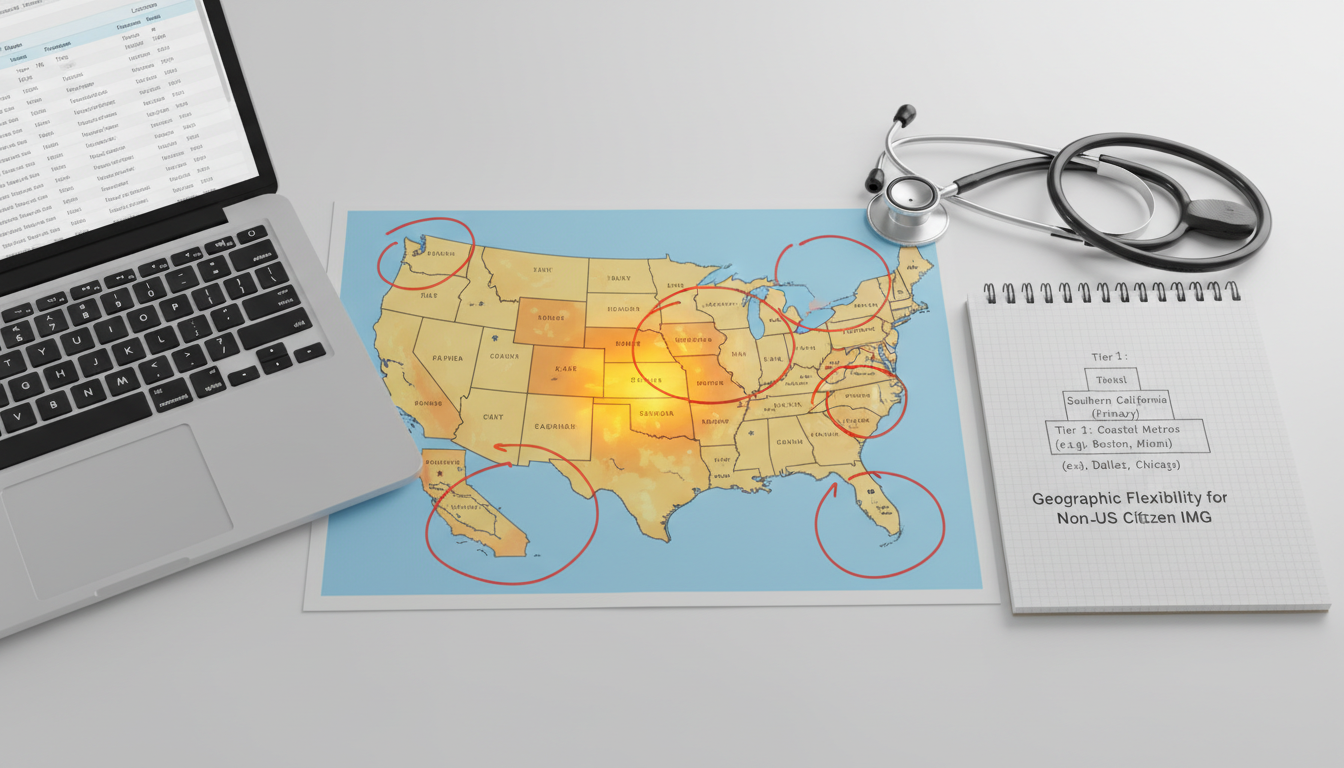
Design a Multi-Tier Geographic Strategy
A smart geographic preference residency strategy for a non‑US citizen IMG might look like this:
Tier 1: Core Target – Southern California
- Apply broadly to all visa-friendly programs in your specialty across:
- Greater Los Angeles (LA County, OC, San Fernando Valley, Long Beach)
- Inland Empire (Riverside, San Bernardino)
- San Diego
- Coachella Valley / desert programs (Palm Springs area)
Tier 2: Broader California & West Coast
- Northern California: Bay Area, Sacramento, Central Valley, coastal cities.
- Neighboring Western states with strong IMG presence and visa sponsorship:
- Nevada, Arizona, New Mexico, Oregon, Washington, Colorado.
Tier 3: Nationwide IMG-Friendly Programs
- Programs historically matching foreign national medical graduates.
- Institutions explicit about J‑1 or H‑1B sponsorship.
- Locations with lower cost of living and fewer geographic barriers.
This tiered structure lets you:
- Clearly favor SoCal.
- Demonstrate location flexibility match behavior.
- Protect yourself from an overly narrow approach.
Applying Smart: ERAS, Personal Statements, and Signaling Geographic Preferences
How you actually present your regional preferences in ERAS and related communications matters almost as much as your internal strategy.
Using the Personal Statement Strategically
For a non-US citizen IMG with a specific regional interest, you have three main options:
One universal personal statement
- Mentions an interest in training in diverse, urban/suburban settings like Southern California.
- Emphasizes your adaptability and openness to different practice environments.
- Works best if your SoCal ties are moderate rather than profound.
Two personal statements
- SoCal-focused version: Sent to Southern California programs (and possibly other California/West Coast programs).
- National version: Emphasizes broad geographic flexibility, adaptability, and eagerness to learn from different patient populations.
- Good if your SoCal interest/ties are strong but you don’t want to appear geographically rigid elsewhere.
Multi-regional statements (use sparingly)
- Examples: West Coast statement, East Coast statement.
- Risk: Complexity and potential for upload/misassignment errors.
- Best if you have truly distinct, meaningful ties to two major regions.
For most non-US citizen IMGs, Option 2 is the safest: one SoCal-focused statement and one broad-flexibility statement.
Key content to include for SoCal programs:
- Specific SoCal experiences or mentors.
- What you’ve learned from the region’s patient population.
- Long-term career goals that realistically connect to staying in or returning to Southern California.
Key content to emphasize for non-SoCal programs:
- History of adapting to new countries/cultures.
- Willingness to commit fully to any program that invests in you.
- Appreciation for a wide range of practice environments (urban, suburban, or even semi-rural, as appropriate).
Handling “Geographic Preferences” Questions
Programs may ask directly:
- “Do you have a geographic preference?”
- “Where else are you applying besides Southern California?”
- “Would you be willing to move out of state?”
A strong answer for a non-US citizen IMG might:
- Affirm your primary interest:
- “My top preference is Southern California because of [specific reasons].”
- Acknowledge professional flexibility:
- “At the same time, my priority is excellent training and a team that supports visa sponsorship and international graduates.”
- Highlight readiness to commit:
- “Wherever I match, I plan to move fully, integrate into the community, and stay for the full length of training and beyond if possible.”
Avoid extremes:
- Don’t say: “Only LA or I won’t be happy.”
- Don’t over-correct: “I have no preference, anywhere is fine,” while your ERAS clearly shows 90% SoCal applications.
How to Address Geographic Preference in Emails and Letters
When updating programs, especially those outside Southern California:
Example language for a non‑SoCal program
“I want to emphasize that although my initial application shows a strong focus on California, I am genuinely interested in training at your program. As a non-US citizen IMG, I deeply value programs that support international graduates, and I would be fully committed to relocating and building my professional and personal life in your region.”
This balances honesty about your SoCal focus with clear, sincere openness.
Visa Sponsorship, Immigration, and Geographic Decisions
For the foreign national medical graduate, visa issues and geography are tightly linked. Programs vary widely in how comfortable they are sponsoring non‑US citizens, and certain states/regions have more experience with IMGs and visas than others.
J‑1 vs H‑1B: Geographic and Strategic Implications
J‑1 visa (ECFMG-sponsored)
- Most common for residency.
- Available in nearly all IMG-friendly programs.
- After training, requires a waiver (usually serving in an underserved area) if you want to stay in the US.
- Waiver opportunities sometimes cluster outside major urban coastal centers, including many non-SoCal regions.
H‑1B visa
- Less common, more complex for programs (cost, paperwork, cap considerations).
- Some Southern California residency programs explicitly do not sponsor H‑1B.
- Programs that do sponsor H‑1B may:
- Prefer candidates with Step 3 passed.
- Have stricter requirements for visa transitions.
When you combine visa needs with Southern California residency plans:
- Some SoCal programs, especially university or county-based, are J‑1 friendly but may not offer H‑1B.
- If you absolutely need H‑1B, your location flexibility match strategy must broaden further, since the pool of programs shrinks.
Communicating Visa Needs Without Limiting Yourself
In ERAS and email communications:
- Be clear and accurate about your current status and needs.
- Avoid unnecessary restrictions like “I will only accept H‑1B” unless absolutely required.
- Demonstrate basic understanding of the process (e.g., having already passed Step 3 if aiming for H‑1B).
If targeting SoCal but open nationwide, you might say in an email or interview:
“I am eligible for J‑1 sponsorship and would be grateful for a J‑1 or H‑1B opportunity. My priority is strong training in an environment supportive of international graduates; I’m flexible regarding visa type as long as I can complete my residency and continue my career pathway in the US.”
This signals both realism and flexibility, which programs appreciate.

Balancing Southern California Ambition with Match Safety
You can be ambitious about SoCal and still be safe. The key question is numbers and distribution: how many programs you apply to, how they’re arranged geographically, and how that matches your competitiveness.
Assessing Your Competitiveness Honestly
Before setting a SoCal-heavy strategy, consider:
- USMLE/Step scores (or equivalent) relative to your specialty norms.
- Number and quality of US clinical experiences.
- Strength of letters of recommendation (US vs international referees).
- Gaps in training or red flags.
- Previous match cycles, if applicable.
In highly competitive specialties (Derm, Ortho, Plastics, etc.), even US graduates struggle to match in SoCal. For a non-US citizen IMG, consider:
- A transitional/preliminary year.
- Broader geography from the start.
- Parallel planning (e.g., Internal Medicine or Family Medicine as a secondary path).
In moderately competitive specialties (Internal Medicine, Pediatrics, Family Medicine, Psychiatry):
- SoCal is still very competitive, but broader West Coast and other states may have significantly more IMG-friendly options.
Example Application Distributions
These are illustrative, not prescriptive, but they show how location flexibility can look in practice.
Case A: Moderately competitive non‑US IMG in Internal Medicine
- 25–30 SoCal programs that sponsor J‑1.
- 20–25 additional California/West Coast programs (Northern CA, Nevada, Arizona, Oregon, Washington).
- 30–40 IMG-friendly programs distributed across the Midwest, South, and Northeast that are J‑1 friendly.
Case B: Strong non‑US IMG in Family Medicine with California ties
- 20 SoCal FM programs.
- 15 elsewhere in California.
- 20 West/Mountain states.
- 15–20 in other regions known for diverse patient populations.
This spread:
- Supports your SoCal ambition.
- Shows regional preference strategy rather than regional blindness.
- Creates enough national reach to protect you from regional bottlenecks.
Interview Acceptance and Ranking Strategy
When interviews arrive:
- Accept broadly at first, especially if you’re non-US citizen IMG with limited interview numbers.
- Track interview offers by region; if you’re getting plenty in a certain area, you can selectively decline later.
- Avoid mass-declining non-SoCal interviews early just because you’re hoping for more LA/San Diego invitations; that’s risky.
At rank-list time:
- Rank programs by fit and training quality first, then by location.
- It’s acceptable to rank SoCal programs at the top if they fit well.
- Still rank all other programs where you’d realistically go and complete training. Even a non-SoCal program is far better than not matching.
Leveraging SoCal and Non-SoCal Experiences to Show Flexibility
Even if you’ve never lived in Southern California, you can still build a strong narrative that combines regional interest with geographic adaptability.
Building SoCal-Relevant Experiences from Abroad
From your home country or current location, you can:
- Join telehealth or remote research projects with faculty from California institutions.
- Participate in public health work related to:
- Migrant or refugee populations similar to those in Southern California.
- Urban underserved communities.
- Learn Spanish or another language commonly spoken in SoCal communities, and actively use it in patient care.
- Attend virtual grand rounds or conferences hosted by California medical centers.
You can then say in your application:
“Although I have not yet lived in Southern California, I have intentionally developed experience caring for Spanish-speaking and migrant populations similar to those in your region. I believe this preparation will help me contribute meaningfully from day one.”
Showing True Location Flexibility Through Your Track Record
Programs look at your history as a predictor of future adaptability. Highlight:
- Times you moved to a new country or region for training and integrated successfully.
- Work in rural or semi-urban areas in your home country.
- Volunteer experience in different cultural or geographic contexts.
For example, in an interview:
“I grew up in [Country A], studied in [Country B], and completed clerkships in [Country C]. Each move required me to adapt to different health systems and cultures. That experience gives me confidence that I can thrive whether I train in Southern California or in another US region.”
This reassures programs that your SoCal interest is not equal to SoCal dependency.
Frequently Asked Questions (FAQ)
1. If Southern California is my top choice, will applying broadly to other regions hurt my chances in SoCal?
No. Programs cannot see where else you applied, only where you interview and how you interact with them. Applying broadly actually makes you look more realistic and mature. Your SoCal chances depend far more on your fit, credentials, and how convincingly you express your interest in the region than on whether you also applied to the Midwest or East Coast.
What can hurt you is inconsistency—for example, telling a SoCal program, “I will only consider living in Southern California,” while your rank list or communications suggest otherwise. Emphasize that SoCal is your preference but not your only acceptable option.
2. As a non-US citizen IMG, should I insist on H‑1B if I eventually want a green card?
Usually, no. Insisting on H‑1B can severely restrict the number of programs willing to sponsor you, especially in popular regions like Southern California. For most foreign national medical graduates, it’s wiser to:
- Be open to J‑1, which is more widely accepted.
- Focus on excellent training and building a strong CV.
- Later, pursue a J‑1 waiver job in a region with available positions, often outside major urban centers.
If you have compelling reasons for H‑1B only, discuss them with an immigration attorney before setting that as a strict condition.
3. How many Southern California programs should I apply to if it’s my dream region?
Apply to all realistic, visa-sponsoring programs in Southern California that fit your specialty and training level, as long as:
- You meet their basic requirements.
- They are IMG-friendly or at least not explicitly IMG-averse.
However, do not only apply there. Even a strong non-US citizen IMG should treat SoCal as part of a broad pool, not the entire strategy. Use SoCal as Tier 1 but ensure robust Tiers 2 and 3 in your application list.
4. Will programs outside Southern California see me as a “flight risk” if I talk about my SoCal preference?
They might, if you frame it poorly. To avoid that:
- Emphasize that your primary priority is training quality and visa support.
- Frame SoCal as one attractive region among several, not an all-or-nothing choice.
- In emails or interviews, explicitly say that you would be fully committed to their program and community if matched there.
For example:
“Southern California is one region I’m interested in because of its diversity and family connections, but I’m genuinely open to building my career wherever I can receive strong training and contribute to the community. If I’m fortunate enough to match at your program, I would plan to fully relocate and commit to your region.”
This balances honesty with the geographic flexibility programs want to see.
By understanding how programs interpret geographic signals, aligning your SoCal medical training ambitions with a realistic location flexibility match plan, and communicating consistently, you can be both strategic and authentic. As a non-US citizen IMG, your path may be more complicated, but with a thoughtful regional preference strategy, you can dramatically increase your chances of matching—and thriving—whether in Southern California or beyond.