
Understanding Geographic Flexibility as a US Citizen IMG
For a US citizen IMG, where you are willing to train can matter almost as much as who you are as an applicant. Program directors consistently say that one of the strongest differentiators between similar candidates is geographic preference and flexibility.
Geographic flexibility is not about “being willing to go anywhere at any cost.” It’s about:
- Knowing your own priorities and constraints
- Understanding how regional dynamics influence the match
- Presenting your preferences strategically in ERAS and interviews
- Using flexibility to expand your opportunities without sabotaging your personal life or long-term goals
As an American studying abroad, you already face specific challenges: visa is not your issue, but clinical exposure, distance, and program familiarity are. Your geographic preference residency strategy can directly offset some of these disadvantages—if you plan it deliberately.
This article breaks down how to think about location, how to balance flexibility with genuine preferences, and how to communicate that effectively during the residency match process.
Step 1: Clarify Your True Geographic Priorities
Before creating any “regional preference strategy,” you need to understand what you actually want and what you truly can flex on. Many US citizen IMGs say “I’m willing to go anywhere” but then only apply in two or three popular metro areas—or only rank programs within driving distance of family. That inconsistency is obvious to program directors.
Identify Your Non‑Negotiables vs. Preferences
Make two columns:
Non‑negotiables (must-have or cannot‑have) might include:
- Must be within X hours of a specific family member (e.g., medically fragile parent, children, spouse)
- Cannot live in locations with severe weather (e.g., strong medical reason, safety concerns)
- Must be in a state where your spouse has realistic employment prospects or appropriate licensure
- Need a certain cost-of-living range because of existing financial obligations (e.g., large loans, dependents)
Preferences (nice-to-have, flexible) might include:
- Urban vs. suburban vs. rural setting
- Proximity to a major airport
- Climate (warm vs. cold)
- Coastal vs. inland
- Proximity to your medical school’s alumni network
- Being near friends or extended family (as opposed to dependent family)
The key is to be honest:
- If you say you’ll go anywhere but you know you will never seriously move to the Upper Midwest, you’re not actually flexible—you’re unstrategic.
- If you have constraints, acknowledge them early and plan around them.
Distinguish “Lifestyle Wishes” From Training Needs
Ask yourself:
- “Will this factor still matter 10 years from now?”
- “Does this factor meaningfully affect my ability to function well in residency?”
For example:
- “I really love beaches” = lifestyle wish
- “I don’t drive and will need reliable public transit to get to work safely at 4 AM” = training-related need
As a US citizen IMG, you often need to trade some lifestyle preferences for better match odds. Being clear on what is truly essential helps you decide when to flex and when to hold firm.
Step 2: Understand US Regional Dynamics for US Citizen IMGs
Geographic flexibility only has value if you understand where it can actually help you. Some regions are saturated and hyper-competitive; others are more open to IMGs and more likely to welcome a US citizen IMG who is location-flexible.
Broad Regional Categories and IMG Friendliness
While individual programs vary, the following broad patterns are common (and especially relevant for an American studying abroad):
1. Highly competitive, high-demand metro areas
- Examples: New York City’s top academic centers, Boston, San Francisco, LA, parts of Chicago, DC
- Features:
- Heavy volume of applicants
- Many US MD and DO applicants with strong home-field ties
- Some programs IMG-friendly, but typically more competitive overall
- Strategy:
- Use these areas selectively, not as the core of your application list
- Focus on IMG-friendly hospitals and community-based programs within these cities and nearby suburbs
2. Mid-Atlantic and Northeast non-major metros
- Examples: Pennsylvania (outside of Philly), New Jersey community programs, upstate New York, Connecticut, parts of Massachusetts outside Boston
- Features:
- Many IMGs, especially in internal medicine, family medicine, pediatrics
- Mix of academic community and community programs
- Strategy:
- Can form a strong regional anchor if you have ties (school, family, prior work)
- Show clear geographic preference residency signals in your application to stand out
3. Midwest
- Examples: Ohio, Michigan, Indiana, Wisconsin, Minnesota, Missouri, Iowa, Kansas
- Features:
- Many IMG-friendly programs, particularly community and regional academic centers
- Some locations are less popular with US grads, offering more room for flexible US citizen IMGs
- Strategy:
- If you are willing to embrace colder climates or smaller cities, the Midwest can dramatically improve your location flexibility match prospects
- Emphasize your genuine interest in the region’s training strengths (breadth of pathology, strong clinical autonomy)
4. South and Southeast
- Examples: Alabama, Mississippi, Georgia, the Carolinas (select areas), Louisiana, Tennessee, Kentucky, Arkansas
- Features:
- High patient volume, broad pathology, many community-based training programs
- Often more open to IMGs, especially in primary care and internal medicine
- Strategy:
- If you have flexibility here, highlight interest in underserved populations and high-volume training
- Use away rotations or observerships, if possible, to build regional ties
5. Mountain West and non-coastal West
- Examples: Colorado, Utah, Nevada, Arizona, New Mexico, Idaho, Montana, Wyoming
- Features:
- Fewer total programs, but some are IMG-friendly depending on specialty
- Many programs prize applicants who commit to the region and its lifestyle
- Strategy:
- If the outdoors / smaller cities appeal to you, this can be a powerful niche
- Demonstrate long-term regional interest (joining state medical societies, targeted PS, etc.)
6. Texas and California (special considerations)
- Texas
- Uses ERAS but has its own separate match system (NRMP + NRMP-like TMDSAS for some schools)
- Many programs, some very IMG-friendly, but some strongly prioritize Texas ties
- California
- High demand, limited positions, extremely competitive in many specialties
- Some IMG-friendly community programs, but overall difficult for IMGs, including US citizen IMG applicants
How This Translates to Strategy
As a US citizen IMG, your competitive advantage often comes from being open to:
- Less glamorous locations (rural/smaller cities)
- Regions with fewer US MD applicants but strong clinical training
- States with many IMG physicians already practicing (demonstrating a known pathway)
Use this to create a tiered regional plan:
Tier 1: High realism + high interest
“Regions I like and that clearly like IMGs”
(e.g., Midwest community programs, Northeast community IM programs)Tier 2: Moderate realism + high interest
“More competitive regions where I have ties or niche strengths”
(e.g., NYC area if you did US clinical experience there)Tier 3: High realism + moderate interest
“Regions I’m willing to move to for strong training, but not my dream lifestyle”
This tier is often where matches actually happen for location-flexible IMGs.
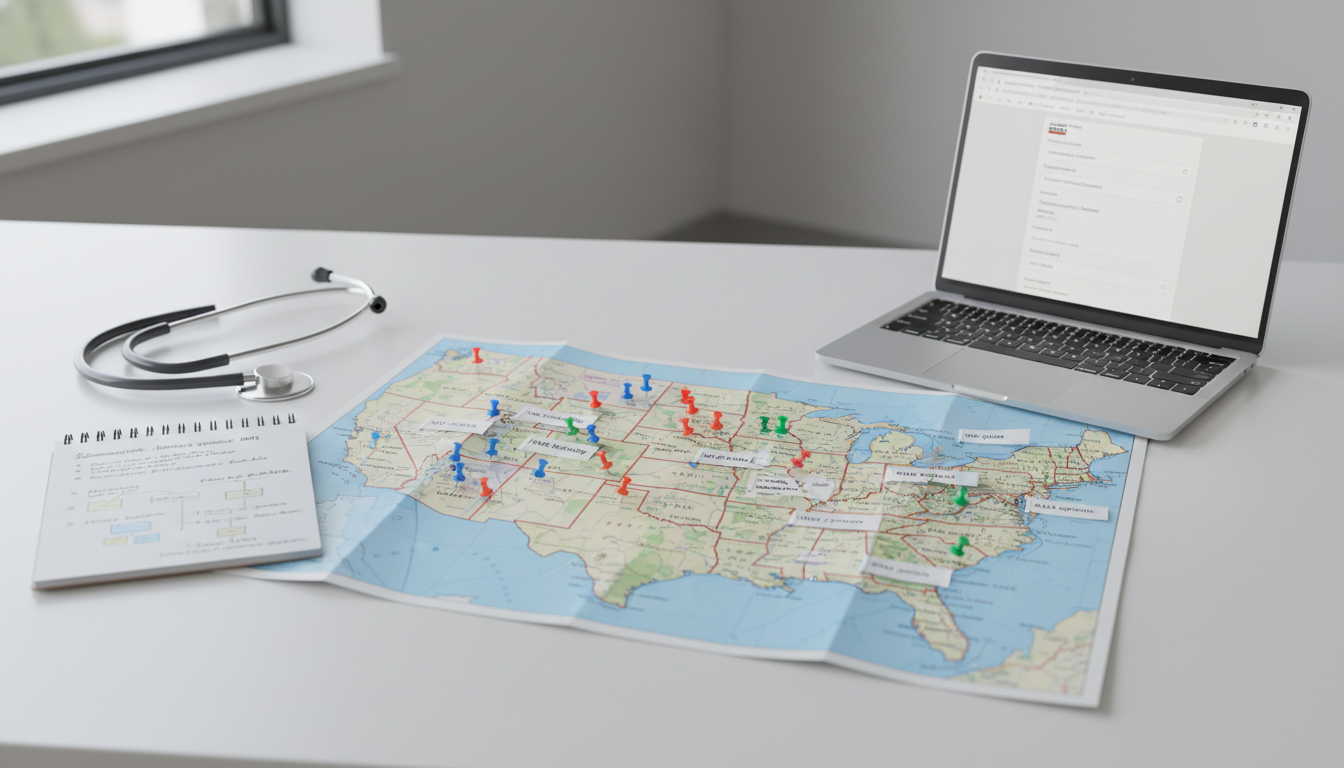
Step 3: Designing a Regional Preference Strategy
Once you understand the landscape, your regional preference strategy becomes a deliberate plan answering:
- Where will I apply heavily?
- Where will I apply selectively?
- Where will I not apply, even if “I’ll go anywhere” sounds good on paper?
Building a Smart Application Map
For each specialty, think in terms of clusters rather than isolated programs.
Example (Internal Medicine, average US citizen IMG profile):
- 4–5 Northeast states with many IMGs (e.g., NY, NJ, PA, CT)
- 4–5 Midwest states with IMG-friendly programs (e.g., OH, MI, IN, MO)
- 3–4 Southern states with strong IM/primary care training (e.g., GA, AL, TN)
- 1–2 “stretch” metro regions where you have strong personal ties (e.g., Boston because your spouse lives there)
Within each cluster:
- Identify IMG-friendly programs (historical matches, website language, current residents’ medical schools)
- Include a mix of:
- Community programs
- Community-based academic programs
- A few academic centers (if your metrics support it)
Aligning Number of Applications With Geographic Flexibility
The more restrictive your location, the more applications you often need to compensate—but only within that geography. Conversely, the more you expand your geography intelligently, the more you can reach a reasonable application volume without burning money on hopeless choices.
For example:
- An IMG who insists on only Southern California might apply to 80+ programs and still get few interviews.
- A similar applicant who targets CA + Southwest + Midwest with a well-researched mix may apply to 80 programs as well but have far better odds because they’ve embraced true location flexibility.
Special Case: Couples Matching as a US Citizen IMG
If you are couples matching (with another IMG, DO, or MD), geographic flexibility becomes even more critical:
- Favor regions with dense clusters of multiple programs within commuting distance (e.g., NYC metro, Philly, Chicago, parts of Texas).
- Consider overlapping specialties or slightly broader specialty choices to maximize the number of reasonable pairings.
- Use a shared map/spreadsheet to identify zip codes or cities that host multiple programs for each partner.
Step 4: Communicating Geographic Preference Strategically
Having a good location flexibility match plan is only half the job; you must communicate it to programs in a way that is believable and aligned with your application actions.
Use ERAS Signaling Tools Carefully
The rules around signaling and geographic signaling have been evolving. Where available (and always check the current ERAS guidelines for your cycle):
If you can signal geographic preference, do so truthfully and strategically:
- Prioritize regions where you are truly willing to move and stay for 3+ years
- Avoid signaling a region you barely applied to—programs will see the mismatch
If you must rank regions (e.g., Northeast > Midwest > South):
- Don’t claim the Northeast if 80% of your applications are in the South and Midwest; that inconsistency weakens trust.
Tailor Your Personal Statement and Experiences
You do not need a different personal statement for every state, but for some key geographic clusters it can be helpful to have a slightly tailored version, for example:
- A version highlighting your desire to serve rural or semi-rural populations if applying heavily to the Midwest or South
- A version referencing prior clinical or life experience in a specific region (e.g., “Having grown up in New Jersey and completed several observerships in the New York metro area…”)
Also:
- Highlight US clinical experience done in your target regions.
- Mention prior long-term residence, college, prior work, or family ties in those areas.
- Show a future orientation: “I envision building a long-term career in the Midwest, where I can practice broad-scope internal medicine…”
Interview Day: How to Talk About Location
During interviews, programs will often ask:
- “Why our city/state/region?”
- “Do you have any ties to this area?”
- “Can you picture yourself living here for 3+ years?”
For a US citizen IMG, strong answers might include:
Ties-based answer:
“I grew up in Pennsylvania and went to college here before medical school abroad. My family is still in this region, and I’d really value training in a system and community I know well.”Interest-based answer (no strong ties):
“Although I don’t have family here, I’m very drawn to training in the Midwest. I’m looking for a program with broad clinical exposure and strong continuity clinics, where I can really get to know a community over time. The patient population and collegial culture I’ve seen here match what I’m seeking.”
Avoid:
- Overly generic statements: “I’m open to anywhere.”
- Comments that sound like you are settling for their region: “Well, I guess I could live here for three years.”
- Overstating connections that don’t exist; program directors have good radar for this.

Step 5: Balancing Flexibility With Your Personal Life and Well-Being
Being a US citizen IMG doesn’t mean you must sacrifice every personal preference. The goal is sustainable flexibility—a location where you can function, grow, and complete training successfully.
Consider Support Systems Beyond Family Proximity
Even if you move far from home, you can still build a support network:
- Resident community: Programs with strong camaraderie can significantly soften the impact of distance.
- Cultural/community organizations: Faith communities, cultural associations, or language-based groups in your new city.
- Medical school alumni: Other US citizen IMGs from your school who matched in the same region.
When assessing programs, ask:
- “How do residents typically spend time outside of work?”
- “Do many residents come from out of state or internationally? How does the program support their transition?”
Handling Long-Distance Relationships or Family Obligations
Be realistic about:
- Time zone differences
- Cost and frequency of travel
- Call schedules and weekend work
If you have significant family obligations (e.g., caregiving for a parent), recognize that geographic preference residency choices are partly about safety and feasibility, not just lifestyle. In such cases:
- Focus more heavily on your home region + surrounding drivable states
- Offset the narrower geography by:
- Broadening your specialty choices (if possible)
- Applying more broadly within that constrained region (community and academic, big and small cities)
- Strengthening every other part of your application
Common Mistakes US Citizen IMGs Make With Geographic Flexibility
Avoiding a few recurring pitfalls can significantly improve your match chances.
Mistake 1: Saying “Anywhere” but Behaving “Selective”
- Application list is 90% coastal major metros
- No applications in rural or smaller cities despite claiming full flexibility
- No evidence of interest in regions with many IMG opportunities
Fix: Make sure your application map reflects what you say in your personal statement and interviews.
Mistake 2: Ignoring IMG-Friendly Regions Due to Perception
Some US citizen IMGs hesitate to apply to the Midwest or South because of:
- Weather stereotypes
- Assumptions about lifestyle or culture
- Desire to be near large coastal immigrant communities only
Fix: Talk to residents who actually live and train in those regions. Many discover that:
- Cost of living is lower
- Community is welcoming
- Clinical experience is excellent and marketable nationwide after graduation
Mistake 3: Overconcentrating in One “Dream” City
Putting 40 of your 70 applications in one metro area (e.g., NYC, LA):
- Makes you vulnerable if that city’s program pool is not favorable to your profile
- Signals to other regions that you’re not truly interested in them
Fix: For every “dream city,” balance your list with multiple realistic clusters elsewhere.
Mistake 4: Failing to Use Ties and Experiences Effectively
You may have:
- Gone to undergrad in one region
- Completed observerships in another
- Have extended family in a third
If none of that appears in your application or interview answers, programs may assume you’re drifting rather than choosing their region.
Fix:
Explicitly mention:
- “Having completed clinical experiences in X state…”
- “After spending four years in Y city during college, I can see myself returning here long term…”
Putting It All Together: A Sample Geographic Strategy for a US Citizen IMG
Imagine you’re an American studying abroad in the Caribbean, applying to Internal Medicine, with:
- Step scores around the national average
- Several US clinical experiences in New Jersey and Ohio
- No strong family obligations tying you to one state
A coherent location flexibility match strategy might look like this:
Primary regions (heaviest applications):
- Northeast (NY, NJ, PA, CT) focusing on IMG-friendly community and community-based academic programs
- Midwest (OH, MI, IN, MO) leveraging your Ohio rotations as proof of regional familiarity
Secondary regions (moderate volume):
- South/Southeast (GA, AL, TN, NC) with interest in high-volume training and underserved populations
Selective regions (few targeted applications):
- 5–10 carefully chosen programs in NYC/Philly where you completed clinical experience or have tangible connections
- 3–5 programs in a “lifestyle interest” region like Colorado or Arizona where you’d genuinely be happy to live
Communications strategy:
- Personal statement version 1: emphasizes Northeast + Midwest ties and interest in training in those regions
- Personal statement version 2: used for Southern programs, highlighting willingness to serve underserved communities and value of high-volume training
- In interviews:
- For Midwest programs, discuss your Ohio experience and comfort with the region’s climate and lifestyle
- For Southern programs, discuss commitment to long-term primary care and comfort in smaller cities
Ranking strategy:
- Rank programs first by training quality + fit, then by geography
- Be honest: if you would truly not move to a certain region, don’t rank programs there, no matter how name-brand they are
This approach balances:
- Genuine preferences
- Image as a location-flexible but intentional US citizen IMG
- Attention to program directors’ need for residents likely to stay, thrive, and complete their training
FAQs: Geographic Flexibility for US Citizen IMGs
1. As a US citizen IMG, do I really need to be geographically flexible to match?
You don’t have to be flexible, but flexibility significantly improves your odds, especially in competitive specialties or with average scores. If you have strong ties or obligations to one region, you can still match, but you must:
- Apply very broadly within that region
- Consider slightly less competitive specialties or program types
- Strengthen other aspects of your application (US clinical experience, letters, research if relevant)
2. How many regions should I target in my application?
Most US citizen IMGs do well with 3–5 regions, grouped as:
- 1–2 primary regions where they have ties or prior experience
- 1–2 additional regions known to be IMG-friendly (often Midwest or parts of the South)
- 1–2 selective “stretch” or lifestyle regions
More than 5 regions can dilute your strategy; fewer than 3 may overly restrict your chances unless you’re very competitive.
3. How do I show geographic preference without sounding desperate?
Focus on:
- Specific reasons you’re drawn to the region (training style, patient population, culture, cost of living)
- Concrete experiences you’ve had there (rotations, schooling, family, previous work)
- A future-oriented plan (“I can see myself practicing long term in this region because…”)
Avoid:
- Over-the-top flattery
- Claims of “this is my absolute dream program” for every interview
- Contradictions between your words and your actual application map
4. If I change my mind about location during the season, what can I do?
You can:
- Add programs in ERAS (within deadlines) in your newly preferred regions
- Adjust your rank list to reflect updated preferences
- Use the interview season to gather more data about lifestyle, program fit, and support systems
What you cannot do late in the season is fully redo your regional application distribution. That’s why initial planning is so important. Still, even late-stage adjustments in ranking can make a meaningful difference in where you end up.
By treating geography as a strategic tool—not just a wish list—you can turn your status as a US citizen IMG into a strength. Thoughtful geographic flexibility allows you to access a broader set of programs, demonstrate maturity and realism, and ultimately find a residency where you can both match successfully and thrive.