
Understanding Geographic Flexibility as a US Citizen IMG
For a US citizen IMG or American studying abroad, “geographic flexibility” is one of the most powerful—and most misunderstood—tools you have in the Match. When you’re based in or near Cleveland, it’s natural to focus on Cleveland residency programs and major academic centers like Cleveland Clinic residency options. But limiting yourself too tightly to one city or region can dramatically reduce your chances of matching.
Geographic flexibility is the deliberate, strategic decision to consider—and genuinely be willing to train in—a wider range of locations than your first choice. For US citizen IMGs, this is rarely optional; it’s often essential.
In this guide, we’ll break down:
- What geographic flexibility really means
- How to balance a Cleveland focus with realistic location flexibility in the Match
- How programs interpret your geographic preferences
- How to build a smart regional preference strategy
- Practical steps for deciding where you truly are willing to train
Throughout, we’ll use examples anchored in Cleveland and the surrounding Midwest to make this concrete for you.
Why Geographic Flexibility Matters So Much for US Citizen IMGs
The competitive reality for US citizen IMGs
As a US citizen IMG, you’re in an in‑between space:
- You do not face visa sponsorship barriers.
- You do face the same “IMG” label that affects interview and rank decisions.
Programs commonly prioritize:
- US MD seniors
- US DO seniors
- US citizen IMGs
- Non‑US citizen IMGs needing visas
You have an advantage over non‑US citizen IMGs but are still competing uphill against US MD/DO seniors—especially at well‑known Cleveland residency programs (Cleveland Clinic, UH, MetroHealth, VA, academic affiliates, etc.).
Geographic flexibility gives you more shots on goal. It widens the set of programs that:
- Will review your application seriously
- Are more likely to interview you
- May have fewer US MD/DO applicants in their preferred geographic area
Why “Cleveland only” is risky
Many American students studying abroad who grew up in Ohio or the Midwest hope to “come home” immediately, often with a narrow list such as:
- Cleveland Clinic residency programs
- University Hospitals (UH) Cleveland
- MetroHealth
- A few other Ohio academic centers
The problem: these are highly competitive and heavily targeted by US MD and DO students with strong local ties, home‑school pipelines, and established audition rotations.
If you apply only to a small collection of major Cleveland programs, you risk:
- Too few interviews
- An over‑reliance on a single city or handful of hospitals
- A higher probability of going unmatched despite being otherwise competitive
Geographic flexibility allows you to:
- Treat Cleveland as a priority, not a restriction
- Build a safer, more diverse list across multiple states and regions
- Use other locations as stepping stones for future moves back to Ohio
Balancing a Cleveland Focus with Realistic Flexibility

Step 1: Define your “anchor region”
For you, Cleveland and Northeast Ohio are likely your anchor region—the area where you have:
- Family support or personal roots
- Established social and professional networks
- Clear understanding of cost of living, lifestyle, and climate
This anchor region can legitimately be:
- Your top preference, and
- The center of your geographic story in your personal statement and interviews
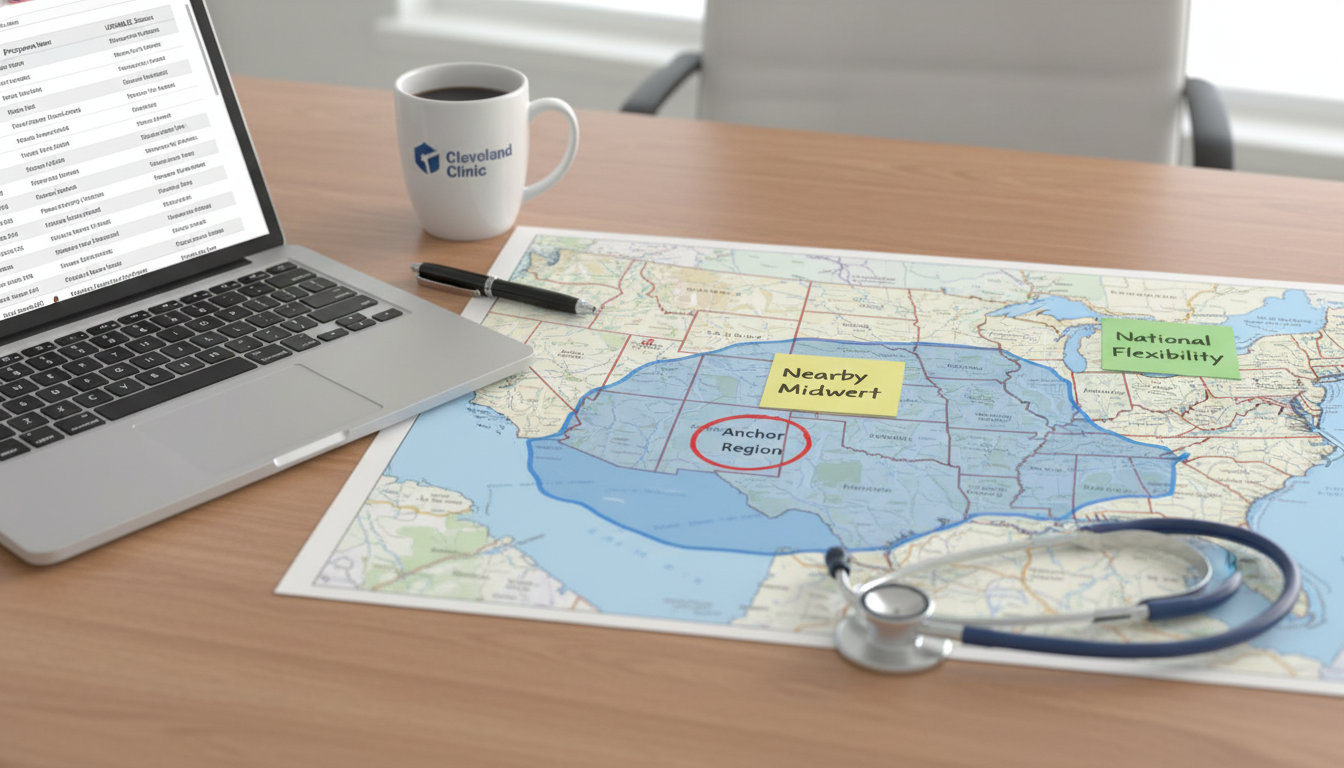
But it should not be the only area on your list. Instead, think of Cleveland as your home base, with concentric circles of flexibility radiating outward.
Step 2: Build concentric circles of geographic flexibility
Imagine your preferences as circles expanding outward from Cleveland:
Circle 1 – Local/Metro Cleveland
- Cleveland Clinic residency programs
- University Hospitals Cleveland Medical Center
- MetroHealth System
- VA Northeast Ohio and affiliated community sites
Circle 2 – Broader Ohio / Nearby States
- Other Ohio cities: Columbus, Cincinnati, Toledo, Dayton, Akron, Youngstown
- Nearby states with similar Midwest culture:
- Pennsylvania (Pittsburgh, Erie)
- Michigan (Detroit, Grand Rapids, Lansing)
- Indiana (Indianapolis, Fort Wayne)
- Western New York (Buffalo, Rochester)
Circle 3 – Midwest and Great Lakes
- Illinois (Chicago suburbs, Peoria, Rockford, Springfield)
- Wisconsin, Minnesota, Iowa, Missouri
- Other Great Lakes areas with similar patient populations and climate
Circle 4 – National but Rational
- Regions you could genuinely imagine living in:
- Southeast (Carolinas, Georgia, parts of Florida)
- Some Southwest or Mountain states
- Focus on cities with:
- Manageable cost of living
- Solid IM or FM community programs
- Historically IMG‑friendly track records
- Regions you could genuinely imagine living in:
By mapping these circles, you turn “I prefer Cleveland” into a structured regional preference strategy rather than a hard constraint.
Step 3: Separate emotional preference from match reality
Ask yourself honestly:
- “If I only match in Cleveland, am I okay with the significant risk of going unmatched?”
- “Would I truly rather go unmatched than train in, for example, a solid community program in Pennsylvania or Michigan?”
For most US citizen IMGs, the rational answer is:
“Cleveland is my top choice, but matching somewhere is more important than matching only in Cleveland.”
Once you accept that, your geographic flexibility becomes a strength, not a compromise.
How Programs View Geographic Preference and Flexibility
What “geographic preference” signals to programs
Programs interpret your geographic preference as a proxy for:
- Likelihood you will rank them highly
- Likelihood you will stay for the full program
- Fit with their patient population and culture
If your application clearly communicates that you prefer the Midwest and have roots in Ohio, then:
- Cleveland residency programs may see you as a strong fit
- Regional programs in Ohio, Pennsylvania, Michigan, or Indiana may view you favorably, assuming you’ll adapt well and be likely to stay
Avoiding the “too narrow” signal
If you mention only Cleveland (or only “Cleveland Clinic residency” by name) in your personal statement, yet you also apply to Illinois, Iowa, or Georgia, you might unintentionally signal:
- You’re applying broadly but not genuinely interested in those other locations
- You may rank them lower or be at risk for attrition if you match there
Programs want residents who want to be there, not who are simply “falling back” on them.
A better framing in your materials is:
- Emphasize Midwest roots or Great Lakes familiarity
- Mention Cleveland as your home base
- Express openness to “other Midwest and Great Lakes cities with similar patient populations and training environments”
This way, you signal a regional preference without closing the door on nearby states or cities.
How geographic preference appears in ERAS and interviews
You show geographic preference and location flexibility in several ways:
ERAS application:
- Home address (if in Ohio/Cleveland)
- Where you completed US clinical experience (Cleveland vs. other regions)
- Personal statement content about roots and preferences
- Program signals (in some specialties)
Interviews:
- Your answers to “Why our city/region?”
- How you explain your ties to the Midwest or to Cleveland
- Whether your narrative about location is coherent across interviews
Programs expect you to have some preferences. The key is to:
- Be honest
- Show that your interest in their region is authentic
- Avoid statements like “I’m only interested in Cleveland” if you are interviewing elsewhere
Crafting a Smart Regional Preference Strategy from Cleveland
1. Start with your anchor story: Cleveland and the Midwest
As an American studying abroad with roots in or near Cleveland, you can build a strong anchor story:
- You grew up in Northeast Ohio or nearby
- Your family is in the region
- You did high school, undergrad, or clinical work in/around Cleveland
- You understand the urban‑suburban mix, industrial history, and health disparities common in the Great Lakes region
In your personal statement and interviews, you might say:
“Having grown up in Northeast Ohio and completed clinical rotations in Cleveland, I feel a strong connection to the patient populations and health systems in the Great Lakes region. While Cleveland is home for me, I am equally enthusiastic about training anywhere in the Midwest where I can care for similar communities and receive strong clinical training.”
This frames you as:
- Genuinely committed to Cleveland
- Realistically open to a broader Midwest footprint
2. Build a tiered program list
Use your concentric circles to develop tiers:
Tier A – High aspiration / Home base (Cleveland and major Ohio centers)
Examples include:
- Cleveland Clinic residency programs (IM, FM, neuro, etc.)
- UH Cleveland Medical Center
- MetroHealth / Case Western–affiliated programs
- OSU, University of Cincinnati, other large Ohio academic centers
These are often competitive, so they should be part of your list, not the entire list.
Tier B – Strong academic and community programs in nearby states
Focus on:
- University‑affiliated community programs in:
- Pennsylvania (UPMC community hospitals, Geisinger sites, etc.)
- Michigan, Indiana, Western New York
- Community‑based programs with a history of IMGs and strong board pass rates
These programs may be more accessible to a US citizen IMG while still keeping you within a day’s drive of Cleveland.
Tier C – IMG‑friendly programs nationwide that fit your profile
Look for:
- Places with:
- High IMG percentages historically
- Reasonable workload and supportive culture
- Acceptable board pass and fellowship match outcomes
- Cities where you could realistically live for 3+ years, even if they are far from Cleveland
Here is where your location flexibility match strategy comes into play. You aren’t just applying “anywhere”—you’re prioritizing places that are:
- Realistic
- Training‑solid
- Personally tolerable or even appealing
3. Use data to refine your geographic strategy
To inform your regional preference strategy, use:
NRMP data:
- Specialty‑specific outcomes for US citizen IMGs
- Average number of programs ranked, match rates, etc.
Program websites & FREIDA:
- Proportion of IMGs
- Geographic distribution of current residents
- Where residents come from (any from your school or similar schools?)
Networking:
- Alumni from your Caribbean or international school who matched in or near Cleveland
- Residents at Cleveland programs you met during rotations
- Faculty advisors with knowledge of Midwest programs
This helps you identify:
- Which regions are more receptive to IMGs
- Which programs outside Cleveland have a realistic track record of taking people like you
4. Be consistent with your story across programs
Whether you’re talking to a Cleveland Clinic residency faculty member or a community program director in Pennsylvania, your story should be coherent:
- Emphasize your anchor: roots in Cleveland / Midwest
- Express authentic interest in their specific city
- E.g., “I’ve spent most of my life in the Great Lakes region, and I see many parallels between Cleveland and your patient population.”
- Convey long‑term commitment to caring for similar communities, even if you’re temporarily farther from home
Practical Tips to Demonstrate Geographic Flexibility Without Seeming Aimless
1. Tailor, don’t copy‑paste, your “Why here?” answers
For each interview, prepare:
- 2–3 city‑specific reasons (cost of living, diversity, family proximity, professional opportunities)
- 2–3 program‑specific reasons (curriculum, patient population, fellowship pathways, program structure)
If you’re applying broadly, you can still keep a theme, such as:
“I’m drawn to cities with a strong sense of community and a diverse patient base, similar to what I experienced in Cleveland. Your program’s patient population and dedication to underserved care align with that.”
This shows coherent values rather than random geographic scattering.
2. Be honest about long‑term plans
If your long‑term goal is to settle in Cleveland or Ohio, you can say so—carefully:
- In Cleveland and Ohio programs:
- You can openly say you hope to practice there long‑term
- In other Midwest or national programs:
- Emphasize that your long‑term home might be Ohio, but you are fully committed to training and building relationships in their region for the duration of residency
A balanced phrasing:
“My long‑term goal is to practice in the Great Lakes region, ideally near Cleveland where my family is. But I strongly believe that excellent training can happen in many places, and I’m excited about the opportunity to become part of your community during residency.”
3. Avoid over‑declaring regional ties you don’t truly have
Don’t manufacture connections you can’t back up. Programs can see through vague statements like:
“I’ve always dreamed of living in [random distant city].”
Better:
- Admit when a place is new to you
- Focus on what authentically appeals to you:
- Program structure
- City size
- Affordable living
- Opportunity for procedural volume, etc.
Programs appreciate sincerity and maturity more than forced enthusiasm.
4. Use your Cleveland experiences as a transferable asset
If you’ve rotated or lived in Cleveland, you’ve seen:
- Complex urban pathology
- Chronic disease in underserved populations
- Multidisciplinary academic care
You can leverage this even in distant regions:
“My rotations in Cleveland exposed me to high‑acuity patients and complex chronic disease management in underserved populations. I’m looking forward to applying those skills in a similar context here, where patients face comparable access and socioeconomic challenges.”
You are not “starting over” in a new city; you’re transferring a skill set developed in Cleveland.
Making a Personal Decision: How Flexible Should You Be?
Geographic flexibility is not an all‑or‑nothing decision. You need a structured process to decide your own comfort zone.
Step 1: Set your non‑negotiables
List the factors that truly matter for your well‑being:
- Absolute “no” locations (certain climates, prohibitively expensive cities, etc.)
- Family or caregiving responsibilities that anchor you near Cleveland or the Midwest
- Health or personal factors that limit where you can realistically live
Be honest; if there are regions you absolutely cannot live in for 3 years, it’s better to exclude them early than apply disingenuously.
Step 2: Identify your “stretch but acceptable” regions
These are:
- Places you might not choose first but could handle
- Regions with good training and livable conditions even if they’re far from home
Ask yourself:
- “If I matched here, would I regret it in 10 years?”
- “Would I still be able to grow as a physician and person?”
If the answer is yes, keep that region in your market.
Step 3: Decide how much “location flexibility match” you will trade for match probability
The more flexible you are:
- The more programs you can apply to
- The higher your interview and match chances
- The more lifestyle trade‑offs you may accept in the short term
You need to decide:
- Is your priority matching this year, even if it means leaving Ohio temporarily?
- Or are you willing to risk going unmatched to stay extremely tight geographically?
For US citizen IMGs, broadening geography is usually more effective than simply reapplying with the same narrow list year after year.
Step 4: Reframe flexibility as an investment, not a sacrifice
Consider this mindset:
- Residency is 3–4 years, fellowship another 1–3
- Your career is 30–40 years
- Training quality, board eligibility, and reputation matter more long‑term than your exact zip code during residency
You can:
- Train in Pennsylvania, Michigan, or Georgia
- Later move back to Ohio for fellowship or attending practice, now with stronger credentials and US experience
Seen this way, geographic flexibility is not giving up on Cleveland—it’s a pathway back to Cleveland under better conditions.
FAQs: Geographic Flexibility for US Citizen IMGs in Cleveland
1. If Cleveland is my top choice, should I say that in every interview, even outside Ohio?
No. In Cleveland and nearby Ohio programs, it’s appropriate to say Cleveland is your first choice region. Outside Ohio, use more nuanced wording:
- Emphasize your Midwest or Great Lakes preference when speaking to regional programs
- Express genuine interest in that city specifically
- You can still mention family in Cleveland as a factor in long‑term plans, but avoid implying you’re only using them as a backup
Programs want to feel you are honestly considering living and training there, not ranking only Cleveland highly.
2. Will applying very broadly geographically hurt my chances at Cleveland Clinic or other competitive Cleveland programs?
Not inherently. Programs rarely know your full application list. What matters is:
- The coherence of your personal statement and interview answers
- Whether your narrative (Midwest roots, Cleveland ties, Great Lakes focus) matches where you applied
- Your track record and letters, especially from Cleveland‑area rotations
Applying broadly actually reduces the risk that you seem “desperate” or “Cleveland or bust,” which could be concerning to some programs if your application is borderline.
3. Can I tell multiple programs in different regions that they are my “top choice”?
You should not explicitly tell more than one program they are your absolute #1 if it is not true. It’s ethically problematic and can backfire if word circulates or if you contradict yourself.
Instead, you can say:
- “Your program is one of my very top choices.”
- “I can confidently say I would be thrilled to train here.”
Reserve a clear, unequivocal “I will rank you #1” for a single program only if you truly mean it.
4. If I don’t match in Cleveland, is it still possible to come back later?
Yes. Many physicians:
- Train in another state (e.g., Pennsylvania, Michigan, Georgia)
- Return to Ohio for:
- Fellowship
- Hospitalist or primary care positions
- Subspecialty practice
To keep the door open back to Cleveland:
- Choose a residency with solid board pass rates and reputation
- Maintain professional and personal ties in Ohio (mentors, family, periodic visits, conferences)
- Network with Cleveland alumni and attendings even during residency
Your first residency location does not lock you out of Cleveland forever. Geographic flexibility in the Match can be a strategic step toward a stronger future position back home.
By approaching geographic flexibility thoughtfully—anchoring your story in Cleveland while embracing a broad, rational regional preference strategy—you can significantly improve your odds of matching as a US citizen IMG. Cleveland can remain your long‑term home base, even if your path there runs through another city or state first.