
As a US citizen IMG with your heart set on Southern California, “geographic flexibility” can feel like a direct challenge to your dream. You might be an American studying abroad who pictures yourself in a Los Angeles apartment, weekend beach trips in San Diego, and SoCal medical training at a major academic center. At the same time, every advisor seems to say: “You need to be flexible about where you match.”
This article will help you reconcile those two realities.
You’ll learn how to:
- Understand how program directors interpret geographic preference
- Use Southern California as a core region while still signaling flexibility
- Build a smart regional preference strategy across California and beyond
- Frame your story as a US citizen IMG in a way that strengthens your application
- Decide when to hold tight to SoCal—and when to widen your net
Understanding Geographic Preference in the Match
Geography doesn’t just shape where you live; it shapes your match odds. For a US citizen IMG, how rigid or flexible you are about location can significantly influence your outcome.
Why program directors care about geography
Residency programs quietly ask themselves three questions about every applicant:
Will this person actually come here if we rank them?
- Programs worry about “phantom interest,” especially from applicants who only want prestigious coastal cities.
- They look for evidence that you have roots, reasons, or genuine interest in their region.
Is this applicant likely to stay in the area long-term?
- Many hospitals hope their residents will become future faculty or community physicians.
- Interest in local communities, underserved populations, or state-specific practice can help.
Does this applicant understand what this region is really like?
- Programs in high-cost, high-volume urban centers (like much of Southern California) want to be sure you know what you’re signing up for.
- Rural or Inland programs want to be sure you’re realistic about lifestyle and patient population.
For a US citizen IMG, geography is often used as a signal of commitment. Applying broadly, but articulating clear, thoughtful reasons for liking certain regions, can make you much more credible.
Geographic preference vs. geographic rigidity
Reasonable geographic preference:
“I have strong ties to Southern California but am open to training anywhere on the West Coast or in similar diverse urban communities.”Red-flag geographic rigidity:
“I will only go to residency in Los Angeles or San Diego.”
The first shows location flexibility with a clear primary interest. The second suggests you may decline interviews, rank minimally, or drop out of the Match if you don’t get what you want.
For an American studying abroad, your file may already raise logistical questions (visa status, travel, exams). Adding obvious rigidity on top of that can make programs nervous.
Southern California as a Core Target Region
If you’re reading this, Southern California is likely where you want to build your life—not just your training. You may have grown up in Irvine, gone to high school in Riverside, or have family in LA or San Diego. Those connections matter and can be used strategically.
Key subregions in Southern California
Understanding the landscape will help you structure your geographic strategy:
Los Angeles County
Large academic centers (USC, UCLA-affiliated, Cedars-Sinai), county hospitals, community programs, and safety net institutions. Highly competitive; IMG-friendliness varies widely.Orange County
Mix of academic-affiliated and strong community programs. Desirable lifestyle, generally competitive, but some community hospitals are more receptive to US citizen IMGs, especially in Internal Medicine and Family Medicine.San Diego
Academic centers (UCSD, military-associated programs) and community sites. Very popular, limited positions relative to interest.Inland Empire (Riverside, San Bernardino, and surrounding regions)
Growing training hub with strong emphasis on underserved and diverse populations. Often more open to IMGs and applicants who show clear commitment to local communities.Central Coast / Greater SoCal periphery
While not always “SoCal” in a strict sense, some applicants treat the broader coastal and Central California region as functionally similar for lifestyle or family reasons.
Your Southern California residency goal is valid—but these internal distinctions matter when balancing competitiveness and flexibility.
Where US citizen IMGs fit into the SoCal landscape
As a US citizen IMG, you typically face:
- No visa sponsorship complications (a major plus)
- Still some bias compared to US MD and often DO candidates
- Competitive disadvantage in high-demand metro programs unless your file is very strong or you have significant ties
In practice:
- Academic LA and San Diego programs: Often very competitive and heavily US MD/DO. Not impossible, but treat them as reach programs unless your metrics and CV are strong.
- Community programs and Inland Empire sites: Often the best opportunities for SoCal medical training if you’re a US citizen IMG, especially in primary care fields.
Your geographic flexibility strategy should acknowledge this regional gradient of competitiveness and adjust your application list accordingly.
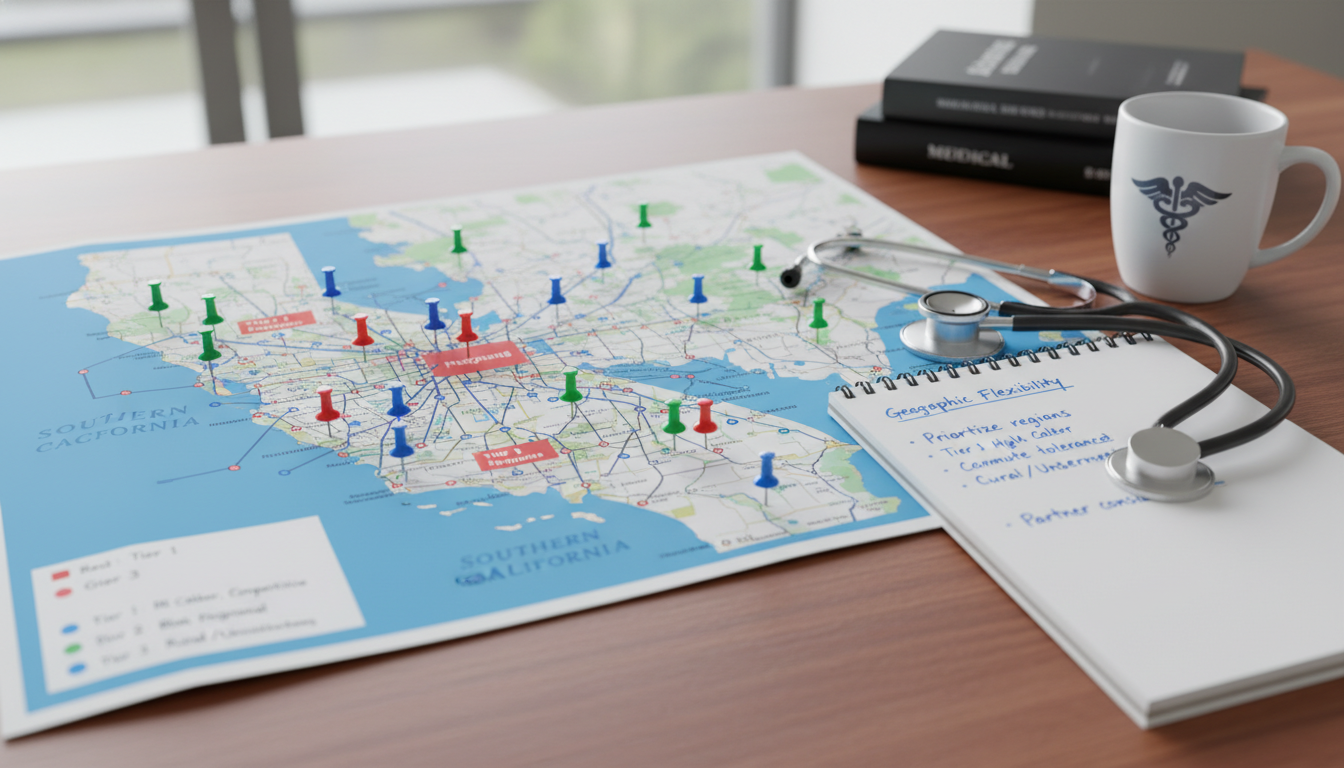
Building a Smart Geographic Flexibility Strategy
You do not have to abandon your Southern California residency dream. But you do need a structured regional preference strategy that balances aspiration with probability.
Step 1: Define your “priority,” “secondary,” and “safety” regions
Think of your application map in three tiers:
Priority Region (Your Core Target)
- For you: Southern California (and maybe parts of Central California depending on your ties)
- This is where you have strong personal reasons: family, long-term plans, cultural or community ties.
- Apply broadly within this region across program types (academic, community, county).
Secondary Regions (Comparable or Acceptable Alternatives)
- Consider Northern California, other Western states (Arizona, Nevada, Oregon, Washington), or regions with similar patient populations and climate.
- Frame these as places where you’d be happy to train if SoCal doesn’t work out.
- These regions keep you in the same general time zone and allow for easier travel back to SoCal.
Safety/Expansion Regions (High Flexibility Zone)
- Regions with more IMG-friendly programs in your specialty—even if they aren’t your first choice for lifestyle.
- Examples: Midwest, certain East Coast community programs, or states known for welcoming IMGs (e.g., parts of New York, New Jersey, Pennsylvania for some specialties).
This three-tier approach allows you to maintain a clear Southern California focus while still demonstrating realistic location flexibility for the match.
Step 2: Match your flexibility to your competitiveness
Your degree of geographic flexibility should be calibrated to your application strength:
Highly competitive US citizen IMG (strong scores, no attempts, US clinical experience, solid letters):
- Can tilt more heavily toward Southern California plus a moderate spread across Western states.
- Still should include some “safety” regions but in smaller proportion.
Moderately competitive US citizen IMG (average metrics, some gaps, or limited USCE):
- Should aim for a balanced distribution:
- ~30–40% SoCal/California
- ~30–40% other regions where you can articulate a meaningful connection or rationale
- ~20–30% strongly IMG-friendly states/programs
- Should aim for a balanced distribution:
More vulnerable application (low scores, attempts, late graduation, or limited USCE):
- Needs maximal geographic flexibility.
- Southern California should remain part of the plan, but not dominate it.
- You may need to consider any region with known IMG-friendliness to maximize interview numbers.
Step 3: Clarify “non-negotiables” vs “preferences”
You might think “SoCal or bust,” but it helps to identify what you actually care about:
Non-negotiables might include:
- Must be in the United States (vs. Canada or elsewhere)
- Need a program that accepts US citizen IMGs in your specialty
- Cannot train in a state where you have licensure or personal constraints
Preferences might include:
- Proximity to family in Southern California
- Access to a diverse or Spanish-speaking patient population
- Urban or suburban setting vs. rural
The Match cares about your non-negotiables; your preferences should guide your rank list but not limit you so much that you don’t match.
How to Communicate Geographic Preference Without Limiting Yourself
You can—and should—acknowledge your interest in Southern California. The key is how you express it in your application materials and interactions.
Personal statement: SoCal focus with national openness
If you plan to apply broadly, write your personal statement so that it:
- Shows authentic ties or interest in Southern California
- Still makes sense if read by a program in another region
For example:
“I was raised in Orange County, and many of my formative experiences in healthcare occurred in clinics serving underserved communities across Southern California. While I hope to return to this region long-term, I am excited to train wherever I can best develop as a compassionate, skillful physician caring for diverse populations.”
This acknowledges SoCal without telling a Chicago or Ohio program: “You’re second-tier and I’d never come.”
ERAS geographic signals and preference statements
If the ERAS year you apply includes a “geographic preference” or “geographic signals” feature (this has varied by year and specialty), keep in mind:
Use your limited signals strategically:
- Signaling one or several Southern California areas may help, but don’t use all your signals only within a small radius unless your application is very strong.
- Consider signaling one or two SoCal regions plus another region where you’d genuinely be happy.
Avoid contradictory messaging:
- Don’t signal only “Pacific” but write an entire personal statement about how your dream is New York.
- For you: Align your signals, PS, and experiences around a realistic blend of Southern California interest plus broader geographical openness.
Interview day: What to say when they ask, “Where else are you applying?”
Programs often ask variations of:
- “Which region are you most interested in?”
- “Are you applying mostly in California?”
- “Do you see yourself staying in this area long-term?”
Strong, flexible answers might sound like:
“My family is in Southern California, so I do have a strong interest in this region, and I’m very familiar with the patient population and cost of living. At the same time, I applied across the West Coast and to a few programs in other regions that serve similar diverse, underserved communities. Ultimately, my priority is finding a program where I can grow clinically and be part of a supportive, mission-driven team.”
“Southern California is my long-term goal, but I understand how competitive it is. I’ve applied more broadly, including to programs that emphasize community service and diverse patient populations, even outside California. If I’m fortunate enough to match somewhere that shares that mission, I’d be genuinely happy to train there.”
Avoid saying:
- “I only applied to California programs.” (Unless you have a very strong, well-advised reason and metrics to back it up.)
- “I’d probably only rank SoCal programs highly.”
These can raise doubts about your location flexibility match potential.

Practical Steps for a US Citizen IMG Targeting Southern California
Beyond mindset and messaging, there are concrete actions you can take to strengthen your SoCal and broader geographic strategy.
1. Leverage and document your Southern California ties
Programs take “ties” more seriously when they are specific and verifiable. Examples:
Personal ties:
- Grew up or went to school in Southern California
- Parents, spouse, or children living in LA/OC/SD/Inland Empire
- Long-term community involvement, volunteering, or work in SoCal before or during med school breaks
Professional ties:
- US clinical experience (USCE) in Southern California hospitals or clinics
- Research collaborations with SoCal institutions
- Presentations or conferences attended at California institutions
How to use these ties:
- Mention them in your personal statement in a short, professional way.
- If appropriate per program instructions, reference them briefly in specific program communications (e.g., thank-you emails or supplemental questions).
- For some programs, a “why this program/region” essay or question is where you can explicitly state:
“As a US citizen IMG and an American studying abroad, I plan to build my long-term career in Southern California, where my family lives and where I have strong community roots.”
2. Choose SoCal-friendly specialties and programs strategically
Some specialties and program types are more open to US citizen IMGs in Southern California than others.
More accessible fields (relatively):
- Family Medicine
- Internal Medicine (especially community programs)
- Psychiatry (varies, but some SoCal programs are IMG-friendly)
- Pediatrics (select programs)
More competitive / limited opportunities for IMGs in SoCal:
- Dermatology, Plastic Surgery, Neurosurgery, ENT
- Some highly competitive academic Internal Medicine or categorical Surgery programs
- Certain subspecialty-heavy or research-intensive programs
Action steps:
- Use resources like FREIDA, program websites, and IMG-specific forums to identify which Southern California programs have historically interviewed or matched US citizen IMGs.
- Prioritize a mix of:
- A few reach academic SoCal programs
- Several realistic community and county programs in SoCal
- Additional programs elsewhere that match your profile
3. Create a realistic program list with geographic tiers
For example, an Internal Medicine applicant who is a US citizen IMG might build:
Tier 1 – Southern California (Core)
- 3–5 academic or hybrid academic–community programs (reach)
- 8–12 community and county programs in LA, OC, SD, Inland Empire (mixed reach/realistic)
Tier 2 – Broader California and West Coast (Secondary)
- 5–10 programs in Northern/Central California, Arizona, Nevada, Oregon, Washington
Tier 3 – IMG-friendly programs elsewhere (Safety/Expansion)
- 10–15 programs in regions known to be more welcoming to IMGs (Midwest, Northeast, certain Southern states), focusing on community hospitals
This kind of distribution maintains your Southern California residency emphasis while giving the Match algorithm enough options to secure you a position.
4. Prepare to explain your flexibility in SOAP or reapplication
Even with careful planning, some applicants don’t match on the first try. A flexible mindset is critical:
During SOAP (Supplemental Offer and Acceptance Program):
- You may need to consider programs outside Southern California or even outside California altogether.
- Show openness: “I’m ready to move wherever I can train, gain strong clinical skills, and serve patients.”
During reapplication:
- If you initially restricted yourself heavily to Southern California, you’ll need to demonstrate increased location flexibility the following year.
- Document what you did in the interim—research, USCE, observerships or externships, exams, or a master’s program—and broaden your geographic reach.
Your narrative can be:
“I will always see Southern California as home, but I’m committed to becoming the best physician I can be—even if that means training in another region first and returning later.”
Balancing Your Southern California Dream with Long-Term Career Goals
Ultimately, residency is temporary; your career span may be 30–40 years, while training is 3–7 years. For many US citizen IMGs, the healthiest mindset is:
- Short-term flexibility, long-term focus.
You can:
- Train in another state with strong education, then return to Southern California for fellowship or practice.
- Build networks and mentorship that later support a move back to SoCal.
- Use your residency years to become the kind of candidate that SoCal health systems want to hire.
In other words, accepting a residency outside your first-choice region does not mean you’ve lost your Southern California goal—it may simply be the most realistic path toward it.
FAQs: Geographic Flexibility for US Citizen IMGs Targeting Southern California
1. Is it a bad idea to apply only to Southern California programs as a US citizen IMG?
For most US citizen IMGs, yes, it’s risky to apply only to Southern California unless:
- Your scores and profile are very strong for your specialty
- You have extensive US clinical experience, especially in SoCal
- You’ve been specifically advised by experienced mentors or advisors that your odds are good
Most applicants significantly increase their chances of matching by including other regions in addition to Southern California.
2. How can I show strong interest in Southern California without hurting my chances elsewhere?
Use a two-layered approach:
- In general materials (personal statement, ERAS application), highlight that you value diverse, underserved communities and certain types of training environments—attributes that exist both in Southern California and in other regions.
- When programs specifically invite regional or program-specific commentary (secondary essays, interview conversations), then mention your SoCal ties and reasons for preferring that region.
This way, programs in other locations still feel you’d be content training there, while SoCal programs see your stronger commitment.
3. Will programs outside Southern California think I won’t come if I have clear ties to SoCal?
They might worry—unless you explicitly address it. During interviews or communications, say something like:
“Although Southern California is where my family lives, my priority at this stage is high-quality training. I’m applying broadly and am very open to relocating for the right program. I would be happy to train here and commit fully to your community.”
This reassures them that your SoCal ties won’t prevent you from honoring a match in their region.
4. If my ultimate goal is to practice in Southern California, is it still worth it to train elsewhere?
Absolutely. Many physicians currently practicing in Southern California trained in other states or regions and returned later. Training outside SoCal can offer:
- Broader clinical exposure
- Potential leadership or teaching opportunities
- Programs that are more welcoming to US citizen IMGs
- A stronger overall CV when applying for SoCal fellowships or jobs
Think of geographic flexibility in residency as a strategic move, not a failure of your SoCal dream. Your long-term goal—to build your life and career in Southern California—can still guide your decisions even if your training path is geographically diverse.
Geographic flexibility doesn’t mean abandoning your identity as a US citizen IMG who wants Southern California. It means structuring your application—and your story—so that Southern California is your anchor, not your only option, giving you the best possible chance to match, train well, and ultimately build the career you envision.