
Understanding Geographic Flexibility as an IMG in the US-Mexico Border Region
For an international medical graduate (IMG) considering residency in the United States, the US-Mexico border region offers a unique blend of opportunity, community need, and cultural familiarity. At the same time, it can be confusing to decide how much you should “lock in” to this area versus showing broader geographic flexibility during the residency match.
This IMG residency guide focuses on geographic preference in the US-Mexico border region, with particular attention to Texas border residency programs. You will learn how to:
- Understand geographic flexibility versus geographic restriction
- Strategically use geographic preference residency signaling
- Balance personal/family needs with match success
- Build a regional preference strategy that is honest, realistic, and effective
- Avoid common mistakes IMGs make when limiting themselves to one region
Whether you see yourself staying long-term near the border or you simply view it as one of several options, your regional strategy should be deliberate—not accidental.
1. What Geographic Flexibility Really Means for IMGs
Geographic flexibility is more than “I’m willing to go anywhere.” In the context of the residency match, especially for IMGs, it includes:
- Primary target region(s): Where you most want to train (e.g., US-Mexico border, especially Texas and adjacent states)
- Secondary acceptable regions: Areas you would be comfortable with if primary options don’t work out
- Non-negotiable limits: Places you truly cannot go due to visa, family, or other constraints
For IMGs, geographic flexibility can significantly impact:
- Number of interviews: More regions = wider net = more potential interviews
- Match probability: A broader, realistic list increases your chances
- Program perception of commitment: Programs like to see evidence that you genuinely understand and value their region
In the context of a border region residency, flexibility also has a “directional” component:
- Are you open to all states along the US-Mexico border (Texas, New Mexico, Arizona, California)?
- Or are you Texas-only, or even South Texas only (e.g., Rio Grande Valley, Laredo, El Paso, Brownsville–McAllen area)?
The narrower your geographic focus, the stronger your profile and preparation usually need to be to remain competitive.
2. The US-Mexico Border Region: Opportunities and Realities for IMGs
To build a geographic strategy, you must understand what the US-Mexico border region actually offers in terms of training.
2.1 Key Features of Border Region Residency Programs
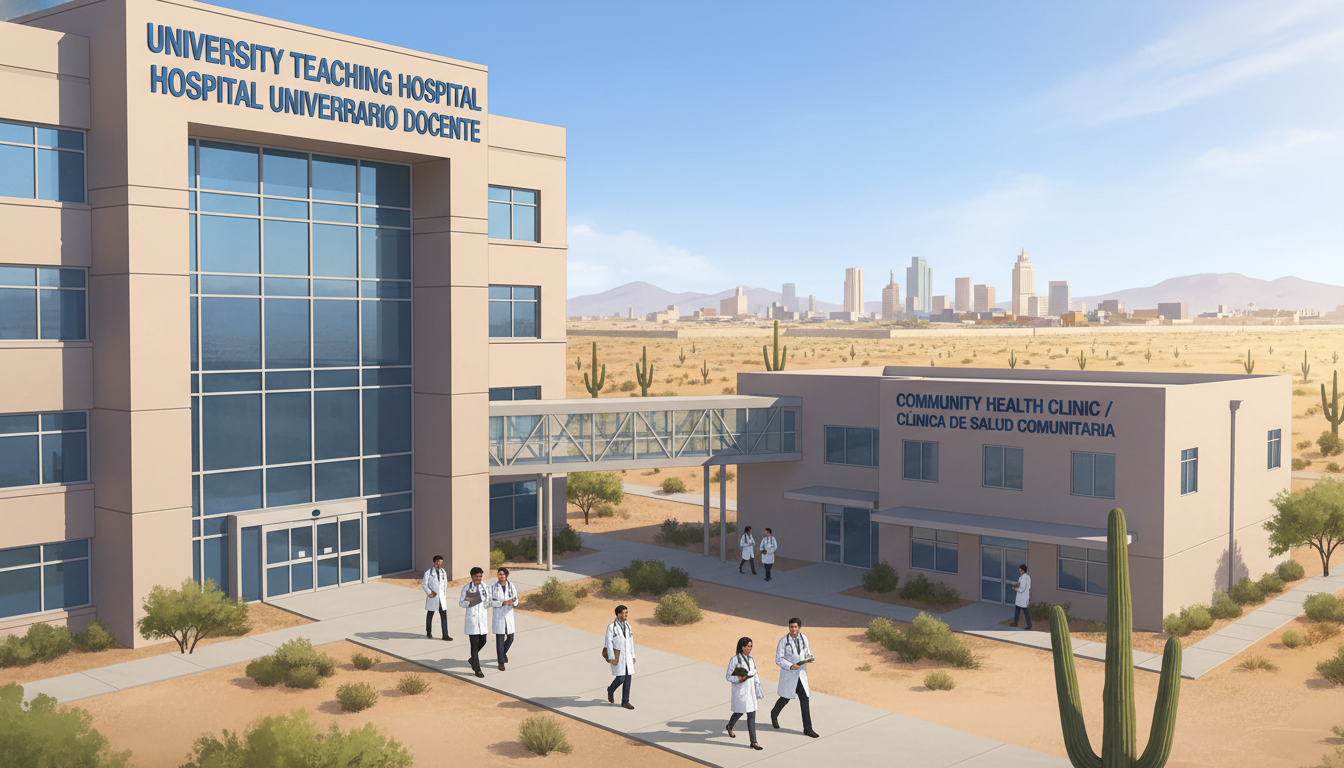
Residency programs in the US-Mexico border region—especially Texas border residency programs—commonly share:
High Spanish-speaking patient volume:
- Many patients are monolingual Spanish speakers or bilingual
- Programs often value Spanish ability as a genuine clinical tool, not just “a plus”
Underserved and high-need populations:
- Higher rates of chronic diseases (diabetes, obesity, hypertension)
- Limited access to specialists; strong emphasis on primary care and continuity
- Social determinants of health are a daily reality (immigration status, food insecurity, transportation barriers)
Cultural and binational context:
- Frequent cross-border care patterns, including patients who move between countries
- Health issues tied to migration, border policies, and transnational families
- Sensitivity to documentation, privacy, and trust in institutions
Growing training infrastructure:
- Expansion of new or recently accredited programs, particularly in family medicine, internal medicine, pediatrics, psychiatry, and OB/GYN
- New medical schools and teaching hospitals in South Texas and along the border
For many IMGs—especially those from Latin America or with Spanish fluency—this can be a natural fit and a major professional advantage.
2.2 Benefits of Targeting the Border Region as an IMG
Focusing on a border region residency can be a powerful part of your match strategy:
Alignment with language and cultural skills
If you speak Spanish and understand Latin American culture, you can contribute immediately and stand out during interviews and in your personal statement.Mission-driven training environment
Many border programs emphasize serving marginalized communities and addressing health inequities—ideal if you can demonstrate mission fit.Potential openness to IMGs
Some border programs (especially community-based or new programs) may have a history of welcoming IMGs, particularly those committed to staying long-term.Career pathways in underserved care
Completing residency in these areas can open positions in Federally Qualified Health Centers (FQHCs), community clinics, and academic border health roles.
2.3 Challenges and Trade-offs
However, it’s important to be realistic:
High clinical workload and complexity
You may encounter heavier patient loads, limited resources, and complex psychosocial issues.Relative geographic isolation
Some border cities are far from major metropolitan centers; access to certain subspecialties or research may be more limited than in big academic hubs.Competition for specific niches
Many US graduates and IMGs want to train where they have cultural or family ties. Strong Spanish-speaking US graduates may also heavily target these programs.
The key takeaway: the border region offers major opportunities, but it should be a strategic preference, not an emotional or impulsive choice.
3. Building a Regional Preference Strategy as an IMG
To use geographic flexibility wisely, you need a structured regional preference strategy, especially if the US-Mexico border is one of your top interests.
3.1 Define Your Priority Tiers
Instead of thinking in “border vs. non-border” terms, build tiers based on your real preferences and needs:
Tier 1 – Strong Preference Regions
- Examples: South Texas border (McAllen, Brownsville, Laredo, Harlingen), El Paso region, select Arizona or California border cities you know well
- Characteristics: Top choice for lifestyle, family proximity, language and cultural fit, or long-term career goals
Tier 2 – Acceptable Regions
- Examples: Non-border but still Southwestern (San Antonio, Houston, Dallas, Phoenix, inland California), or other bilingual/Latino-majority areas
- Characteristics: Good compromise in training quality and lifestyle; you could see yourself living there for 3–5 years
Tier 3 – Flexible/Opportunistic Regions
- Examples: Programs historically IMG-friendly outside your preferred geography (Midwest, East Coast community hospitals, rural centers)
- Characteristics: May not be your dream location, but you are realistically willing to live and train there if it leads to US board certification
For an IMG, limiting yourself only to Tier 1 can be risky unless your profile is exceptionally strong. A wise location flexibility match strategy usually includes all three tiers, but in different proportions.
3.2 Researching Border Region Programs in Depth
If you prioritize the border, treat it like a specialty: research it thoroughly.
Steps for targeted research:
- Identify all programs within ~100–150 miles of the border, particularly in Texas, Arizona, New Mexico, and California.
- Review:
- % IMGs or international graduates currently in the program
- Visa sponsorship (J-1 vs H-1B, if applicable)
- Emphasis on Spanish language or binational health
- Program age (new vs established)
- Look for clues to geographic preference residency patterns:
- Do faculty bios show long-standing ties to the border or to Latin America?
- Do program descriptions highlight “commitment to the border region,” “serving border communities,” or “US-Mexico health”?
This helps you target programs where your background and motivation strongly match their mission.
3.3 Using Your Story to Support a Regional Preference
Your application should clearly explain why the border region is more than a random choice. You can highlight:
- Personal or family ties to border communities or Latin America
- Prior clinical electives or observerships in border or immigrant-heavy settings
- Spanish language skills used in clinical care
- Academic interests in migrant health, public health, or binational issues
For example, in a personal statement tailored to a Texas border residency, you might include:
“During my observership in a community clinic in the Rio Grande Valley, I saw how language and cultural understanding transformed patient trust. As a Spanish-speaking IMG from Mexico, I felt uniquely positioned to bridge gaps between patients and the care system. This motivated me to seek residency training specifically in the US-Mexico border region.”
This demonstrates that your regional preference strategy is intentional and informed.
4. How Much Geographic Flexibility Should You Show?
A central dilemma for IMGs: if you emphasize your passion for the US-Mexico border region, does that mean you should only apply there? The answer is usually no.
4.1 Dangers of Over-Restricting Geography as an IMG
If you set a very narrow location (e.g., “South Texas only”), you may face:
- Reduced interview volume due to a smaller program pool
- High competition in a concentrated region
- No backup if something unexpected affects those programs (e.g., accreditation changes, class size reduction)
This is especially risky if:
- Your USMLE scores are average or below-average for IMGs
- You have gaps in training or limited US clinical experience
- You require a particular visa type that already limits program options
In other words, a too-strict geographic preference can unintentionally become a geographic restriction that hurts your match chances.
4.2 Balancing Passion and Pragmatism
A realistic location flexibility match plan for a border-focused IMG might look like:
- 30–40% of applications: US-Mexico border or nearby regions (especially Texas border residency and neighboring states)
- 30–40%: Other parts of the same broader region (e.g., non-border Texas, New Mexico, Arizona, central/southern California, other heavily Hispanic regions)
- 20–40%: IMG-friendly programs in other US regions, based on data, alumni experiences, and visa support
This preserves your regional identity while protecting your overall match probability.
4.3 Honestly Signaling Border Preference Without Lying
Programs increasingly pay attention to applicants’ geographic preference residency signals—explicit (geographic signaling features in ERAS, program-specific statements) and implicit (personal statement, experiences, electives).
You should avoid:
- Telling each program that it is your “number one” choice
- Claiming deep commitment to a region you know nothing about
- Contradicting yourself in different application components
Instead, you can:
- Clearly state the border region as a primary focus while acknowledging general location flexibility
- Adapt your personal statement slightly to show specific knowledge about a program’s region, without fabricating ties
- Use geographic signaling tools (if available) to prioritize a realistic number of locations
For instance:
“My top geographic preference is the US-Mexico border region, especially programs that serve predominantly Spanish-speaking communities. However, I remain open to training in other underserved areas where bilingual care and cultural competence are valuable.”
This communicates focus without appearing inflexible.

5. Tailoring Your Application to a Border-Focused but Flexible Strategy
Your entire application package should reflect both your regional interest and your openness. Here’s how.
5.1 Personal Statements (PS) and Supplemental Essays
Consider using a two- or three-version PS strategy:
Border-Focused PS
- Emphasize US-Mexico border health, Spanish language, underserved care
- Use for programs in the border region or nearby areas with similar patient populations
General Underserved/Community PS
- Focus more broadly on underserved care without specifying the border
- Use for non-border but safety-net or community-heavy programs
(Optional) Academic/Research-leaning PS
- For university programs where research or subspecialty exposure is key
For border programs, explicitly mentioning your interest in the border region residency environment, and ideally citing real experiences there, can differentiate you from generic applicants.
5.2 ERAS Application and Experiences
Highlight experiences that make you a natural fit for the border region:
- Clinical work or volunteering with immigrant, migrant, or Spanish-speaking populations
- Public health or research projects related to access to care, border health, or health equity
- Leadership roles in diversity initiatives or community outreach
At the same time, make sure your application demonstrates adaptability and prior success in varied settings—this supports your claim of being geographically flexible.
5.3 Letters of Recommendation (LoRs)
Strong LoRs that emphasize:
- Your ability to work across cultures and languages
- Resilience in high-volume or resource-limited contexts
- Teamwork and collaboration in multidisciplinary settings
can be persuasive to border programs and also to others that serve underserved populations.
If you did an observership or rotation in a border or similar environment, a letter from that site can be especially powerful.
5.4 Interview Messaging
During interviews—particularly in Texas border residency programs—you may be asked directly:
- “Why this region?”
- “Do you see yourself living here long-term?”
- “If you do not match here, what other regions are you considering?”
Answer with a balance of commitment and realism:
- Express clear understanding and enthusiasm for the border context
- Avoid promising you will definitely stay forever unless that is genuinely true
- Acknowledge your overall location flexibility match mindset (e.g., committed to underserved care wherever the opportunity arises)
6. Special Considerations: Visa Status, Family, and Long-Term Plans
Geographic decisions for IMGs are rarely purely academic; they intersect with immigration, family, and career.
6.1 Visa and Immigration Factors
Visa status strongly shapes your geographic flexibility:
J-1 visa candidates:
- More freedom in where you match, but subject to the 2-year home residency requirement or waiver later
- Many J-1 waivers are in underserved or rural areas—including parts of the border region—so training there may align with your eventual waiver job
H-1B visa candidates:
- Fewer programs sponsor H-1B, which can restrict geography
- You may need to be more flexible in region to accommodate visa-friendly programs, even if your preference is the border
When researching programs, always confirm:
- Visa types sponsored
- Historical success with IMG visa processing
- Whether the program is in or near areas that frequently offer J-1 waivers (important for long-term planning)
6.2 Family and Personal Support Systems
For many IMGs, the US-Mexico border offers proximity to:
- Family still living in Mexico or Latin America
- Cultural familiarity, Spanish-speaking communities, and religious or social networks
These can greatly improve your wellbeing during residency. However, if, for example:
- Your spouse can only work in certain states
- You have children whose schooling needs favor a particular city size
you must integrate these factors into your regional preference strategy.
Be honest about non-negotiables: if a location would be unsustainable for your family, it should not be on your list—no matter how attractive academically.
6.3 Long-Term Career Vision
Think beyond residency:
- Do you envision practicing in the border region long-term?
- Are you interested in academic border health, public health policy, or community leadership?
- Will completing residency in this region help you build contacts for future jobs or J-1 waivers?
If your long-term vision is strongly tied to the region, it justifies a strong regional preference—but not necessarily total exclusivity, especially as an IMG.
FAQs: Geographic Flexibility for IMGs in the US-Mexico Border Region
1. As an IMG, is it safe to apply only to programs in the US-Mexico border region?
Generally, no. While you can prioritize border programs, most IMGs benefit from applying across multiple regions to maintain a competitive location flexibility match profile. Limiting yourself exclusively to border cities is risky unless your CV is very strong and you have clear, deep ties to that specific area.
2. How can I show strong interest in Texas border residency programs without hurting my chances elsewhere?
Use a border-focused personal statement and tailored language for those programs, emphasizing Spanish skills and interest in border health. For other regions, use a more general underserved-care PS. In interviews, state that the border is a top preference but that you remain open to similar underserved settings in other parts of the US.
3. Do border region programs prefer applicants with Spanish fluency?
Many do, especially those serving predominantly Spanish-speaking populations. Spanish fluency is a significant advantage, but not always mandatory. If you are fluent or advanced, highlight it repeatedly in your CV, personal statement, and interviews. If you are learning, be honest about your level and your commitment to improvement.
4. How many programs should I apply to if I strongly prefer the border region but want to be realistic as an IMG?
Numbers vary by specialty and profile, but a common strategy is:
- 30–40% of applications in the US-Mexico border and adjacent areas
- 30–40% in non-border but similar underserved or Hispanic-majority regions
- 20–40% in other IMG-friendly regions nationwide
This mix allows you to implement a strong regional preference strategy without compromising your overall chance to match.
By approaching the US-Mexico border region as a carefully considered geographic preference—not a rigid limitation—you can authentically pursue a setting that fits your language, culture, and goals while still maximizing your chances of matching into a US residency program as an international medical graduate.