
Understanding Geographic Flexibility as an IMG in Community Hospital Programs
Geographic flexibility is one of the most powerful tools an international medical graduate (IMG) can use to improve their chances of matching into a US residency—especially in community hospital residency programs. While many applicants focus on program reputation and specialty competitiveness, strategic location flexibility can dramatically increase interview numbers and match success, particularly for IMGs navigating the complexities of the US system.
In this IMG residency guide, we’ll break down what geographic flexibility really means, how it intersects with community-based residency programs, and how you can design a smart regional preference strategy without sacrificing your personal or professional goals.
Why Geographic Flexibility Matters More for IMGs
For most IMGs, the match is not only about “where do I want to live?” but also “how can I maximize my odds of getting a position?” Community hospital residency programs often offer excellent clinical training but may receive fewer applications than large academic centers in major cities. This creates an important opportunity for IMGs who adopt a broad geographic preference residency approach.
Key reasons geography is especially impactful for IMGs
Higher competition in popular locations
- Major metros (New York City, Boston, San Francisco, Chicago, Los Angeles) attract a high volume of applicants, including US MD/DO seniors.
- Academic “name-brand” institutions often prioritize US grads or those with strong US connections.
- IMGs heavily concentrated in these locations face lower interview yield.
Community hospital residency advantage
- Many community-based residency programs are outside top-tier metropolitan centers.
- Some of these programs are IMG-friendly, with a track record of accepting IMGs and offering strong clinical exposure.
- Willingness to train in less “popular” regions can be a decisive advantage.
Visa considerations and state-level variability
- Some states and individual community hospitals are more open to sponsoring J-1 or H-1B visas.
- Others have limited or no visa sponsorship, or strong preference for US citizens/green-card holders.
- Geographic flexibility allows you to target locations where IMGs with visas are more likely to be considered.
Interview volume and backup planning
- As an IMG, more interviews usually correlate with better match chances.
- Being open to a wider range of locations significantly increases the number of programs you can target, especially among community-based residency programs that are less saturated.
Bottom line: For IMGs, location flexibility isn’t just a preference—it’s a strategy.
Building a Smart Geographic Preference Strategy
Geographic flexibility does not mean applying blindly to every single program. Instead, you want a structured, intentional regional preference strategy that balances personal constraints, professional goals, and realistic chances.
Step 1: Define your true non-negotiables
Before expanding your options, be crystal clear about what you cannot compromise on. This will prevent burnout and disappointment later.
Consider factors like:
Visa constraints
- J-1 vs H-1B needs
- Programs/state policies on visa sponsorship
- Preference for states with stronger J-1 waiver job prospects if you’re planning long-term practice in the US
Family and support system
- Spouse or partner employment limitations
- Childcare and schooling needs
- Need to be within a certain distance of relatives or a specific city
Financial realities
- Cost of living (big city vs smaller town)
- Ability to afford interview travel, temporary housing, and relocation
Safety and health-related issues
- Climate-related health conditions
- Need for specific medical services or community resources
Be honest with yourself. If you absolutely must be within 1–2 hours of one city for family reasons, build your strategy around that—but recognize it may limit options and increase risk in the Match.
Step 2: Understand geographic tiers for residency applications
A helpful approach is to classify regions into tiers based on both your preference and competitiveness.
Tier 1: High-desirability regions (for most applicants)
Examples:
- Large coastal cities (NYC, Boston, LA, San Francisco, Miami, Seattle)
- Highly competitive academic centers in any region
Characteristics:
- Extremely high demand, many US MD/DO applicants
- Often strong academic research focus
- IMGs match here, but usually with exceptional profiles or strong US ties
Tier 2: Mixed urban–suburban regions and mid-sized cities
Examples:
- Secondary metros or large suburbs (Houston suburbs, Phoenix, Minneapolis–St. Paul, Charlotte, Pittsburgh, Tampa, Denver outskirts)
Characteristics:
- Good balance of lifestyle, cost of living, and training quality
- Many community-based residency and hybrid community–academic programs
- Often moderately IMG-friendly (varies by individual program)
Tier 3: Undersubscribed or less popular regions
Examples:
- Rural or semi-rural areas
- Certain Midwestern, Southern, or inland states that are less known internationally
- Smaller community hospital residency programs in non-tourist locations
Characteristics:
- Fewer total applicants per spot
- Higher willingness to consider IMGs and visa sponsorship in some areas
- Potentially heavier workload but strong hands-on clinical experience
A strong regional preference strategy for an IMG usually means NOT limiting yourself only to Tier 1—and intentionally targeting Tier 2 and Tier 3 areas where your application will stand out more.
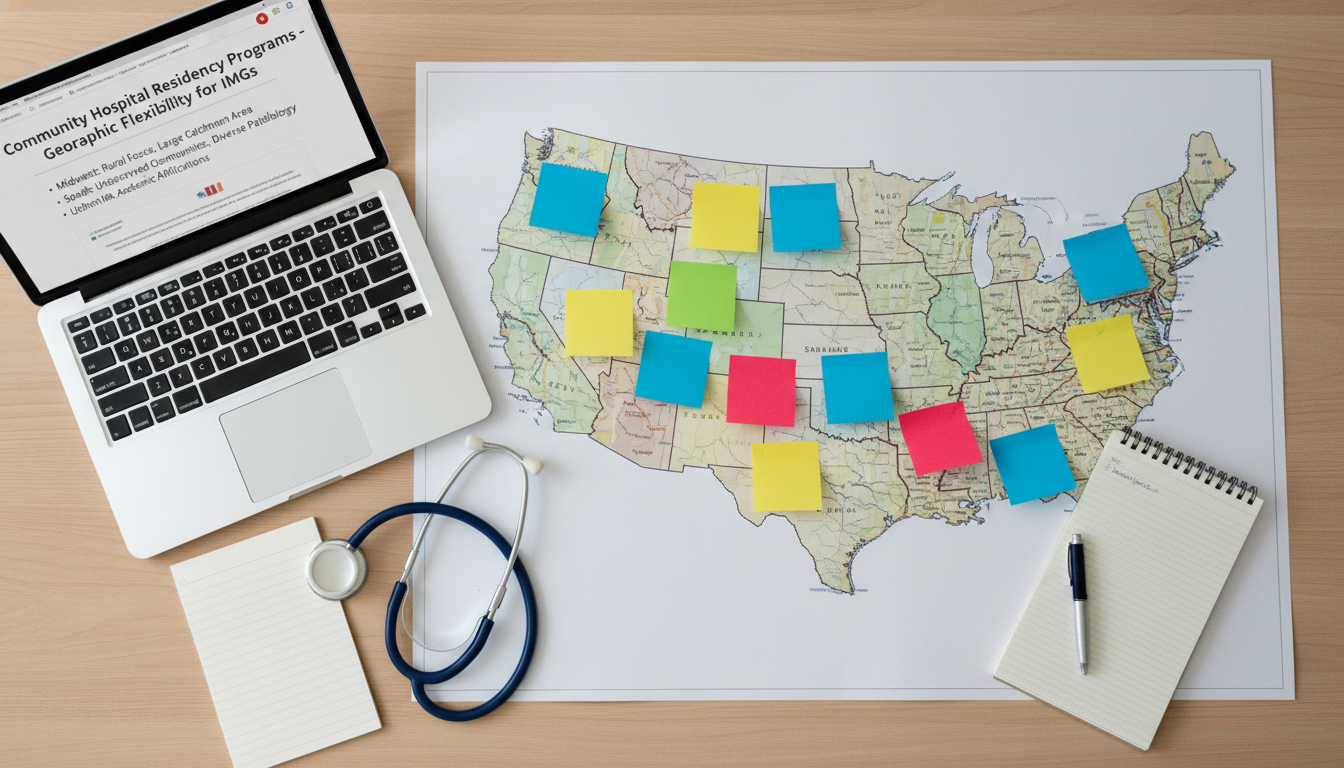
Matching Geographic Flexibility with Community Hospital Programs
Community hospital residency programs are often the best match for IMGs willing to be geographically flexible. These programs can vary widely in size, culture, and academic affiliation, but many share core features that make them attractive.
What makes community-based residency programs IMG-friendly?
Hands-on clinical training
- More direct patient care responsibility early in training.
- Less competition with fellows and large numbers of subspecialty residents.
- Good preparation for independent practice and board exams.
Tight-knit educational environment
- Closer relationships with attendings and program leadership.
- Easier to become known and trusted; stronger letters of recommendation.
- Opportunities to take leadership roles, especially in smaller programs.
Less saturated geographic locations
- Many located in smaller cities or suburban/rural areas that are less saturated with applicants.
- Programs may actively look for reliable, motivated residents—even from abroad.
Track record with IMGs
- Many community hospital residency programs depend on IMGs to fill positions, especially in Internal Medicine, Family Medicine, Pediatrics, and Psychiatry.
- Some have well-established systems for supporting IMGs with clinical adjustment, documentation, and visa issues.
How geography shapes your competitiveness in community hospitals
Your competitiveness is not fixed; it changes depending on where you apply.
Example:
- An IMG with:
- Step 2 score: 225
- 6–12 months of US clinical experience
- 1–2 publications or case reports
- No major gaps
Might be:
- Non-competitive for many NYC or California academic programs
- Moderately competitive for mid-sized city community-based residency programs
- Quite competitive for rural community hospital residency programs in IMG-friendly states
By expanding your location flexibility, you transform “borderline” into “solid candidate” for many programs.
Practical Framework: Designing Your Geographic Application Map
To operationalize your geographic flexibility, you need a practical framework for where and how widely to apply.
Step 1: Research IMG-friendliness and visa patterns by region
Use multiple sources:
- NRMP “Charting Outcomes” for IMGs (to understand broad trends)
- Program websites (check for “We sponsor J-1/H-1B” and resident lists to see IMG representation)
- FREIDA and other databases (filter for IMGs, visa sponsorship, community vs academic)
- Alumni networks and online forums (cross-checked and taken cautiously)
Create a simple spreadsheet with columns like:
- Program name
- City/State
- Type (Community, Community–Academic, Academic)
- Visa sponsorship (J-1, H-1B, none)
- % of residents who are IMGs (estimate from website)
- US clinical experience required? (Yes/No)
- Geographic tier (1/2/3)
Step 2: Decide your regional “clusters”
Instead of randomly scattering applications, group programs by:
- State clusters (e.g., Midwest cluster, Southeast cluster, Texas cluster)
- Lifestyle clusters (e.g., coastal, urban-suburban, small town, rural)
- Visa clusters (states with historically more J-1 waiver opportunities, if important for long-term planning)
For each cluster, ask:
- Is this region historically more open to IMGs?
- Are there multiple community hospital residency programs here?
- Could I realistically see myself living here for 3 years?
Step 3: Balance breadth and depth
As an IMG, you generally need both:
- Breadth – to increase total interview opportunities
- Depth – to show consistent interest in specific regions and avoid looking random
A possible pattern for an IMG focusing on Internal Medicine might be:
- 20–30 programs in 1–2 “priority regions” (e.g., Midwest + Texas; or Southeast + Mid-Atlantic)
- 10–15 programs in secondary regions (e.g., a few programs in Northeast suburbs, Mountain states, or Pacific Northwest)
- Emphasis on community and community-based residency programs, especially in Tier 2 and Tier 3 areas
Step 4: Incorporate geographic preference signals in your application
Programs know that some applicants apply everywhere without genuine interest. To stand out, use:
Personal statements with regional tailoring
- If applying heavily to the Midwest, emphasize adaptability to different climates, interest in community medicine, or family connections in nearby states.
- For rural or semi-rural programs, describe experiences in underserved communities or interest in outpatient continuity of care.
Supplemental ERAS geographic preferences (when applicable)
- Some cycles include questions on geographic preference or regional ties.
- Use these honestly and strategically, reflecting where you plan to concentrate your applications.
Email communications and interviews
- Be ready to answer: “Why this region?” or “Why this community hospital?”
- Use clear, genuine reasons: training style, patient population, cost of living, lifestyle fit, opportunities in primary care or hospital medicine, etc.

Balancing Location Flexibility with Personal and Career Goals
Geographic flexibility should increase your match chances without undermining your long-term satisfaction or career path. Thoughtful planning prevents resentment or burnout later.
Clarify your true “preference vs. necessity” boundaries
Ask yourself directly:
- “Would I rather be in a big coastal city, or do I need to be there?”
- “Am I willing to spend 3 years in a small town if it significantly increases my chances of becoming a board-certified physician in the US?”
- “If I match in a less-desired location but receive strong training, will that still support my career goals?”
For many IMGs, community hospital residency in a smaller or less well-known region is a stepping stone, not the final destination. After residency, there is often more flexibility to move to preferred locations for practice or fellowship.
How geographic flexibility influences future opportunities
Fellowships
- Good performance and strong letters at a community hospital can open doors to fellowships in larger centers and more desirable locations.
- Many fellowship directors care more about your performance and recommendations than the exact name or zip code of your residency.
Job market and J-1 waiver positions (if applicable)
- Some regions with IMG-friendly residencies also offer IMG-friendly job markets (including J-1 waivers) after training.
- Training in a region can build local connections, which may help you secure your first attending job.
Board exam performance
- Community-based programs with intense clinical exposure may prepare you very well for board exams, which is critical for long-term career stability.
Practical examples of geographic flexibility in action
Scenario A: IMG with strong scores but limited US ties
- Step 2: 240+
- No US family or geographic connections
- Willing to live in most parts of the US
Strategy:
- Apply broadly, prioritizing community-based residency and smaller community hospital programs in Tier 2 and Tier 3 regions.
- Add some academic or large city programs as “reach” options, but don’t concentrate only there.
- Emphasize adaptability and interest in diverse populations in personal statements.
Scenario B: IMG with moderate scores and family limited to one metro area
- Step 2: 225–230
- Spouse’s job fixed in one major city
- Cannot relocate more than 1–2 hours away
Strategy:
- Focus heavily on all community hospital and community-based residency programs within the reachable radius.
- Include preliminary and transitional years if needed.
- Consider slightly longer commutes or satellite cities connected by train/short flights if feasible.
- Acknowledge that match odds may be lower and plan for SOAP or reapplication contingencies.
Scenario C: IMG on J-1 visa with long-term US practice goal
- Needs J-1 sponsorship for residency
- Long-term goal: practice in US, possibly in underserved setting
Strategy:
- Target states and regions known for J-1 waiver opportunities (often more rural or underserved states).
- Apply broadly to community hospital residency programs in those states.
- Emphasize interest in primary care, hospitalist medicine, or underserved care, aligning with regional workforce needs.
Actionable Tips to Optimize Your Location Flexibility Match Strategy
To translate all this into concrete action, use the following checklist as you build your application plan.
Pre-application planning
- Define your absolute geographic constraints (family, visa, health).
- Identify 2–4 priority regions that you are genuinely open to living in.
- Research at least 10–15 IMG-friendly community-based residency programs in each priority region.
- Verify visa sponsorship and IMG representation before finalizing program lists.
During application season
- Create slightly tailored personal statement versions for major regions (e.g., “Midwest/South version,” “Texas version”).
- Use ERAS supplemental questions (if present) to honestly indicate geographic preference residency aligned with your real strategy.
- Track interview invites by region; if one region yields more interviews, consider signaling stronger preference there (if appropriate).
During interviews
- Prepare clear, honest answers for “Why this region?” that go beyond generic statements.
- Ask residents about living conditions, community integration, and support for IMGs in that location.
- Show openness and positivity about the local community—directors want residents who will be happy and stay for the full training.
After interviews and before ranking
- Reflect on each region’s long-term potential for you (fellowship, jobs, visa issues, family comfort).
- Do not let location alone make you rank a program with poor training or toxic culture above a balanced, supportive community hospital in a less flashy area.
- Create a rank list that prioritizes training quality + IMG support + reasonable life satisfaction over pure city prestige.
Frequently Asked Questions (FAQ)
1. As an IMG, should I list a strict geographic preference on ERAS if I’m actually flexible?
If the application cycle includes options to specify geographic preference, you should be honest but strategic. If you are truly open to multiple regions, avoid overly narrow preferences that could limit you. Instead, you can:
- Indicate multiple regions you are genuinely willing to consider.
- Use personal statements and interview discussions to highlight flexibility and adaptability.
Overly restricting yourself on paper may unintentionally reduce your interview pool.
2. Can being too geographically flexible make programs doubt my genuine interest?
It can, if your application appears random or generic. To avoid this:
- Group your applications into thoughtful regional clusters.
- Slightly tailor personal statements for those clusters.
- During interviews, be specific about why that region and that community hospital residency program fit your goals (patient population, learning environment, cost of living, etc.).
Flexibility is an asset, but it must be paired with clear, articulated reasons for each program.
3. Are community hospital residency programs in rural areas a “dead end” for career progression?
No. Many IMGs from rural or small-city community-based residency programs go on to:
- Competitive fellowships in larger academic centers.
- Hospitalist or primary care roles in major metropolitan areas.
- Leadership positions in community hospitals or health systems.
Your performance, letters of recommendation, and board exam results carry significant weight. A strong education in a smaller community setting can be a powerful foundation for your long-term career.
4. How many regions should I realistically target as an IMG?
This depends on your constraints and competitiveness, but a common pattern is:
- 2–3 primary regions where you apply most heavily (e.g., 50–70% of your applications).
- 1–2 secondary regions for additional breadth.
The key is to avoid scattering a handful of applications everywhere with no depth. For most IMGs, a focused but flexible regional preference strategy—with an emphasis on community hospital residency and community-based residency programs in less saturated areas—provides the best balance of realism and opportunity.
By approaching location not as a fixed preference but as a strategic lever, you can transform your status as an international medical graduate into a competitive advantage—especially within the rich ecosystem of US community hospital programs.