
Understanding Geographic Flexibility as an IMG in the Great Lakes Region
Geographic flexibility is one of the most powerful—and often underused—strategies an international medical graduate can leverage in the residency Match, especially in the Great Lakes region. For an IMG residency guide focused on this area, “flexibility” does not mean “apply everywhere blindly.” It means understanding your priorities, balancing them with match realities, and using regional preference strategy intelligently.
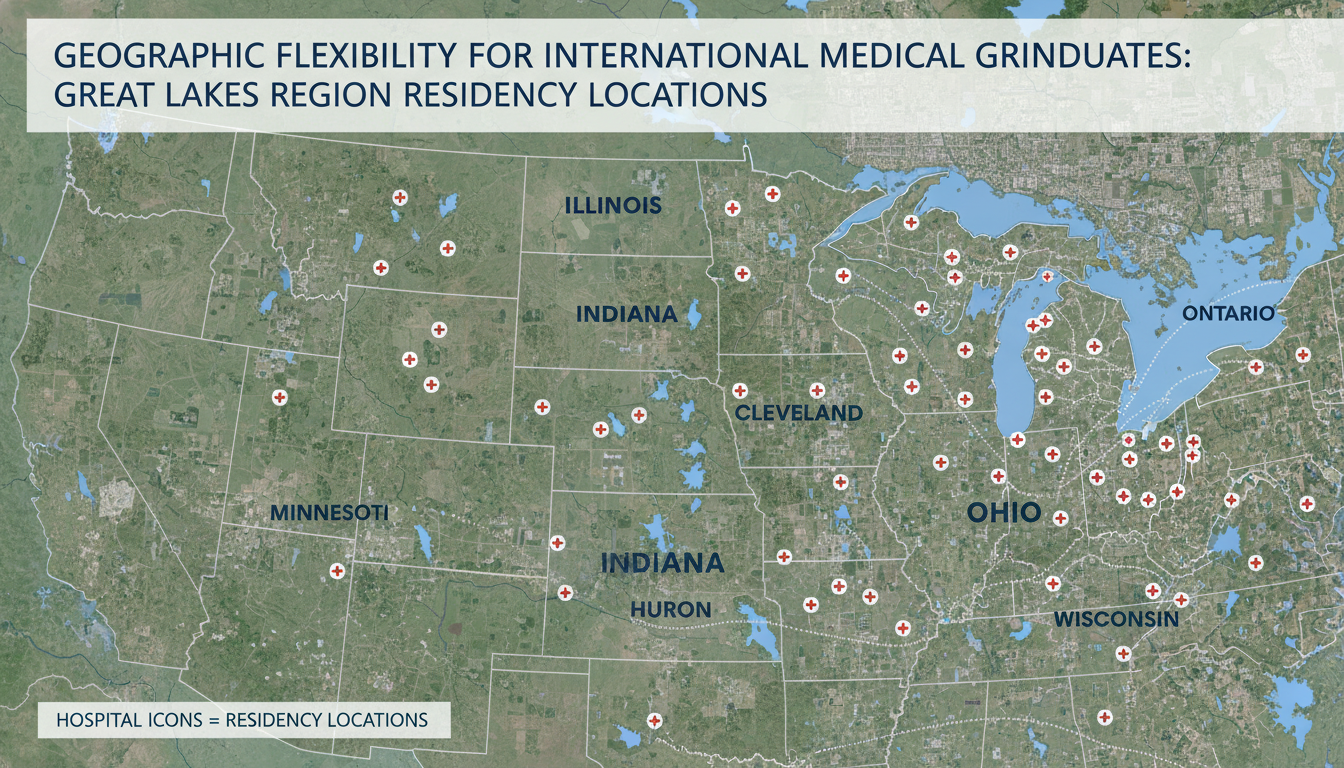
The Great Lakes region (Illinois, Indiana, Michigan, Minnesota, Ohio, Wisconsin) is rich with training opportunities across academic medical centers, strong community hospitals, and hybrid systems. Many midwest residency programs are IMG-friendly, but competition, visa considerations, and local ties all influence outcomes. Your goal is to decide: where should you be firm, where should you be flexible, and how should you communicate that to programs?
This article will walk you through:
- Why geographic flexibility matters specifically for IMGs
- How to think about geographic preference in the Great Lakes region
- Practical steps to structure your application list and signals
- How to highlight or downplay geographic ties and location flexibility in your application
- Common pitfalls and FAQs for IMG applicants considering great lakes residency options
Why Geographic Flexibility Matters More for IMGs
For most international medical graduates, matching is not only about fit—it is also about probability. Geographic flexibility directly affects that probability.
Structural realities for IMGs
In the US Match, IMGs face additional barriers:
- Visa sponsorship: Not all programs sponsor J-1 or H-1B visas. This can significantly limit the pool of options.
- Perceived risk: Some programs are cautious about training IMGs due to differences in medical education systems or previous experiences.
- Limited network: IMGs typically have fewer US mentors and fewer local ties in the Great Lakes region.
Because of these barriers, being overly rigid about location can be risky. A narrow geographic preference residency strategy (e.g., “only Chicago, only near my relatives”) can significantly reduce your chances, even if your application is relatively strong.
How geographic flexibility increases match chances
Geographic flexibility helps you in several ways:
Larger denominator of potential interview offers
- More states → more programs that may be IMG-friendly
- More community and mid-size programs that may not be on every US graduate’s radar
Less competition in less popular locations
- Some excellent midwest residency programs in smaller cities have fewer total applicants.
- IMGs willing to consider these locations often see better interview yield.
Stronger narrative of motivation and adaptability
- Programs often value residents who are open-minded and willing to serve different patient populations, including rural or underserved areas.
In short: as an international medical graduate, you usually cannot afford severe geographic inflexibility—especially when competing for a limited number of IMG positions.
Mapping the Great Lakes Region: Where Flexibility Pays Off
The Great Lakes region is diverse—not just geographically, but culturally, economically, and medically. Understanding these differences will help you design a smart regional preference strategy, instead of just “applying everywhere in the Midwest.”
State-by-state overview for IMGs
Below is a broad, practical characterization (program specifics will vary, and you must verify each program’s current criteria and visa policy):
Illinois
- Major hub: Chicago, with many academic centers and community-based programs.
- Pros: Many hospitals, large immigrant communities, robust safety-net and county hospitals; diverse pathology.
- Cons: Highly competitive urban programs; some specialties saturated; cost of living higher in major metro areas.
Indiana
- Mix of academic centers (e.g., Indianapolis) and well-regarded community programs in smaller cities.
- Often more IMG-friendly outside the largest centers.
- Lower cost of living, strong primary care and internal medicine opportunities.
Michigan
- Major centers in Detroit, Ann Arbor, Grand Rapids, and mid-size cities.
- Many hospitals with tradition of accepting international medical graduates, especially in internal medicine, family medicine, and pediatrics.
- Diverse patient populations (urban underserved, suburban, and rural).
Minnesota
- Anchored by large, world-renowned institutions and several strong community programs.
- Excellent for primary care and some subspecialty exposure; colder climate may deter some applicants (which can be an advantage if you are flexible).
Ohio
- Multiple academic centers (Cleveland, Columbus, Cincinnati, Toledo) and numerous community programs.
- Historically strong for IMG participation in internal medicine, family medicine, and psychiatry at some institutions.
- Balanced mix of urban and semi-rural training sites.
Wisconsin
- Smaller number of programs compared with some neighbors, but good quality training environments.
- Some programs serve large rural catchment areas—attractive if you are open to underserved care.
Urban vs. non-urban trade-offs
When thinking about great lakes residency options, consider this practical comparison:
Major urban centers (Chicago, Detroit, Cleveland, Minneapolis)
- Pros:
- More teaching hospitals and subspecialty exposure
- Larger international communities, easier cultural adaptation
- More academic research opportunities
- Cons:
- High competition
- Higher cost of living
- Some programs heavily favor US graduates
- Pros:
Mid-size and smaller cities (Toledo, Fort Wayne, Green Bay, Kalamazoo, Duluth, etc.)
- Pros:
- Often more IMG-friendly
- Strong hands-on experience and autonomy
- Lower living costs and sometimes higher quality of life
- Cons:
- Fewer high-level academic research opportunities
- Less public transportation; car often required
- Smaller same-language or same-culture communities
- Pros:
For an IMG residency guide in this region, the strategic advice is clear: remain open to mid-size and smaller cities unless you have an overwhelming reason not to.
Example: Two applicants, same scores, different flexibility
- Applicant A: USMLE Step 2 CK 244, needs J-1 visa, applies only to large academic IM programs in Chicago and Ann Arbor due to family preference.
- Applicant B: Same score, also needs J-1, applies across Illinois, Indiana, Michigan, Minnesota, Ohio, and Wisconsin, including academic and community programs in cities of all sizes.
Even though they are similar on paper, Applicant B has a far greater interview pool and higher probability of matching. That is the power of geographic flexibility.
Designing Your Geographic Preference Strategy as an IMG
Geographic flexibility does not mean abandoning all preferences. It means organizing them intelligently and aligning them with the Match process. Think in three layers: must-have, strong preference, and open/flexible.
Step 1: Clarify your true non-negotiables
Non-negotiables should be very few:
Visa type:
- If you must have H-1B, your list will narrow dramatically. In this case, you may need to be more geographically flexible to compensate.
- If you are open to J-1, the geographic pool is much larger.
Family or personal constraints:
- Dependents in a specific city or state for schooling or medical reasons.
- Immigration or legal issues that limit your ability to relocate.
Health or safety requirements:
- Need proximity to a specific specialist or treatment center.
Everything else—climate, city size, nightlife, proximity to major airports—should ideally move from “non-negotiable” to “strong preference” or “nice to have.” This is especially sensible for IMGs during their initial US training years.
Step 2: Rank the Great Lakes states for yourself
Create a simple, honest table:
| State | Personal Appeal (1–5) | IMG Friendliness (per your research) | Notes |
|---|---|---|---|
| Illinois | 4 | 3–4 | Family in Chicago |
| Indiana | 3 | 4 | More community IMGs |
| Michigan | 4 | 4–5 | Many IMG-friendly programs |
| Minnesota | 3 | 3–4 | Cold climate but big-name centers |
| Ohio | 4 | 4 | Large range of programs |
| Wisconsin | 3 | 3–4 | Fewer programs overall |
Then ask: Am I willing to train in any state that scores 3 or higher? If yes, your geographic flexibility is already strong.
Step 3: Build a tiered program list
For each state, identify programs in three general tiers (not official, just for your planning):
Reach programs
- Highly competitive academic medical centers; lower IMG proportions; may require strong US letters and research.
Target programs
- Solid academic-community or community-based programs; regular history of taking international medical graduates; balanced competitiveness.
Safety programs
- Smaller or less well-known hospitals; strong hands-on training; regularly interview and match IMGs with similar profiles to yours.
Within the Great Lakes region, you should aim for a broad mix across all six states, adjusting based on your scores and experiences. For many IMGs, that means:
- Strong emphasis on target and safety programs in mid-size or smaller cities
- Selective applications to reach programs, especially if you have USCE, research, or strong Step scores
A balanced list across multiple states is the core of an effective geographic preference residency strategy.
Communicating Geographic Preference and Flexibility in Your Application
Programs want to understand two things:
- Are you genuinely interested in training in our region?
- Are you likely to stay committed if we invest in you?
Your goal is to show that you have authentic interest in the Great Lakes region and that you are not rigidly tied to just one city or brand-name institution.
Personal statement: Highlight regional interest without sounding desperate
Use your personal statement to:
Mention the Great Lakes region when it is sincere:
- Example: “Having completed observerships in Michigan and Ohio, I have come to appreciate the diversity of patients and the collaborative culture of midwest residency programs. I am particularly drawn to the Great Lakes region for its blend of academic rigor and community-focused care.”
Emphasize adaptability:
- Example: “Relocating from my home country to the United States has reinforced my flexibility and resilience. I am comfortable transitioning to new environments and eager to serve diverse communities across the Great Lakes region, including those in smaller cities or rural settings.”
Avoid over-personalizing a single city unless you are applying almost exclusively there. If you say “I must be in Chicago to support my immediate family,” programs in other states may doubt your commitment.
ERAS geographic preferences and signaling (if applicable)
If the system allows you to indicate geographic preferences or send signals (this evolves over time, so check the current ERAS/AAMC guidance):
Be honest, not maximalist:
- If you indicate every region, it loses meaning.
- If the Great Lakes is truly your top region, you can say so, but still quietly apply to a few programs outside the region as backup.
Use signals strategically:
- Prioritize programs where:
- Your profile is realistic, and
- You can convincingly explain why that program or region suits you.
- Prioritize programs where:
Interviews: How to answer “Why this region?” as an IMG
Expect questions like:
- “Why are you interested in training in the Midwest?”
- “You have no family in this area—why here?”
Strong answer elements include:
Professional reasons:
- Breadth of pathology (e.g., urban underserved in Detroit, industrial health issues in Ohio, rural medicine in northern Michigan or Wisconsin)
- Training philosophy (close-knit teams, robust hands-on experience, well-balanced service and education)
Personal growth:
- “Having lived and studied in different environments, I value the chance to experience a new culture and community. The Great Lakes region offers a combination of academic training and community engagement that appeals to me.”
Commitment:
- “I am looking for a place where I can grow over several years, both professionally and personally. I am open to building a long-term life in the Great Lakes region if I find the right program fit.”
Avoid copying clichés like “I love the four seasons” unless you can back them with actual experiences. Programs recognize authentic enthusiasm.

Balancing Geographic Flexibility With Long-Term Career Goals
Geographic flexibility is a tool for the Match, but you should still keep your eventual career path in view.
Fellowship and career prospects in the Great Lakes region
If you are interested in fellowship:
- Large Great Lakes academic centers (Chicago, Minneapolis–St. Paul, Cleveland, Columbus, Ann Arbor, Detroit) have strong fellowship pipelines.
- Many smaller programs in the region maintain good track records of sending graduates into fellowships, especially in internal medicine and pediatrics.
You do not always need to match initially at a “top-tier” center to reach your goals. A great lakes residency at a strong community or hybrid program can provide:
- Solid clinical training
- Supportive faculty willing to write strong letters
- Opportunities for scholarly projects, QI, and smaller-scale research
Life after residency as an IMG
Consider these factors when weighing your regional choices:
Job market:
- Many Great Lakes states have demand for primary care and hospitalists in both urban and rural settings.
- Being trained in the region can help you build local connections and understand state licensing nuances.
Immigration and waivers (for J-1 holders):
- Many Conrad 30 and other waiver jobs are in midwestern or semi-rural areas. Training in the Great Lakes region could position you well for these opportunities.
Community and cultural adaptation:
- Even if the climate or smaller city size is different from your home country, many IMGs find that the supportive work environment and patient-centered care culture offset the initial adjustment challenges.
Geographic flexibility now does not lock you into a single state forever. Instead, it opens doors: you train where opportunities are strongest, and you can later relocate within or beyond the region as your career evolves.
Practical Action Plan for IMG Applicants Targeting the Great Lakes
To convert this IMG residency guide into concrete steps, use the checklist below.
6–12 months before applications
Research programs systematically
- For each Great Lakes state, list all programs in your specialty.
- Identify which sponsor your required visa.
- Note IMG percentages, alumni outcomes, and location type (urban, suburban, rural).
Connect with current residents and alumni
- Use LinkedIn, program websites, and alumni networks.
- Specifically ask IMGs in great lakes residency programs about living conditions, workload, support systems, and fellowship outcomes.
Strengthen your “regional story”
- Arrange observerships, externships, or electives in at least one or two Great Lakes states if possible.
- Participate in virtual open houses and region-focused events hosted by midwest residency programs.
During application season
Build a broad but targeted list
- Include programs in all six Great Lakes states, unless a state has absolutely no options for your visa or specialty.
- Mix reach, target, and safety programs.
Customize communications
- Tailor a short paragraph in your personal statement (or a secondary statement, if allowed) to express your interest in midwest and Great Lakes training environments.
- Send thoughtful, concise emails when appropriate, emphasizing your genuine reasons for interest and your willingness to relocate.
Prepare for interviews with regional knowledge
- Learn key facts about the city and hospital before each interview (major patient populations, economic background, regional health challenges).
- Be ready with specific reasons you can imagine yourself thriving there, even if it is smaller or colder than what you are used to.
Ranking and Match strategy
Rank all programs where you could realistically see yourself training
- Even if a location is not your “dream city,” you may still have an excellent training experience.
- Avoid the common mistake of ranking only a few programs high because of city prestige.
Balance location with fit
- A supportive program culture, good supervision, and strong educational structure matter more than being in the most famous city.
- Use impressions from interviews, resident interactions, and your research to prioritize.
Keep a long-term mindset
- Remember: residency is 3+ years; your entire career is much longer. A flexible geographic choice now can open many doors later.
FAQs: Geographic Flexibility for IMGs in the Great Lakes Region
1. I am an IMG with strong scores but no US clinical experience. Should I still be geographically flexible?
Yes. Lacking US clinical experience is already a limiting factor; combining that with a rigid geographic preference can severely reduce your interview pool. Targeting a wide range of great lakes residency programs across Illinois, Indiana, Michigan, Minnesota, Ohio, and Wisconsin—especially IMG-friendly community or hybrid hospitals—can compensate for some deficiencies in your application. Meanwhile, actively pursue observerships or tele-rotations in the region to strengthen your profile.
2. If I say I’m “open to anywhere,” will programs in the Great Lakes still think I’m truly interested in them?
They might see you as broadly open, but not necessarily regionally committed. The solution is nuance. In ERAS and interviews, you can explain that you are open to multiple regions but have a particular interest in the Great Lakes because of its mix of academic and community training, diverse patient populations, and strong IM/primary care tradition. This shows both openness and intentionality.
3. I have family in Chicago. Should I only apply to programs in Illinois?
No. Having family support nearby can be helpful, but limiting yourself to a single metropolitan area is risky, even for a strong international medical graduate. A better approach is: prioritize Illinois programs, especially around Chicago, but also apply to IMG-friendly midwest residency programs in neighboring states like Wisconsin, Indiana, and Michigan. Many of these are only a few hours away by car and can offer excellent training with higher match probabilities.
4. Will training in a smaller Great Lakes city hurt my fellowship chances compared with a big academic center?
Not necessarily. Many residents from smaller or community-based great lakes residency programs match into fellowships each year. Success depends heavily on your own performance, letters of recommendation, involvement in research or quality improvement, and networking. Some smaller programs even offer more hands-on responsibility and closer faculty interaction, which can translate into stronger letters. When evaluating programs, look at their recent fellowship match lists rather than assuming city size equals opportunity.
By approaching the Great Lakes region with informed geographic flexibility—balancing your personal needs, visa limitations, and career goals—you can significantly increase your chances of matching as an international medical graduate and lay a strong foundation for your future in US medicine.