
Choosing where to train is one of the most strategic decisions you’ll make as an international medical graduate (IMG). In the Tri-State Area—New York, New Jersey, and Connecticut—the question often isn’t whether to be flexible about geography, but how to use that flexibility wisely.
This IMG residency guide focuses specifically on geographic flexibility and regional preference strategy for the Tri-State region. You’ll learn how to balance your personal needs, visa status, and competitiveness with the realities of the New York New Jersey Connecticut residency market so you can maximize your chances in the Match.
Understanding Geographic Flexibility in the Tri-State Context
Geographic flexibility means being willing and able to train in a range of locations, not just one city or hospital, and being able to communicate that clearly and credibly in ERAS and interviews.
In the Tri-State area, this breaks down into multiple layers:
- Macro level: The Tri-State region vs. other parts of the U.S.
- Meso level: One state vs. another (NY vs NJ vs CT)
- Micro level: Specific metro areas, suburbs, or more peripheral locations within each state
Why Geographic Flexibility Matters More for IMGs
For an international medical graduate, being flexible with geography can:
- Increase total number of realistic programs you can apply to
- Open doors to community and university-affiliated programs that sponsor visas
- Mitigate disadvantages such as:
- Older graduation year
- Moderate USMLE/COMLEX scores
- Limited U.S. clinical experience (USCE)
- Demonstrate commitment and maturity to program directors who may worry about residents leaving after PGY-1
However, geographic flexibility does not mean:
- Saying “I’ll go anywhere” without a coherent reason
- Ignoring your support system, finances, or visa constraints
- Applying randomly without regional focus
A smart location flexibility match strategy balances options with realism.
Mapping the Tri-State Residency Landscape for IMGs
To use geographic flexibility effectively, you must understand how the Tri-State area is structured for residency training and how IMGs typically fit into that ecosystem.
1. New York: High Volume, High Competition, High Diversity
New York is often the first choice for international medical graduates due to:
- Large number of IMG-friendly programs
- Long history of training IMGs
- Strong public hospital systems and safety-net institutions
- Many programs sponsoring both J-1 and H-1B visas
Key regions within New York:
- New York City (NYC) boroughs
- Manhattan, Brooklyn, Queens, Bronx, Staten Island
- Many large academic centers and community programs
- Extremely high cost of living, intense competition for top academic sites
- Downstate / Long Island
- Mix of community and university-affiliated programs
- Somewhat lower living costs than Manhattan but still high
- Upstate (not strictly “Tri-State,” but often grouped in NY preference)
- Buffalo, Rochester, Syracuse, Albany, etc.
- Often more IMG-inclusive and more likely to consider a broader applicant range
New York is the core of most Tri-State residency plans, but also where applicants tend to cluster their applications too heavily. Geographic flexibility within NY (including beyond NYC) can be a major advantage.
2. New Jersey: Community Strength and Commuter Advantage
New Jersey is a crucial part of a Tri-State regional preference strategy:
- Many community-based and community–university affiliated programs
- Good number of programs with IMG-friendly histories
- Several institutions within commuting distance of NYC (by train, bus, or car)
- Often slightly less competitive than top NYC programs, yet with strong training
Typical training environments:
- Northern NJ (e.g., Newark, Jersey City, Paterson, Hackensack area)
- Very close to NYC; many residents commute
- Diverse patient populations; safety-net hospitals
- Central/Southern NJ
- More suburban or semi-rural
- A bit more space, often lower rent, potentially less congestion
- Some programs with strong teaching but less national name recognition (which is fine for many career paths)
For an IMG, including New Jersey programs while emphasizing ties to the greater NYC region can be a smart way to show both focus and flexibility.
3. Connecticut: Smaller, Quieter, But Strategically Valuable
Connecticut has fewer total programs than NY or NJ, but:
- Some highly regarded academic institutions
- Several smaller community or regional hospitals
- Often less saturated with IMG applications compared to NYC
- A wide range of settings:
- Urban (e.g., New Haven, Hartford, Bridgeport)
- Suburban towns with commuter access to NYC
- Areas with strong primary care focus
If your geographic preference residency statement says “Tri-State,” that should explicitly include Connecticut, not just New York and New Jersey. Programs in CT may appreciate IMGs who understand and value the state’s specific setting rather than treating it as an afterthought.
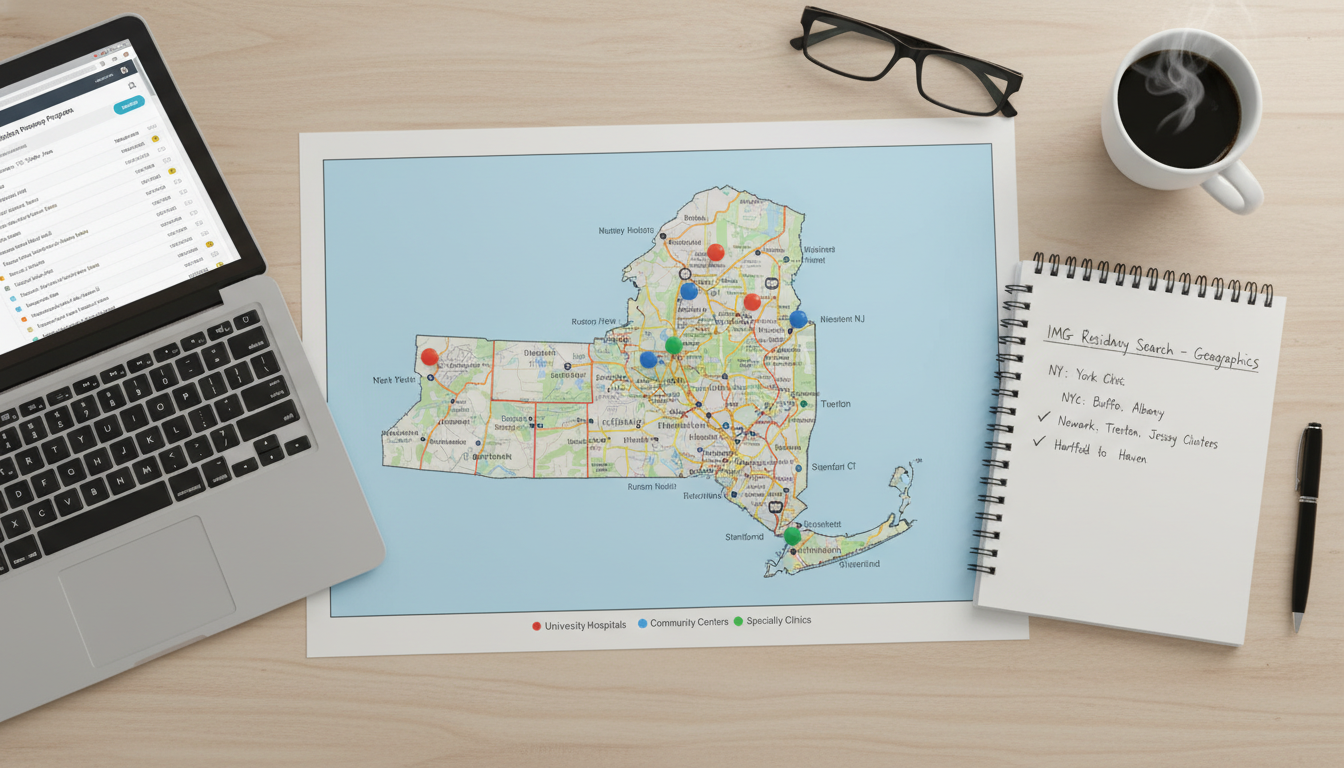
Building a Coherent Geographic Preference Strategy as an IMG
Program directors in the Tri-State area want to know two things about your geography:
- Are you serious about this region, or just mass applying?
- Are you likely to stay and complete training if they select you?
To answer “yes” to both, you need a clear, believable geographic preference strategy.
Step 1: Clarify Your Non-Negotiables
Before choosing where to apply, be honest about your constraints:
- Visa type and sponsorship needs
- J-1 vs H-1B
- Some CT and NJ programs may only sponsor J-1
- Certain NY programs may not offer H-1B due to cost/complexity
- Family or social support
- Do you need to be within commuting distance of a spouse’s job in Manhattan?
- Do you have relatives in New Jersey or Connecticut who provide housing or childcare?
- Financial considerations
- Can you handle Manhattan rent, or would Outer Boroughs/NJ/CT be more realistic?
- Will you have a car? This affects your ability to access more suburban or exurban programs.
- Lifestyle preferences
- Urban vs suburban vs smaller city
- Need for specific religious or cultural community
Write these out. Geographic flexibility doesn’t mean ignoring them—but it does mean you expand your options as far as your true constraints reasonably allow.
Step 2: Group Programs by “Concentric Circles” of Preference
A common and effective IMG residency guide approach is to think in circles:
- Core circle:
Places you very strongly prefer and have strong ties to- Example: Queens, Brooklyn, Manhattan if your family lives in NYC
- Second ring:
Areas within the broader metro region you can genuinely commit to- Example: Northern NJ (Newark, Paterson, Jersey City), parts of CT with train access to NYC
- Third ring:
Wider regional options that are logistically feasible and acceptable- Example: Upstate NY, central/southern NJ, interior CT cities like Hartford
When you discuss tri-state residency in your application, you can frame it like this:
“My primary geographic preference is the Tri-State region—particularly New York City and its surrounding areas in New Jersey and Connecticut—because I have family in Queens and a long-term goal to practice in this region. I am also open to programs in other parts of New York and New Jersey where I can continue serving diverse, underserved populations.”
This sounds intentional, not random.
Step 3: Align Your “Location Flexibility Match” Message Across ERAS
You may be tempted to say “I am open to any location” in one place and “I only want New York City” in another. Programs notice these inconsistencies.
Make your geographic preference residency messaging consistent across:
- ERAS application experiences and geographic preferences
- Personal statement(s)
- Supplemental ERAS application (if used)
- Email communications with programs
- Interview answers
For example, in your personal statement for programs in the Tri-State, you could write:
“Having completed observerships in New York and New Jersey serving multilingual, underserved communities, I have developed a strong commitment to practicing in the Tri-State area. While I remain flexible within the region—whether in urban New York City, neighboring New Jersey communities, or Connecticut cities with similar patient populations—I am especially drawn to programs that care for immigrants and working-class families.”
This communicates both focus (Tri-State) and flexibility (within Tri-State and similar environments).
Practical Application Strategy for Tri-State IMGs
Now let’s translate geographic flexibility into concrete steps for your application plan.
1. Balance Your Program List Across the Region
For a typical IMG aiming at internal medicine, pediatrics, or family medicine (as an example), you might:
- Apply to a mix of academic, community, and university-affiliated community programs
- Spread across:
- New York City (boroughs)
- Long Island/Downstate NY
- Northern and Central New Jersey
- Connecticut urban/suburban programs
- Optionally: selected Upstate NY programs if that fits your plan
Avoid listing only Manhattan or Brooklyn academic centers unless your profile is very strong (high scores, recent grad, strong USCE, research). Geographic flexibility means:
- Not limiting yourself to the “famous name” programs
- Recognizing that many community or lesser-known programs in NJ/CT/outer NYC boroughs provide excellent training and are more IMG-friendly
2. Adjust the Strategy Based on Your Competitiveness
Your level of geographic flexibility should be inversely proportional to how competitive you are:
- Highly competitive IMG (strong scores, recent grad, robust USCE, research):
- Can be somewhat more selective with geography
- Still wise to include NJ and CT programs in your Tri-State plan
- Moderately competitive IMG:
- Should cast a wide net across all three states
- Include more community and hybrid community–academic programs
- Less competitive or older IMG:
- Needs maximum geographic flexibility
- Consider not only Tri-State, but also other U.S. regions
- Within the Tri-State, do not limit yourself to NYC; actively seek out smaller cities and suburban areas
3. Use Observerships and USCE to Strengthen Regional Ties
Programs are more comfortable ranking you highly if they believe you’re serious about the region. For an international medical graduate, you can show this by:
- Doing observerships or externships in:
- NYC public or community hospitals
- New Jersey safety-net or community institutions
- Connecticut hospitals with diverse patient populations
- Listing Tri-State volunteer work, especially in:
- Free clinics
- Community health fairs
- Immigrant or refugee support organizations
- Mentioning your understanding of local patient demographics:
- Spanish/Portuguese/Haitian Creole/Bengali/Russian-speaking communities in NYC/NJ
- Specific underserved communities in CT cities
This transforms “I want to be in Tri-State” from a vague desire into a demonstrated commitment.
4. Prepare Interview Answers About Geographic Preference
You will almost certainly be asked:
- “Why this region?”
- “If you don’t Match in New York, are you open to New Jersey/Connecticut or other states?”
- “Do you see yourself staying here for the full length of residency?”
Strong answers for a regional preference strategy might include:
- Ties:
- “I have close family in Queens and Jersey City, which will support me through residency.”
- Experience:
- “My observership at [Hospital Name] in New Jersey showed me the needs of immigrant communities, and I want to continue caring for similar populations.”
- Realism:
- “While New York City is where I’ve spent the most time, I’m equally open to training in nearby New Jersey or Connecticut, as long as I can serve diverse, underserved patients and have access to solid teaching and mentorship.”
Avoid sounding overly rigid (“New York City only, no exceptions”) or too generic (“I can go anywhere”) unless that’s truly your situation and you can justify it.

Common Pitfalls and How to Avoid Them
Geographic flexibility is powerful when done right—and harmful when done poorly. Here are frequent mistakes IMGs make and how to avoid them.
Pitfall 1: Saying “Tri-State” but Only Applying to NYC
Some applicants write that they prefer the “Tri-State area” but in reality only apply to Manhattan/Brooklyn/Queens. Programs in New Jersey or Connecticut then see:
- No real ties to their state
- An application list heavily skewed to NYC
- Generic reasons for wanting the region
How to fix it:
- If you say “Tri-State,” actually include a meaningful number of NJ and CT programs.
- In your personal statement or interviews for NJ/CT programs, mention something unique about:
- Their patient population
- Training environment
- Your previous experience in similar settings
Pitfall 2: Ignoring Cost of Living and Commuting Realities
Some IMGs assume they can live in New Jersey and commute daily to Manhattan without understanding:
- High transportation costs
- Long, stressful commute times
- Night float and call responsibilities
Or they apply to more suburban CT/NJ programs without a car, not realizing:
- Limited public transportation
- Night/weekend shifts when buses/trains aren’t frequent
How to fix it:
- Before applying, research:
- Public transport routes
- Housing markets around hospitals
- Parking policies and car needs
- Use this information in interviews to show you’ve done your homework and are logistically ready.
Pitfall 3: Overgeneralizing (“I Love Diversity” Without Details)
Many applicants say they love “diverse populations” in NYC/NJ/CT but give no specifics. Program directors hear this so often that it becomes background noise.
How to fix it:
- Be specific:
- “I have experience working with Spanish-speaking patients in my home country and during my observership in the Bronx, and I am actively improving my Spanish for this reason.”
- “In my volunteer work at a New Jersey free clinic, I saw how undocumented patients delay care due to fear, and I want to be part of the solution in similar communities.”
- Connect diversity to something tangible:
- Language skills
- Cultural understanding
- Prior clinical or community experience
Pitfall 4: Inconsistent Messages Across Regions
If you’re applying both to Tri-State programs and to other U.S. regions (for example, the Midwest or South), you must manage:
- Different personal statements
- Different “Why this region?” answers
- Different notes in supplemental ERAS
How to fix it:
- Create region-specific personal statements (e.g., one for Tri-State, one for “open to any location”)
- Keep your core values the same, but adjust the geographic reasoning:
- For Tri-State: emphasize ties, immigrant communities, dense urban training
- For other regions: emphasize openness to new environments, long-term U.S. practice, interest in specific patient populations
FAQs: Geographic Flexibility for IMGs in the Tri-State Area
1. As an IMG, is it risky to limit my applications only to the Tri-State area?
It can be, depending on your profile. If you are a highly competitive IMG (strong scores, recent grad, multiple strong USCE experiences), focusing heavily on Tri-State may still work. However, for most IMGs, limiting yourself strictly to New York New Jersey Connecticut residency programs reduces your Match chances.
A safer strategy is:
- Make Tri-State your primary region, with many applications there
- Add a secondary cluster of programs in at least one other region (e.g., Midwest, other East Coast states) that aligns with your personal situation and visa needs
2. How do I express that I prefer the Tri-State area but I’m still open to other regions?
Use language that shows priority without rigidity, such as:
“My top geographic preference is the Tri-State area due to family support and prior experiences in New York and New Jersey. However, I remain open to opportunities in other regions where I can receive strong clinical training and care for diverse or underserved communities.”
On the supplemental ERAS application (if applicable), reflect this by:
- Selecting relevant preferences honestly
- Avoiding contradictory statements across different submissions
3. Will programs outside New York consider it a red flag if I say I prefer the Tri-State area?
Not necessarily, as long as you show genuine openness and can explain:
- Why Tri-State is meaningful to you
- Why their region also makes sense for your training and life
- That you will move there and stay if matched
When interviewing outside the Tri-State, your answer might sound like:
“I have spent time in the Tri-State area and have ties there, which is why I applied to many programs there. At the same time, I am very open to relocating if I find a program that offers strong teaching, supportive faculty, and a patient population I care about. Your program meets those criteria for me, which is why I’m here today.”
4. Do programs in New Hampshire or Pennsylvania count as part of a “Tri-State” preference?
No. In the context of New York New Jersey Connecticut residency, “Tri-State” almost always refers specifically to NY, NJ, and CT. If you want to include other nearby states, you should name them explicitly:
“I am primarily focused on the Tri-State region (NY/NJ/CT) and nearby northeastern states where I can access similar patient populations and, ideally, be within reasonable travel distance to my family.”
Geographic flexibility for an international medical graduate in the Tri-State area isn’t about giving up your preferences—it’s about strategically widening your options while telling a clear, credible story. By understanding the specific realities of New York, New Jersey, and Connecticut; aligning your application materials; and preparing thoughtful, consistent answers, you can leverage location as a strength in your residency Match journey.