
Understanding the Landscape: IR Pathways, Competitiveness, and IMG Realities
Interventional Radiology (IR) is one of the most competitive specialties in the U.S., and this is even more pronounced for an international medical graduate. Before you do any program research, you must clearly understand:
- How IR training is structured in the U.S.
- Where IMGs realistically fit into the IR match
- What this means for your program research strategy
Training Pathways in Interventional Radiology
As of now, IR training in the U.S. primarily happens via:
Integrated Interventional Radiology Residency
- 6 years total: 1 clinical internship year + 5 years radiology/IR
- Enter through NRMP match after medical school
- Extremely competitive, with relatively few positions nationwide
Independent Interventional Radiology Residency
- 2 years following completion of a Diagnostic Radiology (DR) residency
- You first match into a DR residency, then later apply to independent IR
- Historically more IMG-friendly because IMGs can enter via DR and position themselves for IR
Early Specialization in Interventional Radiology (ESIR)
- A pathway within DR residency that allows advanced standing into independent IR
- Not a separate match, but a track inside certain DR programs
For an IMG, DR → ESIR → Independent IR is often a more realistic and strategic route than directly matching into integrated IR. However, both should be considered depending on your profile.
What This Means for IMGs
Key realities for international medical graduates:
Integrated IR is very competitive and often favors:
- U.S. medical graduates
- Strong USMLE scores
- Significant U.S. clinical experience, especially radiology or IR exposure
- IR research and strong letters from U.S. IR faculty
DR programs with strong IR divisions and ESIR options can be excellent stepping stones:
- More total DR positions exist than IR positions
- Once inside a quality DR program with ESIR, your chances to enter IR improve
When you start researching residency programs, you should usually:
- Treat integrated IR programs as “reach” options unless you are an exceptionally strong IMG (USMLEs, research, U.S. training).
- Focus heavily on DR programs with robust IR, ESIR, and affiliated independent IR programs as your core target list.
This dual awareness protects you from wasting time on unrealistic choices and ensures your IR match strategy remains grounded.
Step 1: Clarify Your Personal Goals and Constraints
Before asking “how to research residency programs,” you must first ask: what do I actually need from a program? Your goals and constraints should shape every search.
Define Your IR Career Goals
Ask yourself:
How procedural vs. diagnostic do I want my career to be?
- Do you see yourself as a “full-spectrum” IR (oncology, peripheral vascular, trauma, women’s health, dialysis access, etc.)?
- Or are you open to hybrid DR+IR roles?
Am I aiming for a highly academic career or a more community/practice-based career?
- Academic IR: research, fellowships, subspecialization (e.g., IO, neurointerventional)
- Community IR: broad procedural mix, less research focus, more clinical productivity
Do I prefer a large tertiary center or more intimate community training environment?
Your answers will influence:
- Which program websites look most promising
- How you weigh research vs. case volume vs. lifestyle
Identify Your Practical Constraints as an IMG
For international medical graduates, these concrete constraints matter deeply:
Visa Requirements
- Do you need a J-1 visa, H-1B visa, or are you a permanent resident/green card holder?
- Some programs:
- Do not sponsor any visa
- Sponsor J-1 only
- Rarely sponsor H-1B (especially for IR/DR)
USMLE Profile
- Step 1 (numeric or Pass), Step 2 CK scores
- Failed attempts
- Time since graduation (many programs prefer ≤5–7 years since graduation)
Geographic Constraints
- Do you need to be near family or a specific region?
- Are you flexible nationwide, including less popular states or smaller cities?
Financial and Time Constraints
- How many ERAS applications can you realistically afford?
- How many away rotations or observerships can you pursue?
Write these down in a simple document. This will become the “filter” you apply when evaluating residency programs.
Step 2: Build a Structured Program Research Strategy
You should treat this as a professional project, not something you casually browse. An effective IMG residency guide for IR always emphasizes organization.
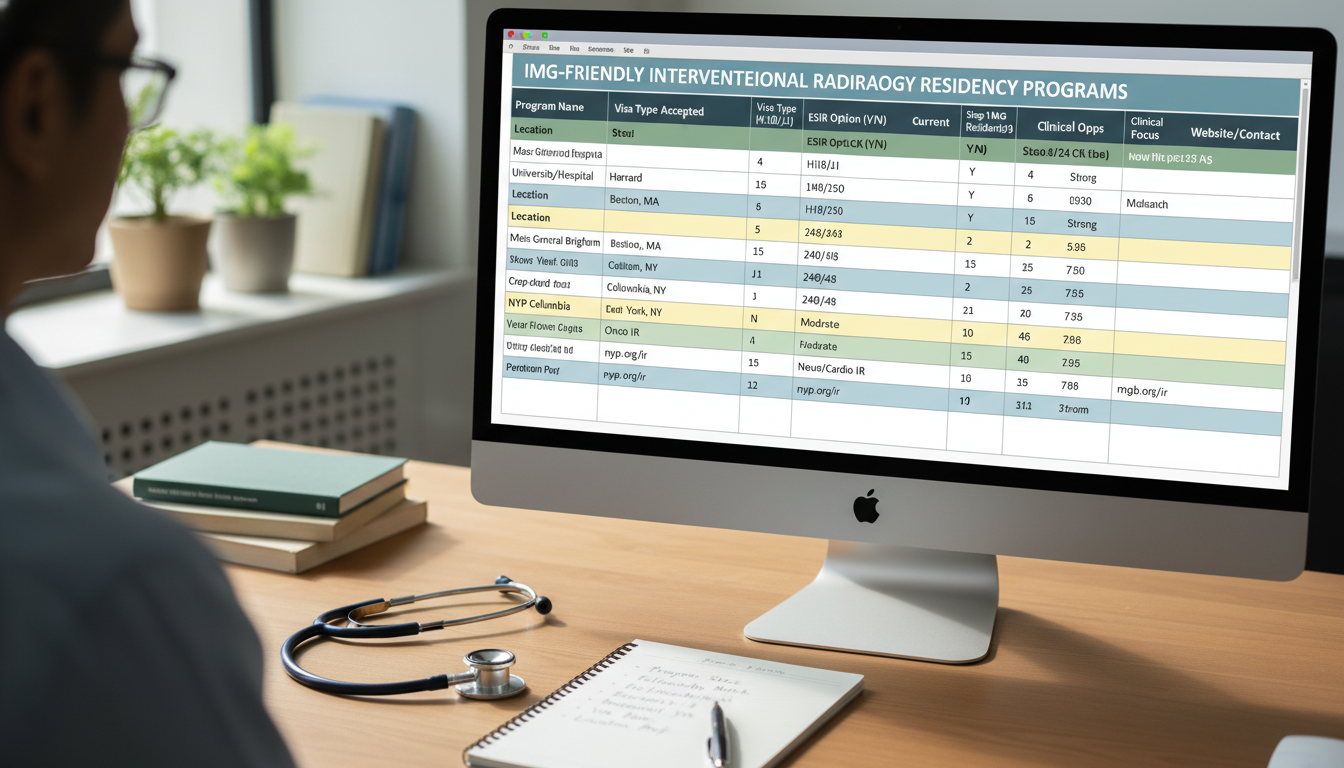
Step 2A: Create a Program Research Spreadsheet
Set up a spreadsheet with columns like:
- Program Name
- Institution / Hospital System
- City, State, Region
- Program Type: Integrated IR / DR with ESIR / DR only
- Visa Policy: J-1, H-1B, None, Case-by-case
- IMG-Friendly? (Yes / Possibly / No)
- Last 3 years: number of IMGs matched (if available)
- Presence of ESIR
- Affiliated Independent IR Residency (Yes/No)
- IR Faculty Count
- IR Case Mix (oncology, PAD, trauma, complex venous, women’s health, etc.)
- Research Opportunities (Strong/Moderate/Limited)
- Call Schedule Notes
- Location Pros/Cons
- Your Priority Tier (High/Medium/Low)
- Notes & Red Flags
This becomes your central document for evaluating residency programs and will guide your IR match planning.
Step 2B: Identify Initial Program Lists
Use multiple sources to construct your initial long list:
FREIDA (AMA Residency & Fellowship Database)
- Filter by: Radiology – Interventional & Diagnostic, Radiology – Diagnostic, etc.
- Check program details, positions, and contact info.
NRMP and ERAS Program Lists
- Use specialty filters: Interventional Radiology (Integrated), Diagnostic Radiology.
- Take note of programs participating in IR match vs DR match only.
Society of Interventional Radiology (SIR)
- Look for lists or maps of IR training programs, ESIR programs, and independent IR residencies.
Your first pass should generate a broad list (often 80–150 programs including DR + IR) before you narrow down.
Step 3: How to Research Residency Programs Systematically
Once you have your long list, now you must go deeper. Here is a step-by-step approach tailored for IR and IMGs.
3.1 Start with Non-Negotiable Filters (Visa, IMGs, Time Since Graduation)
Your first pass should apply hard filters:
Visa Sponsorship
- Go to the program’s website and FREIDA listing:
- Confirm if they sponsor J-1, H-1B, or no visas.
- If the website is unclear, email the coordinator with a short, professional question:
- “Dear [Name], I am an international medical graduate interested in your [Integrated IR / DR] residency. Could you please confirm if your program currently sponsors J-1 and/or H-1B visas?”
Any program that definitively does not meet your visa needs can be removed from your list.
- Go to the program’s website and FREIDA listing:
Time Since Graduation
- Some programs clearly state:
- “We prefer graduates within the last 5 years”
- Or “No more than 3 years from medical school graduation without substantial clinical experience”
- If you graduated more than 5–7 years ago, prioritize programs known to be more IMG-friendly and more flexible.
- Some programs clearly state:
Explicit IMG Exclusion or Inclusion
- Look for statements such as:
- “We do not accept international medical graduates”
- Or positive signals like “We welcome IMGs and have matched [X] IMGs in recent years”
- Search the program’s residents page: how many current residents have international schools listed?
- Look for statements such as:
Use these filters to reduce your list to programs where you are at least eligible.
3.2 Evaluate IR-Specific Strength and Structure
For each remaining program, evaluate how strong and accessible IR training is. This is core to any IMG residency guide focused on interventional radiology.
Key questions:
Is there an Integrated IR Residency at the institution?
- If yes:
- Are they known to take IMGs? (Check resident lists, LinkedIn, or program social media.)
- How many integrated IR positions per year?
- If yes:
Does the Diagnostic Radiology Program Offer ESIR?
- ESIR is a major asset; if accepted, it shortens independent IR training and improves competitiveness for IR.
Is There an Affiliated Independent IR Program?
- A DR program at an institution with:
- ESIR
- Independent IR residency
- Strong IR section with multiple faculty
…gives you a built-in pipeline to IR.
- A DR program at an institution with:
IR Case Volume and Diversity
- Read the IR section of the program website:
- Do they mention high volumes in oncology, PAD, trauma, hepatobiliary, neuro, women’s interventions, etc.?
- Are there dedicated IR clinics, inpatient consult services, and longitudinal patient follow-up?
- Read the IR section of the program website:
Clinical IR Identity vs “Procedure Service”
- True, modern IR is clinically oriented, not just technical:
- Look for mention of IR outpatient clinics, multidisciplinary tumor boards, and IR-led decision-making.
- This environment will shape your eventual practice and training depth.
- True, modern IR is clinically oriented, not just technical:
Record these in your spreadsheet qualitatively (e.g., IR Strength: Strong/Moderate/Weak).
3.3 Assess Academic vs Community Orientation
Programs can roughly be categorized:
Highly Academic Centers
- University-based, NIH-funded research, subspecialty IR clinics
- Pros: advanced procedures, research, strong mentorship
- Cons: may be less IMG-friendly, more competitive, heavy workload, politics
Hybrid Academic-Community Programs
- University-affiliated but based in large community hospitals
- Often good case volume with moderate research expectations
- Frequently more approachable for well-qualified IMGs
Pure Community Programs
- Focus on practical, broad IR & DR practice
- Less research but good hands-on exposure
- Sometimes more open to IMGs, but IR exposure quality can vary widely
Think about your career goals:
- If you want IR fellowship or subspecialty academic IR, prioritize academic/hybrid with strong IR research.
- If you want general IR practice, a strong community or hybrid program may be ideal.
3.4 Research Culture, Support, and Resident Outcomes
You are not only choosing training; you are choosing an environment. Investigate:
Resident Cohort and Diversity
- Check resident bios:
- Do they include IMGs?
- Are there residents with non-traditional paths, older graduates, or second careers?
- Check resident bios:
Graduate Outcomes
- Where do graduates go?
- IR fellowships (before, now independent IR) at reputable places?
- Academic vs private practice jobs?
- Some programs list recent graduates and their destinations.
- Where do graduates go?
Mentorship and Support
- Look for:
- Formal mentorship programs
- IR-specific advisors
- Systems to support research involvement
- Look for:
Wellness and Workload
- Call schedule descriptions
- Night float vs 24-hour call
- Comments in reviews (e.g., Reddit, Student Doctor Network) about burnout or support
Caution: Online forums can be biased, but broad patterns can still be informative.
Step 4: Advanced Tactics for Evaluating Programs as an IMG
Once you’ve done the basic research, refine your evaluation using more advanced strategies.
4.1 Use Social Media and Online Footprints
Many IR and DR programs actively use:
- Twitter/X, Instagram, LinkedIn
- Search: “[Program Name] radiology residency” or “[Program Name] interventional radiology”
- Look for:
- Resident spotlights
- Case highlights
- Research announcements
- Posts about away rotators or visiting IMGs
This can reveal:
- IR culture: Are they proud of their IR services and residents?
- Openness: Do they showcase diversity, IMGs, or international collaborations?
4.2 Direct Communication with Residents and Alumni
This is one of the most powerful tools in evaluating residency programs:
- Find residents or alumni on LinkedIn or through the program website.
- Send a short, respectful message:
- Introduce yourself as an IMG interested in IR/DR.
- Ask 3–4 specific questions (not “Tell me everything about your program”).
Examples:
- “How supportive is the program for residents interested in IR?”
- “Does the program actively support ESIR applications?”
- “How has your experience been as an IMG in this environment?”
- “Are graduates consistently able to secure IR positions after DR?”
Be polite, concise, and appreciative of their time.
4.3 Attend Virtual Open Houses and Webinars
Many programs hold:
- Virtual open houses
- Specialty-specific panels (IR-focused)
- Research or Q&A sessions
Do the following:
- Track dates via program social media or websites.
- Prepare concise questions that show you’ve done your homework, such as:
- “How many DR residents pursue ESIR each year, and how many are typically accepted?”
- “What kind of mentorship do IR-interested residents receive?”
- “Have recent IMGs in your program successfully matched into IR?”
Take notes and transfer key insights to your research spreadsheet.

Step 5: Prioritizing and Categorizing Programs for Your IR Match
After thorough research, you’ll have a long list with dozens of data points. Now you need to convert this into a realistic IR match strategy.
5.1 Tier Your Programs
Create categories that reflect both competitiveness and personal fit:
Tier 1: Reach Programs
- Highly academic, top-tier IR or DR programs
- Limited IMG history, or highly competitive integrated IR spots
- You apply if your credentials are strong (high USMLE, research, U.S. experience)
Tier 2: Target Programs
- Solid academic or hybrid DR programs with ESIR and/or strong IR section
- Some history of matching IMGs
- Good case volume, mentorship, and IR outcomes
Tier 3: Safety/Realistic Programs
- More IMG-friendly DR programs (and possibly a few IR programs)
- May be community or smaller university-affiliated
- IR exposure is present; ideally ESIR or strong independent IR connections, but not always
For most IMGs interested in IR, your core volume should be in Tier 2 and 3 DR programs with IR strength, with a selective application to integrated IR in Tier 1–2.
5.2 Balance DR vs IR Applications
For an IMG, a balanced program research strategy often looks like:
Integrated IR (if eligible):
- Apply broadly but realistically (for example, 10–30 programs, depending on profile).
- Recognize many may not interview IMGs without strong U.S. credentials.
Diagnostic Radiology Programs:
- This should form the bulk of your applications (often 40–80 or more).
- Prioritize:
- Programs with ESIR
- Strong IR sections
- Affiliated independent IR programs
Independent IR Later:
- Not part of your initial ERAS, but your DR choice now should set you up well for this future step.
Your final list should reflect:
- Programs that meet visa and eligibility criteria
- A mix of geographic regions and levels of competitiveness
- A clear path toward IR: integrated now, or DR → ESIR → Independent IR later
5.3 Re-Check Your List Against Your Constraints
Before finalizing:
- Verify visa status again for borderline programs.
- Confirm that programs without explicit IMG acceptance are worth the application.
- Make sure you are not overloading your list with ultra-competitive integrated IR programs at the expense of realistic DR options.
Step 6: Practical Examples of Evaluating Residency Programs as an IMG
To make this more concrete, consider two simplified example scenarios.
Example 1: IMG with Strong Profile
- Recent graduate (<2 years)
- Step 2 CK: >250
- Publications including IR case reports
- 2–3 months of U.S. IR observerships
- Requires J-1 visa
Program research approach:
Apply to 20–30 integrated IR programs:
- Prioritize those that:
- Sponsor J-1
- Have at least occasional IMGs in DR or IR
- Include several top-tier academic centers and some mid-tier academic/hybrid ones.
- Prioritize those that:
Apply to 50–70 DR programs with:
- ESIR
- Strong IR section
- IR clinics and research opportunities
Avoid:
- Programs that explicitly exclude IMGs or do not sponsor J-1
Example 2: IMG with Moderate Profile and Older Graduation
- 7 years since graduation
- Step 2 CK: 235
- Limited research, but strong clinical experience in home country IR
- No U.S. clinical electives yet
- Requires J-1
Program research approach:
Focus heavily on DR programs:
- Particularly community and hybrid programs known to be IMG-friendly
- Strongly favor any that:
- Have ESIR
- Have an affiliated independent IR program
- Have IMGs in current DR residents
Integrated IR:
- Apply to a small handful that explicitly welcome IMGs or have prior international graduates.
Consider:
- Building U.S. experience (observerships, research positions) to strengthen your IR profile.
- Prioritizing programs in less competitive locations (Midwest, South, smaller cities).
In both scenarios, the underlying approach—structured research, spreadsheet tracking, and IR-focused evaluation—remains the same.
Frequently Asked Questions (FAQ)
1. As an IMG, should I prioritize integrated interventional radiology residency programs or diagnostic radiology programs?
Most IMGs should prioritize diagnostic radiology (DR) programs with strong IR exposure, ESIR, and affiliated independent IR over applying only to integrated IR. Integrated IR is highly competitive and often favors U.S. graduates. By matching into a strong DR program with robust IR, you create a realistic and flexible pathway to IR via ESIR and independent IR. You can still apply to integrated IR as “reach” programs, but they should not be your only strategy.
2. How do I know if a residency program is truly IMG-friendly?
Look for multiple converging signs:
- The website or FREIDA explicitly states they accept international medical graduates.
- Current or recent residents include IMGs (check the residency roster).
- Social media posts or alumni lists mention IMGs.
- The coordinator responds positively when you ask about IMG applicants and visas.
- Online forums or word of mouth indicate prior IMGs have matched there.
Relying on a single indicator is risky; instead, build a picture from several sources.
3. How important is ESIR when evaluating residency programs as an IMG interested in IR?
ESIR is very important but not absolutely mandatory. Programs with ESIR:
- Allow you to complete part of IR training during DR residency.
- Make you more competitive for independent IR residency.
- Often indicate a mature IR infrastructure and culture.
However, some strong DR programs without ESIR still place residents into excellent IR positions, especially if they have an affiliated independent IR residency and strong IR faculty. ESIR is a major plus, not the only pathway.
4. Should I avoid community programs if I want a career in interventional radiology?
Not necessarily. Many community or hybrid programs offer:
- High IR case volume
- Strong hands-on experience
- Good mentorship, especially if there is a dedicated IR group
You should assess community programs carefully:
- Do they have ESIR or a history of residents going into IR?
- Is IR clinically oriented (clinics, consults) or mainly a procedure support service?
- Are there ties to independent IR residencies?
For IMGs, some community or hybrid programs can be excellent, realistic routes into IR, especially if highly academic centers are less accessible.
By approaching your search with a structured program research strategy—grounded in your goals, IMG-specific constraints, and the realities of the IR match—you will transform an overwhelming process into a manageable, data-driven project. This disciplined way of evaluating residency programs significantly increases your chances of finding the right pathway into interventional radiology as an international medical graduate.