
Understanding the Landscape: Nuclear Medicine Residency for IMGs
Choosing where to apply is one of the most high‑stakes decisions in your nuclear medicine residency journey, especially as an international medical graduate (IMG). A smart program research strategy can dramatically improve your chances of a successful nuclear medicine match, help you avoid wasted applications and fees, and ensure you end up in a program where you can truly thrive.
Nuclear medicine is a small but highly specialized field, and that works both for and against IMGs:
- Pros: Smaller applicant pool, highly niche interest, and programs often very appreciative of motivated applicants who understand the specialty.
- Cons: Limited number of positions, some programs integrated with radiology or diagnostic imaging, and variability in how open they are to IMGs.
This IMG residency guide focuses on how to research residency programs in nuclear medicine, specifically tailored to international medical graduates who may be less familiar with the U.S. system, visa processes, and the hidden culture of training programs.
By the end, you’ll know how to:
- Build a targeted list of nuclear medicine programs
- Interpret program websites beyond the marketing language
- Evaluate residency programs using IMG‑specific criteria
- Strategically narrow your list to maximize match chances
- Use networking and data to validate your choices
Step 1: Clarify Your Priorities as an IMG in Nuclear Medicine
Before you search, you need to know what you’re looking for. For IMGs, this goes beyond “good training” or “big-name hospital.” You must integrate:
- Visa realities
- Your background (e.g., nuclear medicine experience, research, radiology exposure)
- Family, financial, and geographic needs
- Long‑term career goals (academia vs community; hybrid radiology-nuclear career vs pure nuclear medicine)
Key Priority Domains to Define
Use these domains as your starting framework:
Visa and Immigration Needs
- Do you need J-1 or H-1B sponsorship?
- Are you already in the U.S. on another visa (e.g., F-1, J-1 research, H-4) and need a transition plan?
- Are there states or institutions with historically better support for IMGs?
Training Structure and Career Goals Nuclear medicine training in the U.S. can be:
- Independent nuclear medicine residency (often 3 years after internship/PGY1)
- Pathways linked with Diagnostic Radiology (e.g., combined programs, nuclear radiology fellowships after DR)
- Programs with strong theranostics, PET/CT, PET/MR, and advanced molecular imaging
Reflect on:
- Do you want a pure nuclear medicine career?
- Or do you eventually want diagnostic radiology plus nuclear?
- Are you interested in academic careers with strong research?
Program Size and Setting
- Large academic center vs medium community‑academic hybrid vs smaller community program
- Number of residents/fellows in nuclear medicine
- Volume and diversity of PET/CT, SPECT/CT, radionuclide therapy (e.g., Lu‑177, I‑131, Ra‑223)
Competitiveness and Your Profile As an IMG, consider:
- USMLE/COMLEX scores and attempts
- Graduation year (recency of graduation)
- U.S. clinical experience, especially imaging or nuclear medicine observerships
- Research in nuclear medicine, radiology, or oncology
- English fluency and communication skills
Lifestyle and Geography
- Cost of living
- Climate and safety
- Existing support system (family, friends, IMG communities)
- State licensing rules for IMGs and visas
Document your priorities in a short, 1-page “Personal Criteria Sheet.” You’ll use this later to score and compare programs objectively.
Step 2: Build a Targeted List of Nuclear Medicine Programs
Now that your priorities are clearer, you can start identifying programs systematically. This is the foundation of an effective program research strategy.
2.1 Use Official Databases First
Start with authoritative sources:
ACGME (Accreditation Council for Graduate Medical Education)
- Search ACGME for “Nuclear Medicine” residency programs.
- Confirm:
- Program accreditation status
- Number of approved positions
- Sponsoring institution
FREIDA (AMA Residency & Fellowship Database)
- Filter by specialty: Nuclear Medicine (and, if relevant, related tracks such as Nuclear Radiology).
- Use filters:
- Program size
- Visa sponsorship info (J-1, H-1B)
- Type of institution (university-based, community-based)
NRMP Data (for the Nuclear Medicine Match if applicable)
- Review specialty reports for nuclear medicine:
- Number of positions vs applicants
- Percentage of IMGs matched
- Trends over the last 3–5 years
- Review specialty reports for nuclear medicine:
These sources help ensure you are looking at current, accredited, and active nuclear medicine residency programs.
2.2 Distinguish Between Nuclear Medicine and Related Pathways
For IMGs, it’s crucial to understand the correct pathway:
Nuclear Medicine Residency (ACGME-accredited):
- Typically 3 years after an internship.
- Focused on nuclear medicine, PET/CT, radionuclide therapy, and molecular imaging.
Nuclear Radiology Fellowships (after Diagnostic Radiology):
- Suitable if you are targeting Diagnostic Radiology first, then an additional year.
Integrated or combined programs:
- Some institutions may offer combined radiology-nuclear imaging exposure.
- Read program descriptions carefully to clarify eligibility and pathways for IMGs.
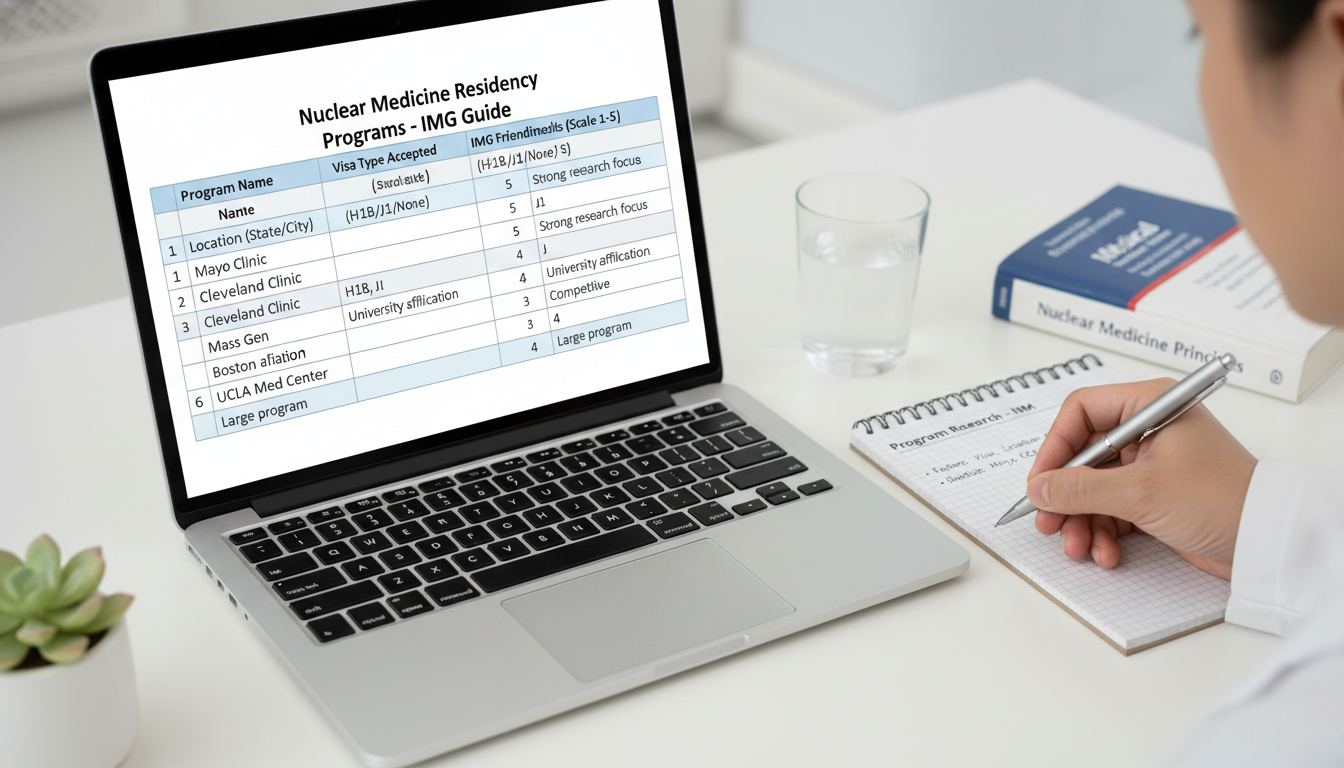
Create a spreadsheet with:
- Program name and state
- Program type (Nuclear Medicine residency vs Nuclear Radiology vs hybrid pathway)
- Number of positions
- Contact info and website link
This will become your central tracking document.
2.3 Add Secondary Sources
After building the official list, cross-check and expand with:
- Program websites (for the most current details)
- Society of Nuclear Medicine and Molecular Imaging (SNMMI) website or directories
- Institutional GME pages for visa and IMG policies
- Informal sources:
- Online forums and IMG communities
- Specialty interest groups or social media pages led by nuclear medicine departments
Treat informal sources as supplementary, never primary. Use them to guide questions, not to form conclusions.
Step 3: How to Research Residency Programs Online Effectively
Many IMGs rely almost entirely on websites. Learning how to research residency programs systematically online will help you filter quickly and accurately.
3.1 Decode the Program Website
For each program, review the following pages carefully:
Program Overview / About the Program Look for:
- Emphasis areas: PET/CT, theranostics, oncology imaging, cardiac nuclear medicine
- Type of institution: cancer center, academic medical center, VA hospital, community hospitals
- Mission statement: research-heavy vs clinically focused vs hybrid
Curriculum and Rotations Important for nuclear medicine:
- Time spent on:
- PET/CT
- SPECT/CT
- General nuclear imaging
- Radionuclide therapies (I‑131, Lu‑177, Y‑90, Ra‑223, etc.)
- Exposure to:
- Molecular imaging research
- Cross-sectional imaging (CT/MRI) correlation
- Children’s nuclear medicine (pediatrics)
- Call responsibilities and work hours
- Time spent on:
Faculty and Leadership
- How many faculty are board-certified in nuclear medicine or nuclear radiology?
- Is there a program director with a strong academic profile and interest in education?
- Are there leaders in subfields (e.g., theranostics, neuro-PET, cardiac PET)?
Residents/Fellows and Alumni
- Do they list current residents or fellows with photos and bios?
- Do they mention prior graduates’ career paths:
- Academic positions
- Private practice nuclear medicine
- Hybrid radiology-nuclear careers
- Are there examples of international medical graduate alumni, especially from your region?
Eligibility and Requirements
- Explicit references to:
- IMGs or international graduates
- Required exams (USMLE vs COMLEX, minimum scores, attempts)
- Recency of graduation
- Need for U.S. clinical experience
- Any mention of “must be graduates of LCME-accredited or U.S. schools only” (a red flag for IMGs)
- Explicit references to:
Visa Sponsorship
- Check if the site explicitly mentions:
- J-1 sponsorship
- H-1B possibility (less common but important)
- If it’s unclear, note it as “Visa unclear – must email” in your spreadsheet.
- Check if the site explicitly mentions:
3.2 Evaluate IMG-Friendliness from Public Information
Signals that a program may be IMG-friendly:
- They list current or recent residents who are clearly IMGs (e.g., international medical schools, foreign-sounding names).
- The website states: “We accept applications from international medical graduates.”
- Explicit visa sponsorship policies.
- Program photos and bios show diverse resident cohorts.
- SNMMI or departmental news showcasing international collaborations, visiting scholars, or global health work.
Signals a program may be less IMG-friendly:
- No mention of IMGs or visas.
- Narrow eligibility criteria (e.g., “U.S. or Canadian graduates only”).
- Language like “must be ECFMG certified at time of application” is standard, not a problem—but lack of any further mention may suggest IMGs are rare.
Use a simple scale in your sheet:
- IMG-Friendly Rating:
- 3 = Clear history of IMGs and explicit support
- 2 = Neutral / unclear, but no exclusion statements
- 1 = Explicitly or indirectly unfavorable to IMGs
3.3 Analyze Research and Academic Opportunities
For an international medical graduate, strong research experience can be a significant differentiator.
Look for:
- Active clinical trials in nuclear medicine or molecular imaging
- Publications listed on the department website
- Laboratories or centers such as:
- Molecular Imaging Center
- Theranostics Center
- PET Radiopharmacy or Cyclotron Facility
- Faculty with notable publications in PET/CT, theranostics, or quantitative imaging
- Options for residents to:
- Present at conferences (SNMMI, RSNA, EANM)
- Publish in imaging or nuclear medicine journals
If you are already engaged in research, you may prioritize programs where your background will be valued and extended.
Step 4: Systematic Criteria for Evaluating Residency Programs
Once you gather data, the key is how to evaluate residency programs systematically. A scoring system can help remove some bias and emotion from the process.
4.1 Create a Scoring Matrix
In your spreadsheet, add columns such as:
Visa Support (Weight: High for IMGs)
- 3: Clear J‑1 sponsorship, maybe H‑1B, history of IMGs
- 2: J‑1 only, or policy unclear but no exclusions
- 1: No visa support or unclear with U.S.-only language
IMG Track Record (Weight: High)
- 3: Multiple IMG alumni or current trainees
- 2: One or two IMGs, or unclear
- 1: No apparent IMGs; strongly U.S.-grad focused
Training Quality and Case Mix (Weight: High)
- 3: High PET/CT volume, multiple therapy procedures, academic setting
- 2: Moderate volume, some therapies, fewer advanced modalities
- 1: Limited variety, unclear exposure, or smaller practice without therapies
Research and Academic Environment (Weight: Medium)
- 3: Robust research, multiple ongoing projects, conference presence
- 2: Some research, optional involvement
- 1: Largely service-based, minimal research activity
Geography and Lifestyle Fit (Weight: Medium)
- 3: Strongly preferred region or city (family, community, climate)
- 2: Acceptable but not ideal
- 1: Less desirable region, major lifestyle tradeoffs
Competitiveness Relative to Your Profile (Weight: High)
- 3: Your scores and background align well with or exceed program norms
- 2: Reasonable but slightly below typical profile
- 1: Significant gap (e.g., older YOG, multiple exam attempts, limited experience)
Assign each category a weight (e.g., Visa ×2, IMG track record ×2, Training ×2, Research ×1, Geography ×1, Competitiveness ×2). Calculate a total score per program.
4.2 Example: Comparing Two Hypothetical Programs
You are an IMG with:
- USMLE Step 2 CK: 238
- Two nuclear medicine research abstracts
- 3 months of U.S. observerships (radiology and nuclear medicine)
- Need J‑1 sponsorship
Program A: Major University Cancer Center
- J‑1 supported, history of multiple IMGs
- High PET/CT and theranostics volume
- Strong research mission
- High overall competitiveness
Program B: Community-Academic Hybrid Hospital
- J‑1 supported, one IMG alum
- Moderate PET/CT volume, some I‑131 therapies
- Less research, more clinically focused
- Slightly less competitive
Using the scoring system, you might rate:
- Program A: Excellent training and research but borderline competitive
- Program B: Solid training, better match with your profile
Both may stay on your list, but you’ll rank them differently in priority for outreach and interview expectations.
Step 5: Going Beyond Websites – Networking and Direct Outreach
Website information often lags behind reality. To refine your IMG residency guide, you must go beyond static pages.
5.1 Contact the Program Coordinator (Strategically)
As an IMG, coordinators are key sources for:
- Visa policy specifics (J‑1 vs H‑1B)
- Application details (cutoff dates, documents, USMLE minimums)
- Clarification of ambiguous website statements
When emailing:
- Keep your message concise and professional.
- Ask specific questions, for example:
- “Does your program sponsor J‑1 visas for nuclear medicine residents?”
- “Does your nuclear medicine residency accept applications from international medical graduates who completed their medical degree outside the U.S.?”
Avoid overwhelming them with your entire CV or personal story at this stage.
5.2 Connect with Current or Former Residents
This is one of the most powerful ways to understand how to research residency programs effectively and deeply.
Ways to connect:
- LinkedIn: Search for “[Institution Name] nuclear medicine resident.”
- SNMMI trainee or young professional groups
- Alumni directories or nuclear medicine interest groups in your region
Questions to ask (politely and selectively):
- How supportive is the program for IMGs?
- What is the typical case mix (PET, therapies, general imaging)?
- How is the teaching quality and faculty accessibility?
- What is life like in the city as an IMG (cost of living, community)?
- Did the program provide help with visa and licensing processes?
Always respect their time; a 15–20 minute call or a short email exchange is valuable. Be clear that you are not asking for special favors, just insights.
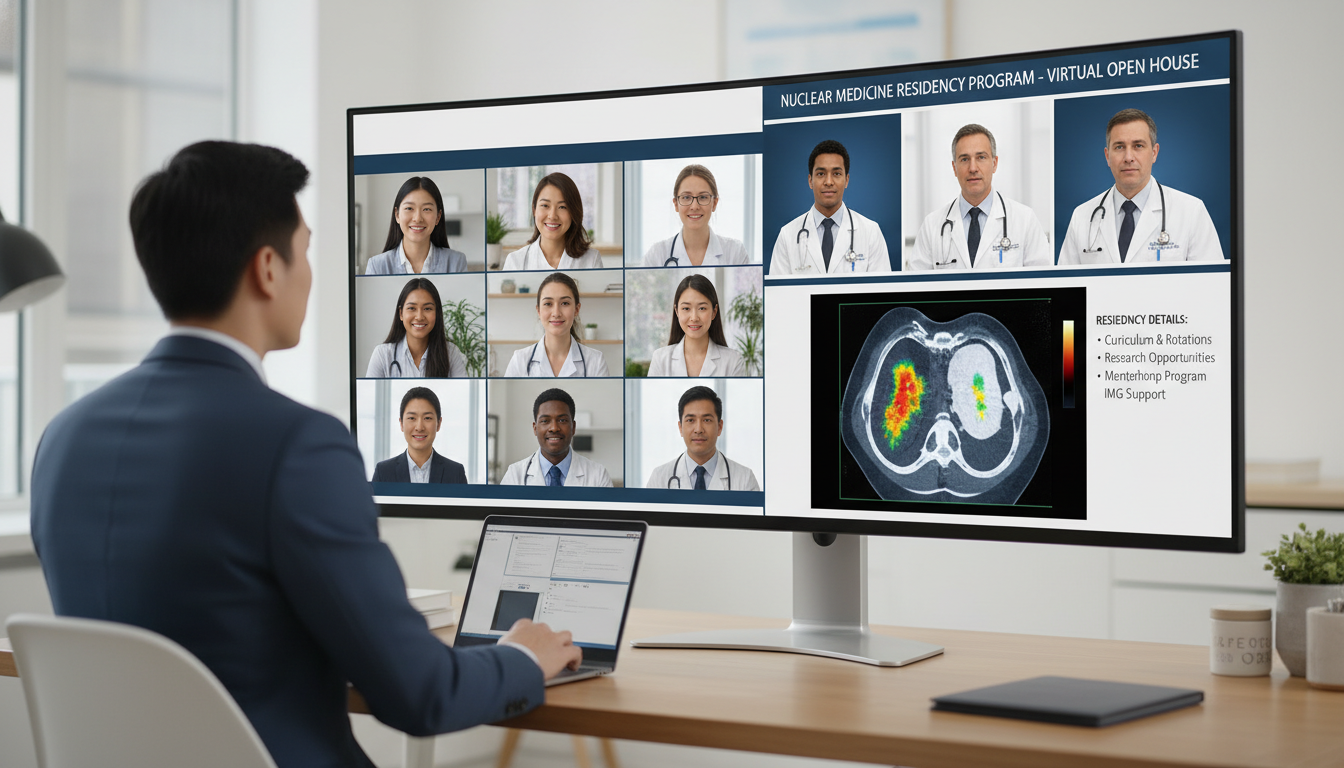
5.3 Attend Virtual Open Houses and Webinars
Many nuclear medicine programs and societies now host:
- Virtual open houses
- Q&A sessions for applicants
- Special IMG-focused or international sessions
For nuclear medicine and molecular imaging, monitor:
- SNMMI trainee events
- Departmental social media (Twitter/X, LinkedIn)
- Institutional GME announcements
Use these events to:
- Ask thoughtful questions about curriculum, research, and nuclear medicine match outcomes
- Gauge the “culture” of the program
- See how they talk about diversity and international backgrounds
Step 6: Narrowing Your List and Planning Applications
After gathering and validating information, you’ll need to refine your list to a target number of programs that balance ambition and realism.
6.1 Categorize Programs: Reach, Target, and Safety
For each program, based on your scoring and impressions:
Reach Programs:
- Highly competitive programs, top research institutions, or programs with very few positions.
- You may be slightly below typical scores or experience.
Target Programs:
- Programs where your profile matches well with past successful applicants.
- Reasonable volume and academic environment.
Safety Programs:
- Less competitive settings (smaller programs, community-based).
- Where you are clearly above or comfortably within the typical applicant profile.
In a small specialty like nuclear medicine, the total number of programs may not be huge, so your categories might look like:
- 20–30% Reach
- 40–50% Target
- 20–30% Safety
Adjust according to your financial situation and the cost of applying through ERAS or equivalent platforms.
6.2 Pay Attention to Nuclear Medicine Match Data
Use national data to calibrate your expectations:
- Typical fill rate for nuclear medicine
- Percentage of positions filled by IMGs
- Trends: Are more positions going to U.S. graduates, or is there still strong IMG representation?
If nuclear medicine has a relatively high IMG share, well-prepared IMGs with nuclear medicine exposure and clear motivation can be very competitive—especially if they have a targeted program research strategy instead of a random application list.
6.3 Pre-Application Self-Check
Before you submit:
- Ensure you meet minimum requirements for each program (USMLE, ECFMG, graduation year).
- Align your personal statement and CV with nuclear medicine–specific themes:
- Interest in PET/CT, molecular imaging, theranostics
- Experience in oncology, cardiology, or radiology interpretive fields
- Long-term commitment to the specialty
- For IMG-specific concerns:
- Confirm ECFMG status timeline
- Anticipate and prepare documentation for visa and licensing steps
If any program has ambiguous visa policies, follow up before paying application fees.
Step 7: Common Pitfalls IMGs Should Avoid When Researching Programs
As an international medical graduate, certain mistakes in program research can significantly hurt your chances or waste resources.
7.1 Applying Blindly to Every Program
Nuclear medicine is a small specialty; some IMGs assume they must apply to every program regardless of fit. This can lead to:
- Huge financial costs
- Many applications to clearly non-IMG-friendly programs
- Spreading your effort too thin
Instead, prioritize quality of research over quantity of applications.
7.2 Ignoring Visa Reality
Do not assume:
- “If they like me, they will figure out a visa.”
- “All academic programs must offer J‑1 or H‑1B.”
Reality: some programs genuinely cannot sponsor certain visas due to institutional or state rules. Always verify.
7.3 Over-Relying on Informal Gossip or Single Opinions
Hearing that “X program is bad” or “Y program loves IMGs” from one person is not enough.
- Seek multiple data points (website, coordinator, alumni).
- Consider the time gap—a program’s policy toward IMGs can change with new leadership.
7.4 Not Considering Long-Term Career Path
Especially for nuclear medicine:
- Understand if the program equips you for board certification (ABNM or ABR nuclear certification options).
- Ask about graduates’ career outcomes:
- Are they practicing pure nuclear medicine?
- Are they in hybrid imaging positions?
- Are they returning to their home countries or staying in North America?
You want a program that aligns with your future practice environment, whether in the U.S. or abroad.
Frequently Asked Questions (FAQ)
1. As an IMG, how many nuclear medicine residency programs should I apply to?
The number varies by profile, but many competitive IMGs in a small specialty like nuclear medicine may apply to 10–25 well-researched programs. Your focus should be on targeting programs that:
- Accept IMGs and sponsor the visa you need
- Match your training and research goals
- Are realistic based on your scores, experience, and graduation year
If you have lower scores or older graduation, consider applying to more programs, but always maintain a targeted list rather than applying blindly.
2. How can I tell if a nuclear medicine program is IMG-friendly?
Look for:
- Evidence of current or recent IMG residents/fellows on the website
- Explicit statements about accepting international graduates and sponsoring visas
- Responses from the program coordinator that clearly welcome or outline pathways for IMGs
- Alumni or current residents (especially on LinkedIn or SNMMI) who trained at international schools
Use these indicators together; no single sign is definitive.
3. Do I need prior radiology experience to be competitive for nuclear medicine residency?
Radiology experience is helpful but not mandatory. Strong candidates may have:
- Exposure to imaging through radiology electives, observerships, or research
- Experience in oncology, cardiology, endocrinology, or internal medicine with imaging utilization
- Clear understanding of what nuclear medicine encompasses (diagnostic imaging, PET/CT, theranostics)
If you lack formal radiology training, highlight your interest in imaging, pattern recognition, and quantitative data, as well as any related research or projects.
4. Is research essential for IMGs applying to nuclear medicine?
Research is not mandatory, but it is a strong asset, especially in an academic, technology-driven field like nuclear medicine. Helpful research areas include:
- Nuclear medicine or PET/CT projects
- Oncology or cardiology imaging studies
- Quantitative imaging, dosimetry, or molecular imaging research
Even case reports, quality improvement projects, or audit work can demonstrate your interest and initiative, especially when linked to imaging questions.
By approaching this process methodically—clarifying your priorities, using structured program research strategy tools, and engaging directly with current trainees—you can transform the overwhelming task of program selection into a deliberate, data-informed plan. As an international medical graduate pursuing nuclear medicine residency, thoughtful program research is not just about increasing your chances in the nuclear medicine match; it is about building a sustainable, satisfying career in a highly specialized and rapidly evolving field.