
Why Program Research Matters So Much for IMGs in Pathology
For an international medical graduate, the pathology match is not just about having a strong CV and good scores—it’s about targeting the right programs with a smart, deliberate program research strategy. Because pathology is relatively smaller than many other specialties and can be highly selective, choosing where to apply has an outsized impact on your outcome.
Many IMGs struggle not because they are weak applicants, but because they:
- Apply broadly without understanding which programs realistically interview IMGs
- Underestimate the importance of program fit and specific pathology interests
- Fail to distinguish between “IMG-friendly” and “IMG-possible” programs
- Miss red flags that could make training unsatisfying or unsupported
This IMG residency guide will walk you step-by-step through how to research residency programs in pathology so you can create a targeted, data-driven, and realistic application list. You will learn how to evaluate residency programs beyond reputation, understand what makes a pathology program IMG-friendly, and design a program research strategy that plays to your strengths.
Step 1: Clarify Your Own Priorities Before You Start Searching
Before asking “Is this a good program?” clarify: “Is this a good program for me?” You can’t meaningfully evaluate residency programs until you understand your own goals, constraints, and deal-breakers.
A. Academic and Career Goals in Pathology
Ask yourself:
- Career direction
- Do you see yourself mainly in academic pathology, doing research and teaching?
- Or in community practice, focusing on diagnostic work in a hospital or private lab?
- Are you interested in subspecialty training (e.g., hematopathology, cytopathology, GI, derm, neuropathology, molecular, transfusion)?
Programs vary greatly:
- Strong academic centers may emphasize research, subspecialty exposure, and fellowships.
- Community programs may offer broader general sign-out and earlier autonomy.
- Future fellowship interests
Even if you’re not sure, make a tentative list:
Hematopathology? Cytopathology? Molecular genetics? Forensic pathology?
Look for programs with:
- In-house fellowships in your area of interest, or
- Strong track records of placing graduates into those fellowships elsewhere.
- Research needs
If you need to strengthen your research portfolio (common for IMGs), target:
- Programs with structured research time,
- Attending pathologists with active publications,
- A clear history of residents presenting at national meetings (USCAP, CAP, ASCP).
B. Personal and Practical Factors
Residency is 3–4 years of your life. The program’s context matters.
Consider:
- Geography and climate: Can you tolerate harsh winters? Small cities? Rural settings?
- Visa requirements: Do you need J-1 or H-1B? Some pathology programs explicitly do not sponsor H-1B.
- Family needs: School-age children? Spouse’s job prospects? Proximity to relatives?
- Cost of living: Your resident salary won’t stretch the same in New York City as in the Midwest.
- Support networks: Are there other IMGs or people from your region at the institution?
Write down your top 5–7 priorities (e.g., “must sponsor J-1,” “academic pathology track,” “safe, family-friendly city”). These will guide your program research strategy and help you make decisions when comparing multiple options.
Step 2: Build a Long List Using High-Yield Databases and Filters
Once your priorities are clear, start constructing a long list of pathology residency programs that meet your basic criteria.
A. Use ERAS and ACGME as Your Core Databases
ERAS/AMA FREIDA Online
- Use the pathology specialty filter to generate a list of ACGME-accredited programs.
- Filter by:
- State/region
- Program type (university, community, hybrid)
- Visa sponsorship (J-1, H-1B if available)
- Note: FREIDA has an “International Medical Graduate” and “Visa” field for many programs.
ACGME Accreditation Data System
- Verify the program’s accreditation status.
- Check for any recent citations or warnings.
- You want a stable, fully accredited program while you’re in training.
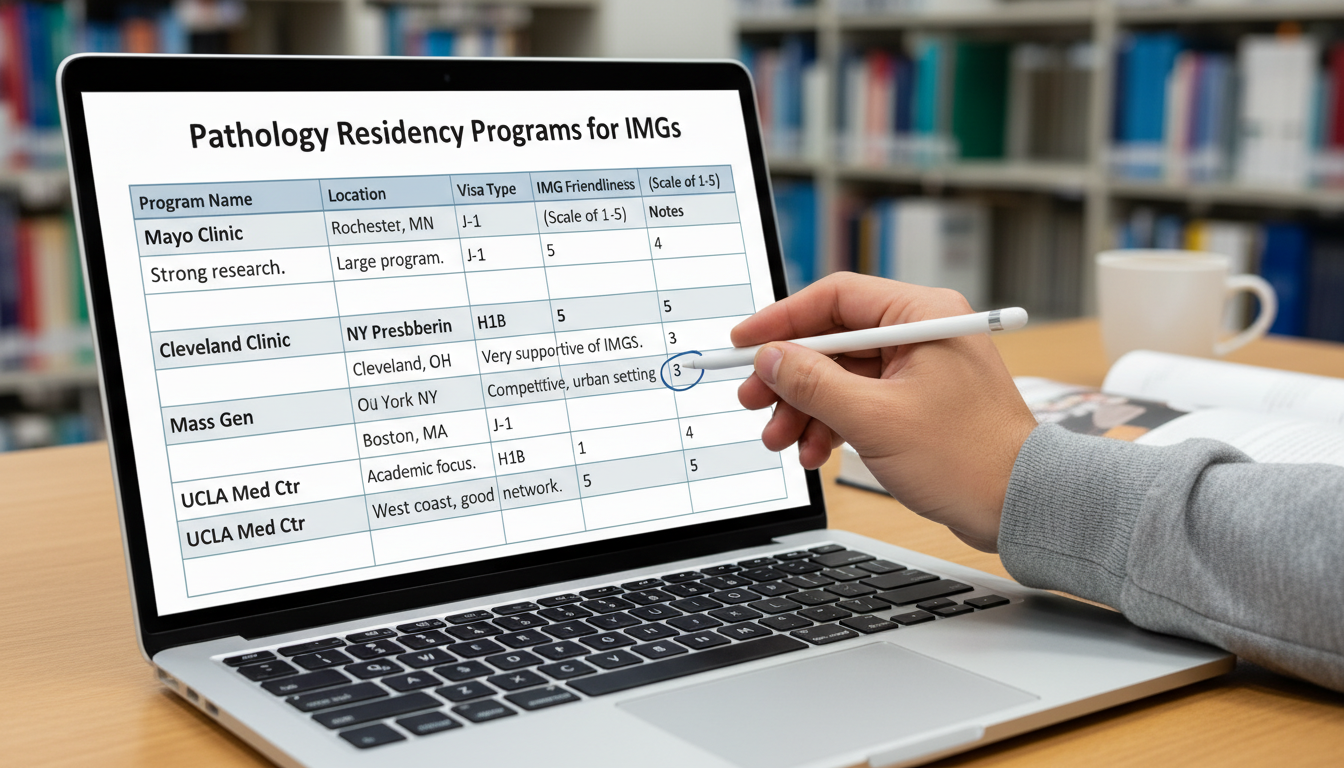
Create a spreadsheet with columns such as:
- Program name
- Location
- Program type (academic/community)
- Visa type supported
- Number of positions per year
- IMG percentage (if known)
- Website link
- Notes (initial impressions)
This will be your central hub as you continue to evaluate residency programs.
B. Use NRMP Data to Identify IMG-Friendly Programs
The NRMP’s annual Charting Outcomes in the Match and Program Director Survey are critical.
Look for:
- Percentage of non–US citizen IMGs in pathology who match
- Average USMLE scores and publications of matched IMGs
- Pathology program directors’ most important selection criteria (often LORs, performance on clinical electives, Step scores, and communication skills)
Then, check the NRMP “Results and Data” reports or individual program websites to:
- See how many positions each program offers
- Note if they historically fill with US grads only or include IMGs
While not all programs publish detailed match lists, many pathology departments highlight their resident composition, including IMGs.
Step 3: Deep-Dive into “IMG-Friendliness” and Visa Policies
For an international medical graduate, a strong pathology residency match plan depends heavily on realistic program selection. Not every program that trains one IMG is truly “IMG-friendly.”
A. How to Identify IMG-Friendly Pathology Programs
Look for these signs:
Current residents and alumni
- Go to the department or residency website → “Current Residents” or “Residents & Fellows” page.
- Do you see:
- Names suggesting diverse backgrounds?
- Explicit mentions of medical schools from outside the US/Canada?
- Many programs provide residents’ medical school names and countries.
Resident biographies
- Read the brief bios. Look for:
- IMGs from a range of countries
- Graduates from schools similar to yours (region, language, or level of international reputation)
- Read the brief bios. Look for:
Program social media
- Follow their residency program or pathology department on Instagram, X, or LinkedIn.
- Look at:
- Match Day posts (do they celebrate IMGs?)
- Resident spotlights
- Diversity and inclusion content
Historical match lists (if provided)
- Some programs show where their residents came from.
- Others show where graduates go for fellowships or jobs—indicating academic strength and reputation.
A truly IMG-friendly program typically:
- Has multiple IMGs in every class (not just a single exception)
- Mentions familiarity with visa processes
- Includes IMGs in chief resident or leadership roles
B. Visa Sponsorship: Reading the Fine Print
Visa issues are a major filter in an IMG residency guide and must be integrated into your program research strategy from the beginning.
Common scenarios in pathology:
- J-1 only: Most common. Sponsored by ECFMG.
- J-1 and H-1B: More flexibility but fewer programs; may require Step 3 before starting.
- No visa sponsorship: Only for US citizens or permanent residents.
How to confirm:
- Check the program website under “Eligibility,” “International Medical Graduates,” or “Application Requirements.”
- Some programs are vague; if unclear, email the coordinator with a concise question:
- “Dear [Name], I am an international medical graduate interested in your pathology residency. Could you please confirm whether your program sponsors J-1 and/or H-1B visas for residents?”
Always document answers in your spreadsheet. Eliminate programs that cannot accommodate your visa needs.
C. Filter by IMG-Friendliness
At this point, narrow your long list by:
- Removing programs that:
- Do not sponsor your visa type
- Have zero visible IMGs in the program and no mention of IMG policies
- Prioritizing programs that:
- Clearly have an international cohort
- Publicly welcome IMGs on their website
This will turn your long list into a targeted long list that is both realistic and IMG-appropriate.
Step 4: Evaluate the Strength and Fit of Each Pathology Program
Once you have a filtered list of IMG-possible programs, you need to evaluate quality and fit, not just whether they “take IMGs.”
A. Core Elements of a Strong Pathology Residency
When evaluating residency programs, review the following:
Case volume and diversity
- Does the program mention:
- Annual surgical pathology case numbers?
- Variety of subspecialties (oncology, transplant, pediatric, etc.)?
- A solid case mix prepares you for both exams and real practice.
- Does the program mention:
Subspecialty exposure and fellowships
- Look for in-house fellowships (e.g., cytopathology, hematopathology, molecular, GI, derm, forensic).
- Programs with multiple fellowships often:
- Attract subspecialty cases
- Provide more mentorship and post-residency options
Board pass rates
- Some programs publish AP/CP board pass rates for first-time takers.
- Consistently high pass rates suggest:
- Structured teaching
- Good exam preparation culture
Academic and research activity
- Check faculty profiles:
- Do they publish regularly?
- Are they involved in national societies (CAP, USCAP, ASCP)?
- Look for resident publications, presentations, posters.
- Ask in future interviews: “How many residents present at national meetings each year?”
- Check faculty profiles:
Resident autonomy and graduated responsibility
- Strong programs balance supervision with:
- Increasing sign-out responsibility
- Opportunities to preview cases, handle consults, and triage intraoperative consultations (frozen sections)
- Strong programs balance supervision with:
B. Evaluating Learning Environment and Culture
Website language and online presence can reveal a lot about the culture:
- Mission statements emphasizing:
- Resident wellness
- Diversity and inclusion
- Education as a top priority (not just service)
- Didactics structure:
- Regular conferences, unknown case reviews, journal clubs
- Dedicated “education afternoons” or protected teaching time
- Support for IMGs specifically:
- Mentoring systems
- Guidance on communication skills and US-style professionalism
Red flags may include:
- No mention of resident wellness or education
- Extremely heavy service expectations with minimal teaching
- High resident turnover, unfilled positions, or frequent program director changes
Step 5: Compare Programs Systematically with a Scoring Rubric
Researching dozens of programs can become overwhelming unless you use a structured comparison method. A simple scoring rubric helps you make consistent decisions.
A. Build a Personal Program Scoring System
Create 8–10 criteria, each scored from 1–5 (1 = poor, 5 = excellent), tailored to an international medical graduate in pathology:
Possible criteria:
- IMG-friendliness (number of IMGs, explicit support)
- Visa compatibility (J-1 only vs. J-1/H-1B vs. unclear)
- Academic strength (publications, research, conference presentations)
- Fellowship opportunities (in-house options or strong placement history)
- Case mix and volume (varied, complex pathology vs. limited)
- Board pass rates (if available)
- Lifestyle and location fit (city size, cost of living, climate)
- Program culture (inferred from website, testimonials, alumni comments)
- Alignment with your career goals (academic vs. community track)
- Overall “gut feeling” (based on everything you’ve seen/read)
Calculate a total score for each program and sort your spreadsheet.
This helps clarify:
- Top-tier programs to prioritize
- Mid-tier “safety” or “realistic” programs
- Programs that are technically possible but low priority
B. Use Public and Peer Feedback Cautiously
You can get additional insights from:
- Online forums (Reddit r/medicalschool, r/Residency, Student Doctor Network)
- Pathology-specific groups and IMG communities
- Alumni from your medical school who matched in pathology
Ask targeted questions:
- “How supportive is the program for IMGs?”
- “How is the workload vs. teaching balance?”
- “Do residents get time for research or conferences?”
Be cautious:
- Individual opinions can be biased or outdated.
- Use them to identify areas to look into further, not to make final decisions alone.

Step 6: Tailor Your Program Research Strategy to Your Profile
Not all IMGs are the same. Your specific background should shape how you research residency programs and where you focus.
A. If You Have Strong Scores and Research
You can reasonably target:
- More academically prestigious university programs
- Programs with strong subspecialty fellowships and established research labs
Focus on:
- Research alignment: labs or faculty whose work overlaps with your interests
- Resident research infrastructure: protected time, statistical support, funding for conferences
- History of graduates matching into competitive fellowships
B. If Your Scores Are Average or You Have Gaps
You may do better targeting:
- Mid-sized university-affiliated programs
- Community-based academic programs with solid training but less intense competition
In your research, prioritize:
- Programs that regularly accept IMGs with diverse profiles
- Strong teaching and support systems (you want a place that invests in training, not just service)
- Clearly stated minimum requirements (e.g., Step scores, time since graduation) to avoid automatic rejections
C. If You Have a Long Gap Since Graduation or Need US Experience
For IMGs with older graduation dates:
- Focus on programs where:
- Current residents include several IMGs with varied graduation years
- They explicitly state flexibility about “years since graduation”
- Look for:
- Opportunities for observerships or research positions within the same department
- Pathology departments that welcome visiting scholars or outside rotators
Your program research will also include exploring pre-residency opportunities at places where you might later apply.
Step 7: Use Email and Networking Strategically (Without Overdoing It)
Direct communication can add valuable detail that websites don’t provide.
A. When and How to Email Programs
It is reasonable to email when:
- Visa policy is unclear
- IMG eligibility is not specified
- You are completing or have completed a rotation/research there and want to express genuine interest
Keep emails:
- Short, polite, and specific
- Focused on questions that are not answered on the website
Example:
Subject: Question about IMG Eligibility – Pathology Residency
Dear Ms. Smith,
I am an international medical graduate from [Country], planning to apply to pathology residency this cycle. I have reviewed your website but could not find information regarding visa sponsorship.Could you please let me know whether your program sponsors J-1 and/or H-1B visas for residents?
Thank you for your time and assistance.
Sincerely,
[Your Name], MD
Record the response in your spreadsheet. This keeps your program research systematic and avoids repetitive questions.
B. Networking with Faculty and Alumni
If you have:
- Done electives, observerships, or research in US pathology departments
- Worked with pathologists who trained at US programs
Ask respectfully:
- For their perspective on particular programs
- Whether they know of departments that are particularly IMG-supportive
- If they can help you understand program culture, not necessarily to “get you in”
These conversations give context that’s rarely visible online, and can help refine how you’re evaluating residency programs.
Step 8: Finalize a Balanced Application List
As the application season approaches, convert your researched list into a realistic application strategy.
A. Strive for a Mix of Program Competitiveness
Based on your scoring rubric and self-assessment, aim for a mix like:
- Ambitious / Reach:
Prestigious academic centers, high research intensity, strong fellowships; they take IMGs but are selective. - Realistic / Target:
Solid university or community-academic programs, consistent IMG intake, good training and fellowship outcomes. - Safer Options:
Smaller programs, less famous locations, but demonstrably IMG-friendly and stable.
The actual number of programs depends on your budget, profile, and level of risk tolerance, but many IMGs in pathology apply to 40–60 programs or more. Your careful program research allows you to apply intelligently rather than randomly.
B. Keep Updating Your Information
Websites change, policies evolve, and programs occasionally lose or gain accreditation or fellows. Each year:
- Re-check visa and IMG policies before applying
- Verify that program directors, coordinators, and contact details are up to date
- Monitor recent match outcomes and resident class composition where available
Pathology is a dynamic field—especially with digital pathology and molecular diagnostics—so ensure the programs you target are evolving and forward-looking.
Frequently Asked Questions (FAQ)
1. How many pathology residency programs should an IMG apply to?
There is no universal number, but many non–US citizen IMGs apply to 40–60 pathology programs to maintain reasonable match odds. The quality of your program research strategy matters as much as quantity. If you are a strong applicant (high scores, research, US experience), you may match with fewer applications. If you have lower scores, older YOG, or limited US exposure, leaning toward the higher end of that range is wise.
2. How can I tell if a program really accepts IMGs or just one exception?
Look for:
- Multiple IMGs in current and recent resident classes (on the website or social media)
- Diversity of medical schools represented
- Clear statements about IMGs and visas on the website
- NRMP or FREIDA information confirming non–US grad participation
One isolated IMG from 10 years ago does not make a program IMG-friendly. A consistent pattern of international medical graduate representation is a better indicator.
3. Is it better for an IMG to choose community or university pathology programs?
Both can be excellent, depending on your goals:
University/academic programs:
- More research and teaching opportunities
- More subspecialty exposure and in-house fellowships
- Often more competitive, but many are IMG-friendly
Community or community-affiliated programs:
- Broad general pathology training
- Possibly more autonomy and hands-on experience early
- Sometimes more open to IMGs, especially outside major cities
Your program research should evaluate case mix, teaching quality, IMG-friendliness, and fellowship prospects, rather than relying only on the label “university” or “community.”
4. How important is research when evaluating pathology residency programs as an IMG?
Research is quite important for:
- Academic careers and subspecialty fellowships
- Strengthening an IMG’s profile in the pathology match
When evaluating residency programs, look for:
- Residents regularly presenting at USCAP, CAP, ASCP, etc.
- Protected research time or elective time usable for research
- Faculty with active grants and recent publications
However, a clinically strong community program without extensive research can still provide excellent training if your career goal is primarily diagnostic practice rather than academia. Tailor your priorities to your own path.
By approaching this process methodically—clarifying your goals, using structured data sources, assessing IMG-friendliness and visa options, and systematically evaluating residency programs—you greatly increase your chances of a successful pathology residency match as an international medical graduate. Your time spent now in careful, strategic program research is one of the highest-yield investments you can make in your future career.