Understanding the Landscape: PM&R Residency for IMGs
Physical Medicine & Rehabilitation (PM&R), or physiatry, is a smaller specialty compared to internal medicine or pediatrics, but it is highly desirable and increasingly competitive—especially for the international medical graduate. Before diving into how to research residency programs, you need a clear picture of the terrain you’re navigating.
Why program research matters even more for IMGs
As an IMG, you face additional filters and scrutiny in the physiatry match:
- Some programs do not sponsor visas
- Others accept IMGs but have implicit score or graduation-year cutoffs
- A subset has never (or rarely) interviewed or matched IMGs
- PM&R is relatively small; each program’s culture and exposure (inpatient vs outpatient, pain vs MSK vs neurorehab, etc.) vary widely
Randomly applying to every program is expensive and inefficient. A structured program research strategy helps you:
- Target programs realistically open to IMGs
- Prioritize those aligning with your career goals (academic vs community, pain vs neuro, etc.)
- Tailor your personal statement and interview prep to demonstrate fit
- Avoid wasting money on applications where you’re extremely unlikely to be considered
Think of this as your IMG residency guide specifically tailored to PM&R: understanding the specialty, then systematically evaluating residency programs using reliable data.
Step 1: Clarify Your PM&R Career Goals and Constraints
Before searching for programs, get clarity on what you are looking for. That will shape how you research and evaluate each residency.
A. Define your PM&R career interests
PM&R is diverse. Your interests influence which programs are a better fit:
Ask yourself:
- Am I more drawn to:
- Inpatient rehabilitation (stroke, spinal cord injury, TBI, complex medically ill rehab)?
- Outpatient MSK / sports (joint injuries, musculoskeletal ultrasound, procedures)?
- Pain medicine (interventional pain, chronic pain management)?
- Neuromuscular & electrodiagnostics (EMG, NCS)?
- Pediatrics rehabilitation (CP, spina bifida, developmental disabilities)?
- Do I envision a career in:
- Academic medicine (teaching, research, fellowship, university hospital)?
- Community practice (general physiatry, rehab hospital, outpatient clinics)?
You do not need to have everything decided, but even a “top 2–3 interests” list will help you judge whether a program’s case mix and curriculum fit your goals.
B. Identify your personal constraints as an IMG
These non-negotiables should be clear before you start comparing programs:
- Visa requirements
- Do you need J-1 or H-1B sponsorship?
- Are you already in the US on a different visa (e.g., F-1, J-2) that affects choices?
- Timeline since graduation
- How many years since you graduated from medical school?
- Some programs have cutoffs (e.g., “within 5 years of graduation”)
- USMLE / COMLEX scores
- Are your scores around/above the recent PM&R match averages for IMGs?
- Do you have any attempts or low scores?
- US clinical experience (USCE)
- Do you have PM&R-related USCE (electives, observerships, externships)?
- Any letters of recommendation from US physiatrists?
- Geographic factors
- Restrictions based on family, finances, or support system?
- Preference for specific regions (Northeast, South, Midwest, West)?
Write these down. When you later filter programs, you’ll compare each against this list.
Step 2: Build Your Initial Program List Using Reliable Data Sources
You now know your needs and goals. Next, build a master list of PM&R residency programs and then narrow it to a focused target list. This is the foundation of a solid program research strategy.
A. Start with official directories
Use official sources first—they are usually the most accurate and current.
ACGME Program Search
- Search for Physical Medicine & Rehabilitation programs
- Confirm:
- Accreditation status (no probation/warnings ideally)
- Program length (usually 4 years PGY-1–4 or 3 years PGY-2–4 with advanced positions)
- Program location and sponsoring institution
ERAS / AAMC
- Use the ERAS Program Directory for PM&R
- Check:
- Whether they participate in ERAS for the coming cycle
- Contact info (email, coordinator, website link)
- Notes on visa sponsorship if listed
FREIDA (AMA)
- Filter for PM&R residency and then by region, size, and other features
- FREIDA often includes:
- Minimum score expectations
- USMLE/COMLEX acceptance
- Some information on IMGs, visas, and alumni work locations
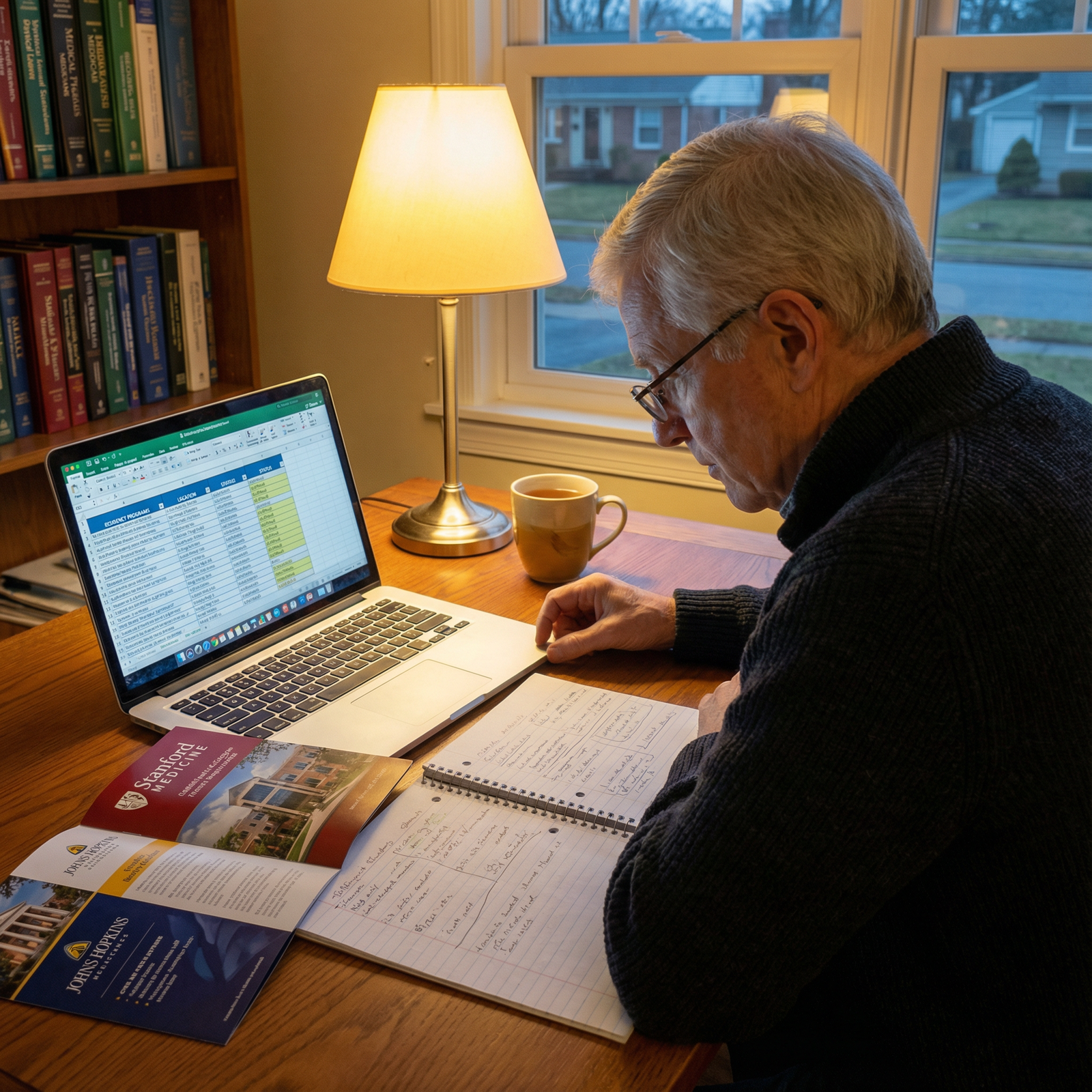
Combine these into a single spreadsheet (Google Sheets / Excel) with columns like:
- Program name
- City/State
- University vs community
- Website link
- Contact email
- Visa sponsorship (J-1 / H-1B / none / unclear)
- IMG presence (yes/no/unknown)
- Notes (from website, word-of-mouth, etc.)
This document will become your central tool for evaluating residency programs.
B. Cross-check with NRMP and match data
To understand competitiveness and your relative position, use NRMP resources:
- NRMP Charting Outcomes in the Match (if available for recent years)
- Find data for international medical graduates in PM&R
- Note:
- Average Step scores for matched vs unmatched IMGs
- Match rates for IMGs in PM&R
- NRMP Program Director Survey
- See what PM&R PDs value most:
- USMLE Step scores
- Letters from physiatrists
- US clinical experience
- Performance in PM&R rotations
- Research or scholarly work
- See what PM&R PDs value most:
This doesn’t give program-level info, but it sets realistic expectations and helps you prioritize which strengths to highlight when you research individual programs.
C. Supplement with specialty-specific resources
Look for PM&R-focused sources that also mention program characteristics:
- AAPM&R (American Academy of Physical Medicine and Rehabilitation)
- Resident and medical student sections
- Some institutions share program presentations or overviews
- AAP (Association of Academic Physiatrists)
- Lists of member departments
- Opportunities for student/resident events where programs present themselves
- PM&R-focused student interest groups
- Virtual meet-ups, Q&A sessions with programs
- Can help you learn about culture and IMG-friendliness informally
These sources can help you identify lesser-known programs that may be more welcoming to IMGs or more aligned with your specific clinical interests.
Step 3: Use Program Websites to Assess Fit and IMG-Friendliness
After forming a broad list of PM&R programs, start deep dives into each program’s website. This is where your how to research residency programs skills become critical.
A. Core questions to answer from every website
For each program, systematically look for answers to these questions and log them in your spreadsheet:
Do they sponsor visas?
- Look under Eligibility, Application Information, or FAQ pages
- Explicit phrases:
- “We sponsor J-1 visas” (common)
- “We sponsor H-1B visas” (less common, highly valuable if you need H-1B)
- “We do not sponsor visas” (eliminate if you require sponsorship)
- If unclear, mark as “Unknown – email needed”
Do they accept IMGs?
- Look for:
- Lists/photos of current residents with medical schools
- Statements like “We accept applications from US and international medical graduates”
- Some explicitly state they do not consider IMGs or require US citizenship/permanent residency
- Look for:
What are their minimum requirements?
- USMLE/COMLEX:
- Minimum Step 1/2 scores (if listed)
- Whether they accept COMLEX only, or require USMLE for DOs/IMGs
- Year of graduation cutoff (e.g., “within the last 5 years”)
- Requirements for US clinical experience, e.g., “at least 3 months of USCE” or “prior US residency required”
- USMLE/COMLEX:
What is the clinical structure and exposure?
- Inpatient vs outpatient balance:
- Dedicated rotations in SCI, TBI, stroke, general rehab
- Amount of time in MSK, sports, pain clinics
- Exposure to:
- Electrodiagnostics (EMG/NCS)
- Ultrasound-guided procedures
- Spasticity management (Botox, intrathecal baclofen)
- Prosthetics & orthotics
- Community vs tertiary-care academic center
- Inpatient vs outpatient balance:
What is the educational environment like?
- Didactics:
- Weekly lecture schedules, journal clubs, board review
- Research:
- Required scholarly projects
- Access to mentors in your interest areas (e.g., SCI, sports, pain)
- Fellowships:
- Do they have in-house fellowships (SCI, TBI, pain, sports, peds pharm, etc.)?
- Where do their graduates match for fellowship?
- Didactics:
B. Red flags and green flags for IMGs
When evaluating residency programs, certain patterns matter more for international medical graduates:
Green flags:
- Current or recent international medical graduates on resident roster
- Clear statement: “We sponsor J-1 and/or H-1B visas”
- Transparent criteria: they explicitly mention IMGs in their application section
- Leaders or faculty who themselves trained as IMGs (often more understanding of IMG challenges)
- Active diversity & inclusion initiatives that mention immigrant or international backgrounds
Red flags:
- “We only accept graduates from LCME-accredited US/Canadian medical schools”
- “US citizenship or permanent residency required”
- No mention of visas, and no IMGs among current or recent residents
- Extremely rigid cutoff (e.g., “Graduation within 3 years” when you graduated 7 years ago)
- No contact or outdated website—may indicate limited attention to recruitment and education
Make your spreadsheet work for you: color-code programs (e.g., green = high potential, yellow = maybe, red = unlikely) based on visa, IMG history, and baseline alignment with your goals.
Step 4: Go Beyond Websites – Reputation, Culture, and Outcomes
Program websites show the official face; you also need insight into culture, support, and hidden strengths/weaknesses. This matters a lot for evaluating residency programs as an IMG, because you need environments that are both educationally strong and supportive of international trainees.
A. Talk to people: networking strategically
For PM&R, networking can be particularly impactful because the community is relatively small and interconnected.
Who to contact:
- Residents or recent graduates
- Look up resident names on the website; some list emails
- Connect via LinkedIn or alumni networks from your home institution
- Faculty with similar interests
- If you’re interested in SCI, reach out to the program’s SCI attending
- IMG mentors
- IMGs who have already matched into PM&R
- Members of IMG sections in organizations (AAPM&R, AAP, etc.)
How to approach professionally:
- Use a concise email:
- Introduce yourself (IMG, current status, visa need)
- Express specific interest in PM&R and their program
- Ask 3–4 focused questions only (e.g., IMG support, visa, clinical exposure)
- Be respectful of time; avoid long life stories in the first message.
Example questions to ask a current resident:
- “How supportive is your program of international graduates in terms of visa, onboarding, and cultural adaptation?”
- “How would you describe the balance between inpatient and outpatient PM&R?”
- “Do residents regularly match into competitive fellowships from your program?”
- “What do you wish you had known about the program before you joined?”
These conversations can reveal whether the program genuinely values and supports IMGs, not just tolerates them.
B. Use online forums and social media carefully
Platforms like Reddit (r/MedicalSchool, r/Residency), Student Doctor Network, and WhatsApp/Telegram IMG groups may offer insider information, but treat them as supplementary, not primary sources.
Look for patterns:
- Multiple independent reports about:
- Strong teaching and mentorship
- Fair workload and call schedule
- Respectful culture and wellness support
- Consistent negative themes:
- Chronic understaffing or excessive scut work
- Poor support for visa issues or licensing
- Lack of supervision or teaching
Always cross-check anecdotal comments with more objective data (accreditation status, board pass rates, faculty publications, etc.).
C. Evaluate outcomes: where do graduates go?
An important, often overlooked dimension when researching residency programs is to see what happens after graduation.
On program websites or through residents, try to find:
- Fellowship matches:
- Do graduates match into:
- Pain medicine
- Sports medicine
- SCI, TBI, pediatrics, neuromuscular, etc.?
- At reputable institutions?
- Do graduates match into:
- Practice patterns:
- Are graduates working in:
- Academic hospitals
- Large rehab networks
- Private practice MSK/sports clinics
- Are graduates working in:
- Board pass rates:
- First-time pass rate for ABPMR (American Board of Physical Medicine & Rehabilitation) exams
For an IMG, strong outcomes suggest:
- Solid clinical training
- Good reputation among fellowship programs and employers
- A supportive environment where residents meet their goals—critical if you later need sponsorship or academic positions.

Step 5: Prioritize and Categorize Programs for a Smart Application Strategy
At this stage, you have data from directories, websites, and networking. Now refine your list into a focused, realistic set of programs to apply to.
A. Create tiers: dream, target, and safety programs
For a thoughtful physiatry match strategy, categorize your programs:
Reach (“dream”) programs
- Highly academic, prestigious, very competitive
- You may be slightly below their typical score range or they rarely take IMGs
- You still meet minimum requirements and/or have some compensating strengths (research, strong LORs, unique experience)
Target programs
- Reasonable alignment with your scores, experience, and visa needs
- Have a history of accepting IMGs
- Clinical and academic profile matches your interests
Safety programs
- Clearly IMG-friendly (regularly take IMGs)
- Requirements well within your metrics
- Perhaps smaller or less-known geographically, but still ACGME-accredited and solid training
The exact numbers depend on your profile, but many IMGs in PM&R aim for something like:
- 20–30 PM&R programs total, with a mix across the three tiers
(Adjust up if you have significant red flags, down if you have a very strong overall application and budget constraints.)
B. Prioritize based on fit, not just prestige
As an international medical graduate, your success and growth might be better at a supportive mid-tier program than at a famous but IMG-averse institution.
Weight these factors when ranking:
- Visa sponsorship guaranteed vs uncertain
- Evidence of IMG success (past residents’ stories, fellowship placement)
- Specific exposure important to you (e.g., strong SCI service if you love neurorehab)
- Geographic considerations (cost of living, support network, climate)
- Culture: resident happiness, mentorship, openness to diversity
A program where you are welcomed and supported will be far more valuable than a big name that sees you as “just another number” or a “borderline applicant.”
C. Maintain an organized, living document
Keep updating your spreadsheet as you:
- Receive email responses from coordinators
- Talk with residents and alumni
- Attend virtual open houses or information sessions
Add columns like:
- Interested to apply? (Y/N)
- Priority ranking (1–3)
- Specific notes to highlight in personal statement (e.g., “strong SCI rotation,” “robust EMG training,” “research with Dr. X in stroke rehab”)
This approach ensures your applications are targeted and personalized, rather than generic mass submissions.
Step 6: Use Your Research to Strengthen Applications and Interviews
Effective program research does more than help you choose where to apply; it also directly improves your application quality and interview performance.
A. Tailor your personal statements and program-specific messages
Use your knowledge of each program to show genuine interest and fit:
- Highlight relevant experiences:
- If a program is known for SCI rehabilitation, emphasize your related volunteer work, rotations, or research.
- If they prioritize musculoskeletal ultrasound, mention your interest and any hands-on exposure.
- Mention specific program features:
- “I am particularly drawn to your program’s strong focus on interdisciplinary inpatient rehabilitation and early exposure to electrodiagnostics.”
- “Your department’s integrated pain and MSK clinic aligns closely with my interest in outpatient physiatry.”
For some programs, you may send follow-up emails or update letters later in the season; having detailed notes makes this efficient and authentic.
B. Prepare targeted questions for interviews and open houses
When you’ve done your homework, your questions stand out as thoughtful and specific. Examples:
- “I noticed you have 4–5 months of dedicated EMG training. How early in residency do residents start hands-on EMG procedures?”
- “For IMG residents, how does the program support adaptation to the US healthcare system and documentation expectations?”
- “What has been the recent experience of your graduates in obtaining pain or sports fellowships?”
- “Could you describe the typical balance between inpatient rehab and outpatient clinics by PGY-4 year?”
These questions reveal your genuine interest and help you gather more data to refine your rank list later.
C. Rank list decisions based on evidence, not emotion
After interview season, revisit your research:
- Cross-check:
- Initial impressions vs what you learned on interview day
- How programs treated IMGs during the process (communication, respect, clarity on visas)
- Consider:
- Where did you feel most supported and welcomed?
- Which programs best match your long-term PM&R goals?
Use your spreadsheet and notes to craft a rank list that balances dream opportunities with realistic outcomes and supportive cultures.
FAQs: Researching PM&R Residency Programs as an IMG
1. How can I quickly identify IMG-friendly PM&R programs?
Look for three main signs:
- History of IMGs
- Check resident rosters for international medical graduates and their schools.
- Clear visa policy
- Explicit statements like “We sponsor J-1 visas” or “We accept qualified IMGs” on the website.
- Transparent criteria
- Programs naming USMLE minimums and graduation year limits are often more open and organized, even if selective.
Then cross-check with informal sources (residents, alumni, forums) to confirm.
2. Is it worth applying to PM&R programs that don’t clearly state their visa policy?
Only cautiously. If:
- You strongly like the program’s training and location, and
- You have time to email the coordinator for clarification,
then you can include a few such programs. But avoid building your list around uncertainty. Prioritize programs with clear statements and a history of sponsoring your needed visa type.
3. How important is US clinical experience in PM&R specifically?
Very important. For an IMG in physiatry:
- PM&R-specific USCE (electives, observerships) shows:
- You understand the specialty’s realities
- You can function in US clinical environments
- It often leads to letters of recommendation from US physiatrists, which PM&R program directors weigh heavily.
- If you cannot secure PM&R electives, try rotations in:
- Neurology, orthopedics, internal medicine rehab units, or pain clinics
These provide at least partial relevance and local references.
- Neurology, orthopedics, internal medicine rehab units, or pain clinics
4. I have marginal USMLE scores. How should that affect my program research strategy?
If your scores are below the typical matched IMG range:
- Be more selective with reach programs and increase your number of safety/target programs.
- Focus on programs that:
- Emphasize holistic review
- Have a track record of taking IMGs
- Do not publish strict high score cutoffs
- Strengthen other areas:
- Robust PM&R exposure and USCE
- Strong letters from physiatrists
- Consistent commitment to rehabilitation in your CV and personal statement
Researching programs thoroughly will help you avoid wasting applications on places that are score-obsessed and closed to IMGs.
By following this structured approach to how to research residency programs in PM&R—grounded in reliable data, focused networking, and honest self-assessment—you transform your search from guesswork into a targeted program research strategy. As an international medical graduate, that preparation is one of the strongest advantages you can create for yourself in the physiatry match.