
Understanding the Big Picture: Why Program Research Matters So Much for IMGs
For an international medical graduate (IMG) pursuing psychiatry in the United States, how you research residency programs can be as important as your scores, CV, or letters. Thoughtful, structured research directly affects:
- Where you have a realistic chance to match
- How many programs you should apply to
- How you tailor your personal statement and ERAS application
- Which programs you ultimately rank for the psych match
- Your long-term well-being and career satisfaction as a psychiatrist
Many IMGs fall into two traps:
- Mass applying to hundreds of programs with minimal research
- Over-filtering and missing strong-fit programs because of assumptions or hearsay
This IMG residency guide focuses specifically on how to research residency programs in psychiatry, with a structured, stepwise program research strategy you can implement immediately.
Step 1: Define Your Personal and Professional Priorities
Before diving into databases and spreadsheets, clarify what you need and want. This isn’t generic advice—your research quality depends on how clearly you define your criteria.
Think in three categories:
1. Academic and Training Priorities
Consider what kind of psychiatrist you want to become:
Type of practice you’re leaning toward
- Outpatient vs inpatient psychiatry
- Community mental health vs academic vs private-practice–oriented
- Interest in subspecialties: child & adolescent, addiction, forensics, consult-liaison, geriatric, psychosomatic, etc.
Research interest
- Do you want programs with significant psychiatry research output?
- Are you aiming for a future fellowship at a big-name institution?
- Are you content with minimal/no research so long as clinical training is strong?
Psychotherapy training
- Some programs emphasize psychotherapy with robust supervision (psychodynamic, CBT, DBT, etc.).
- Others are more biologically focused and medication-management oriented.
Program size and structure
- Large academic program vs small community-based program
- Single main hospital vs multiple training sites
- Presence of other learners (medical students, APPs, psychology trainees)
2. Immigration and Practical Considerations
As an IMG, these can be deal-breakers:
- Visa sponsorship
- J-1 only vs J-1 and H-1B vs no visa sponsorship
- History of consistently sponsoring IMGs and renewing visas
- Board exams / graduation
- Minimum USMLE/COMLEX step cutoffs
- Maximum years since graduation (YOG)
- Requirement for US clinical experience (USCE) and what counts
- Geographic constraints
- Need to be near family or a support system
- Preference for certain climate or cities vs smaller towns
- Cost of living
- Major cities with high rent vs more affordable areas
- Ability to live comfortably on a resident salary
3. Personal Values and Lifestyle
Residency is intense; environment matters:
- Culture and support
- IMG-friendly environment
- Diversity and inclusion
- Resident support systems and wellness initiatives
- Workload and schedule
- Typical call schedule, night float, weekend coverage
- Culture of staying late vs respecting work-hour limits
- Patient population
- Safety-net hospital vs private, insured population
- Exposure to severe mental illness, substance use, trauma, asylum seekers, etc.
- Interest in specific populations (e.g., LGBTQ+ mental health, refugee mental health)
Actionable exercise:
Write down your top 5 “must haves” and top 5 “nice to haves.” You will use these later when evaluating residency programs.
Step 2: Build Your Initial Long List Using Objective Filters
This is where your IMG residency guide transitions from reflection to action. Your first goal is to build a long list of psychiatry residency programs that are:
- Eligible for you (visa, graduation year, exam scores)
- Not obviously out of reach based on their published criteria
Core Research Tools for IMGs in Psychiatry
Use several sources together; no single source is perfect.
FREIDA (AMA Residency & Fellowship Database)
- Filter by: Specialty → Psychiatry
- Then refine:
- IMG friendliness: number/percentage of IMGs in program
- Visa sponsorship: J-1 / H-1B / none
- Program size (number of residents per year)
- Note: Some details (like specific score cutoffs) may not be listed; you’ll supplement with program websites.
Program Websites (Official Source of Truth)
For each program, you’re looking for:- Stated visa policy (J-1, H-1B, both, or none)
- USMLE minimums (if any) or preferences
- Years since graduation limits
- USCE requirements
- Number of categorical psychiatry positions per year
- Name and email of program coordinator/director
- Description of curriculum and training sites
NRMP Data (for Psych Match Competitiveness)
- Use the NRMP “Charting Outcomes” and “Program Director Survey” (for Psychiatry):
- Percent of positions filled by IMGs in psychiatry
- Average Step scores of matched IMGs
- Factors program directors rank as most important (letters, USCE, personal statement, etc.)
- This helps you understand where you stand vs typical matched candidates and which programs may be more IMG friendly.
- Use the NRMP “Charting Outcomes” and “Program Director Survey” (for Psychiatry):
ERAS and AAMC Resources
- ERAS Participating Specialties & Programs gives a sense of participating psychiatry programs.
- Some programs use ERAS filters (YOG, Step scores); others state this directly on their websites.
How to Apply Objective Filters Efficiently
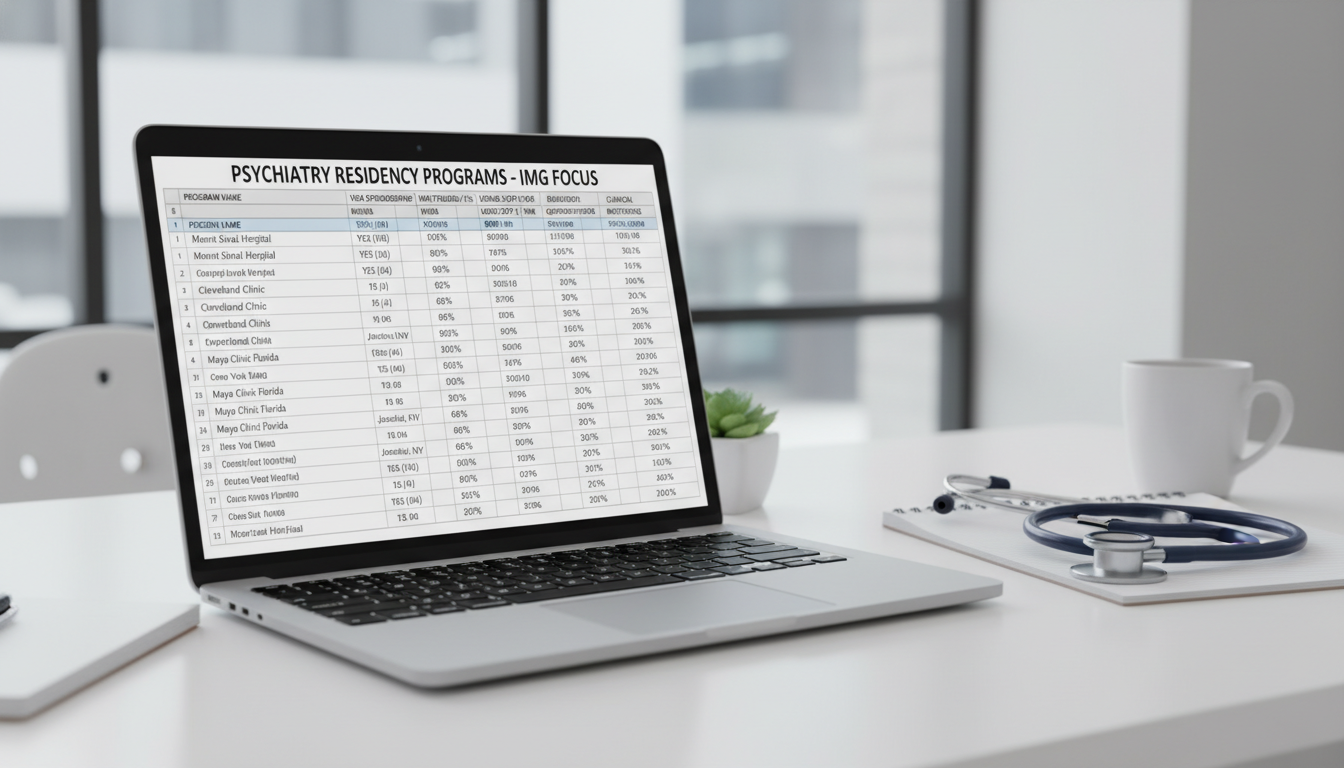
Create a simple spreadsheet (Excel/Google Sheets) with the following columns:
- Program Name
- State / City
- University vs Community vs Hybrid
- J-1? H-1B?
- IMGs in Current Residents (Yes/No/Number)
- Approx. % IMGs (if public or estimate from resident bios)
- USMLE Cutoff / “require passing on first attempt?”
- YOG Limit (if any)
- Requires USCE? (Y/N/type)
- Number of PGY-1 Psychiatry Positions
- Website Link
You can later add more subjective columns (like “culture” or “teaching quality”), but start with objective data first.
Example:
Say you are an IMG with:
- YOG: 2019
- USMLE Step 2: 237 (Step 1: pass)
- 4 months of USCE in psychiatry
- Needs J-1 sponsorship; H-1B is a bonus
Your initial filters might be:
- Psychiatry programs that:
- Explicitly accept IMGs or clearly have IMGs in current residents
- Sponsor J-1 visas
- Do not require Step scores > 250
- Do not require YOG within 3 years
This should still leave you with a large number of programs. This is your long list.
Step 3: Evaluate Program Fit Beyond Numbers
Once you’ve built a long list, the next critical step is evaluating residency programs for overall fit, not just eligibility. This is especially important in psychiatry, where culture, supervision, and psychotherapy exposure shape your development.
Key Dimensions to Evaluate
Use your priorities from Step 1 to score each program on a 1–5 scale (or Low/Medium/High) in your spreadsheet.
1. Training Environment and Curriculum
On the program website, look for:
- Rotation structure
- PGY-1: Mix of psychiatry, internal medicine, neurology
- PGY-2–4: balance of inpatient, outpatient, consult-liaison, emergency psych, subspecialty rotations
- Psychotherapy training
- How many required psychotherapy cases?
- Formal teaching in CBT, DBT, psychodynamic therapy?
- Group therapy, family therapy exposure?
- Electives
- Are there strong electives in areas you care about (addiction, forensics, CL, neuropsychiatry, women’s mental health, etc.)?
- Call and workload
- Night float vs traditional overnight call
- Frequency of call and typical patient volume
2. Program Culture and Support for IMGs
Understanding culture requires reading between the lines:
- Resident roster
- How many are IMGs? From which countries?
- Presence of senior IMGs in PGY-3/4 suggests long-term support
- Faculty diversity
- Internationally trained faculty often signal an IMG-friendly environment
- Website language
- Does the program explicitly mention diversity, inclusion, and support?
- Any mention of mentorship programs, wellness initiatives?
3. Academic and Career Development
- Research opportunities
- Are there ongoing research projects in psychiatry?
- Publications listed on the website?
- Dedicated research time or scholarly projects?
- Fellowship match outcomes
- Do graduates go on to competitive fellowships (e.g., child & adolescent, addiction, CL, forensics)?
- Do they enter academic positions, community practice, or a mix?
4. Location and Lifestyle Factors
- City/town characteristics
- Public transportation vs needing a car
- Safety, cost of living
- Proximity to airports (if you need to travel home)
- Personal safety and comfort
- Some IMGs may prefer larger, more diverse cities
- Others may prioritize quieter, less expensive areas
Example: Comparing Two Hypothetical Programs
Program A
- University-based in a large city
- 40% IMGs among current residents
- J-1 and H-1B sponsorship
- Strong addiction and CL psychiatry; high research output
- High cost of living; heavy call schedule
Program B
- Community program in a mid-sized town
- 70% IMGs, several faculty trained abroad
- J-1 only
- Strong psychotherapy focus; less research
- Lower cost of living; more relaxed schedule
Depending on your priorities—research vs psychotherapy, big city vs cost of living—either could be a great fit. Program research strategy is about aligning options with your personal goals and constraints.
Step 4: Use Advanced Tools and Indirect Information (Carefully)
Once you’ve filtered based on official criteria and basic fit, you can turn to secondary sources to refine your understanding, while recognizing their limitations.
1. Residency Explorer, Doximity, and Similar Tools
- Residency Explorer
- Compares your academic metrics to matched residents at each program (where data available)
- Helps gauge relative competitiveness
- Doximity Residency Navigator
- Provides reputation-based rankings and resident reviews
- Useful for:
- Getting a rough sense of academic reputation
- Identifying programs with strong subspecialties
- Limitations:
- Biased toward academic centers
- Resident comments may not represent the full picture
Use these tools as supplements, not primary decision makers.
2. Social Media and Program Outreach
Many psychiatry programs are active on:
- Twitter/X
- Program blogs or newsletters
Look for:
- Resident spotlights (do they include IMGs?)
- Photos of didactics, wellness activities, conferences
- Posts about diversity, global mental health, or international initiatives
This gives insight into culture and resident satisfaction beyond what official websites say.
3. Word-of-Mouth and Networking
- Talk to current or former residents if possible:
- Through your USCE sites
- Alumni from your medical school
- Professional associations (e.g., APA, IMG groups)
- Ask targeted questions:
- “How supportive are they of IMGs?”
- “How approachable are faculty?”
- “What is the workload really like?”
- “How do they treat residents when mistakes happen?”
Be careful not to overreact to a single negative or positive opinion; look for patterns in feedback.
Step 5: Contacting Programs Strategically (and Professionally)
For many IMGs, direct contact with programs can feel intimidating. It’s not required, and it won’t magically overcome weak scores, but when done thoughtfully, it can:
- Clarify visa policies or ambiguous requirements
- Show genuine interest—especially if linked to prior contact (away rotation, virtual open house)
- Help address specific concerns (e.g., YOG, unique background)
When It Makes Sense to Email a Program
Appropriate reasons:
- Visa policy is unclear or contradictory across sources
- YOG or USMLE requirements are not specified, and you’re borderline
- You did an observership/rotation there and want to reaffirm interest
- You have a specific question not answered on the website (avoid broad “tell me about your program” emails)
Avoid:
- Sending generic “please consider my application” emails
- Asking for exceptions before you’ve even applied
- Repeatedly emailing if you get no response
How to Structure a Professional Email
- Use a clear subject line:
- “Prospective Psychiatry Applicant – Visa Sponsorship Question”
- Briefly introduce yourself (1–2 lines)
- State your question clearly and respectfully
- Thank them for their time
This can also be used later in the cycle to ask about virtual open houses or informational sessions, which are excellent opportunities to understand the program culture and to ask residents about IMG support.

Step 6: Tiering Your List and Creating an Application Strategy
By now, you may have 60–120 psychiatry programs on your long list (or more, depending on your competitiveness and constraints). The next step is turning that into a strategic application plan.
Categorize Programs into Tiers
Using all information gathered, group programs into:
Reach Programs
- Very competitive (high academic reputation, many US grads)
- Less IMG representation but still some presence
- Your metrics (scores, YOG) are near or slightly below their typical range
Target Programs
- Moderate to strong programs with clear IMG representation
- Visa sponsorship aligned with your needs
- Your metrics match or slightly exceed their typical range
Safety Programs
- Historically IMG-friendly, often community or hybrid programs
- Strong track record of J-1 sponsorship
- Your metrics are comfortably above their typical minimums
For IMGs in psychiatry, an application mix might look like:
- 20–25% Reach
- 50–60% Target
- 20–30% Safety
The actual number of applications will vary based on your competitiveness, but it’s common for IMGs to apply to 60–100+ psychiatry programs. Use realistic self-assessment:
- Strong IMGs (excellent scores, robust USCE, research, narrow YOG gap)
→ can lean a bit more toward target and reach. - IMGs with weaker metrics or older YOG
→ should prioritize safety and IMG-heavy programs.
Aligning Program Research with ERAS and Personal Statements
Use your program research to tailor:
- ERAS Experiences and descriptions
- Highlight psychiatry-related work that matches program strengths (addiction, community psych, consult-liaison, etc.)
- Personal statement
- Emphasize aspects that fit the types of programs you’re applying to (e.g., interest in community psychiatry vs academic research)
- If using multiple versions of your personal statement, you can emphasize different themes for different groups of programs.
During interviews and in your rank list, your earlier program research strategy becomes extremely valuable—you’ll already have a clear idea of what each program offers and how well it aligns with your goals.
Step 7: Reassessing During Interview Season and Ranking
Program research doesn’t stop once interviews start. Your early work becomes the foundation for deeper evaluation when you:
- Attend interviews
- Join virtual open houses
- Talk to current residents and faculty
During Interviews: What to Clarify
Have a few standardized questions to ask every program so you can compare:
- “How does your program support international medical graduates specifically?”
- “What percentage of recent graduates pursued fellowships, and in which areas?”
- “Can you describe the psychotherapy training and supervision structure?”
- “What types of patients and clinical settings form the core of your training?”
- “How does the program support resident wellness and mental health?”
Use your spreadsheet after each interview:
- Rate overall impression (1–5)
- Pros and cons specific to your priorities
- Red flags (e.g., residents looking exhausted, evasive answers about workload)
- Green flags (e.g., open support for IMGs, enthusiastic residents)
Ranking Programs for the Psych Match
When building your final rank list:
- Trust your experience and data, not just name recognition.
- Prioritize:
- Visa reliability and IMG support
- Training quality in your areas of interest
- Program culture and your sense of belonging
- Use your “must-have” and “nice-to-have” lists from Step 1 to break ties.
A lesser-known but IMG-supportive psychiatry residency where you feel comfortable and well-trained is often better than a more famous name where you felt uneasy or unsupported.
Common Mistakes IMGs Make When Researching Psychiatry Programs
Avoid these frequent pitfalls:
- Relying only on reputation lists (Doximity, gossip, rankings)
- Ignoring visa details or assuming all programs sponsor the same visas
- Over-focusing on a few big-name academic centers and neglecting solid community programs
- Not checking resident rosters for evidence of IMGs
- Neglecting psychotherapy training in a psychiatry specialty where this is central
- Underestimating the impact of location and cost of living on day-to-day life
- Failing to organize information, leading to confusion when interviews and ranking begin
A deliberate, organized approach to how to research residency programs protects you from these errors and dramatically improves matching outcomes.
FAQs: Program Research for IMGs in Psychiatry
1. How many psychiatry programs should an IMG apply to?
There’s no perfect number, but for many IMGs:
- Relatively strong profile (good scores, recent YOG, USCE): 60–80 programs
- Moderate profile or older YOG: 80–120+ programs
Quality research is important—don’t just mass apply. Ensure your list contains a healthy mix of reach, target, and safety programs that all meet your non-negotiable criteria (especially visa sponsorship).
2. How do I know if a program is truly IMG friendly?
Look for multiple converging signs:
- Several IMGs among current residents and alumni
- Clear statement on the website that they welcome international graduates
- History of consistent visa sponsorship
- Internationally trained faculty
- Positive feedback about IMG support from current or past residents (if accessible)
A single IMG in the program might be a positive sign, but a pattern of IMGs is stronger evidence of friendliness.
3. Should I avoid programs that don’t list hard cutoffs for USMLE scores or YOG?
Not necessarily. Some programs intentionally avoid publishing cutoffs to review applicants more holistically. For such programs:
- Compare your metrics to typical matched IMG data for psychiatry from NRMP.
- See whether they currently have IMGs.
- If your scores/YOG are significantly below usual ranges, treat them as reach but not impossible.
If you’re borderline, you may send a brief, professional email asking whether your profile is eligible, but don’t overdo this.
4. Is it worth doing observerships or externships at specific programs to improve my chances?
Targeted USCE at a psychiatry program can:
- Give you familiarity with the program
- Provide strong letters of recommendation
- Sometimes increase your likelihood of being interviewed there
However:
- It doesn’t guarantee an interview or match.
- It’s most useful when:
- The program is reasonably IMG friendly, and
- You can secure strong letters and genuine connections.
When choosing observerships, prioritize places you might realistically apply and rank highly, and integrate them into your overall program research strategy rather than treating them as shortcuts.
By approaching psychiatry residency search as a structured research project—clarifying priorities, systematically filtering programs, evaluating fit, and organizing data—you greatly improve your chances of a successful psych match as an international medical graduate. Above all, aim for programs where you can grow into the kind of psychiatrist you want to become, in an environment that supports both your professional development and personal well-being.