
Understanding Your Starting Point as an MD Graduate
As an MD graduate entering the diagnostic radiology residency match, you occupy a strong position in the allopathic medical school match system. However, radiology is competitive, application numbers are high, and program diversity is vast. A deliberate, structured program research strategy is essential to avoid random, unfocused applications.
Before you look at individual residency websites, clarify three things:
1. Your Academic and Application Profile
Take an honest inventory of your application strengths and limitations:
- USMLE/COMLEX performance
- Step 2 CK score and any test failures or delays
- Relative strength compared with national radiology applicants (use NRMP data)
- Medical school background
- Allopathic medical school match history for radiology
- School reputation and radiology advising support
- Clinical performance
- Clerkship grades, especially medicine, surgery, radiology electives
- Honors/awards, Alpha Omega Alpha (AOA), Gold Humanism
- Scholarly output
- Publications, abstracts, posters, QI projects
- Radiology-focused projects vs non-radiology
- Additional factors
- Red flags (gaps, professionalism issues, leaves of absence)
- Visa needs (if applicable)
- Dual-degree background (MD/PhD, MPH, etc.)
This self-assessment helps you target an appropriate mix of “reach,” “target,” and “safety” programs and informs how to research residency programs with realistic expectations.
2. Your Professional and Personal Priorities
Diagnostic radiology programs can differ dramatically. Start by ranking what matters most to you:
- Training priorities
- High case volume and complexity
- Strong subspecialty exposure (e.g., neuroradiology, MSK, IR, breast)
- Early independence vs more supervised first year
- Research infrastructure and academic opportunities
- Lifestyle factors
- Geographic preference (region, urban vs suburban)
- Proximity to family/partner
- Cost of living and call structure
- Career goals
- Academic radiology vs private practice vs hybrid
- Interest in fellowship-heavy subspecialties
- Desire for leadership, teaching, or informatics roles
- Environment and culture
- Program size and resident camaraderie
- Diversity, equity, and inclusion efforts
- Wellness and support systems
Write these down and rank them. You will use this list to evaluate residency programs consistently.
3. Understanding the Radiology Residency Landscape
Know the basic structure and terminology, so program descriptions make sense:
- Program type
- Categorical diagnostic radiology: Includes PGY-1 clinical year and PGY-2–PGY-5 radiology training in one program.
- Advanced diagnostic radiology: Radiology training begins at PGY-2; you must separately match into a PGY-1 preliminary or transitional year.
- Size and setting
- Large academic centers vs smaller university-affiliated or community-based programs
- Single-hospital vs multi-hospital systems
- Niche strengths
- Some programs are renowned for specific subspecialties: e.g., neuroradiology, IR, pediatric radiology, breast imaging, cardiac imaging.
Understanding these structural elements lets you compare programs on more than just name recognition.
Building a Program Research Strategy: Step-by-Step
Instead of randomly clicking through program websites, approach this like a staged project. This will help you narrow hundreds of options into a strategic, realistic list.
Step 1: Start with National Data Sources
Begin with broad, objective data:
FREIDA (AMA Residency & Fellowship Database)
- Filter by: Diagnostic Radiology, geographic region, program type (categorical vs advanced).
- Note:
- Number of residents
- Program type and length
- Institution type (university, community, university-affiliated)
- Visa policies (if relevant)
- Export or copy a list of potential programs.
ERAS Program Listings & NRMP Data
- ERAS: Confirm which programs are participating and whether they offer categorical or advanced positions.
- NRMP:
- Review the Charting Outcomes in the Match for diagnostic radiology.
- Compare your metrics (Step 2 CK, research, AOA) with matched vs unmatched MD graduates.
- Look at historical trends: competitiveness, number of applications per applicant, and interview numbers needed to match.
Residency Explorer (if available)
- Enter your anonymized data to see how your profile compares with residents at specific programs.
- Use this to estimate:
- Reach programs: where your metrics are below the median
- Target programs: near the median
- Safer programs: above the median in key metrics
Your outcome from Step 1: a broad list of 60–100+ programs that you might consider, with an initial sense of competitiveness.
Step 2: Basic Triaging – Geography, Program Type, and Deal-Breakers
Next, rapidly trim your list based on non-negotiables:
- Geographic limits
- Exclude regions where you cannot realistically live (family obligations, partner constraints, personal reasons).
- Program type preferences
- If you want a single-application pathway, prioritize categorical programs.
- If you prefer flexibility to choose your intern year environment, include advanced programs and plan to research prelim/transitional years separately.
- Deal-breakers
- No visa sponsorship (if needed)
- Extremely small programs (e.g., 1–2 residents/year) if you strongly prefer larger cohorts
- Programs without core subspecialty exposure you consider essential (e.g., pediatric rotations, breast imaging experience)
Your outcome from Step 2: a trimmed list of perhaps 40–80 programs that meet structural and geographic requirements.
Step 3: Deep Dive into Individual Program Websites
Now you shift from broad filters to qualitative evaluation. This is where you begin truly evaluating residency programs rather than collecting names.
For each program on your shortened list, examine:
A. Curriculum and Clinical Exposure
Look for:
- Case volume and diversity
- Academic centers with multiple hospitals often offer:
- High volumes in trauma, oncology, transplant imaging
- Specialized imaging (cardiac MRI, functional neuroimaging)
- Community-heavy programs may offer:
- Great bread-and-butter radiology
- Strong preparation for private practice
- Academic centers with multiple hospitals often offer:
- Rotation structure
- How rotations are distributed over PGY-2 to PGY-5:
- Early exposure in all major modalities (CT, MRI, US, plain film, nuclear medicine)
- Progressive autonomy
- Night float timing and duration
- How rotations are distributed over PGY-2 to PGY-5:
- Subspecialty exposure
- Dedicated rotations in:
- Neuroradiology
- Musculoskeletal
- Body imaging
- Chest imaging
- Pediatrics
- Breast imaging (mammography, tomosynthesis, MRI)
- Nuclear medicine and PET
- IR exposure for interests overlapping with procedural radiology
- Dedicated rotations in:
Ask yourself: “Does this curriculum align with my ultimate career vision: academic, fellowship-heavy, or broad community practice?”
B. Educational Culture and Teaching Structure
Focus on signals of strong teaching:
- Daily structured teaching conferences
- Protected didactic time (no reading room interruptions)
- Regular physics instruction and board review
- Use of teaching files, online resources, and simulation
- Faculty-to-resident ratio and faculty involvement in teaching
Programs that explicitly highlight resident learning over service and describe robust didactics often provide a stronger training environment.
C. Call, Workload, and Autonomy
Look for clear descriptions of:
- Call structure (night float vs traditional q4–q6 call)
- When residents begin taking independent call
- Average volume during call shifts
- Attending availability for backup
- Typical daily schedule and weekend responsibilities
A strong diagnostic radiology residency balances:
- Exposure and responsibility: enough volume and independence to become confident
- Protective oversight: so major errors are safely prevented
- Sustainable workload: avoiding chronic burnout

Advanced Program Research: Beyond the Website
Once you have an understanding of curriculum and structure, you should deepen your program research using more nuanced sources.
Evaluating Research and Academic Strength
If you are leaning toward academic radiology, fellowship at high-profile institutions, or a future in research, investigate:
- Faculty profiles
- PubMed search by faculty names or department
- Presence of funded research (NIH, foundation grants)
- Resident scholarly output
- Conference presentations (RSNA, ARRS, subspecialty societies)
- Resident publications listed on program websites
- Structured research paths
- Dedicated research tracks or time (e.g., 6–12 months research for interested residents)
- Support staff: biostatistics, study coordinators, medical illustrators
- Funding for conference travel and presentations
Ask: “Does this program offer the mentorship, time, and infrastructure that match my research ambitions?”
Assessing Reputation and Outcomes
Reputation matters particularly if you aim for a competitive diagnostic radiology match followed by elite fellowship positions; however, name alone should not dominate your decision.
Gather data on:
- Fellowship placements
- Where do graduates go for fellowship (top-tier academic vs regional)?
- Subspecialties pursued (neuro, MSK, IR, breast, body, pediatrics)
- Job outcomes
- Percent of graduates entering academics vs private practice
- Placement in desired geographic locations
These data are often found in:
- Program websites (alumni pages)
- Virtual open houses or information sessions
- Direct questions to residents or program leadership during interview season
Culture, Wellness, and Fit
Culture is harder to quantify but just as important. Signs of a healthy program:
- Resident autonomy with support
- Residents describe “graduated independence,” not abandonment.
- Resident involvement in governance
- Resident councils, curriculum committees, QI projects
- Wellness initiatives
- Access to mental health resources
- Flexible scheduling for life events
- Policies about pregnancy/parenting, family leave
- Diversity and inclusion
- Representation among residents and faculty
- Active DEI committees and mentorship for underrepresented trainees
Where to find this:
- Residency program social media (Instagram, X, YouTube)
- Virtual happy hours, Q&A sessions, and open houses
- Asking carefully framed questions to residents:
- “How does the program support residents when they’re struggling?”
- “How approachable are attendings during high-stress situations like busy calls?”
Comparative Evaluation: How to Systematically Rank Programs
With dozens of programs researched, you must turn scattered impressions into a structured comparison. This is where many MD graduates fail: they collect information but don’t analyze it consistently.
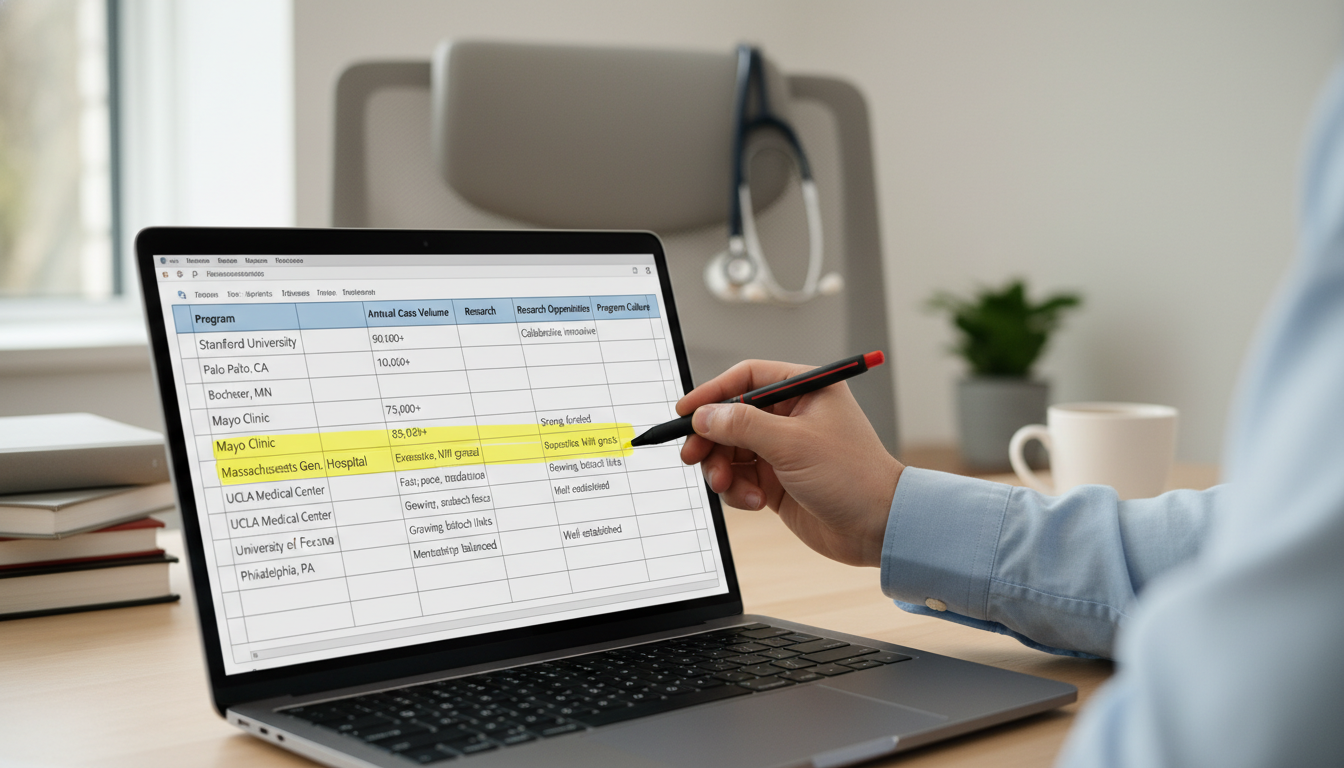
Building a Program Evaluation Spreadsheet
Create a spreadsheet or tracking document with columns such as:
- Program name
- Location and region
- Program type (categorical/advanced)
- Size (residents per year)
- USMLE competitiveness (approximate, from NRMP + Residency Explorer)
- Case volume and subspecialty strengths
- Call structure and workload
- Research opportunities (low/moderate/high)
- Fellowship and job placement
- Culture/fit notes
- Personal priority score (e.g., 1–5)
You can assign weights based on your previously identified priorities. For example:
- Training quality: 30%
- Geographic preference: 20%
- Research/academic opportunities: 20%
- Culture and wellness: 20%
- Program prestige/name recognition: 10%
Then score each program from 1–5 on each domain and calculate a weighted score.
Using Tiers: Reach, Target, and Safety
To optimize your radiology residency application strategy:
- Reach programs
- Highly competitive national institutions
- Your scores/research may be slightly below the median of past matched residents
- Still worth applying if other aspects (e.g., leadership, unique experiences) are strong
- Target programs
- Your academic and research profile is near or slightly above the historical averages
- Likely the largest portion of your list
- Safety programs
- You exceed their typical metrics, or the program is in a less competitive region
- Still offering strong training, but maybe less name recognition
For MD graduates in diagnostic radiology, a balanced application list might look like:
- 20–30% reach
- 40–60% target
- 20–30% safety
Exact numbers depend on your competitiveness and budget, but the key is intentional distribution, not random volume.
Aligning with Your Career Goals
As you rank programs, keep your long-term plans in the foreground:
- If you foresee a career in academic neuroradiology:
- Prioritize programs strong in neuro, with established research, and a track record of matching fellows into elite neuro programs.
- If you anticipate private practice in a mid-sized city:
- Prioritize programs with:
- Excellent general diagnostic training
- Strong independent call experience
- Alumni who enter community practice in similar locations
- Prioritize programs with:
- If you are undecided:
- Favor broad programs with:
- Diverse exposure across subspecialties
- Good fellowship placement variety
- Solid didactics and case volume
- Favor broad programs with:
Practical Examples: Applying This Strategy
To illustrate how this process works in reality, consider two hypothetical MD graduates.
Example 1: The Academic-Neuro Focused Applicant
- Strong Step 2 CK, top quartile
- Several neuroradiology-related publications
- Wants academic career, potentially at a large university hospital
Program research focus:
- Filters for large academic centers with strong neurology and neurosurgery services
- Reviews:
- Faculty neuro publications
- Neuro fellowship placements
- Call structure allowing early neuro exposure
- Places high weight on:
- Research infrastructure
- Dedicated research time
- Department academic reputation
Final list:
- Reach: Famous national centers with very high academic output
- Target: Solid university programs with strong neuro divisions and moderate research expectations
- Safety: Regional academic and hybrid community-university programs with at least decent neuro exposure and some scholarly output
Example 2: The Lifestyle-Oriented, Community-Focused Applicant
- Solid but not elite USMLE scores
- Limited research
- Prefers staying near family in the Midwest; wants eventually to join a local private practice
Program research focus:
- Filters for Midwestern programs, including community-based and university-affiliated
- Evaluates:
- Bread-and-butter imaging exposure
- Independence on call
- Resident satisfaction and culture
- Fellowship outcomes—particularly for general and body imaging
- Places high weight on:
- Geographic proximity
- Resident camaraderie
- Practical training for community practice
Final list:
- Fewer large “brand-name” reach programs
- Many target and safety programs in desired region
- Mix of academic and community environments emphasizing generalist training and solid autonomy
These examples show how your program research strategy should change based on your profile and goals, not just generic ideas of “top programs.”
Using Direct Contact and Networking to Refine Your List
A crucial but often underused step is talking directly to people before applications are finalized.
Leverage Your Home Institution
As an MD graduate from an allopathic medical school, you likely have:
- Home radiology department
- Attendings can provide candid insight into which programs are strong, overhyped, or hidden gems.
- Faculty may know program directors or chairs personally.
- Former graduates
- Alumni now in radiology residencies can describe cultures and training in detail.
- Advisors and deans
- They can compare your application to previously matched graduates and guide your application volume and level.
Ask targeted questions:
- “Which programs do you think align with my goals and strengths?”
- “Are there programs you would particularly recommend or caution me about, and why?”
Attend Open Houses and Virtual Events
Many radiology programs now host:
- Virtual open houses
- Resident Q&A sessions
- Live or recorded information sessions
Make use of these to:
- Clarify unclear aspects of curriculum or call
- Get a sense of resident personality and morale
- Ask specific questions about:
- Fellowship support
- Research mentorship
- Departmental culture and feedback style
Take notes and update your spreadsheet after each interaction. Your subjective impressions are as important as objective data.
FAQs: Researching Diagnostic Radiology Residency Programs as an MD Graduate
1. How many radiology programs should I apply to as an MD graduate?
The ideal number depends on your competitiveness, but most MD graduates targeting the diagnostic radiology match apply to somewhere between 30–60 programs. Highly competitive applicants with strong metrics and research may lean toward the lower end, while those with weaker scores, geographic restrictions, or red flags may need more. Focus on quality of research and fit, not just raw volume.
2. How important is program “prestige” compared to training quality and fit?
Prestige can matter for certain ultra-competitive fellowships and early academic jobs, but beyond a certain threshold, what matters most is:
- Case volume and diversity
- Subspecialty exposure
- Quality of teaching and mentorship
- Resident autonomy and preparation for boards and independent practice
A slightly less famous program that fits your priorities and offers robust training is often better than a well-known name where you may struggle, feel unsupported, or be unhappy.
3. Should I prioritize programs with strong research if I’m not sure I want an academic career?
You don’t need heavy research infrastructure if you don’t enjoy research. However, programs with at least moderate scholarly activity often:
- Keep up with evolving imaging techniques
- Encourage academic curiosity
- Provide a richer learning environment
If you’re truly uninterested in research, focus more on clinical volume, generalist training, and alumni placement into the kind of practice you want, while still valuing programs that support residents in exploring research if they change their minds.
4. What’s the best way to compare programs after interviews?
Before interview season, build your comparison spreadsheet and scoring system. After each interview:
- Immediately write down your impressions:
- Resident happiness
- How faculty interacted with trainees
- How comfortable you felt asking questions
- Re-score each program using your predefined criteria.
- Pay attention to your “gut feeling,” but run it through the lens of your objective priorities (training quality, geography, career goals). Combining structured evaluation with honest personal reaction usually yields a strong rank list.
By approaching the process systematically—starting with broad data, narrowing via priorities and deal-breakers, diving deep into curriculum and culture, and then synthesizing everything into a clear comparison—you can move beyond generic advice and truly understand how to research residency programs in diagnostic radiology as an MD graduate. This method will help you assemble a thoughtful, strategic application list and, ultimately, find a program where you can thrive both professionally and personally.